
The useful question about AI in sports injury recovery and rehabilitation is not whether an AI-assisted tool can make rehabilitation look more modern. It is whether the tool improves the outcome the patient actually needs next. A 2025 PROSPERO-registered network meta-analysis by Luo et al. gives clinicians the cleanest comparative view available so far: 33 randomized controlled trials, 13 AI-assisted intervention categories, and three outcome domains that should not be blended together—pain, functional recovery, and range of motion.[1]
The rankings do not point to one universal winner. Therapeutic exergaming and robotic exoskeletons had the highest probabilities of being best for pain relief, with SUCRA values of 87.6% and 86.3%. Gamified exergaming was the standout for functional recovery, with a SUCRA of 99.6%, while conventional care ranked far lower at 17.1%. For range of motion, single-joint rehabilitation robots and AI-feedback motion training led the field, with SUCRA values of 84.7% and 83.7%.[1]
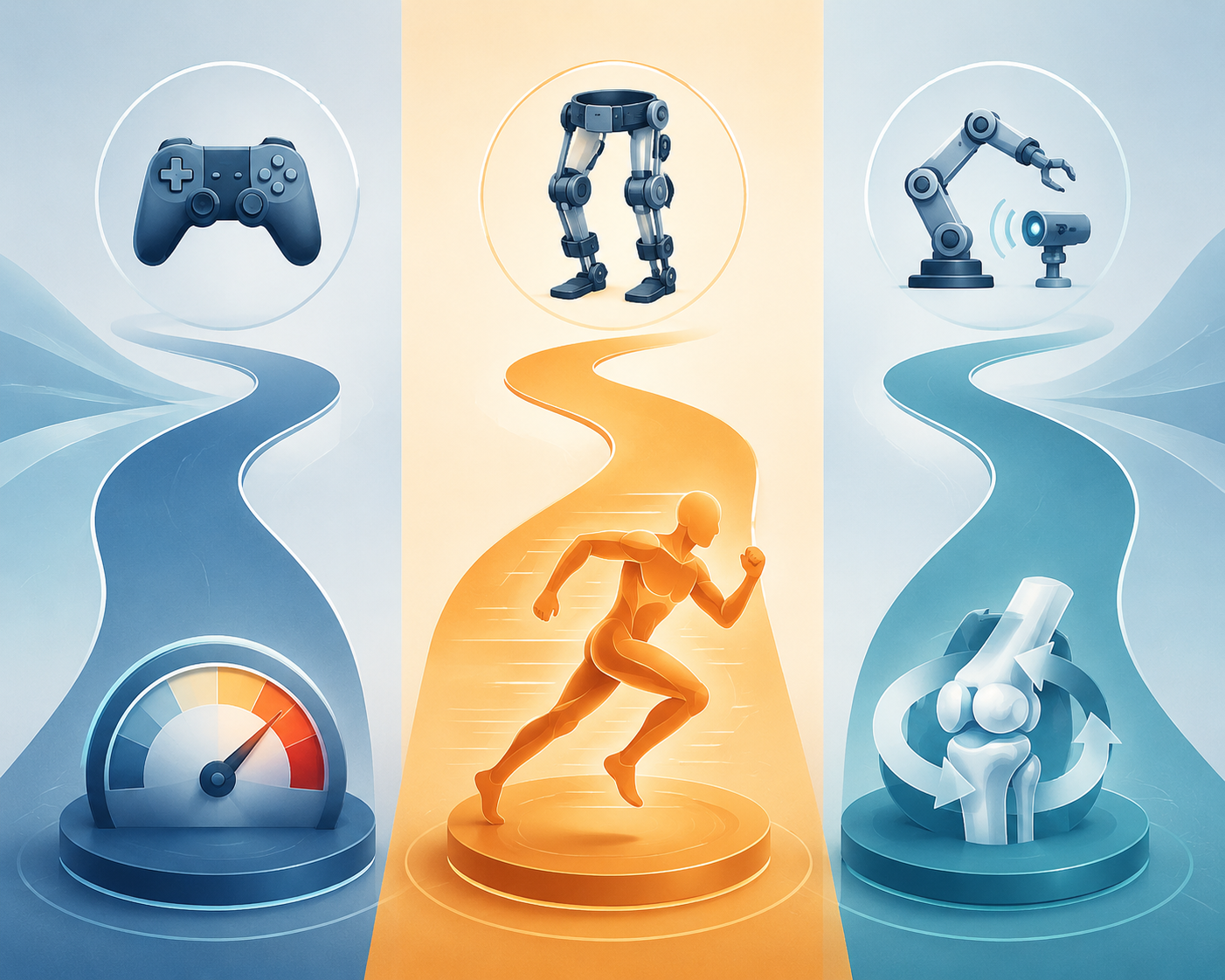
That outcome split matters clinically. Pain relief can get an athlete moving, but it does not prove they can decelerate, load a tendon, regain shoulder excursion, or tolerate sport-specific demands. Function can improve while a joint remains restricted. Range can improve without restoring confidence or performance. The evidence is most useful when it is read by outcome, not by technology label.
What the Rankings Actually Compare
Luo et al. classified interventions into 13 categories rather than treating AI-assisted rehabilitation as a single exposure. That is an important design choice because these systems are not technically or clinically interchangeable. A sensor-driven feedback platform, a therapeutic game, an exoskeleton, and a single-joint robot may all sit under the “AI-assisted” umbrella, but they ask different things from the patient and solve different problems for the therapist.[1]
SUCRA, the ranking statistic used in the analysis, is best read as a probability-style ordering of treatments. A higher SUCRA value means an intervention is more likely to rank near the top among the compared options for that specific outcome. It does not mean every patient gets that percentage of improvement, and it does not erase the quality, size, or follow-up limits of the underlying trials.[1]
| Target outcome | Highest-ranked AI-assisted options | Clinical reading |
|---|---|---|
| Pain relief | Therapeutic exergaming, robotic exoskeletons | Best read as short-term symptom reduction support, not proof of full recovery |
| Functional recovery | Gamified exergaming | Most relevant to task performance, but not the same as return-to-play clearance |
| Range of motion | Single-joint rehabilitation robots, AI-feedback motion training | Most useful where controlled joint excursion and movement feedback are the main bottlenecks |
Pain Relief: A Near-Tie, Not a Clear Coronation
For pain, therapeutic exergaming ranked just ahead of robotic exoskeletons, but the margin is small enough that it should be interpreted as a clinically meaningful cluster rather than a single-device victory. Therapeutic exergaming reached a SUCRA of 87.6%, while robotic exoskeletons reached 86.3%.[1]
The plausible appeal is different for each modality. Exergaming can make repeated movement more tolerable by adding goals, feedback, and attention-shifting structure. Exoskeletons can support or guide movement when loading or control is difficult. The analysis ranks them together near the top for pain, but it does not show that they relieve pain through the same mechanism or that they suit the same patient profile.[1]
This is where the word “works” needs discipline. If the immediate treatment goal is pain modulation during early activity exposure, either high-ranked category may deserve attention. If the patient’s limiting problem is cutting mechanics, landing tolerance, throwing volume, or late-stage strength under fatigue, the pain ranking alone is not enough.
Function Is Where the Contrast Becomes Harder to Ignore
Functional recovery is the most clinically loaded outcome in the meta-analysis because it sits closer to the promises made in sports rehabilitation. The patient does not come back merely to report a lower pain score. They come back to climb, accelerate, squat, pivot, throw, jump, absorb contact, or repeat a sport-specific task without the injured region becoming the rate-limiting step.
Here, gamified exergaming separated sharply from conventional care. Luo et al. reported a SUCRA of 99.6% for gamified exergaming in functional recovery, compared with 17.1% for conventional care.[1]
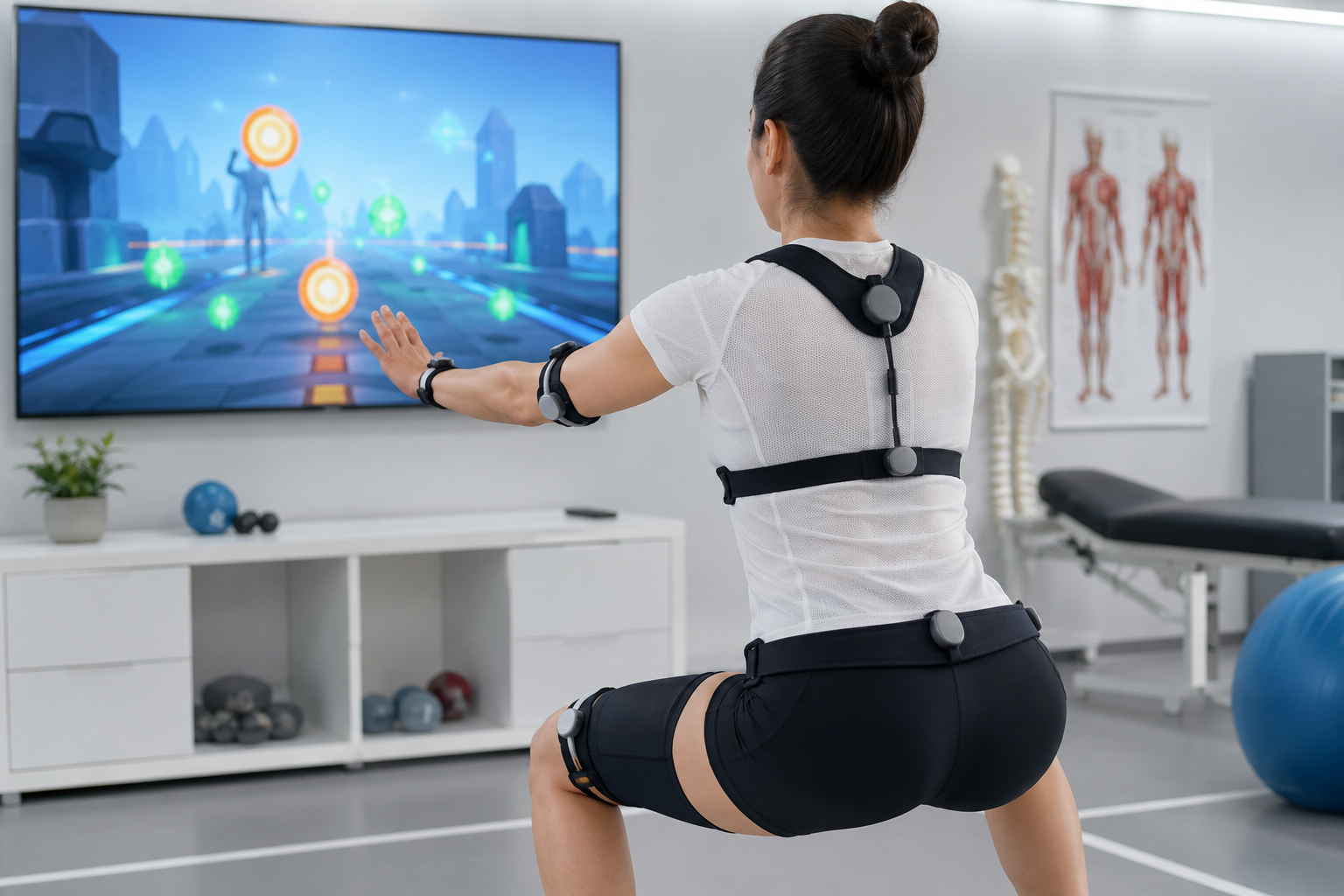
That gap is not a license to replace clinical reasoning with a screen. It does suggest that when the desired endpoint is functional improvement, a system that turns movement practice into a responsive task may have more to offer than a low-feedback program. The likely clinical value is not the game layer by itself; it is the way the task can invite repetition, expose movement quality, and keep the patient engaged long enough for practice volume to matter.
The ranking also raises a practical translation question. Functional outcome measures in musculoskeletal trials are not the same as return-to-sport decisions. They may capture better daily function, symptom-limited activity, or standardized task performance, but the meta-analysis does not establish that gamified exergaming shortens return-to-play timelines or reduces reinjury risk in athletes.[1]
For a clinic choosing where to invest first, that distinction is still useful. If the goal is to improve functional participation during a short rehabilitation window, gamified exergaming has the strongest comparative signal in the available evidence. If the goal is late-stage sport clearance, it should be treated as one component of assessment and training, not as a substitute for progressive loading, field testing, or sport-specific criteria.
Range of Motion Favors More Targeted Biomechanical Tools
Range of motion is where the leading categories look less like general engagement tools and more like targeted movement systems. Single-joint rehabilitation robots ranked highest, with a SUCRA of 84.7%, followed closely by AI-feedback motion training at 83.7%.[1]
That result is clinically coherent. When the problem is joint excursion, the intervention has to do more than encourage activity. It has to expose the joint to controlled movement, provide feedback about the motion being produced, and help the therapist decide whether the restriction is improving or merely being compensated around.
Single-joint robots and AI-feedback motion training may be especially relevant when the rehabilitation question is narrow: how much knee flexion is being restored, whether ankle dorsiflexion is improving during a task, or whether shoulder motion is returning without substitution. The network meta-analysis supports that outcome-specific use more strongly than it supports a broad claim that more technologically complex rehabilitation is always better.[1]
The category labels still need careful reading. Some systems described as AI-assisted may rely heavily on sensors, rule-based feedback, or pre-set progression rather than adaptive machine learning. That does not make them useless. It does mean procurement and protocol decisions should look at what the system actually measures and changes, rather than treating the AI label as the active ingredient.
The Low-Ranking Options Matter Too
Asynchronous telerehabilitation and conventional care consistently ranked near the bottom across the three outcome domains in Luo et al.’s analysis.[1] That finding should not be overread as proof that remote follow-up or standard therapy has no role. It does suggest that low-feedback, delayed-feedback, or non-adaptive delivery may be a weak choice when the clinic is specifically trying to improve pain, function, or range over a short measured window.
The more useful interpretation is operational. If a patient needs close movement correction, task engagement, or guided joint excursion, a passive or asynchronous model may leave too much of the rehabilitation work unobserved. That is not an argument for technology in every visit. It is an argument against pretending that all digital rehabilitation models provide the same therapeutic exposure.
What This Evidence Can and Cannot Support in Sports Clinics
The main limitation is population fit. The network meta-analysis covers musculoskeletal disorders broadly; not all 33 randomized trials specifically targeted sports injuries, and subgroup analyses separating athletes from general rehabilitation populations were not available.[1]
Follow-up is another hard boundary. Most trials reported outcomes over 2 to 12 weeks, and the dataset does not provide long-term follow-up for durable recovery, return-to-play timing, or reinjury prevention.[1] That makes the evidence more appropriate for selecting short-term rehabilitation support than for predicting season-level outcomes.
Luo et al. also reported that younger patients and those with mild-to-moderate musculoskeletal disorders appeared to benefit more.[1] That pattern is clinically plausible, but it should not be converted into a guarantee for competitive athletes. Age, training history, injury type, surgical status, sport demands, and access to supervised progression can all change the meaning of a short-term rehabilitation response.
There is also a regulatory caution. No FDA-cleared AI tools specifically for sports injury rehabilitation were identified in the available sources. That does not mean every related product is unsafe or unusable, but it does mean clinics should avoid procurement-style certainty when a system is marketed as AI for sports rehabilitation without a clear cleared indication, trial population, and outcome claim.
Monitoring Benchmarks Are Useful, but They Are Not Outcome Proof
A 2026 Scientific Reports study gives a concrete example of how AI-assisted rehabilitation monitoring is being evaluated in athletes. In a single-site sample of 50 athletes, the system reported 92.3% accuracy and 188 ms latency.[2]
Those numbers are relevant to implementation because movement feedback has to be fast and accurate enough to matter during exercise. A delay that feels invisible on a dashboard can become meaningful during a cutting drill or repeated loaded movement. But the study should be kept in its lane: it is a monitoring-performance benchmark from one athlete sample, not validation of the Luo et al. intervention rankings, not proof of clinical superiority across sports, and not evidence of lower reinjury rates.[2]
The same distinction applies to generative AI planning tools. UC San Diego has described work pointing toward AI-driven personalized rehabilitation planning, which is a reasonable direction for the field.[3] Planning support, however, is not the same evidentiary object as a randomized comparison showing better pain, function, or range-of-motion outcomes. A more personalized plan still has to be delivered, progressed, adhered to, and tested against the outcome that matters.
A CU Anschutz perspective on AI in sports medicine frames the same caution in plain terms: the technology is not yet a “slam dunk.”[4] That is the right posture for rehabilitation adoption. The current evidence is promising enough to guide selective use, but too thin to justify treating AI-assisted rehabilitation as a finished category.
A Practical Reading of the Evidence
For short-term musculoskeletal rehabilitation, the comparative evidence supports matching the modality to the clinical target. If pain reduction is the priority, therapeutic exergaming and robotic exoskeletons have the strongest ranking signal. If functional recovery is the priority, gamified exergaming stands out most clearly. If range of motion is the priority, single-joint rehabilitation robots and AI-feedback motion training are the better-supported options.[1]
That is an evidence-informed selection framework, not a treatment prescription. The available trials are short, the populations are mixed, and athlete-specific generalizability remains uncertain. For now, AI-assisted rehabilitation is most defensible when the clinic can name the target outcome, choose the modality with the strongest evidence for that outcome, and keep the return-to-sport decision anchored in sport-specific function rather than technology exposure alone.
References
- Comparative effectiveness of AI-assisted rehabilitation for sports-related musculoskeletal injuries, Frontiers in Bioengineering and Biotechnology, 2025.
- Nature Scientific Reports 2026 study, Scientific Reports, 2026.
- UCSD generative AI piece, UC San Diego Today.
- AI in sports medicine is not a slam dunk yet, CU Anschutz News.
Comments
Join the discussion with an anonymous comment.