
A community outbreak can leave a biological trace in wastewater before it becomes visible in clinic schedules, test orders, laboratory confirmations, or case reports. That is the appeal of AI for water quality monitoring and public health alerts: it can move surveillance closer to the moment when pathogens are spreading, not the later moment when enough people have sought care to be counted.
The strongest recent evidence comes from the ICA-Var study, which reported that a machine learning pipeline detected emerging SARS-CoV-2 variants in wastewater 1–6 weeks earlier than Freyja, a widely used computational deconvolution tool, using as few as 2–5 wastewater samples when variant prevalence was low. The study analyzed 3,659 wastewater samples collected over two years and showed that the method could identify co-varying mutation patterns without prior clinical data.[1]
That result is important enough to take seriously and limited enough to handle carefully. It was retrospective, it came from Southern Nevada, and it compared a new analytical approach against another wastewater variant estimation method rather than against a fully operational public health alerting system. Earlier detection is the beginning of the question, not the end of it.
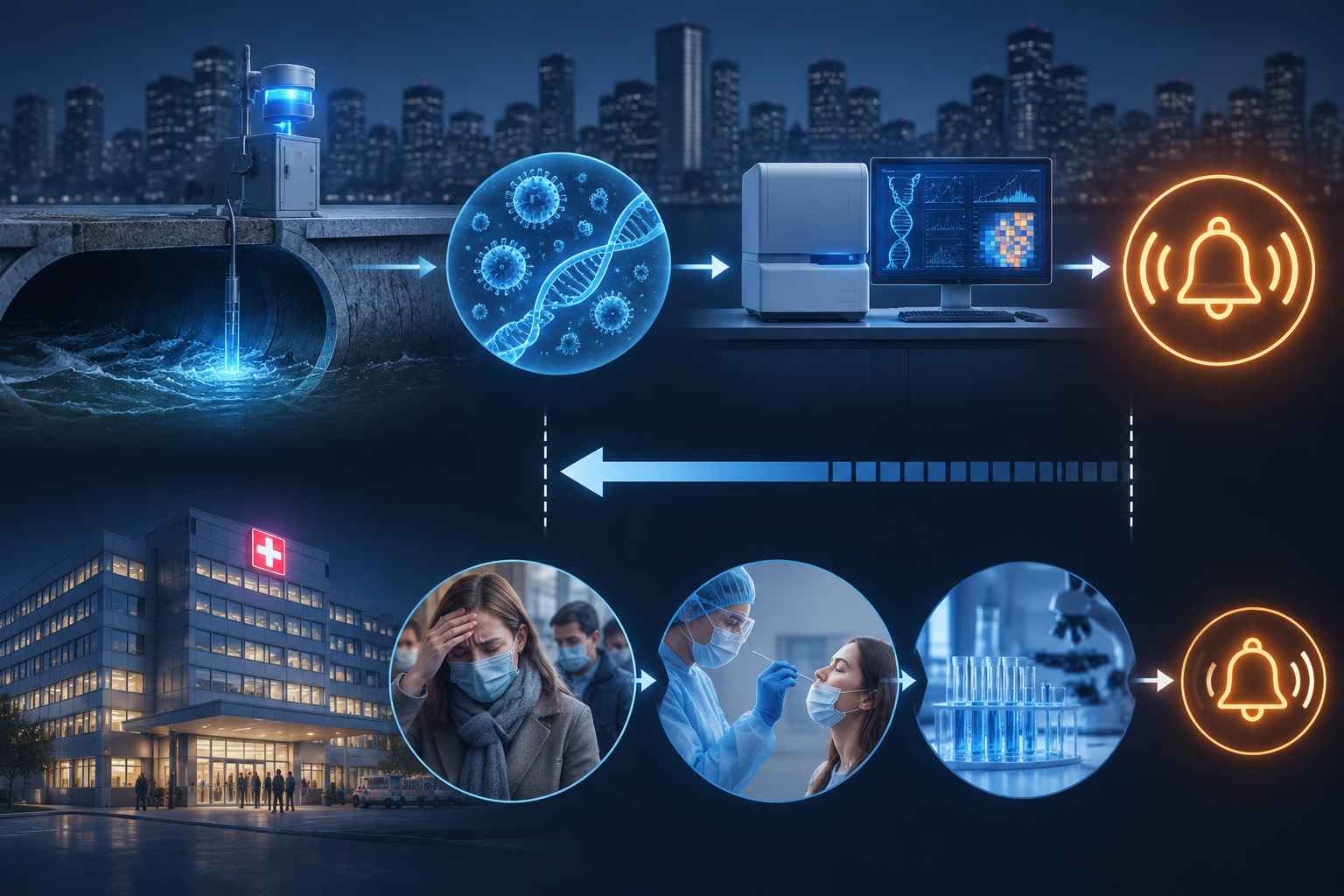
Why Wastewater Can Move Faster Than Case Surveillance
Clinical surveillance depends on a chain of events. People have to develop symptoms or have another reason to test. They need access to testing, a willingness to seek it, and a pathway into a reporting system. Delays and exclusions accumulate at each step. Wastewater surveillance samples a different object: aggregate biological material shed by a community.
That does not make wastewater a cleaner or simpler signal. It is pooled, noisy, and shaped by sewer geography, sampling schedules, lab protocols, rainfall, industrial inputs, population movement, and assay performance. But it can capture viral RNA from people who never test, test late, use home tests that do not enter public health reporting, or have limited access to care.
This is why the national infrastructure matters. The CDC’s National Wastewater Surveillance System expanded from 209 sampling sites in September 2020 to more than 1,500 by December 2022, covering approximately 47% of the U.S. population at that time.[2] That figure should be read as evidence of rapid buildout, not as a current 2026 coverage estimate; no newer official coverage figure was provided in the available source material.
NWSS has also moved beyond SARS-CoV-2 to include influenza A, RSV, mpox, and avian influenza A(H5), making wastewater surveillance a plausible multi-pathogen early warning substrate rather than a single-pandemic emergency instrument.[3] Scale, however, is not the same as readiness. A large network with uneven sampling density, variable laboratory practices, and nonuniform data formats is not yet a single coherent sensor.
From Sewer Sample to Public Health Signal
The useful comparison is not “AI versus epidemiology.” The pipeline is more practical than that. A wastewater sample is collected from a treatment plant, sewer shed, or other sampling point. Viral material is concentrated and measured. For variant work, sequencing generates a mixture of genetic fragments from multiple viral lineages. Computational methods then try to estimate what is present, whether something is changing, and whether the pattern deserves attention.
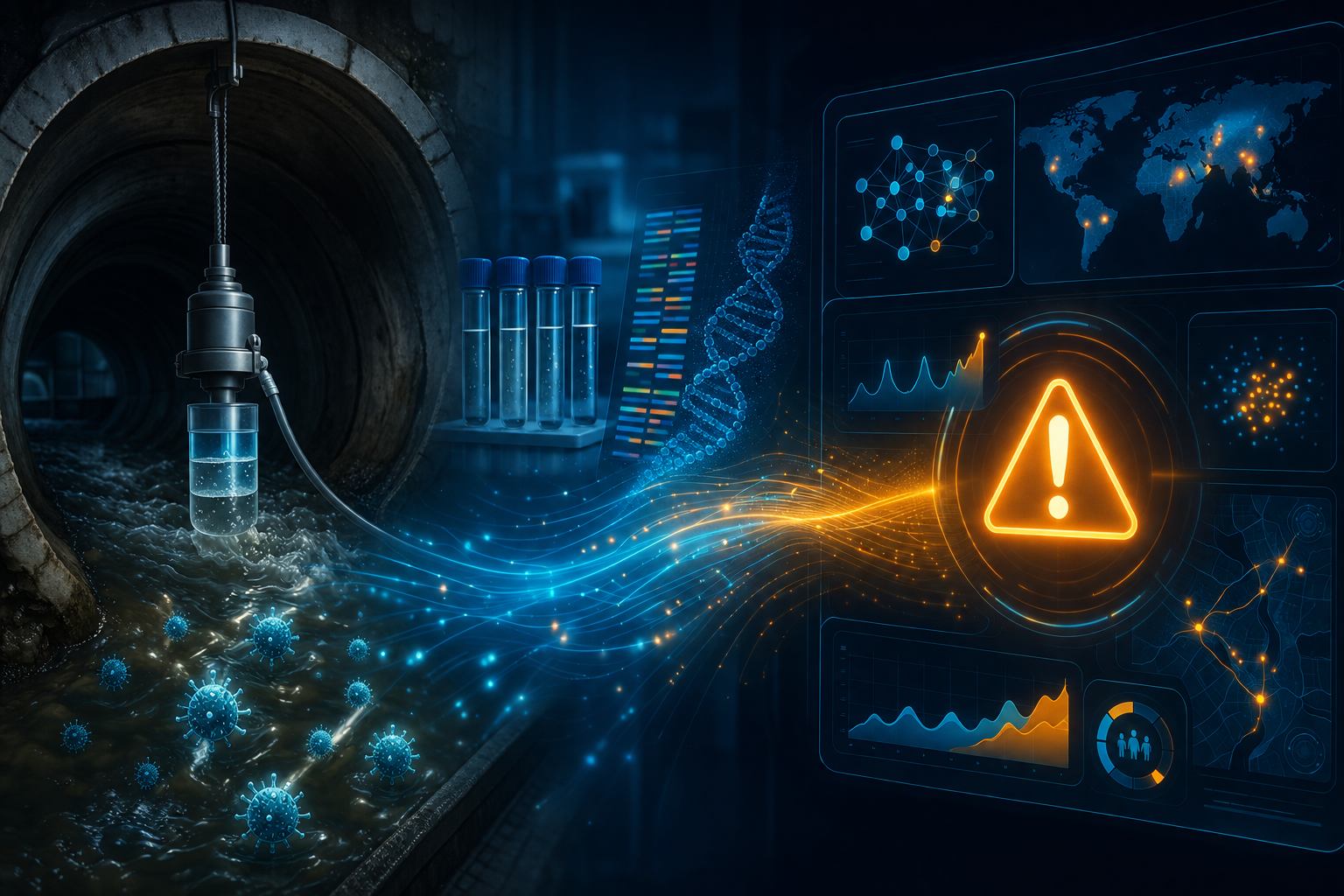
Freyja-style deconvolution uses known mutation profiles to estimate the abundance of SARS-CoV-2 lineages in a mixed sequencing sample. That is a powerful approach when the relevant lineages are already characterized and the sequencing signal is adequate. ICA-Var asks a different question: do mutations move together in a way that suggests an emerging variant pattern, even before clinical data have defined it?
| Surveillance component | What it contributes | Where caution enters |
|---|---|---|
| Clinical case surveillance | Patient-level diagnoses, severity context, demographic and care-setting information when reported | Delayed by care-seeking, testing access, reporting practices, and underascertainment |
| Wastewater sampling | Community-level biological signal, including from people who may not seek or receive testing | Affected by sewer coverage, sampling design, dilution, and representativeness |
| Genome sequencing | Mutation-level evidence for variant detection and tracking | Requires sufficient viral material, sequencing quality, and comparable laboratory workflows |
| Deconvolution tools such as Freyja | Estimates lineage mixtures using known variant information | Less suited to signals that are not yet well represented in reference data |
| ICA-Var-style machine learning | Detects co-varying mutation patterns without requiring prior clinical data | Needs validation across regions and interpretable-enough decision workflows |
| Epidemiological modeling | Places wastewater trends into transmission, timing, and response context | Can amplify uncertainty if inputs are inconsistent or poorly documented |
Deep neural networks and other machine learning methods can sit at several points in this chain: quality control, anomaly detection, variant pattern recognition, trend forecasting, and alert prioritization. The danger is treating the model output as the alert itself. In practice, public health teams need to know whether the signal is robust across samples, whether it aligns with neighboring sites or clinical trends, whether a lab artifact is plausible, and what action would be proportional.
The operational alert is therefore a judgment assembled from evidence, not a single number on a dashboard. A low-prevalence variant signal might trigger intensified sequencing, targeted review of emergency department syndromic data, communication with laboratories, or internal readiness checks. It should not automatically trigger public messaging unless the uncertainty, possible consequences, and action threshold have been defined in advance.
What the ICA-Var Result Actually Shows
The ICA-Var study deserves attention because it tests an especially difficult surveillance problem: how to see an emerging variant when it is still a weak signal inside a mixed wastewater sample. The investigators analyzed 3,659 wastewater samples over two years and reported that ICA-Var identified emerging SARS-CoV-2 variants 1–6 weeks earlier than Freyja.[1]
The “1–6 weeks earlier” claim is not a generic promise that every wastewater AI system will beat every clinical reporting system by that interval. In this study, the comparison was between ICA-Var and Freyja on the analyzed wastewater sequencing data. The useful takeaway is narrower and stronger: a machine learning method looking for co-varying mutation patterns may detect variant emergence before a lineage-focused deconvolution method can confidently estimate it.
The “2–5 samples” finding is also notable for the right reason. Public health surveillance often struggles at the beginning of an emergence event, when prevalence is low and the evidence is fragmentary. A method that can extract a coherent signal from a small number of wastewater samples could reduce the blind spot between biological introduction and recognized spread.[1]
But this is where retrospective performance and operational reliability part ways. A retrospective analysis can evaluate whether the model would have detected a pattern earlier after the full historical context is known. A prospective alerting workflow has to decide what to do on the day the signal appears, while the future is still unavailable and competing explanations remain open.
Southern Nevada is not a trivial limitation. Wastewater systems differ by sewer architecture, population movement, climate, sampling locations, laboratory partnerships, and the density of clinical sequencing available for comparison. A method that performs well in one region may still need recalibration, additional quality checks, or different alert thresholds elsewhere.
The Black-Box Problem Is a Governance Problem
Machine learning methods do not have to be perfectly transparent to be useful. Public health already acts on imperfect evidence: syndromic increases, sentinel surveillance, laboratory clusters, and modeled estimates all carry uncertainty. The difference is that a black-box variant signal can be difficult to defend when the action is costly, public, or politically sensitive.
The practical standard should be interpretable enough, not magically explainable. A health department needs documentation of inputs, quality flags, model version, expected error modes, confidence conventions, comparison signals, and escalation criteria. Without that, an early signal may remain trapped in a dashboard: visible to analysts, too uncertain for leadership, and too abstract for action.
How It Compares With Traditional Clinical Surveillance
Clinical case surveillance still does things wastewater cannot do. It can link infection to symptoms, severity, hospitalization, mortality, vaccination status, treatment, age, occupation, comorbidity, and care setting when those data are collected. It can distinguish a variant that is merely present from one associated with a changing clinical burden. It can support individual-level interventions and clinical guidance.
Wastewater surveillance is strongest where clinical surveillance is slowest or thinnest. It can detect pathogen circulation before reported case counts rise, and it is less dependent on individual test-seeking behavior. During periods when home testing, limited access, mild disease, or reporting fatigue reduce the visibility of cases, wastewater can preserve a population-level view.
The two systems answer different questions. Clinical surveillance asks who is sick, how sick they are, and which groups are affected. Wastewater surveillance asks what biological signal is present in a contributing population and whether that signal is increasing, decreasing, or changing genetically. AI-enhanced wastewater analysis adds a third question: are there weak patterns in the data that a conventional workflow would miss?
| Question | Clinical surveillance is better positioned to answer | AI-enhanced wastewater surveillance is better positioned to answer |
|---|---|---|
| Is disease severity changing? | Yes, through hospitalization, clinical outcomes, and patient-level reporting | Only indirectly, if paired with clinical data |
| Is a pathogen circulating before many people test? | Often delayed | Often earlier, if the sewer-shed and sampling design capture the population |
| Is an emerging variant appearing at low prevalence? | Depends on testing and clinical sequencing density | Potentially earlier through sequencing and mutation-pattern detection |
| Which communities are underserved by care access? | Can reveal disparities among those who enter care | Can detect aggregate signal but may obscure who is affected |
| Should officials issue a public alert? | Provides clinical consequence and case context | Provides early signal that requires corroboration and predefined thresholds |
This comparison matters because replacement language leads to poor design. If wastewater is treated as a substitute for clinical surveillance, officials lose the clinical context needed to judge severity and allocate care resources. If clinical surveillance is treated as sufficient on its own, officials may miss the early phase of spread among people who are not yet counted.
A better workflow uses wastewater as an early warning layer. A rising SARS-CoV-2 variant signal, for example, could prompt review of clinical sequencing, syndromic emergency department data, laboratory positivity trends, hospitalization indicators, and neighboring wastewater sites. The signal does not have to prove the outbreak by itself to be useful. It has to arrive early enough, be reliable enough, and point to an action that would otherwise have been delayed.
Where Broader AI Surveillance Evidence Fits
Wastewater AI sits inside a broader field of infectious disease early warning systems that use machine learning to detect anomalies, forecast trends, classify signals, and integrate heterogeneous data streams. A 2025 systematic review in Frontiers in Public Health describes this wider methodological landscape for AI-based early warning in infectious disease surveillance.[4]
That broader literature is useful because it prevents wastewater surveillance from being judged as a novelty dashboard. The same questions recur across AI surveillance systems: What data are missing? Does the model generalize outside its training setting? How are alerts evaluated? Who receives them? What decision follows? How are false positives and false negatives counted?
Practitioner-facing coverage of AI-backed wastewater surveillance has emphasized its potential to enhance detection of emerging viruses, which is a reasonable framing when kept at the level of complement rather than replacement.[5] The distinction is not semantic. A complementary system can be evaluated by whether it adds time, coverage, or resolution to existing workflows. A replacement system would need a much higher evidentiary burden.
What Must Be Standardized Before Alerts Can Scale
The national surveillance substrate is large enough to make AI-enhanced analysis plausible, but the hard work is ordinary and technical. Sampling frequency, composite versus grab sampling, concentration methods, sequencing depth, quality thresholds, metadata fields, normalization practices, and reporting formats all shape what a model sees. If those inputs vary without documentation, a centralized algorithm may learn site artifacts as if they were epidemiological patterns.
Standardization does not require every site to become identical. It requires enough comparability and metadata for analysts to know when a difference is meaningful. A rural site sampled weekly and an urban site sampled several times a week may both be useful, but they should not be interpreted as if they offer the same temporal sensitivity or population coverage.
- Define alert thresholds before the signal appears, including what level of uncertainty is acceptable for internal review, partner notification, or public messaging.
- Preserve model provenance, including input data version, model version, laboratory method, and quality-control flags.
- Compare wastewater signals against clinical, syndromic, laboratory, and neighboring-site indicators rather than treating the model output as self-validating.
- Audit coverage so communities outside dense urban sewer systems are not systematically less visible.
- Document false alarms and missed signals as operational outcomes, not just model-performance statistics.
Equity is part of the measurement problem. Wastewater systems do not cover all populations equally, and sewer-shed boundaries rarely match the neighborhoods, counties, tribal lands, campuses, shelters, workplaces, or institutions that public health teams need to protect. A technically sophisticated alert can still widen a surveillance gap if it mainly improves visibility where infrastructure is already strongest.
Privacy concerns are different from individual clinical privacy but not irrelevant. Wastewater data are usually aggregated, yet small catchments, institutional sampling, or repeated reporting from identifiable locations can create stigma or political pressure. Public reporting policies should consider what level of geography is appropriate and what action the public can reasonably take from the information provided.
The 2026 Evidence Position
The evidence supports a careful but positive position. ICA-Var shows that machine learning can extract early variant signals from wastewater sequencing data before a leading deconvolution approach detects them, at least in the retrospective Southern Nevada analysis. NWSS shows that the United States has built a surveillance network large enough to make multi-site wastewater analytics a serious public health capability rather than a laboratory demonstration.[1][2]
The evidence does not support replacing clinical surveillance. It also does not yet support treating a single-region retrospective model result as a national alerting standard. The next test is prospective performance across diverse geographies, laboratory workflows, pathogens, sewer systems, and public health agencies, with alert rules that can be explained well enough for real decisions.
AI-enhanced wastewater surveillance is a credible complementary early warning layer in 2026, especially for variant and outbreak detection. Its value depends less on whether an algorithm can produce an earlier signal in isolation and more on whether public health systems can standardize the inputs, interpret the uncertainty, protect equity, and act before the clinical curve has already made the outbreak obvious.
References
- Early detection of emerging SARS-CoV-2 Variants from wastewater through genome sequencing and machine learning. Nature Communications, 2025.
- The National Wastewater Surveillance System (NWSS): From inception to widespread coverage, 2020–2022, United States. PMC.
- CDC National Wastewater Surveillance System documentation. CDC.
- Artificial intelligence in early warning systems for infectious disease surveillance: a systematic review. Frontiers in Public Health, 2025.
- Wastewater Surveillance Backed by AI Can Enhance Detection of Emerging Viruses. Clinical Laboratory Products Magazine.
Comments
Join the discussion with an anonymous comment.