
The public health case for AI in wildfire forecasting starts with the smoke, not the software. In a Yale-led analysis of 3,108 counties in the contiguous United States from 2007 through 2020, long-term exposure to wildfire-related PM2.5 was associated with an estimated 11,415 excess non-accidental deaths per year, including 4,512 cardiovascular deaths.[1] That estimate does not make every death preventable by a better forecast. It does make one point difficult to avoid: wildfire prediction is now part of the same prevention conversation as heat alerts, air-quality warnings, evacuation planning, and hospital surge readiness.
This matters because wildfire exposure often arrives before the health system sees the patient. A plume crosses a county line; older adults stay indoors without adequate filtration; people with asthma or heart disease deteriorate; clinics and emergency departments see the burden later. A forecast that only helps suppress a fire is useful. A forecast that gives public health departments enough lead time to warn dialysis patients, open cleaner-air spaces, pre-position respiratory supplies, or identify neighborhoods likely to evacuate late is a different kind of tool.
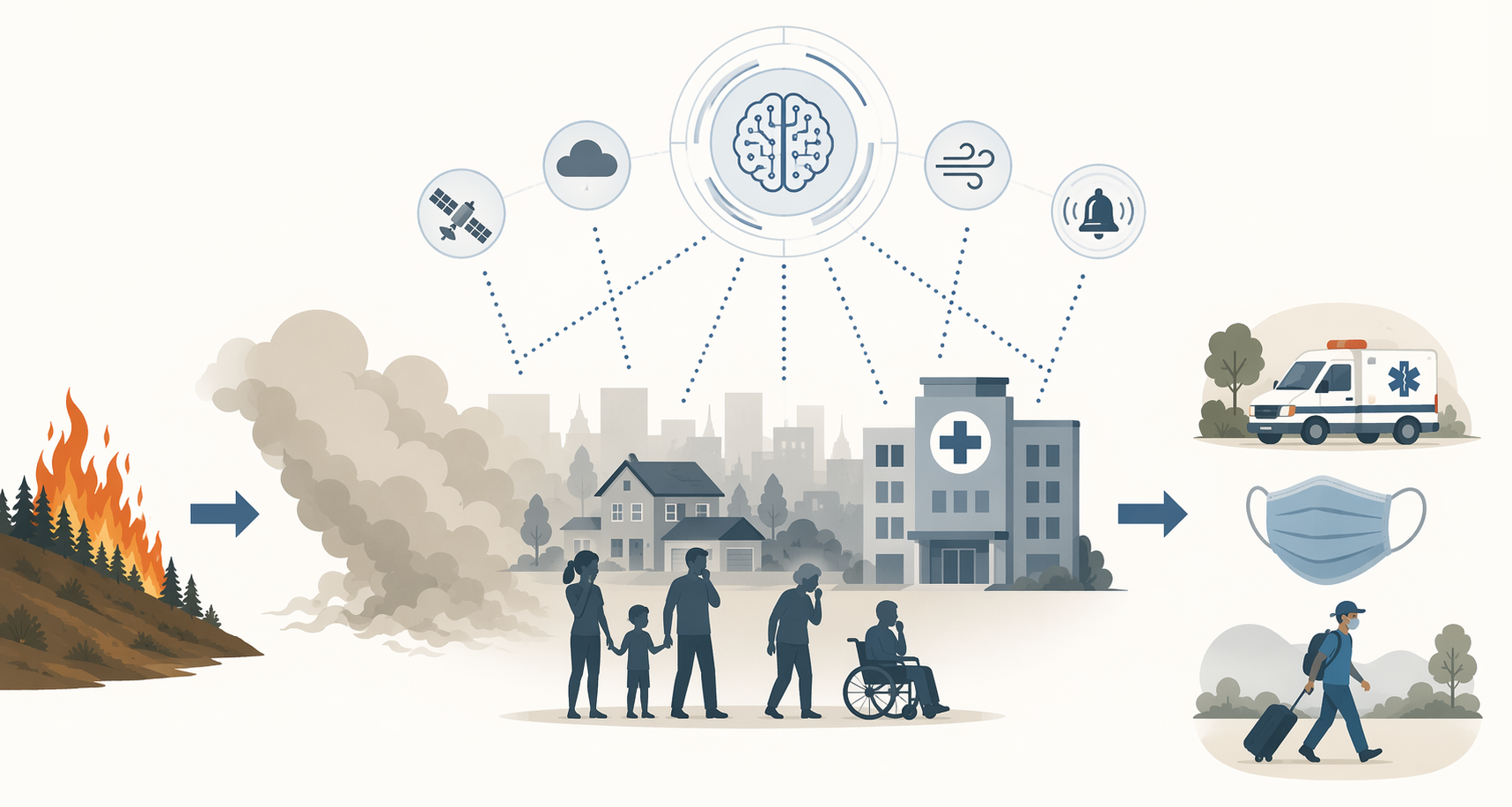
The burden is also not limited to acute burns or evacuation injuries. Stanford clinicians and researchers have emphasized that wildfire smoke contains a complex mixture of fine particles and combustion byproducts, and Lisa Patel has described wildfire PM2.5 as roughly 10 times more toxic than fossil-fuel PM2.5.[2] That figure should be treated as an urgency signal rather than a settled comparative-toxicology endpoint; it is a clinical estimate, with related work still moving through the evidence pipeline. Still, it aligns with what public health and clinical teams already see: wildfire smoke is not a nuisance exposure that can be managed only with generic air-quality language.
The same caution applies to emerging neurologic-risk evidence. A reported analysis of 1.2 million older adults in Southern California found a 21% increase in dementia risk per 1 μg/m³ rise in wildfire-related PM2.5, compared with a 3% increase per 3 μg/m³ rise from non-wildfire sources. The finding is too important to ignore, but it should not be used as if every individual wildfire event produces a predictable dementia burden. Its more appropriate role is to widen the lens: repeated smoke exposure may create chronic risks that evacuation orders and acute respiratory alerts do not fully capture.
What would make a forecast a public health intervention?
A more accurate wildfire model is not automatically a health intervention. To reach that threshold, it has to change a decision before exposure occurs or before illness worsens. The relevant chain is practical: detect or anticipate a fire earlier, estimate where fire and smoke are likely to move, identify who will have trouble acting on the warning, and connect that information to agencies with the authority and resources to intervene.
| Forecasting function | Public health value | Evidence status |
|---|---|---|
| Fire probability and ignition-risk prediction | Earlier staffing, surveillance, public warning, and resource staging | Peer-reviewed model-performance evidence is strengthening |
| Fire spread and smoke progression modeling | More precise timing for evacuation, sheltering, and air-quality protection | High-resolution research models are improving but are not always operational |
| Camera and satellite-based detection | Faster confirmation and dispatch, especially in remote areas or overnight | Operational deployments exist, but some performance data are vendor-reported |
| Evacuation behavior modeling | Targeted support for residents likely to leave late or not at all | Decision-support research is promising and still developing |
That chain is where AI becomes relevant. Machine learning can combine data streams that traditional fire indices treated separately or did not use at all: vegetation moisture, lightning, human presence, satellite imagery, topography, road networks, prior evacuation behavior, and real-time sensor feeds. The important question is not whether the model is sophisticated. It is whether the additional signal arrives early enough, at the right spatial scale, and in a form that emergency management and health agencies can use.
The strongest technical evidence is about lead time and resolution
The ECMWF Probability of Fire model is one of the clearer examples of AI improving a measurable forecasting task. Reported in 2025, the model improved predictive skill by up to 30% compared with the traditional Fire Weather Index by incorporating additional variables, including vegetation moisture, human presence, and lightning activity.[3] The associated Nature Communications paper frames this as early warning for complex climate risk, which is the correct register: the value is not that a model “knows” where a disaster will happen, but that it can elevate risk earlier and with more context than a weather-only index.[4]
For public health planning, that distinction matters. A county health department does not need a perfect point prediction to begin preparing cleaner-air shelters, reviewing oxygen and inhaler availability, or contacting long-term care facilities. It needs a credible enough signal, early enough, to justify action before emergency departments are already receiving smoke-related exacerbations.
The USC work adds a different piece of the chain. In April 2026, USC Viterbi researchers described a generative AI model that combines VIIRS and GOES satellite data to reconstruct wildfire progression at 5-minute temporal resolution while accounting for terrain slope effects.[5] The model was validated against high-resolution infrared aircraft perimeters, which is a meaningful technical comparison. It is also not the same as proof of operational health benefit. The model’s present value is that it points toward finer-grained timing: which roads may become unsafe sooner, which communities may sit under smoke longer, and when incident teams might need to move resources before the visible perimeter makes the risk obvious.
AI smoke detection and satellite-informed systems occupy a more operational space. exci reports that its system has processed more than 1 billion images across more than 130 million acres and detected more than 140,000 wildfires since 2019.[6] Those figures are useful as a deployment illustration, not as independent effectiveness evidence. Vendor-reported detection counts may not map neatly to unique events, avoided exposure, or reduced mortality. Still, image-based detection has a plausible role in health protection because minutes matter when a remote ignition can become an overnight evacuation or a smoke event affecting medically vulnerable residents.
The same pattern appears in public-sector camera deployments. Cal Fire’s AI-supported smoke detection network, using more than 1,000 mountaintop cameras, has been described as enabling rapid response to a remote overnight fire.[6] A single response example does not establish population-level benefit. It does show the operational pathway: detection shortens the time between ignition and human review, and that shorter interval can affect dispatch, public alerting, and exposure prevention.
The hard part is not only predicting the fire. It is predicting who can act.
Evacuation is often written as if it were a binary instruction: leave or stay. In practice, warnings pass through disability, age, transportation, caregiving obligations, job constraints, pet ownership, language access, prior false alarms, distrust, and road capacity. A technically strong fire forecast can still fail as a public health intervention if it assumes that every resident receives, believes, and can act on the warning at the same speed.
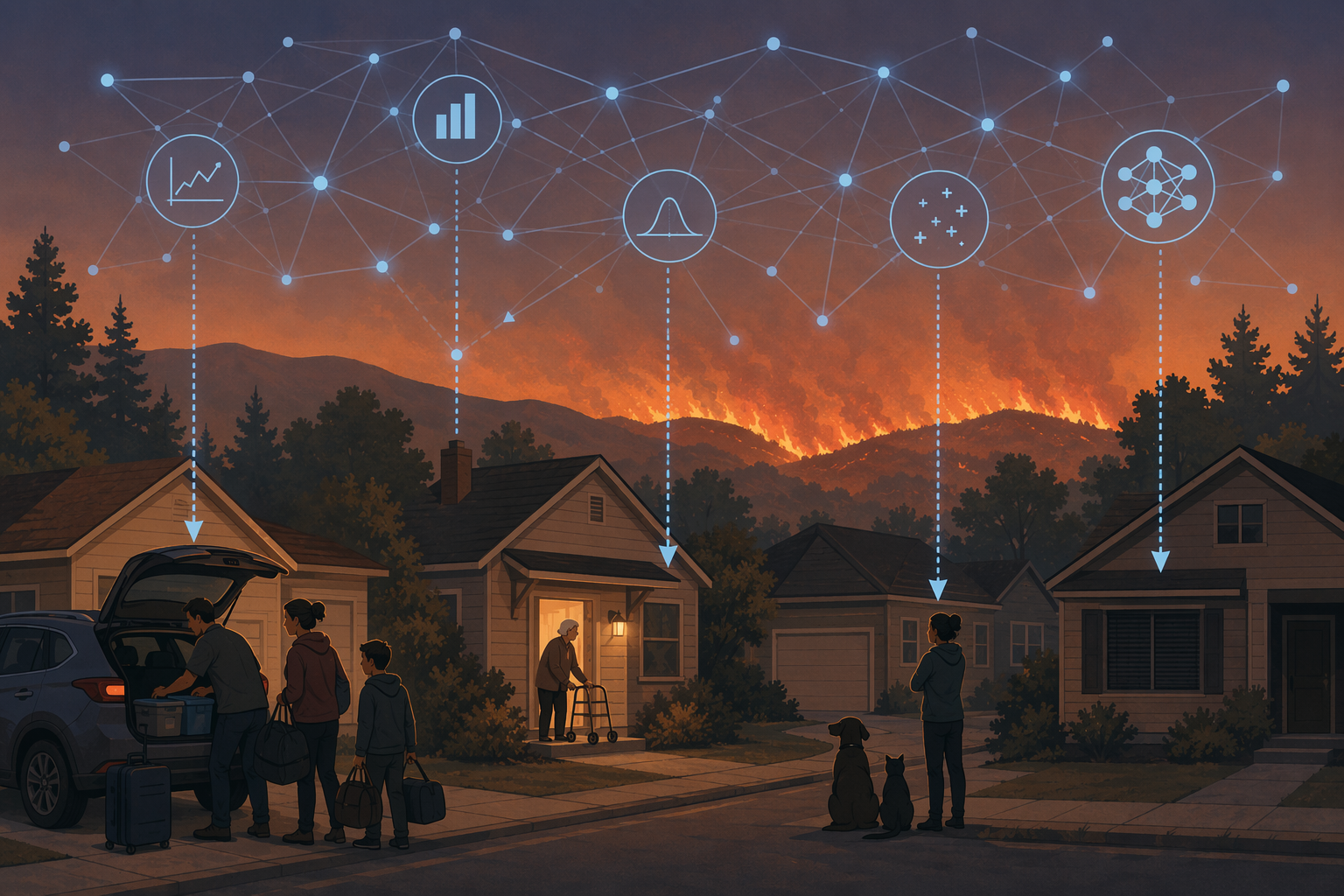
This is why evacuation modeling deserves more attention than it usually receives in AI wildfire discussions. The University of Florida’s Wildland-urban interface Evacuation and decision-support Modeling platform, or WEM, is described as integrating multi-source real-time data to support emergency response decision-making and has been tested in Sonoma County.[7] The health relevance is direct: if a model can identify when a road network, warning sequence, or population distribution is likely to produce late evacuation, planners can intervene before delay becomes injury, smoke exposure, or rescue demand.
FLARE, a Johns Hopkins and University of Florida project supported by an approximately $1.2 million National Science Foundation award, moves further into the behavioral layer. The project uses large language models grounded in behavioral theory to model evacuation decisions and identify populations likely to evacuate late or not at all.[8] That is not merely a communications problem. It is a resource-allocation problem: who needs transportation, who needs a clinician to authorize medication continuity, who needs language-specific outreach, who may require help moving durable medical equipment, and where shelters need filtration or power backup.
The caution is equally important. FLARE is being developed under a 2026 award; its transferability across regions with different infrastructure, cultures, warning systems, and evacuation policies remains to be shown.[8] A model trained or calibrated around one region’s behavior may not generalize cleanly to another. Public health agencies should treat such systems as decision-support tools that require local validation, not as substitutes for community knowledge.
Where the evidence is strongest, and where it still thins out
The current evidence base supports several narrower conclusions with reasonable confidence. Wildfire smoke is associated with a substantial mortality burden in the United States.[1] AI and machine-learning models can improve some fire-risk forecasting tasks compared with older indices.[3][4] Satellite-based and camera-based systems can increase the speed and resolution of detection and progression monitoring.[5][6] Evacuation decision-support tools are beginning to connect hazard prediction with human behavior, which is where many preventable harms occur.[7][8]
The evidence is thinner at the endpoint public health most cares about: fewer deaths, fewer exacerbations, fewer admissions, fewer rescues, less avoidable strain on clinics and hospitals. Forecasting accuracy is not the same as morbidity reduction. A model can improve risk classification and still fail to protect health if alerts are delayed, if agencies lack staff, if residents cannot leave, if cleaner-air shelters are unavailable, or if hospitals are not integrated into the warning workflow.
That gap should not be used to dismiss AI wildfire forecasting. Many accepted public health interventions began with intermediate outcomes before mortality studies were feasible. But the intermediate outcomes need to be named honestly. A system may show faster detection, better spread prediction, earlier warning, improved evacuation clearance estimates, or more targeted outreach. Those are valuable. They are not yet the same as demonstrated reductions in cardiovascular deaths, dementia risk, asthma exacerbations, or emergency department surge.
What public health agencies should ask before adopting an AI wildfire tool
For health systems and public health departments, the procurement question should be framed around use, not novelty. A tool that gives incident commanders a better perimeter estimate may be useful but still leave hospitals out of the loop. A tool that predicts smoke arrival without identifying medically vulnerable populations may improve awareness but not change outcomes. A tool that models evacuation delay without transportation partnerships may simply document inequity faster.
- What decision will change if this forecast is correct, and who has authority to make that decision?
- How much lead time does the model add compared with the current workflow?
- Does the system distinguish fire spread, smoke exposure, evacuation delay, and clinical vulnerability, or does it collapse them into one generic risk score?
- Has performance been evaluated independently, or are the available data vendor-reported?
- Can alerts reach public health, emergency management, hospitals, long-term care facilities, and community organizations before exposure peaks?
- What outcome will be monitored after deployment: warning time, evacuation clearance, shelter use, ambulance demand, respiratory visits, cardiovascular events, or deaths?
The outcome question is the one most likely to be skipped. It is also the one that determines whether AI in wildfire forecasting and public health becomes an evidence-based intervention or another layer of emergency software. Health agencies do not need every local deployment to run a randomized trial. They do need prospective evaluation plans, pre-specified endpoints, and enough transparency to know whether earlier warnings changed behavior and clinical burden.
The calibrated case
The case for AI wildfire forecasting as a public health intervention is now credible, but it is not complete. The health burden is large enough to justify attention beyond fire management. The technical evidence shows improving predictive skill, finer temporal resolution, and faster detection. The operational evidence shows plausible routes from earlier signal to earlier action, especially for smoke exposure, evacuation planning, and targeted support for medically vulnerable residents.
The next threshold is direct evaluation in the places where warnings become care: counties, clinics, hospitals, long-term care facilities, shelters, and households that cannot leave without help. AI-enabled forecasting should be judged by whether it gives those systems usable lead time and whether that lead time reduces illness, deaths, or avoidable clinical strain.
References
- Long-term exposure to wildfire smoke associated with higher risk of death — Yale School of Public Health
- What we know about the health effects of wildfire — Stanford Report
- Scientists present new ML tool for improved fire prediction — ECMWF
- Early warning of complex climate risk with integrated artificial intelligence — Nature Communications
- The Fire Forecast: AI Model Accurately Predicts the Spread of Wildfires in Real Time — USC Viterbi
- Wildfire Smoke: The Silent Killer and AI Battling Its Threat — exci
- Using AI to Improve Wildfire Emergency Response — University of Florida
- Researchers use AI tools to model, improve wildfire evacuation — Johns Hopkins Hub
Comments
Join the discussion with an anonymous comment.