
AI forecasting does not yet offer a single automated product that should decide whether a match, concert, school field day, or community festival goes ahead when wildfire smoke is expected. The defensible version is narrower and more useful: smoke models forecast PM2.5 or AQI before the plume arrives, public-health staff map that forecast to a published threshold, and someone accountable decides whether the expected exposure justifies cancellation, relocation, or delay.
That distinction matters because the most valuable interval is before the sky looks bad. A 48-hour warning can change staffing, transportation, communications, and clinical advice for people with asthma, older adults, children, and outdoor workers. A 10-day signal may be useful for contingency planning. Neither is the same as an order to close.
| Decision input | What it must answer | Why it matters for closures |
|---|---|---|
| Forecasted PM2.5 or AQI | How much smoke exposure is expected at or near the venue? | Closure decisions need a measurable exposure estimate, not a visual impression of haze. |
| Forecast horizon | Is the forecast for 24-48 hours, 4 days, or 10 days ahead? | Near-term forecasts can support operational decisions; longer horizons are better suited to planning and watch conditions. |
| Jurisdictional threshold | Which AQI level triggers cancellation, relocation, or sensitive-group restrictions? | The same forecast can produce different decisions under different public-health guidance. |
| Validation and uncertainty | How large is the error, and does performance hold during extreme events? | A model that forecasts smoke well on average may still fail when the event is outside its training or validation experience. |
The Forecast Has to Arrive Before Exposure
NOAA’s HRRR-Smoke is the current operational backbone in the United States. It became operational in 2021 as the first U.S. weather model incorporating smoke’s impact, producing 48-hour forecasts at about 3 km resolution and ingesting fire radiative power from NOAA-20 and Suomi-NPP satellite observations.[1] For an outdoor venue decision, those details are not technical decoration. They describe whether the forecast is local enough and early enough to support action before spectators, staff, athletes, performers, or schoolchildren are already breathing the plume.
Trace AQ, developed from University of Utah work and launched with $1.25 million in seed funding in 2025, points to a newer pattern: combine physics-based air-quality modeling with machine learning, then deliver a decision-facing forecast. The system fuses EPA CMAQ modeling with machine learning, offers 4-day smoke forecasts, and reports a mean absolute error of ±12 AQI points at 24 hours.[2] That 24-hour error figure is more useful for public-health planning than a vague claim that the model is “accurate,” because many closure thresholds sit close enough together that a dozen AQI points can change the advice.
The important public-health question is not whether the model uses artificial intelligence. It is whether the forecast is timely, geographically specific, and explicit enough to be mapped to a protective rule. A 4-day smoke forecast may let a health department warn event organizers, prepare cancellation language, and identify shelters or indoor alternatives. A 24-hour forecast with a known AQI error can help determine whether to activate that plan. A same-afternoon sensor reading may confirm the hazard, but by then the preventive window has narrowed.
The Health Link Matters More Than the Venue Story
The strongest evidence for anticipatory closure does not come from a stadium case study. It comes from the BlueSky wildfire smoke forecasting evaluation by Yao and colleagues, which tested whether forecasted smoke concentrations were associated with measured PM2.5 and with respiratory health outcomes during the 2010 British Columbia fire season.[3]
The model was not perfect. The evaluation reported a global correlation of r=0.40 and an index of agreement of 0.53 between forecasted and measured PM2.5.[3] Those numbers should prevent anyone from treating a smoke forecast as a clean substitute for monitoring. But the health signal is still hard to dismiss: each 30 μg/m³ increase in forecast PM2.5 was associated with 8% more salbutamol dispensations, with a 95% confidence interval of 6% to 10%, and 5% more asthma physician visits, with a 95% confidence interval of 1% to 9%.[3]
That is the bridge closure decisions need. A forecasted increase in PM2.5 was not merely a map color changing from yellow to orange. It corresponded to more rescue medication use and more asthma-related medical visits. For a public-health agency, that makes early closure less like administrative caution and more like a plausible intervention to reduce avoidable respiratory burden.
The age of the study also matters. A 2013 paper using 2010 fire-season data should not be treated as final validation for every AI-enhanced smoke tool now on the market. Its value is more specific: it shows that forecasted wildfire PM2.5 can have measurable associations with respiratory-health demand, which is exactly the kind of evidence missing when closure discussions focus only on inconvenience.
Why This Is No Longer a Rare-Event Problem
Stanford researchers used an AI model to estimate PM2.5 specifically from wildfire smoke and reported a 27-fold increase in Americans exposed to unhealthy smoke days of at least 100 μg/m³ over the last decade. They also estimated an 11,000-fold increase in exposure to smoke days of at least 200 μg/m³.[4] These figures do not validate any particular venue-closure forecast. They set the scale of the planning problem.
Outdoor venues used to be able to treat smoke as a sporadic emergency in many regions. That is becoming a poor fit for the exposure pattern. If high-smoke days are no longer exceptional, then health departments and health systems need repeatable decision rules before each bad-air episode, not a fresh debate every time an event approaches.
Forecasts Become Closure Decisions Only Through AQI Rules
A smoke model can forecast PM2.5. A public-health policy decides what level of predicted exposure is unacceptable for an outdoor crowd. Those are related steps, but they are not interchangeable.
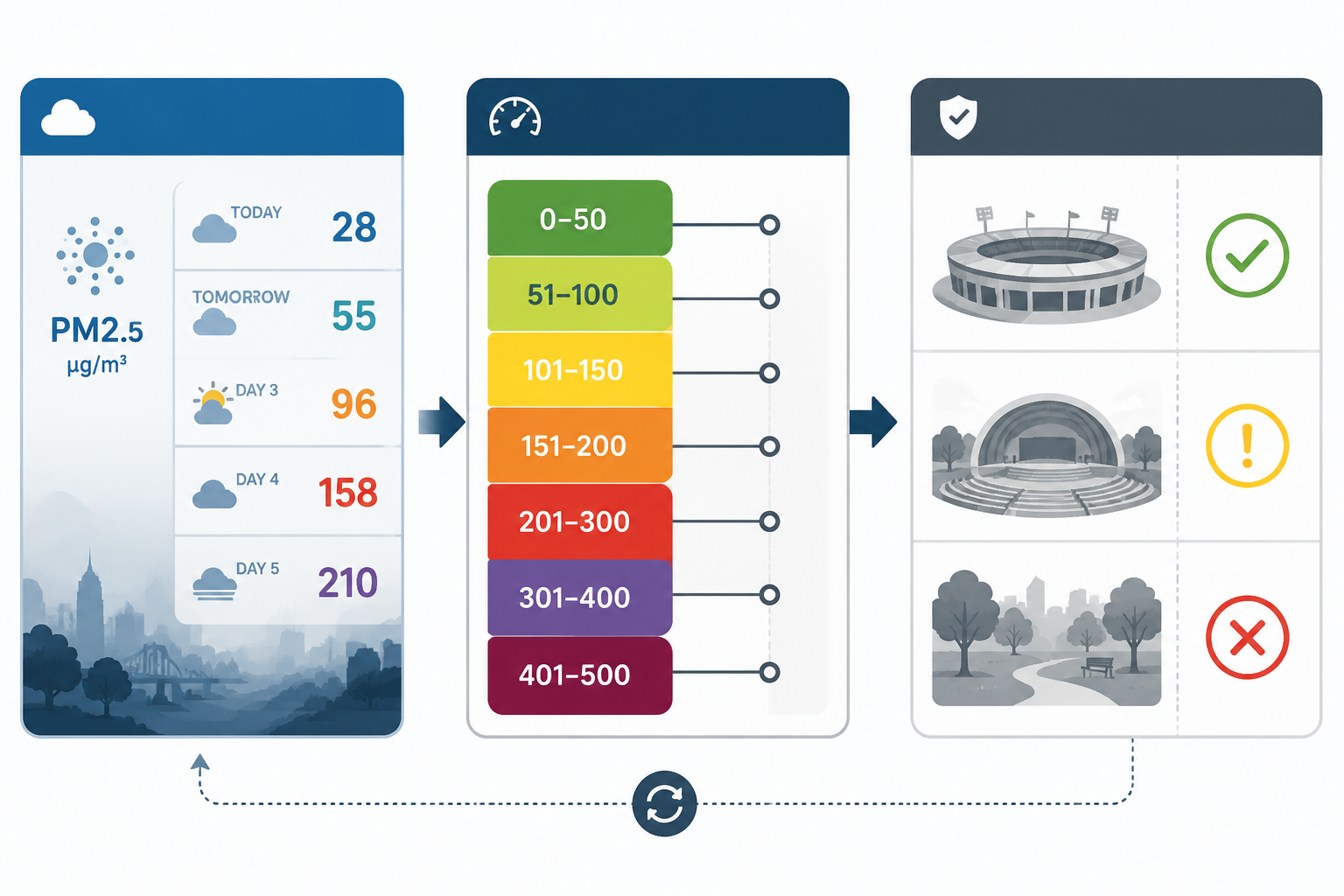
The thresholds already differ by jurisdiction and purpose. Washington State Department of Health guidance identifies AQI 201 or higher, the “Very Unhealthy” range, as a point to cancel outdoor public events. California guidance described in public reporting places cancellation of all outdoor events at Level 5, the hazardous level. EPA-style general guidance is more cautious earlier in the scale, with consideration of cancellation at AQI 151 or higher for sensitive groups.[5]
| Guidance signal | AQI level described in the brief | Closure implication |
|---|---|---|
| Washington State Department of Health | AQI 201+ | Cancel outdoor public events. |
| California guidance | Level 5 hazardous | Cancel all outdoor events. |
| EPA general guidance | AQI 151+ | Consider cancellation for sensitive groups. |
This is where a venue-facing AI claim can become misleading. If a model predicts AQI 170 for tomorrow afternoon, it may support cancellation for a youth sports event involving children with asthma under one framework, while prompting monitoring and mitigation rather than full cancellation under another. If it predicts AQI 220 with enough confidence at the right location and time, the public-health case for cancellation becomes much stronger under Washington-style guidance. The model has not “decided” either outcome; the model has supplied an exposure estimate that a published threshold can interpret.
This threshold step should be visible in any serious closure workflow. The public should be able to see which forecast was used, which AQI rule was applied, what time window was considered, and whether the decision protects the general public or a sensitive subgroup. Without that, “AI predicted the closure” becomes a way to hide judgment behind software.
Longer Horizons Help Planning, But Need More Humility
Ten-day air-quality forecasting is appealing because large outdoor events often cannot wait until the morning of the event. Johns Hopkins Applied Physics Laboratory reported a deep-learning emulator that produced accurate 10-day air-quality forecasts using only 21 hours of input data, described as seven model timesteps, while traditional chemical transport models require months of computation.[6] That is an important technical signal, but the claim comes from an institutional news release, not the same kind of peer-reviewed health-outcome evaluation as the BlueSky study.
Combined machine-learning and mechanistic-modeling approaches are also moving quickly. Fu described combined ML-MMF models as achieving more than 90% accuracy and being 66% more accurate than chemical transport models alone.[7] Those figures suggest the frontier is advancing, but they still need to be translated into venue-relevant questions: accuracy for which pollutant, at which spatial scale, during what kind of smoke event, and near which threshold?
For closure decisions, the forecast horizon should change the action. A 10-day signal can justify a watch, contingency planning, and early communication that smoke may affect the event. A 4-day forecast can start operational preparation. A 24- to 48-hour forecast with known error can support a stronger recommendation. The closer the decision is to cancellation, the less acceptable it is to rely on a distant, unqualified forecast.
Where Reliability Breaks Down
Extreme smoke events are exactly when public-health protection is most needed and exactly when models can be most stressed. Forecast accuracy can degrade when an event is not well represented in training data or when fire behavior, wind, plume injection, and atmospheric chemistry depart from familiar patterns. This is not a reason to ignore forecasts. It is a reason to avoid pretending that a closure threshold can be applied without uncertainty.
- Use near-term forecasts for final closure decisions when possible, especially within 24-48 hours.
- State the AQI threshold and the population being protected, rather than citing “AI” as the authority.
- Pair forecasts with monitoring data as the event approaches, because modeled PM2.5 and measured PM2.5 are not identical.
- Treat news-release accuracy claims as preliminary unless independent validation is available.
- Track false alarms and missed events, because repeated over-closure can erode public trust even when the intent is protective.
The false-alarm problem deserves more attention than it usually receives in health-protection discussions. A public-health agency may reasonably accept more precaution than a venue finance office would, especially when children, older adults, or people with respiratory disease are involved. But if the public repeatedly sees events closed on days that later look acceptable, future warnings become harder to defend. The answer is not to wait until smoke is visible. It is to document the forecast, threshold, uncertainty, and rationale each time.
What a Defensible Closure Workflow Looks Like
A practical workflow starts with the forecast but does not end there. Public-health staff identify the event location and time window, review the most relevant smoke forecast, convert PM2.5 to AQI if needed, compare the expected AQI with the jurisdiction’s guidance, and then decide whether the event should proceed, be modified, moved indoors, delayed, or canceled.
The BlueSky evaluation gives a reason to take forecasted PM2.5 seriously as a health signal. HRRR-Smoke and Trace AQ show that actionable lead time is already available at operationally useful horizons. Stanford’s exposure work explains why this is no longer an occasional planning edge case. The AQI guidance supplies the public rule that prevents a model output from becoming an opaque administrative judgment.
Current AI smoke forecasting can support proactive outdoor-venue closures when paired with explicit AQI guidance. It cannot, by itself, authorize them. The defensible decision depends on forecast horizon, event extremity, local policy, and the quality of validation behind the model being used.
References
- A Model that Predicts the Spread of Wildfire Smoke Becomes Operational — NOAA NESDIS
- U scientists develop AI-powered tool to forecast wildfire smoke — University of Utah
- Evaluation of a Wildfire Smoke Forecasting System as a Tool for Public Health Protection — Environmental Health Perspectives, 2013
- Wildfire smoke is unraveling decades of air quality gains — Stanford Sustainability
- When should wildfire smoke cancel an outdoor event? — Fresno Bee
- Using Artificial Intelligence, Better Pollution Predictions Are in the Air — Johns Hopkins Applied Physics Laboratory
- AI can help forecast air quality, but freak events like wildfire smoke can throw off the models — The Conversation, 2023
Comments
Join the discussion with an anonymous comment.