
The 2025 Neurology report is the study that pulled artificial sweeteners and cognitive decline back into clinical conversation: in 12,772 adults followed for 8 years, higher low- and no-calorie sweetener intake tracked with faster cognitive decline, but the finding remains observational and cannot show that sweeteners caused the decline [1].

The ELSA-Brasil study is the sharpest signal so far
What makes ELSA-Brasil harder to dismiss than older diet-soda headlines is not just the size of the cohort. It measured seven individual compounds rather than treating all sweetened products as interchangeable, and it followed cognition over a meaningful interval instead of relying on a single cross-sectional snapshot [1].
- Six of the seven measured compounds — aspartame, saccharin, acesulfame-K, erythritol, sorbitol, and xylitol — were associated with faster global cognitive decline; tagatose was the only exception [1].
- Participants in the highest intake tertile had 62% faster global cognitive decline, with an effect estimate of β = −0.024 (95% CI −0.040 to −0.008), which the study translated into about 1.6 years of brain aging [1].
- Verbal fluency was the most striking domain: decline was 173% faster in the highest tertile and 110% faster in the middle tertile compared with the lowest tertile [1].
- The association reached statistical significance only in participants under 60, and it was stronger in people with diabetes, who also had higher absolute LNCS intake [1].
- The main caution is still structural: exposure came from a single baseline food-frequency questionnaire, so changing intake over the 8-year follow-up could not be captured [1].
That age split is intriguing, but it should not be forced into a neat midlife-vulnerability story. It could reflect a real susceptibility window, but it could also reflect survivor bias, different consumption patterns by age, or the fact that dietary habits shift after metabolic diagnoses and counseling. The study shows a signal; it does not settle the timing problem.
Framingham makes the causal problem harder, not easier
The earlier Framingham Offspring analysis remains important because it did not just find an association; it exposed the interpretive puzzle. Daily consumption of artificially sweetened soft drinks was linked with a 3-fold hazard of ischemic stroke (HR 2.96, 95% CI 1.26–6.97) and a 3-fold hazard of Alzheimer’s dementia (HR 2.89, 95% CI 1.18–7.07) over 10 years [2].
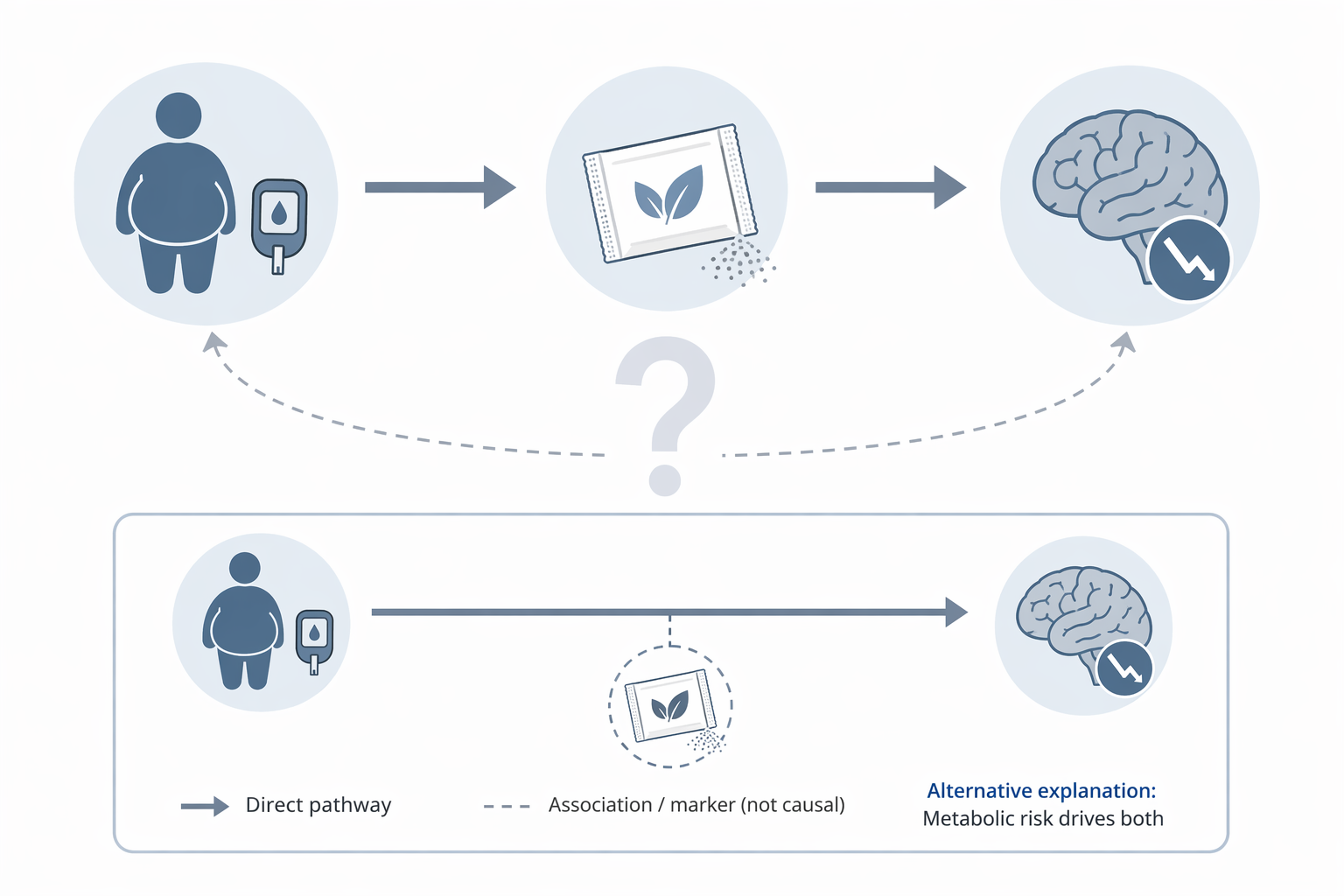
Diabetes partially mediated the dementia association, but the signal persisted even after participants with diabetes were excluded (HR for Alzheimer’s dementia 3.23, 95% CI 1.22–8.52) [2]. That persistence matters because it weakens the easy version of the sick-user explanation without eliminating it. People at higher metabolic risk may preferentially switch to diet beverages, which means the exposed group can already be carrying more vascular and cognitive risk before sweetener intake is even considered.
The null finding for sugar-sweetened beverages is the part that keeps the causal argument from becoming tidy [2]. If the sweetener itself were the whole story, the comparison would look different; if the diet-soda group is enriched for pre-existing risk, then the apparent sweetener effect may be partly a marker of the underlying health profile of the drinker. Framingham therefore sharpens the question rather than answering it, and it does so with beverage-level exposure, not compound-specific measurement.
The broader vascular literature points in the same direction
NutriNet-Santé is useful less because it answers the brain question directly than because it shows the pattern is not confined to cognition. In more than 103,000 participants, total artificial sweetener intake was associated with increased cardiovascular disease risk, which supports the idea that the epidemiologic signal extends across vascular outcomes rather than appearing in a single study or a single endpoint [3].
That broader pattern does not prove a shared mechanism, and it does not make the cognitive finding causal. It does, however, make the totality of the prospective evidence look less like an isolated anomaly and more like a recurring association that deserves explanation.
Why short-term trial reassurance does not settle the question
This is where the literature keeps splitting. Short-term randomized trials of low- and no-calorie sweeteners often look neutral or metabolically favorable, especially for weight-related endpoints, but they were never designed to test whether repeated exposure over years changes dementia or stroke risk. Cognitive decline and cerebrovascular disease unfold on a different time scale from a feeding trial.
That mismatch leaves three unresolved possibilities on the table: the exposure itself could matter, the observed association could be partly reverse causality because people with diabetes or other metabolic risk change to diet products, or residual confounding could survive even careful adjustment. The problem is not that observational data are useless; it is that lifetime exposure is not something researchers can ethically randomize in the way a short-term feeding trial can.
The WHO’s 2023 guideline adds context without resolving the neurocognitive question: it conditionally advises against using non-sugar sweeteners for weight control [4]. That recommendation is about weight management, not dementia prevention, but it shows that concerns about long-term benefit have already reached beyond neurology.
What clinicians can say without overstating the evidence
The most defensible counseling message is narrow. Higher artificial sweetener intake has repeatedly been associated with worse cognitive and vascular outcomes in prospective cohorts, including stronger associations in people with diabetes and, in ELSA-Brasil, a signal concentrated under age 60 [1][2][3]. That is enough to understand the risk conversation, but not enough to tell patients that avoiding these products will prevent dementia.
For the patient who switched to diet soda because it seemed safer, the honest answer is not reassurance by default and not alarm by default. The evidence supports treating non-sugar sweeteners as an imperfect metabolic trade-off with an unresolved long-term cognitive signal, not as proven neurotoxins and not as proven neutral substitutes.
References
- “Low- and no-calorie sweetener consumption and cognitive decline in ELSA-Brasil” — Neurology, 2025
- “Artificially Sweetened Beverages and Stroke, Dementia, and Alzheimer’s Disease” — Stroke, 2017
- “Artificial sweeteners and risk of cardiovascular diseases” — BMJ, 2022
- “WHO advises not to use non-sugar sweeteners for weight control in newly released guideline” — World Health Organization, 2023-05-15
Comments
Join the discussion with an anonymous comment.