
The usual argument about chlorine disinfection in healthcare starts in the hallway, not in the lab. Someone smells bleach after a terminal clean. Someone else remembers a splash, a headache, or a coughing episode. Before long, the product is being discussed as if every chlorine-based disinfectant were the same chemical, used the same way, at the same concentration, with the same exposure profile.
That is where many chlorine disinfection myths in healthcare begin to do real operational damage. Bleach is not harmless. It is also not automatically a cloud of chlorine gas. Hypochlorous acid is not magic just because it is gentler in some use conditions. Spraying is not proven safe because a label says “hospital disinfectant,” and wiping is not proven safe just because it looks calmer. The useful question is narrower: which chlorine compound, at what concentration, applied how, for how long, on what surface, and with what worker exposure?

The smell is real. The conclusion people draw from it is often wrong.
Sodium hypochlorite bleach can release toxic chlorine gas when it is mixed with acids or ammonia. That is a concrete hazard, not a theoretical one, and it is why chemical compatibility belongs in every EVS training program and every supply-room decision. CDC infection-control guidance describes sodium hypochlorite as a chemical disinfectant and warns against reactions that can produce harmful chlorine gas when bleach is mixed with incompatible chemicals such as acids or ammonia-containing products [1].
But the routine odor after proper bleach use is not, by itself, proof that staff are breathing chlorine gas. CloroxPro’s manufacturer-sponsored explanation says the recognizable bleach smell is associated with chemical reactions during cleaning, including reactions with proteins and other soils, rather than simple off-gassing of chlorine gas under normal use conditions [2]. Because that source has an obvious commercial interest, it should not carry the whole argument. It is best treated as consistent with the chemistry boundary CDC emphasizes: the serious gas hazard is mainly a mixing and compatibility failure, not the mere presence of a bleach odor [1][2].
The practical takeaway is not “ignore the smell.” Odor complaints still matter. They can signal poor ventilation, over-application, inadequate dilution control, a product unsuited to the task, or staff being asked to work around wet disinfectant before a space is ready. What the smell should not do is collapse the assessment into a single assumption: “chlorine gas.” The fix for odor is an exposure review, not a rumor.
Respiratory risk is the concern that deserves the most discipline
Healthcare workers are not worried about respiratory effects because they are fragile or poorly informed. They are worried because they are the ones pushing carts, turning rooms, cleaning bathrooms, responding to spills, and working through product changes that may have been chosen far from the unit. If a disinfectant program increases coughing, wheezing, or asthma-like symptoms, the burden does not land on the purchasing spreadsheet first.
A key recent synthesis is the 2025 systematic review and meta-analysis by Fontana and colleagues on chlorine spraying and occupational health effects in healthcare workers. It found that use of chlorine-based products was associated with increased odds of respiratory conditions, with an odds ratio of 1.71 and a 95% confidence interval of 1.41 to 2.08. The authors rated that evidence as moderate certainty [3].
That does not prove that bleach directly causes asthma in every exposed worker. It does mean respiratory symptoms and diagnoses cannot be dismissed as anecdote when chlorine-based products are used regularly. The same review matters because of its limits: 23 of the 29 included studies were cross-sectional and at high risk of bias, so the evidence is better for identifying occupational association than for proving a clean causal chain from one product to one disease outcome [3].
The Dumas cohort adds a more grounded signal. In a JAMA Network Open study of 73,262 U.S. female nurses, regular disinfectant exposure was associated with increased incidence of chronic obstructive pulmonary disease, and regular bleach use was among the exposures examined [4]. Again, this is observational evidence. It should influence risk assessment, ventilation planning, product selection, and staff surveillance; it should not be inflated into proof that every bleach exposure produces chronic lung disease.
| Claim heard in practice | What the evidence supports | What should not be assumed |
|---|---|---|
| “Bleach causes asthma.” | Chlorine-based products are associated with increased odds of respiratory conditions in healthcare worker studies. | That every asthma case has a single disinfectant cause. |
| “If we wipe instead of spray, the respiratory issue is solved.” | Spraying showed increased respiratory risk in the 2025 meta-analysis. | That wiping is proven meaningfully safer in the available comparative evidence. |
| “If staff smell bleach, they are breathing chlorine gas.” | Chlorine gas is a recognized hazard when bleach is mixed with incompatible chemicals. | That routine odor alone proves chlorine gas exposure. |
Spraying looks riskier, but wiping has not been cleared
Application method matters because it changes the way workers encounter the chemical. Aerosolization, mist, droplet size, proximity to the breathing zone, dwell time, room turnover pressure, and ventilation all affect exposure. The Fontana meta-analysis found that spraying was associated with a 125% increase in respiratory risk, with an odds ratio of 2.25 [3].
The easy shortcut would be to say, “Stop spraying and wipe everything.” The evidence does not quite allow that. In the same review, the relative odds ratio comparing spraying with wiping showed no statistically significant difference, with an ROR of 0.98 and a 95% confidence interval of 0.63 to 1.51, and the certainty of that comparison was low [3].
For protocol work, that distinction matters. Spraying may increase risk, but the available comparative evidence is not strong enough to declare wiping a respiratory-safe alternative in all settings. A saturated wipe used repeatedly in a poorly ventilated room, with the worker’s face close to the surface, can still be an exposure problem. The review supports caution around spraying; it does not support complacency around wiping.
“Chlorine-based” is not one disinfectant
A surprising amount of disinfectant debate gets sloppy right at the word “chlorine.” Sodium hypochlorite, hypochlorous acid, chlorine dioxide, and other chlorine-based chemistries do not behave identically. Even within one compound, performance changes with dilution, organic soil, pH, surface material, application volume, and contact time.
Gallandat and colleagues’ systematic review of chlorine-based surface disinfection efficacy is useful because it does not treat efficacy as a product slogan. It emphasizes concentration-time relationships, pH, soil load, and surface type as major determinants of microbial reduction [5]. That is the level where real protocols either succeed or fail. A disinfectant that performs well in a clean test condition can underperform when blood, mucus, biofilm, residue, or incompatible surface materials enter the picture.
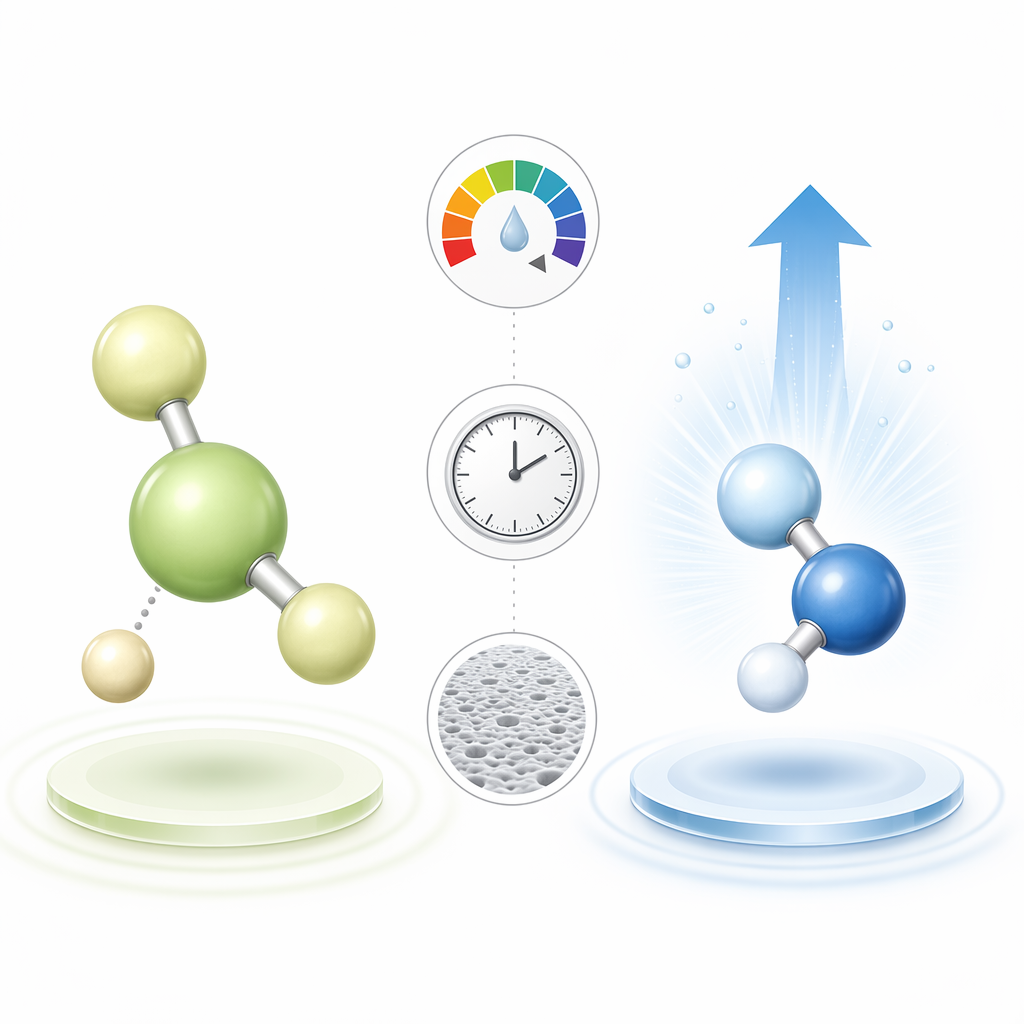
This is where sodium hypochlorite and hypochlorous acid deserve comparison, but not theater. Sodium hypochlorite is the familiar bleach chemistry: durable, broadly used, inexpensive at the bottle level, and capable of strong disinfection when the concentration and contact time fit the task. It can also be corrosive, irritating, and unforgiving when mixed incorrectly or overused in spaces with poor ventilation.
Hypochlorous acid, or HOCl, is often presented as the gentler chlorine option. Block and Rowan’s review describes HOCl as naturally produced by human white blood cells and discusses its antimicrobial activity and relatively favorable human safety profile [6]. The same review describes HOCl as non-toxic to humans in the context of its reviewed applications [6]. That does not turn every HOCl product into a universal substitute for bleach. Stabilization, available free chlorine, shelf life, generation controls, surface compatibility, and organism-specific claims still have to be verified against the intended use.
The often-cited claim that HOCl can be 80 to 200 times more effective than sodium hypochlorite against bacteria on surfaces should be read as a chemistry- and condition-dependent comparison, not as a blanket guarantee across every healthcare surface and pathogen challenge [6]. In a facility decision, that number may justify a closer look. It should not replace label review, contact-time verification, compatibility checks, and environmental monitoring.
Efficacy lives in the contact time no one wants to wait for
On paper, a disinfectant can look excellent. On a unit, the question is whether the surface stays wet long enough, whether staff have time to reapply, whether the product is being used on compatible materials, and whether organic soil was removed before disinfection. The Gallandat review’s emphasis on concentration multiplied by time is not academic. It is the difference between a product that works in a protocol and a product that works only in a brochure [5].
A hypothetical example is enough to show the problem. If a high-touch surface requires a defined wet contact time but dries halfway through because the wipe is under-saturated or the room is warm and well ventilated, the process may fail even though the correct product was chosen. The same kind of failure can happen when staff are told to clean faster during bed pressure, when a disinfectant is used on a surface that binds or neutralizes active chlorine, or when visible soil is left in place.
That is also why “stronger” is not always better. Higher available chlorine can improve performance in some conditions, but it can also increase odor, irritation, material damage, and staff resistance. A protocol that staff quietly work around is not a high-reliability protocol. Infection prevention has to own that tradeoff instead of sending EVS staff into it alone.
The cheapest product is not always the cheapest program
Bleach often wins on obvious unit price. That is one reason it has remained a workhorse. But the “always cheapest” claim becomes less sturdy when the full program is counted: dilution control, staff training, PPE, ventilation complaints, surface damage, storage, shelf life, product waste, and time lost to rework or odor management.
On-site HOCl generation is the most interesting counterexample. Block and Rowan describe systems that generate disinfectant from salt, water, and electricity, with equipment costs under $275 and production at pennies per gallon [6]. Those figures make HOCl worth evaluating in some facilities, especially where shipping, storage, and recurring product costs are major concerns.
Even there, the cost claim has to stay conditional. A facility still has to validate concentration, quality control, staff competency, workflow fit, surface compatibility, regulatory status, and whether the generated product’s shelf life matches real use patterns. A cheap gallon that cannot be reliably produced, documented, stored, or applied for the required contact time is not cheap in practice.
What a better chlorine protocol actually accounts for
The better question is not whether healthcare should be “for” or “against” chlorine disinfection. Chlorine-based disinfectants include useful tools, and some of them are hard to replace in specific situations. The weak protocols are the ones that choose a product class and stop thinking.
- Name the compound, not just the family. Sodium hypochlorite and HOCl should not be evaluated as if they were interchangeable.
- Match concentration and contact time to the organism, surface, and soil condition the staff actually face.
- Treat application method as an exposure decision. Spraying, fogging, pouring, mopping, and wiping create different worker contact patterns.
- Check ventilation and workflow before blaming staff for odor complaints or shortcutting dwell time.
- Count total program cost, including training, compatibility, storage, waste, complaints, and rework.
- Do not use manufacturer claims as the final word when independent reviews, occupational studies, or facility-specific validation can narrow the decision.
The evidence does not support panic around every bleach smell. It also does not support casual confidence that routine chlorine use carries no respiratory burden. It does not make wiping a guaranteed safe harbor, and it does not make HOCl a miracle product. The useful conclusion is more exacting: healthcare disinfection decisions improve when they are built around the actual compound, the actual concentration, the actual application method, the actual exposure pattern, and the actual surface task.
References
- Chemical Disinfectants | Infection Control, CDC.
- Busting Myths About Bleach, CloroxPro.
- Occupational Health Effects of Chlorine Spraying in Healthcare Workers: A Systematic Review and Meta-Analysis, International Journal of Environmental Research and Public Health, 2025.
- Association of Occupational Exposure to Disinfectants With Incidence of Chronic Obstructive Pulmonary Disease Among US Female Nurses, JAMA Network Open, 2019.
- A systematic review of chlorine-based surface disinfection efficacy, American Journal of Infection Control, 2020.
- Hypochlorous Acid: A Review, Journal of Oral and Maxillofacial Surgery, 2020.
Comments
Join the discussion with an anonymous comment.