
Chris Johnson’s ALS diagnosis became public in the way many neurological diseases become public: late enough that the clinical consequences were already visible. The former NFL running back announced on Good Morning America on June 29, 2026, at age 39, after first noticing hand weakness and after receiving a private diagnosis at an unspecified earlier date. By the time he spoke publicly, deterioration in his natural speech meant he was using a speech-generating device with an AI-generated synthetic voice. He also said he was taking three standard ALS medications and participating in an anti-inflammatory clinical trial.[1]
That detail—the device speaking for a patient whose own voice has changed—is the part that should stay with anyone thinking about Chris Johnson’s ALS diagnosis as more than a public sports story. AI is already helping Johnson communicate. AI for ALS diagnosis is a different matter. As of Q3 2026, the models drawing attention in ALS research have not been cleared by the FDA as clinical diagnostic tools, and none can be described responsibly as something that could have shortened Johnson’s diagnostic pathway.
The need is real. ALS diagnosis is often delayed by 6 to 18 months, a punishing interval for a disease in which function can decline before certainty arrives. The CDC estimates that 31,000 Americans have ALS; veterans are diagnosed at higher rates; and the available drug landscape remains limited, with four FDA-approved drugs and none that halt progression. Johnson’s case has also renewed public attention and fundraising energy, including a revival of the Ice Bucket Challenge, but research attention and clinical availability are not the same thing.[6][7]
The practical question is narrower and harder: could any current AI approach identify ALS earlier, reliably enough, in a real diagnostic pathway, for a clinician to use today? Three approaches deserve attention because they are not interchangeable. One reads electrophysiology data already collected in neuromuscular evaluation. One looks for plasma protein signatures. One combines expression and genomic variant data. Their promise comes from different signals; their limitations converge around validation, generalizability, and regulatory status.
The Diagnostic Gap Johnson’s Case Makes Visible
ALS is not usually diagnosed from one unmistakable laboratory value. Early weakness, fasciculations, cramps, speech change, or swallowing symptoms can overlap with more common conditions. Clinicians work through history, examination, electrodiagnostic studies, imaging, laboratory evaluation, and exclusion of mimics. That workup is necessary, but it consumes time.
Johnson’s public account does not provide enough information to reconstruct his exact diagnostic interval. It does show the clinical stakes of delay: hand weakness was an early signal, and by the time of public disclosure his voice had deteriorated enough to require assisted communication.[1] The responsible inference is not that a named AI model would have changed his course. It is that ALS creates exactly the kind of diagnostic pressure that makes earlier pattern detection attractive.
That pressure is especially relevant because most ALS is sporadic rather than inherited. Johnson reported no family history, fitting the broader reality that roughly 90% of ALS cases are sporadic.[1] A diagnostic strategy that depends only on known familial mutations will not be enough for most patients. Pattern recognition across routine physiology, blood proteins, or multi-omic data could matter—if it survives the tests that separate promising models from usable medical tools.
Mayo’s F-Wave Model Starts Closest to the Clinic
The Mayo Clinic F-wave model is the most immediately recognizable to a neuromuscular workflow because it uses data from routine nerve conduction studies rather than requiring a new omics platform. F-waves are late motor responses elicited during nerve conduction testing. In ALS evaluation, electrophysiology already helps document lower motor neuron involvement and distinguish ALS from mimics. The model’s appeal is that it tries to extract more diagnostic and prognostic signal from a test clinicians already order.
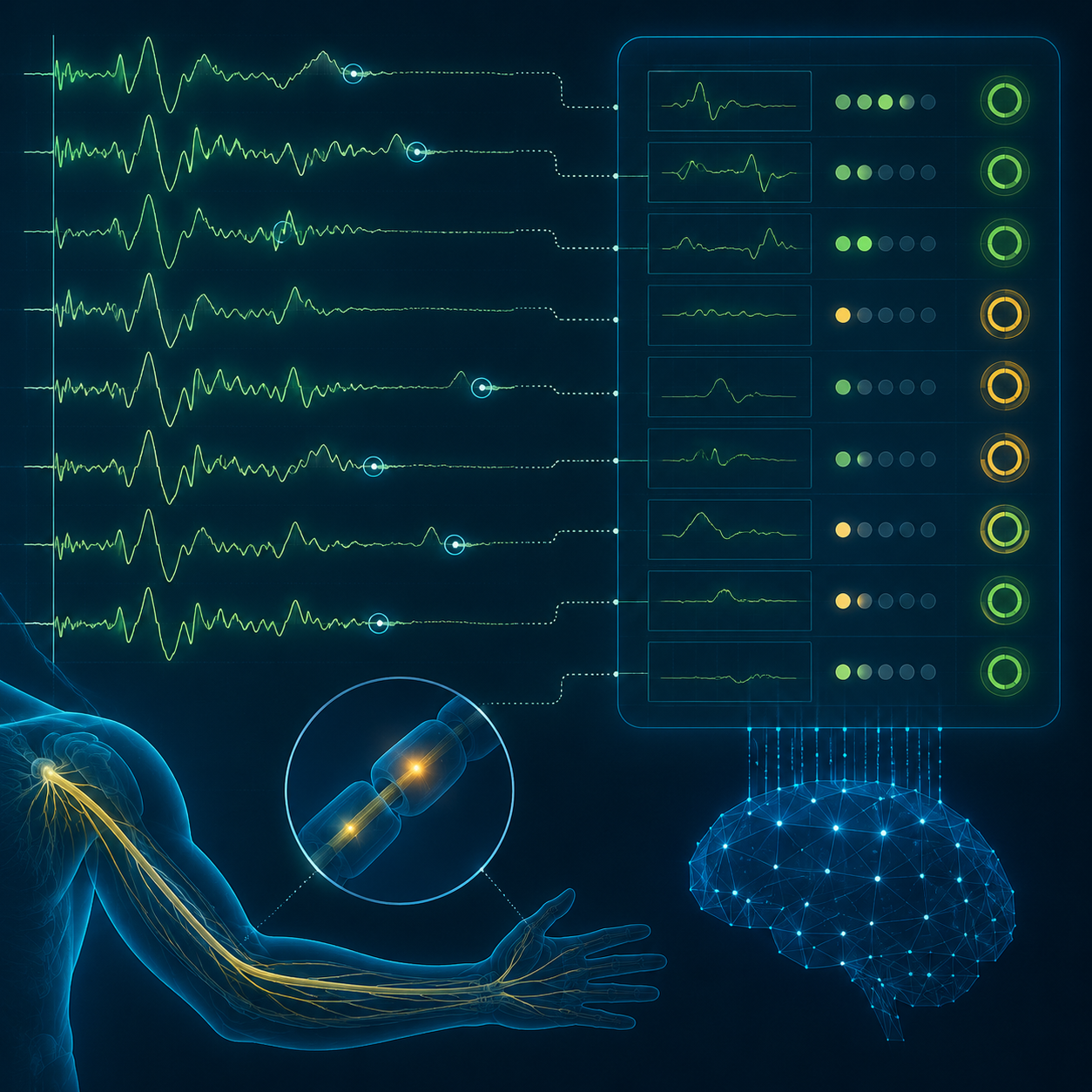
Mayo reported an AI model trained on F-wave responses from 46,802 patients. The work, published in Brain in 2025, classified ALS using routine nerve conduction study data and also predicted survival. Mayo’s summary emphasizes that the model outperformed manual waveform interpretation, a meaningful point because manual reading of F-wave patterns can be limited by subtlety, variability, and the number of waveform features a human interpreter can consistently integrate.[2][3]
The survival component matters. A model that only separates ALS from non-ALS in a retrospective dataset is one thing; a model that also captures a signal related to disease trajectory suggests it may be reading biologically relevant electrophysiologic change rather than noise. For clinicians, prognosis is not an abstract output. It affects counseling, timing of respiratory monitoring, assistive technology planning, and clinical trial stratification.
Still, proximity to existing workflow should not be mistaken for deployment. The key evidence is retrospective. The model would need prospective testing in the messy setting where ALS suspicion first arises: patients with incomplete signs, variable referral timing, different equipment, different laboratories, and competing diagnoses. It would also need external validation that shows performance beyond the development environment and a regulatory pathway before it could be represented as a diagnostic aid in routine care.
If one were choosing which AI diagnostic direction looks easiest to imagine in clinic, the F-wave approach has the cleanest operational story. It asks whether data already generated during electrodiagnostic testing can be interpreted more consistently. But “easiest to imagine” is still not “available,” and publication in Brain is not equivalent to a cleared clinical tool.
The Plasma Proteomics Signal Is Striking, and Needs Slower Reading
The NIH-linked plasma proteomics work is the most dramatic of the three approaches because it points toward a blood-based signal before clinical symptoms. Secondary reporting described a model based on 33 differentially expressed proteins, with a 96.2% area under the curve in discovery, validation in more than 23,000 individuals at greater than 99% accuracy, and ALS-related proteomic changes detectable up to 10 years before symptom onset.[4]
Those numbers, if read too quickly, can do more harm than good. AUC is not the same as a diagnosis delivered to a patient. Accuracy depends heavily on cohort composition, disease prevalence, control selection, sample handling, and the threshold chosen for classification. A claim about changes years before symptoms also raises immediate questions: who was sampled, how later ALS onset was confirmed, what comparison groups were used, and whether the model distinguishes ALS risk from broader neurodegenerative or inflammatory signals.
The research brief flags an important constraint: the “greater than 99% accuracy” and long pre-symptomatic window are available here through secondary reporting of a Nature Medicine study, not through direct appraisal of the original paper’s methods. That does not make the result unimportant. It does mean the figure should not float through clinical discussion as if the validation design, case mix, and intended-use population were already settled.[4]
A blood-based ALS test would be valuable for exactly the patients who now spend months moving through uncertainty. It might help prioritize urgent neuromuscular referral, select patients for closer follow-up, or identify research cohorts earlier. But those uses are different from screening the general population, confirming ALS in symptomatic patients, or predicting ALS before symptoms in a way that changes care. Each intended use would require its own validation.
There is also a burden that comes with pre-symptomatic signals in a disease without a therapy that halts progression. Earlier biological detection is not automatically earlier clinical benefit. A test that tells a person they may develop ALS years before symptoms would need exceptional specificity, careful counseling, and an evidence-based action that follows the result. Without that, the technology may shift uncertainty earlier rather than reduce it.
MOALS Shows the Multi-Omics Direction, With a Smaller Evidence Base
The MOALS model takes a different route: instead of reading nerve signals or plasma proteins, it integrates gene expression and genomic variant data. In the Heliyon 2024 study, the model used 17,546 genes from expression and variant data and reported 92.06% diagnostic accuracy, improving performance by 1.7 to 6.2 percentage points over single-omic approaches.[5]
That is a sensible biological bet. ALS is heterogeneous, and a single data layer may miss patterns that become clearer when expression and variation are analyzed together. Multi-omics also fits the broader movement in neurodegenerative disease research toward classification systems that reflect mechanism rather than only phenotype.
The constraint is scale and maturity. The study involved 672 samples, including 593 ALS samples and 79 controls, and remains a single-study result.[5] That sample imbalance and limited control set matter for judging diagnostic use. A model can perform well when the comparison is relatively clean and then struggle when asked to distinguish ALS from cervical myelopathy, multifocal motor neuropathy, myasthenia gravis, inflammatory neuropathies, or other real-world mimics.
MOALS is best read as evidence that integrated biological data may improve classification, not as evidence that multi-omics is ready to shorten time to diagnosis in a neuromuscular clinic. It also has a harder operational path than the F-wave model: multi-omics testing is not part of every ALS diagnostic workup, and implementation would require standardized sampling, processing, interpretation, reimbursement, and clinical decision rules.
What the Three Approaches Actually Support
| Approach | Main signal | Reported evidence | Closest clinical use case | Main constraint |
|---|---|---|---|---|
| Mayo F-wave AI | Routine nerve conduction study F-wave responses | Trained on 46,802 patients; classified ALS and predicted survival | Decision support during electrodiagnostic evaluation | Retrospective evidence; needs prospective external validation and clearance |
| NIH plasma proteomics panel | 33 plasma proteins | 96.2% AUC in discovery; secondary reporting describes validation in more than 23,000 individuals at greater than 99% accuracy and changes up to 10 years before symptoms | Earlier risk or diagnostic stratification, depending on validated intended use | Methodology must be judged from the original paper; clinical use case and consequences remain unsettled |
| MOALS multi-omics classifier | Expression plus genomic variant data across 17,546 genes | 92.06% diagnostic accuracy in a 672-sample study | Research classification and hypothesis generation | Single-study, preliminary evidence; harder workflow integration |
The strongest case for AI in ALS diagnosis is not that one model has already solved the problem. It is that different data streams are beginning to show separable signals: electrophysiologic patterns, plasma protein changes, and integrated genomic-expression features. That convergence is encouraging because ALS is unlikely to yield to one neat diagnostic shortcut.
But the clinical standard is not encouragement. A diagnostic AI tool has to answer ordinary operational questions. Where does it sit in the pathway—primary care, general neurology, neuromuscular referral, electrodiagnostic lab, research screening? What patient population was it validated on? What happens when the result is wrong? Does it improve time to diagnosis, referral accuracy, trial enrollment, or patient outcomes in a prospective study?
Those questions are not academic obstacles placed in front of innovation. They are the difference between a model that performs well on curated data and a tool that can be used when a patient has one weak hand, equivocal findings, and a clinician deciding whether to accelerate an ALS workup.
Why None of This Yet Reduces the Delay
The diagnostic delay in ALS is not caused by one missing algorithm. It reflects symptom ambiguity, referral timing, access to neuromuscular specialists, the need to exclude mimics, and variation in how early disease presents. AI could help at several points, but only after its intended role is tested in the setting where the delay actually occurs.
For the F-wave model, that means prospective use during electrodiagnostic evaluation and proof that it improves clinician decision-making beyond standard interpretation. For the proteomics panel, it means defining whether the test is for symptomatic diagnosis, high-risk surveillance, trial recruitment, or some other purpose, then validating it in that population. For MOALS, it means showing that multi-omic classification holds up outside the original dataset and can be translated into a practical testing pathway.
None of the cited approaches is currently an FDA-cleared AI diagnostic for ALS. None has been shown, on the evidence available here, to prospectively shorten the 6- to 18-month diagnostic delay in clinical practice. That is the uncomfortable line between research momentum and patient reality.
Johnson’s public diagnosis makes the need for earlier ALS recognition vivid without proving that any present model could have helped him. His use of an AI-generated voice shows one area where technology is already supporting life with ALS. The diagnostic side remains earlier in the pipeline: scientifically serious, potentially useful, and still not ready to be offered as a practical answer to the patient waiting for a diagnosis.
References
- Former NFL star Chris Johnson reveals ALS diagnosis at 39 — ABC News
- Research finds AI model can predict ALS — Mayo Clinic
- Artificial intelligence models using F-wave responses predict amyotrophic lateral sclerosis — Brain, 2025
- Study points toward earlier and more accurate detection of ALS — News Medical, 2025
- Amyotrophic lateral sclerosis diagnosis using machine learning and multi-omic data integration — Heliyon, 2024
- Former NFL star Chris Johnson ALS diagnosis renews calls for more funding — WTVG
- Chris Johnson revives 2014 viral ALS Ice Bucket Challenge — Los Angeles Times
Comments
Join the discussion with an anonymous comment.