
Coffee consumption and heart disease risk reduction sounds cleaner than the literature really is. In large observational evidence, the middle of the curve is where the signal appears: roughly 2–4 cups per day, with about a 10–15% lower cardiovascular risk, and the 2026 AHA statement judged the certainty low-to-moderate rather than causal. That is the useful starting point, but it is not the whole exposure. Brewing method, timing, and host factors all change what “coffee” means in cardiovascular terms.

What the dose-response data actually support
The broad backbone comes from Kim et al. 2019, a meta-analysis that pooled 3,852,651 participants. The lowest all-cause mortality sat at about 3.5 cups per day, and the cardiovascular signal was most favorable in the 2–4 cup range, where risk was roughly 10–15% lower than at lower intakes. The 2026 AHA Scientific Statement is consistent with that pattern and extends it across coronary heart disease, heart failure, stroke, and atrial fibrillation, while still rating the certainty as low-to-moderate [1][2].
The point is not that coffee is a treatment. The point is that the observational signal survives across large cohorts and later synthesis often enough to make moderate intake a plausible lower-risk zone, especially around 3–4 cups per day, where the AHA statement highlighted a 21% lower stroke risk in its summary of the literature [2]. That is stronger than a casual association, but still weaker than a causal claim.
Brewing method changes the exposure
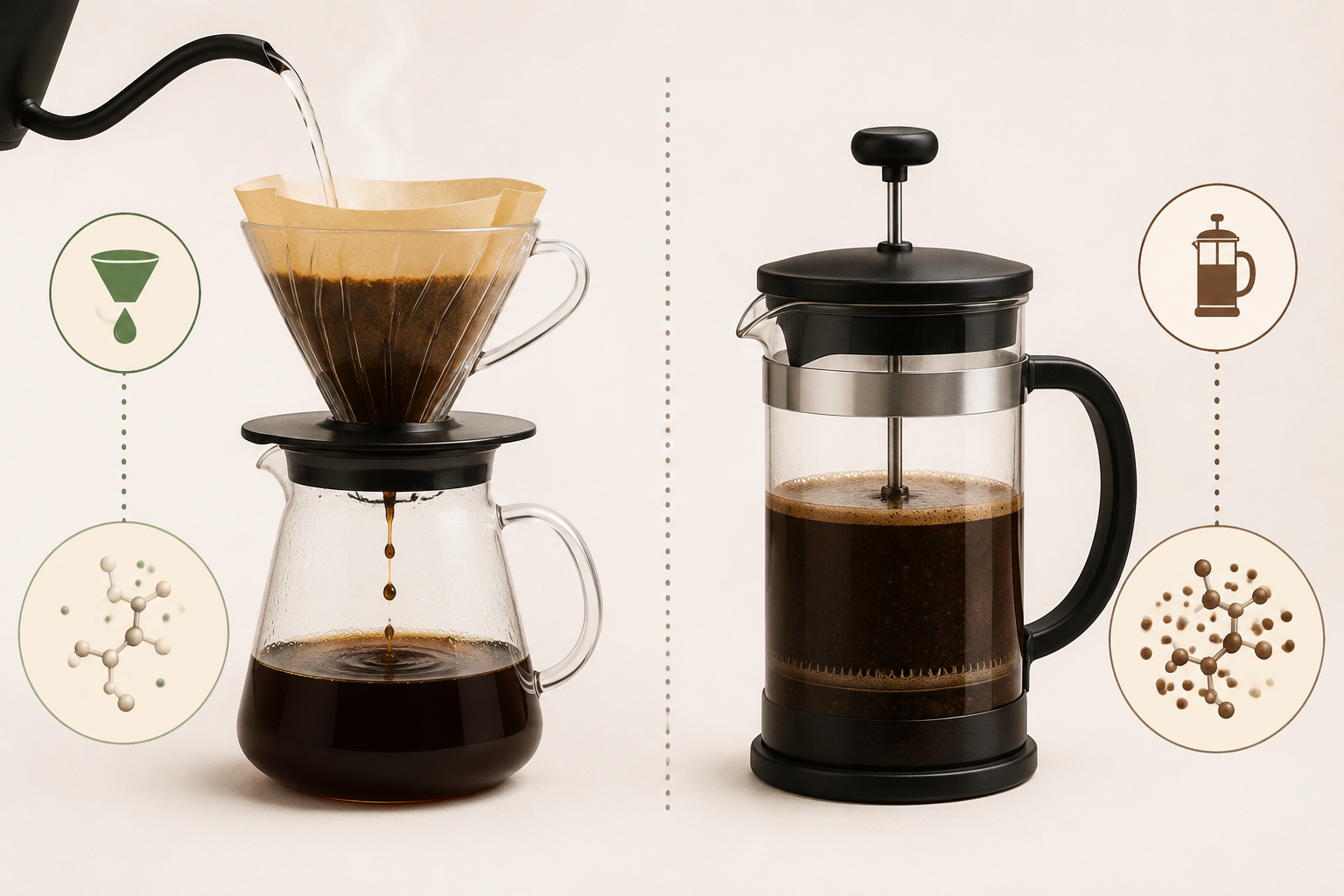
Filtered coffee and boiled or unfiltered coffee should not be lumped together. Unfiltered coffee contains far more cafestol — about 7.2 mg per cup versus about 0.02 mg in paper-filtered coffee — and cafestol is the part of coffee that raises LDL cholesterol. Paper filtration removes most of that lipid-raising diterpene burden while leaving much of the coffee’s phenolic acid profile intact, which is why the word “coffee” is too blunt to use as a single cardiovascular exposure [6].
That distinction is clinically useful because it explains why a filtered morning cup and a French press habit do not sit on the same risk surface. If coffee looks favorable on average, that average is partly built from exposure definitions that matter.
Timing is intriguing, but still provisional
Wang et al. 2025 adds a newer modifier. In 40,725 adults, morning-only coffee drinkers had 31% lower cardiovascular mortality (HR 0.69) and 16% lower all-cause mortality, while all-day coffee drinkers did not show a significant benefit. The pattern held across light, moderate, and heavy morning intake, which makes the timing signal interesting rather than obviously dose-dependent [5].
That is not enough to turn schedule into prescription. It is a novel observational pattern, not a replicated rule, and it should be treated as hypothesis-generating until other cohorts or designs can test whether the timing itself matters or whether it is tracking another behavior that happens to cluster with morning-only coffee use.
Heart failure, decaf, and why the machine-learning result mattered
The heart-failure literature is useful because it does not rely on one method alone. Stevens et al. used random forest analysis across the Framingham Heart Study, ARIC, and CHS and found coffee consumption among the top predictors of incident heart failure. In that analysis, 2 cups per day was associated with an HR of 0.69, with p<0.001, and decaf did not show the same protection [3].
That result is easy to overread as an “AI discovery,” but the more careful reading is that machine learning surfaced a signal already visible in cohort data. Biswas et al. 2026 then updated the dose-response literature and again found an inverse association between coffee intake and incident heart failure, which makes the heart-failure finding look less like a one-off model artifact and more like a repeated observational pattern [4].
Genetics and severe hypertension narrow the message
The CYP1A2 story is plausible enough to keep in mind and inconsistent enough to avoid turning into routine practice. Cornelis et al. 2006 reported that about half the population carried the slow-metabolizer CYP1A2*1F variant, and among slow metabolizers, 2 or more cups per day was associated with higher myocardial infarction risk, with an odds ratio of 1.36 [7].
Later work has not consistently reproduced that interaction, so genetics should be treated as a modifier with uncertain portability rather than a settled reason to genotype coffee drinkers. The same caution applies to severe hypertension: the favorable average association should not be pasted onto people with stage 2 hypertension as if all cardiovascular contexts were interchangeable.
The cleanest interpretation through mid-2026 is conditional, not promotional. Moderate coffee consumption, especially when it is filtered and not spread all day, is associated with lower cardiovascular risk in observational evidence, but the estimate shifts with brewing method, timing, and host biology, and the underlying certainty remains low-to-moderate [1][2].
References
- Coffee consumption and all-cause and cardiovascular mortality: a meta-analysis — European Journal of Epidemiology, 2019
- Caffeine and Cardiovascular Disease: A Scientific Statement From the American Heart Association — Circulation, American Heart Association, 2026
- Coffee Consumption and Incident Heart Failure: A Machine Learning Analysis — Circulation: Heart Failure, 2021
- Coffee consumption and incident heart failure: an updated systematic review and dose-response meta-analysis — Journal of Health, Population and Nutrition, 2026
- Timing of coffee consumption and mortality — European Heart Journal, 2025
- Coffee and cardiovascular health: a comprehensive review — 2023
- Coffee, CYP1A2 genotype, and risk of myocardial infarction — JAMA, 2006
Comments
Join the discussion with an anonymous comment.