
College football is organized around measurement. Load, velocity, body weight, sleep, soreness, acceleration, return-to-play milestones: almost everything that touches performance can be counted. That makes the nutrition challenge facing college football programs especially awkward. The sport asks athletes to train and recover with precision, while the evidence suggests many of them are still being left to guess at basic and sport-specific fueling questions.
A University of Connecticut study reported that college athletes scored about 45% on total nutrition knowledge and about 35% on sport-specific nutrition knowledge.[1] Those numbers are stark, but the more important point is that they are not an isolated campus embarrassment. A 2025 scoping review synthesized 21 studies and found consistently low sports nutrition knowledge across athlete populations.[2] The gap is not simply that athletes fail to recite ideal plate models. It is that many are being asked to make daily decisions about fueling, hydration, recovery, supplements, and body composition without the level of applied nutrition understanding that their training environment assumes.
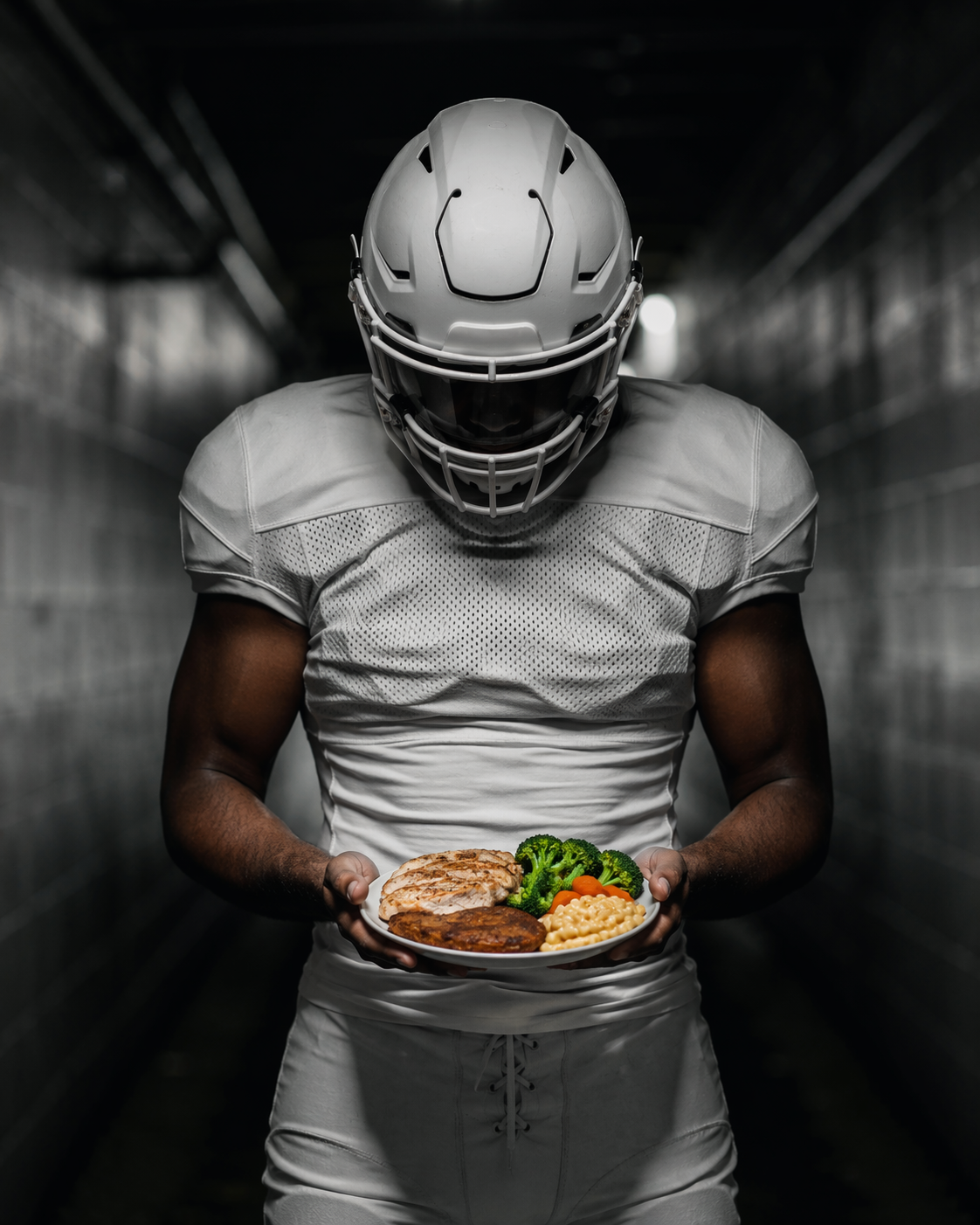
What Low Nutrition Knowledge Actually Means
Nutrition knowledge scores can sound abstract until the distinction between general and sport-specific knowledge is kept in view. General nutrition knowledge might involve recognizing food groups, broad nutrient roles, or the relationship between dietary patterns and health. Sport-specific nutrition asks a different kind of question: how intake should change around training, how carbohydrate availability affects repeated high-intensity work, what recovery timing can and cannot do, how hydration guidance changes with sweat losses, and when a supplement claim should trigger caution rather than confidence.
That is why the lower sport-specific score matters. A player can know that protein is relevant to muscle repair and still misunderstand how to distribute intake across a long day. An athlete can recognize that carbohydrates provide energy and still not connect carbohydrate timing with practice demands. A team can post general nutrition messaging and still leave the most consequential decisions to athletes who are moving between lifts, class, film, treatment, meetings, practice, and travel.
The scoping review matters here because it keeps the discussion from turning into a story about one group of athletes being unusually uninformed. Across the included studies, low sports nutrition knowledge appeared repeatedly, including work that addressed football-specific athlete samples.[2] The pattern points to a system-level problem: the knowledge needed for performance nutrition is specialized, but access to specialized interpretation is uneven.
The Barriers Are Not Just Attitude Problems
It is easy, and usually lazy, to translate low knowledge scores into a lecture about athlete responsibility. The better evidence asks what gets in the way of eating well. Brauman and colleagues identified five significant barriers to healthy eating among collegiate athletes: lack of time, easy access to unhealthy foods, cost of healthy foods, lack of nutrition knowledge, and lack of cooking skills.[3]

Those barriers are not interchangeable. Time pressure changes when an athlete can eat. Food access changes what is convenient. Cost changes what is realistic. Cooking skill changes whether a grocery list can become meals. Knowledge changes whether the athlete can adapt when the ideal option is unavailable. When all five appear together, the athlete is not simply choosing poorly; the athlete is operating inside a constrained food environment.
| Barrier identified in collegiate athletes | Why it matters for football nutrition support |
|---|---|
| Lack of time | Fueling decisions get compressed between training, class, treatment, meetings, and travel. |
| Easy access to unhealthy foods | The most available option may not match recovery or body composition goals. |
| Cost of healthy foods | Recommendations that ignore budget become less usable. |
| Lack of nutrition knowledge | Athletes may not know how to adjust intake when schedules, training loads, or food options change. |
| Lack of cooking skills | Even appropriate food access may not translate into consistent meals. |
Food insecurity is adjacent to this discussion and should not be treated as a footnote in athlete health. Available estimates for food insecurity among college football players range widely, from 19% to 63%, depending on institution and methodology. That range is too broad to support a single prevalence claim for all programs, but it is enough to warn against assuming that every athlete has stable access to the foods a nutrition plan prescribes.
For staff, the practical consequence is that education cannot be the only intervention. A nutrition talk may raise awareness, but it does not create time, lower food prices, improve dining availability, or teach cooking by itself. Assessment has to include the conditions under which the athlete is being asked to act.
Where AI Enters the Problem
AI becomes interesting in this setting because the need is larger than many staffs can handle manually. Athletic departments may want more frequent intake data, faster summaries, better tracking of meal patterns, and easier calculation of structured targets. Those are real workflow problems. They are also different from asking a model to function as a sports dietitian.
The current evidence does not support a clean answer to whether AI is “good” at sports nutrition. Solomon and Laye tested ChatGPT, Gemini, and Claude on sports nutrition knowledge, and accuracy ranged from 31% with ClaudePro using simple prompts to 89% with Claude3.5Sonnet on certification exam questions.[4] That spread is the finding. Model choice, prompt type, and question domain changed performance enough that any broad claim about AI nutrition accuracy becomes unstable.
The same study found stronger performance on structured macronutrient and timing questions and weaker performance on hydration, energy availability, and supplements.[4] That pattern fits what many clinicians would expect. Formula-like tasks are easier to constrain. Clinical judgment is harder to compress into a prompt.
The Tasks AI Can Credibly Support
The most credible use case is not autonomous advice. It is structured support inside a supervised workflow. If an athlete records intake, an AI-assisted tool may help organize entries, flag missing meals, estimate macro totals, or compare a recorded day with pre-set targets. If a dietitian has already established a carbohydrate periodization framework, a tool may help calculate what a lower-, moderate-, or higher-carbohydrate training day would require. These uses are not trivial; they reduce clerical friction and can make follow-up more efficient.
Macronutrient calculation is a useful example because the task has visible boundaries. The athlete’s body mass, training goal, phase of season, and dietitian-selected target range can be entered. The output can be checked against a formula. Errors are easier to audit. A model is not deciding whether the athlete’s fatigue reflects low energy availability, illness, intentional restriction, schedule disruption, or a mismatch between training load and intake. It is helping perform arithmetic and organization.
Carbohydrate periodization sits in a similar but slightly more complex category. The tool can help align planned carbohydrate intake with training-day categories when those categories are set by a professional. The clinical work still sits upstream: deciding which athletes need which targets, how goals interact with body composition pressures, and when a pattern that looks efficient on paper is becoming risky in practice.

This is the same distinction that appears across other AI-in-sports-medicine discussions: the tool may scale measurement or pattern recognition, while professional judgment remains responsible for interpretation. Readers tracking this broader area may see a parallel in AI-assisted rehabilitation for sports injuries, where the evidence question also turns less on novelty and more on which decisions the technology is actually qualified to support.
The Tasks That Still Need Clinical Judgment
Hydration guidance is not just a matter of telling athletes to drink more. Sweat rates, environment, body size, training duration, acclimatization, gastrointestinal tolerance, sodium losses, and medical history can all affect what appropriate guidance looks like. Solomon and Laye’s weaker AI performance in hydration questions is therefore not a minor inconvenience; it is a warning about a domain where confident generic advice can mislead.[4]
Energy availability is even less suitable for unsupervised model output. Assessing it requires more than comparing intake with expenditure. A dietitian has to consider training load, weight history, symptoms, menstrual function where relevant, injury patterns, intentional restriction, appetite, food access, and the athlete’s relationship with body composition expectations. In football, where position demands and body-size pressures vary, a surface-level answer can miss both underfueling and inappropriate overcorrection.
Supplement safety belongs in the same caution category. A model may summarize a common ingredient or repeat a general claim, but that is not the same as evaluating contamination risk, banned-substance concerns, medical contraindications, dosage, third-party testing, or whether the supplement is being used to compensate for a solvable food problem. The evidence that large language models can answer some exam-style sports nutrition questions does not make them reliable supplement gatekeepers.
Individualized behavior change is also easy to underestimate. If an athlete lacks time, affordable food access, nutrition knowledge, and cooking skills, the next step is not simply a more detailed recommendation. The next step may involve changing meal timing around the team schedule, coordinating with dining services, building a low-prep food plan, identifying what the athlete can actually buy, or deciding when medical referral is needed. Those are care-process decisions, not content-generation tasks.
A Better Assessment Workflow
A credible AI-assisted workflow for college football nutrition would start with narrower permissions. The tool can collect and structure data before the appointment, but it should not diagnose the nutrition problem or prescribe individualized clinical guidance on its own.
- Collect: food logs, meal timing, missed meals, supplement use, training-day context, and athlete-reported barriers.
- Structure: organize entries into a reviewable format, identify incomplete data, and separate weekday, travel, and competition-day patterns.
- Calculate: estimate macronutrient totals or compare intake with dietitian-selected targets where inputs are clear.
- Flag: surface issues that require human review, such as recurring missed meals, supplement use, possible underfueling indicators, or hydration concerns.
- Escalate: route interpretation, counseling, risk assessment, and plan changes to a registered dietitian or qualified clinical professional.
The value of that workflow is not that AI knows more than the dietitian. It is that the dietitian spends less time cleaning up scattered information and more time on the work that requires judgment. In a program with limited staff capacity, that difference can matter.
The workflow also respects what the nutrition knowledge data are actually saying. If athletes score poorly on sport-specific nutrition knowledge, programs need better systems for assessment and follow-through, not just more information pushed at athletes. A model that summarizes a food log may help. A chatbot that confidently answers a supplement question without context may create a new problem while appearing to solve the old one.
The Evidence Boundary
There is also a direct evidence gap: no studies in the materials reviewed here have tested an AI-powered nutrition intervention specifically in a college football population. The AI evidence comes from broader sports nutrition question-answering and related athlete contexts, not from a football team implementation showing improved intake, recovery, health, or performance outcomes.
That matters because college football has its own constraints. Roster size, position-specific body demands, travel, team meals, summer training, scholarship status, dining access, and staff availability all shape what nutrition support can realistically do. A tool that performs well on structured prompts may still fail when the hard part is getting accurate intake data from a tired athlete with limited time and inconsistent food access.
The evidence supports a modest boundary. College football athletes face a documented nutrition knowledge gap, especially in sport-specific concepts, and the major barriers include time, access, cost, knowledge, and cooking skills. AI can help collect, structure, and calculate parts of assessment when a qualified professional defines the task and reviews the output. It cannot yet carry the interpretive responsibility involved in energy availability, hydration risk, supplement safety, or individualized behavior change.
That leaves AI in a copilot role. It may help athletic programs scale certain assessment tasks, particularly where staff capacity is thin. But the nutrition challenge in college football is not just an information gap, and current evidence does not support replacing registered dietitians or treating large language model output as individualized clinical guidance.
References
- What Should Be on Your Plate? Study Shows Student-Athletes Don’t Know, UConn Today, 2025.
- Sports nutrition knowledge of athletes: a scoping review, PubMed Central, 2025.
- Barriers to healthy eating in collegiate athletes, PubMed, 2023.
- Artificial intelligence in sports nutrition: Comparing ChatGPT, Gemini, and Claude on sports nutrition knowledge, PLOS ONE, 2025.
Comments
Join the discussion with an anonymous comment.