
The 2026 Cyclospora outbreak is a poor setting for the usual reassurance that consumers can wash risk away. As of CDC’s July 14 Health Alert Network advisory, 1,645 confirmed cyclosporiasis cases had been reported across 34 states, and the food vehicle had not been identified; CDC also noted that case counts were preliminary and could rise because of reporting lag.[1] That combination matters: a large, multistate outbreak with an unidentified source leaves investigators, produce firms, clinicians, and exposed consumers dealing with contamination that has already moved through the chain.
The immediate question behind preventing cyclospora contamination in produce is therefore not whether rinsing has any value. Rinsing can remove visible soil, reduce some surface material, and support ordinary food-handling hygiene. The harder question is whether routine washing or common chemical sanitizers can be treated as a dependable kill step for Cyclospora cayetanensis oocysts. CDC’s consumer prevention language remains cautious, and FDA’s Cyclospora action plan is blunter: typical chemical treatments used on farms are not effective against the parasite, and farmers have limited options once contamination occurs.[2][3]
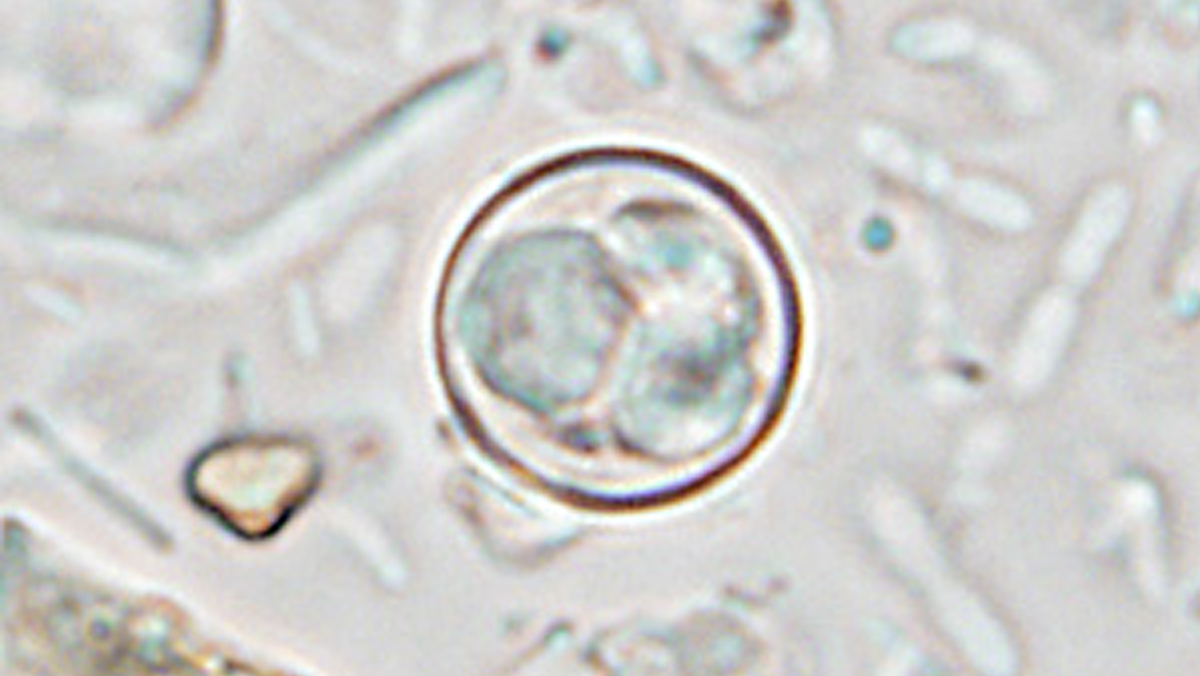
Washing Is Not the Same as Inactivation
Cyclospora control gets muddled when removal, recovery, detection, and inactivation are treated as interchangeable. They are not. A method that improves laboratory recovery of oocysts from produce is not automatically a prevention method. A sanitizer that helps with general microbial quality is not automatically effective against a parasite oocyst. A rinse that reduces debris is not evidence that the remaining produce is safe.
Chandra, Torres, and Ortega’s 2014 work belongs in that distinction. Their study evaluated wash solutions such as Alconox and HCl-pepsin for recovering Cyclospora oocysts from produce for diagnostic purposes. That is useful for detection workflows; it does not establish that these washes eliminate oocysts from foods people eat.[4] The distinction is operational, not semantic. A produce company deciding whether it can rely on a wash step needs inactivation evidence. A laboratory trying to find oocysts on a difficult matrix needs recovery evidence.
This is why the outbreak’s unidentified vehicle should not be turned into a whodunit at the expense of prevention. If early signals point toward a category such as leafy greens but remain unconfirmed, the correct conclusion is narrow: the vehicle has not been established. The broader lesson is already visible. When the contaminated item cannot be traced quickly and the organism is not reliably neutralized by end-stage washing, prevention has to begin before the product reaches a sink, a salad spinner, or a finished-food line.
Where Controls Can Actually Operate
The useful control map is not consumer versus industry. It is contamination prevention before harvest, validated inactivation where the commodity allows it, and carefully bounded post-harvest technologies where processing conditions are compatible with the food. That map also keeps expectations honest: many fresh produce outbreaks involve foods intended to be eaten raw, so the most robust kill steps may be unavailable for the products of greatest concern.

| Point in the chain | Control with current support | What the evidence permits | Main limitation |
|---|---|---|---|
| Before harvest | Agricultural water quality management and worker sanitation | Prevents introduction or spread of contamination where later removal is unreliable | Once contamination occurs, farmers have limited effective chemical options |
| Cooking or heat-compatible processing | Heat at or above 70°C | Kills Cyclospora oocysts under studied conditions | Not applicable to many raw produce items |
| Deep-freezing research context | −70°C freezing | Stops sporulation under studied conditions | Not equivalent to ordinary refrigeration or typical frozen-food handling |
| Cold storage | 4°C refrigeration | Does not provide reliable inactivation | Useful for quality and some food-safety purposes, but not a Cyclospora kill step |
| Selected post-harvest processing | High-pressure processing, irradiation, and emerging chemical approaches | Promising under specific experimental conditions | Evidence depends on surrogates or indirect viability endpoints |
Before harvest: water and sanitation carry more weight than the final rinse
FDA’s Cyclospora Prevention, Response and Research Action Plan places heavy emphasis on prevention because the agency recognizes how few effective options remain after contamination is present. The plan identifies agricultural water and worker hygiene as central control areas and states that typical chemical treatments used on farms are not effective against Cyclospora.[2] That is a consequential admission for quality assurance teams: a post-contamination chemical rescue step cannot be assumed.
The logic is straightforward. If oocysts reach irrigation water, wash water, harvest containers, hands, equipment, or the field environment, later controls must either remove them, detect them, or inactivate them. For Cyclospora, each of those verbs carries uncertainty. Prevention at the water and worker-sanitation stage is not glamorous, but it is one of the few places where action can occur before the parasite is attached to a delicate raw commodity.
Temperature: one of the clearest controls, with a narrow use case
Sathyanarayanan and Ortega’s temperature work is unusually useful because it gives concrete thresholds. In their study, temperatures at or above 70°C killed oocysts, −70°C stopped sporulation, and 4°C refrigeration did not inactivate the organism.[5] For produce that will be cooked, heat can be a real kill step. For refrigerated herbs, berries, leafy greens, or prepared salads eaten raw, that finding mostly clarifies what refrigeration cannot do.
The −70°C finding also needs careful handling. It shows that extreme freezing can stop sporulation under studied conditions; it should not be casually translated into a household freezer recommendation or a general frozen-produce control claim. The point is not that temperature is irrelevant. It is that temperature only helps when the actual product, process, and endpoint match the evidence.
The Surrogate Problem Runs Through Every Technology Claim
Cyclospora evidence is constrained by a basic laboratory problem: C. cayetanensis cannot be reliably cultured, and the field lacks a dependable animal model, in vitro culture system, and direct viability assay. Reviews of the parasite and federal gap analyses repeatedly identify this as a central barrier to intervention validation.[6][7] As a result, many studies use surrogate organisms such as Eimeria acervulina or rely on sporulation-based endpoints. Those approaches can be informative. They are not the same as directly proving infectious C. cayetanensis has been eliminated from a commercial produce item.
That limitation does not make all intervention studies useless. It changes the strength of the claim. The strongest practical question is not “does this technology kill Cyclospora?” but “under these conditions, using this surrogate or endpoint, is there evidence consistent with inactivation, and can those conditions be placed in a real produce supply chain without damaging the product or creating a new feasibility problem?”
High-pressure processing: plausible for some products, not a universal produce answer
Kniel and colleagues tested high-pressure processing against Eimeria acervulina as a surrogate on raspberries and basil. The study reported efficacy at 550 MPa at 40°C for 2 minutes under the tested conditions.[8] That is a meaningful experimental result because it involves produce matrices that matter for Cyclospora risk discussions. It still remains a surrogate study, and HPP feasibility depends on product tolerance, packaging, texture, cost, and where the process would fit.
For a QA team, the right takeaway is conditional. HPP may be worth evaluating for specific commodities or prepared products that can tolerate pressure treatment. It should not be described as a replacement for agricultural water controls, field sanitation, or traceability, particularly for fresh items sold with minimal processing.
Gamma irradiation: evidence of efficacy, with adoption questions outside the endpoint
Lee and Lee’s gamma irradiation work found efficacy at doses of at least 1.0 KGy in the studied model.[9] The result supports irradiation as a candidate inactivation approach. It does not resolve product-specific quality effects, regulatory permissions, consumer acceptance, facility access, or whether the tested endpoint maps cleanly onto infectious C. cayetanensis on every produce matrix.
That distinction matters because adoption is often mistaken for effectiveness, and effectiveness under experimental conditions is often mistaken for deployability. Irradiation may be part of the control discussion for certain products and markets. It is not evidence that the produce sector can simply irradiate its way out of Cyclospora prevention.
Magnesium oxide nanoparticles: early laboratory signal, not a field control
Hussein and colleagues evaluated magnesium oxide nanoparticles and reported significant reduction in sporulation in laboratory studies.[10] This is best read as emerging chemical-control research, not as an available farm or packinghouse intervention. Sporulation reduction is a relevant endpoint, but it remains indirect, and the research does not by itself establish commercial produce safety, residue acceptability, field performance, or routine operational use.
The temptation with nanoparticles is to let novelty stand in for validation. Cyclospora is exactly the wrong organism for that shortcut. Without direct culture and viability tools, every promising result needs a careful account of organism, matrix, endpoint, and deployment conditions before it becomes a control recommendation.
What the 2026 Outbreak Exposes
The July 2026 CDC alert does not identify a source, and that uncertainty should stay visible rather than be filled with confident guesses.[1] CIDRAP’s contemporaneous coverage likewise emphasized how much remained unknown about the outbreak, including the vehicle.[11] For clinicians, that means cyclosporiasis has to stay on the differential when patients present with compatible illness and exposure histories during outbreak periods. For public health teams, it means case interviewing and traceback must proceed without the shortcut of a known commodity. For industry, it means a final-product rinse cannot be the main defense.
Consumer-facing coverage can help people understand the outbreak, but it also tends to arrive at the point where the consumer has the least control. Advice to rinse produce, avoid visibly damaged items, and follow public health alerts is reasonable as far as it goes. It should not be allowed to imply that household action can compensate for contaminated agricultural water, inadequate sanitation, or a supply chain that cannot quickly identify the vehicle.[12]
The same boundary applies to surveillance technology. Better outbreak detection and communication can shorten the time from scattered illnesses to a recognized signal. Adjacent work on AI-powered wastewater surveillance, Cyclospora tracking gaps, and AI education tools belongs beside, not instead of, prevention. Detection after exposure is valuable, but it is not a kill step.
A Multi-Hurdle Control Standard
Preventing Cyclospora contamination in produce is not waiting for a stronger wash instruction. The current evidence supports a layered standard: reduce the chance that oocysts enter the field or handling environment; maintain agricultural water and worker-sanitation controls because later chemical rescue is weak; use heat where the product is meant to be cooked; avoid treating refrigeration as inactivation; and evaluate post-harvest technologies only where the tested organism, endpoint, matrix, and process conditions justify the claim.
The unresolved research gaps are not academic footnotes. Until C. cayetanensis can be cultured or measured with a reliable viability system, intervention claims will continue to rest on surrogates and indirect endpoints. That is enough to guide cautious development of HPP, irradiation, and other tools. It is not enough to let the produce system pretend that the final rinse is a backstop.
References
- CDC Health Alert Network 00531. Centers for Disease Control and Prevention. July 14, 2026.
- Cyclospora Prevention, Response and Research Action Plan. U.S. Food and Drug Administration.
- Preventing Cyclosporiasis. Centers for Disease Control and Prevention.
- Chandra, Torres & Ortega (2014) on wash solution efficacy for oocyst recovery.
- Sathyanarayanan & Ortega (2006) on temperature inactivation.
- Cyclospora cayetanensis and Cyclosporiasis: An Update. Almeria, Cinar, Dubey. 2019.
- NACMCF 2023 knowledge gaps report.
- Kniel et al. (2007) on HPP surrogate study on raspberries and basil.
- Lee & Lee (2001) on gamma irradiation.
- Hussein et al. (2018) on MgO nanoparticles.
- What we truly know about the huge US Cyclospora outbreak—and what we don’t. CIDRAP. July 2026.
- Cyclospora Outbreak 2026: What Consumers Need to Know. Consumer Reports. July 2026.
Comments
Join the discussion with an anonymous comment.