
The public health response to rabid bat exposure in the United States has a strong center: identify a credible exposure quickly, test the bat when possible, and use postexposure prophylaxis before symptoms begin. CDC guidance for rabies PEP is explicit that people who have never been vaccinated should receive wound care, human rabies immune globulin, and a four-dose vaccine series; for bat encounters, public health assessment treats any direct contact as potentially relevant unless the bat tests negative or the circumstances make exposure implausible.[1]
That framework is one reason human rabies remains rare in the United States. It is also why recent bat-associated deaths are so uncomfortable to read. In 2021, three U.S. rabies deaths were reported after bat encounters in Idaho, Illinois, and Texas; in 2024, two more were reported in Minnesota and California. Across those five cases, the encounters were not all hidden mysteries. The recurring problem was that recognized bat contact did not become timely PEP: risk was not understood, a bite was not perceived, or vaccination was declined despite exposure concern.[2][3]

That is the practical contradiction. The system has a defensible clinical-public health frame, but the event that matters to the exposed person may feel too minor, too ambiguous, or too embarrassing to trigger a call. A bat in a bedroom, a small mark, a brushed hand, a confused account from a child or a sleeping adult: these are not dramatic scenes. They are ordinary handoffs, and rabies prevention depends on whether the handoff works.
What the U.S. System Is Built to Do
ACIP-style rabies response starts with exposure assessment rather than panic. The question is not whether every bat is rabid, or whether every person near a bat needs vaccine. The question is whether saliva or neural tissue from a potentially rabid animal could have entered a wound or mucous membrane, and whether the animal can be tested fast enough to avoid unnecessary PEP.
Bats make that assessment harder than larger mammals. Direct contact matters even when a bite is not obvious, because bat bites can be small and go unnoticed. CDC guidance does not require a minimum duration of contact before an encounter becomes worth evaluating. If there was direct bat contact and the bat is unavailable for testing, public health officials generally have to treat the uncertainty seriously.[1]
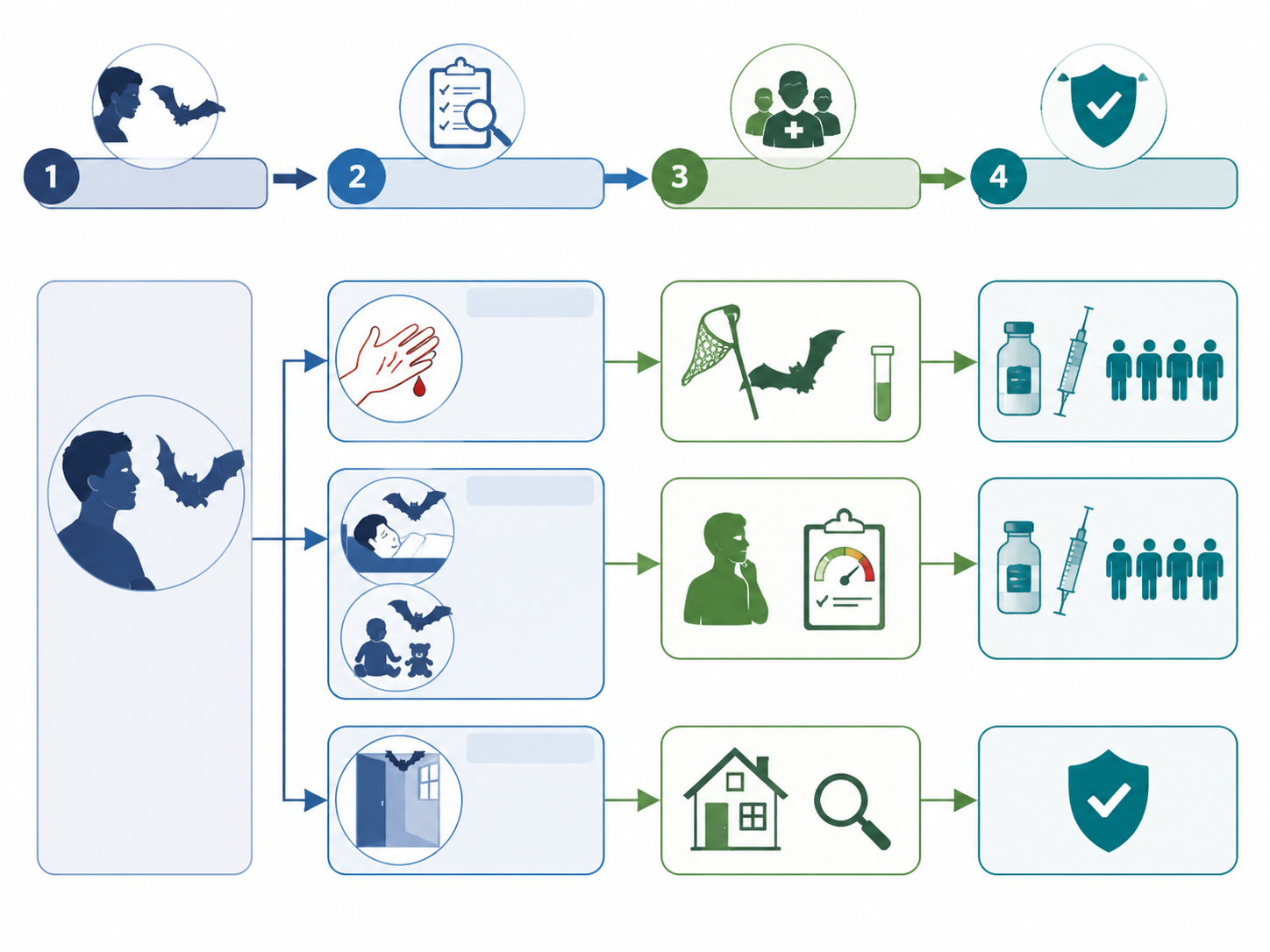
| Encounter pattern | Operational question | Why it is difficult |
|---|---|---|
| Clear bite or scratch from a bat | Can the bat be tested, and should PEP begin while results are pending? | The clinical risk is easier to explain, but delays still occur if the person does not know rabies prevention is urgent. |
| Direct contact without a visible bite | Could saliva have contacted broken skin or mucous membranes? | The person may remember touching the bat but not interpret the contact as an exposure. |
| Possible contact that cannot be reconstructed | Was the person asleep, impaired, very young, or unable to give a reliable history? | The decision often depends on incomplete accounts, not a clean witness statement. |
| Bat nearby but no direct contact | Is there any credible route for exposure? | Public messaging has to avoid both false reassurance and unnecessary alarm. |
The surveillance picture shows that this machinery is used often. CDC reports that about 1.4 million people in the United States seek care each year for possible rabies exposure, about 100,000 receive PEP, and fewer than 10 die of rabies annually. In 2020, approximately 24,000 bats were tested, with 1,401 confirmed positive, or 5.8%.[4]
Those figures should temper any claim that the U.S. rabies system is broadly broken. Many people do seek care. Animals are tested. PEP is given frequently. Human deaths remain rare. The failures that matter are narrower and more stubborn: a person does not recognize an exposure, a clinician or hotline message does not land, a bat is released before testing, or a local agency faces a complicated exposure cluster without a practiced protocol.
The Recent Deaths Point to a Communication Failure, Not a Mystery Pathogen
The 2021 MMWR report is useful because it does not need embellishment. Three people died in August 2021 after bat-associated rabies exposures. The report identified missed prevention opportunities: people either did not recognize the exposure as a rabies risk, did not seek PEP, or declined vaccination. The report also emphasized that bites can be difficult to detect.[2]
The 2024 Minnesota and California cases, reported later by CDC, repeat the same uncomfortable pattern. They were not evidence that PEP had stopped working. They were evidence that PEP was not used in time. The relevant public health question is therefore upstream of vaccine effectiveness: how did a recognizable bat encounter fail to become an urgent exposure assessment?[3]
That distinction matters. If a health department treats every bat story as a reason for blanket alarm, it will waste vaccine, money, staff time, and public trust. If it treats uncertain bat contact as too trivial, it may miss the narrow window in which rabies is preventable. Good response lives in the middle, where the investigator asks enough precise questions to separate proximity from exposure and still moves quickly when direct contact cannot be ruled out.
Mass Bat Exposure Events Are Where Clarity Thins Out
Individual exposure assessment is hard enough. A mass bat exposure event adds time pressure, crowd dynamics, inconsistent memories, and a public messaging problem. A bat found in a camp cabin, school, dormitory, workplace, shelter, or other shared indoor space can produce dozens of calls before anyone knows who had direct contact, who was asleep, who saw the bat, whether the bat was captured, and whether the exposure window can be narrowed.

The best national evidence on state practice variation remains a 2016 survey by Hsu and colleagues. That age has to stay visible: it does not prove what every state is doing in 2026. But it is still the most directly relevant national look at mass bat exposure preparedness identified in the evidence base. In the survey of 45 state health agencies, 69% said ACIP guidelines were unclear for mass bat exposure event investigations, and only 7% reported having an MBE-specific protocol.[5]
The same survey showed how much local experience can shape response. Agencies categorized as experienced reported receiving 16.9 MBE-related calls per year, compared with 1.2 among inexperienced agencies. Forty percent of responding agencies said they would recommend PEP for any exposure regardless of timing.[5] That is not a small difference in interpretation at the margins; it is the kind of variation that changes who gets interviewed, who gets reassured, who gets referred, and how much vaccine is used.
This is where a clean national recommendation can run out of operational detail. ACIP guidance tells responders how to think about rabies exposure and PEP. It does not, by itself, answer every mass-event question a local team faces after hours: who drafts the public notice, how to triage hundreds of potentially exposed people, what script to use when parents or employees call, how to handle people who slept in the same room on different nights, or when to stop expanding the contact list.
A mass-event protocol does not need to replace expert judgment. It should make judgment usable when the phone is ringing. At minimum, it should define who leads the investigation, how exposure categories are documented, when animal testing changes recommendations, how clinicians receive consistent PEP guidance, and what language the public receives about direct contact, uncertain contact, and no known contact.
The Burden Is Not Only Clinical
Large contact investigations are labor events before they are vaccine events. The imported rabies case involving Kentucky and Ohio in 2024 was canine rabies associated with Haiti, not bat rabies, so it should not be treated as a bat-exposure model. Its value here is narrower: it shows the scale that rabies contact assessment can reach. Investigators assessed 709 contacts, recommended PEP for 60 people, and reported that 88% of contacts were healthcare workers.[6]
That burden lands on local and state teams that may not see mass bat exposure events often. A department can be competent and still be underprepared for a rare event that requires rapid interviewing, consistent risk classification, animal testing coordination, clinician consultation, and public communication. Preparedness is not just having the ACIP document bookmarked. It is having a process that a tired team can actually run.
The same system-preparedness issue appears in other parts of public health surveillance. Discussions about digital modernization often focus on advanced tools, but adoption remains uneven; one related analysis, Is AI Transforming Public Health Surveillance?, notes the gap between technical possibility and agency-level uptake. Rabies response is more concrete, but the lesson is similar: a tool or guideline only matters if the receiving system can use it under pressure.
What Public Messages Need to Accomplish
Public messaging about bats has to carry an awkward balance. Rabies is nearly always fatal after symptoms begin, but an individual bat encounter is not automatically a rabies exposure. The message has to be urgent enough to prompt evaluation and restrained enough to preserve credibility.
Communication research offers a useful clue. In a PLOS ONE study of 521 participants, Lu and colleagues found that messages acknowledging bats’ ecological value while also explaining rabies risk increased intentions to follow rabies guidance compared with risk-only messages.[7] That finding should not be overread as proof that a specific flyer prevents rabies deaths. It does suggest that people may respond better when public health does not frame bats only as a threat.
A practical message does several things at once. It tells people not to handle bats. It tells them to safely capture or contain the bat for testing if possible and if this can be done without further exposure. It explains that a bite may be too small to notice. It distinguishes being in the same general area from direct or uncertain contact. It gives a specific route to public health evaluation instead of leaving people to decide alone whether the encounter was serious.
For mass exposure events, the audience also needs to know what will happen next. People are more likely to cooperate when they understand why some individuals are interviewed in detail, why others are not recommended for PEP, why animal testing matters, and why recommendations may change if the bat tests negative. Ambiguity creates its own workload: every unclear sentence becomes another call, another rumor, or another person who waits too long.
Where the Response Needs Sharper Edges
The evidence does not support a sweeping claim that U.S. rabies prevention is failing. It supports a more specific judgment. The backbone is sound: ACIP PEP guidance gives a defensible exposure framework, CDC surveillance shows extensive testing and frequent PEP use, and human deaths remain rare.[1][4] The weak points appear where uncertainty has to be converted into action.
- Mass bat exposure guidance needs more operational detail, especially for triage, documentation, public notification, and stopping rules.
- State and local agencies need protocols that translate national recommendations into after-hours workflows.
- Clinicians and public health staff need consistent language for direct contact, uncertain contact, and situations where a bite cannot be ruled out.
- Public messages should make minor or inapparent bat bites understandable without turning all bat proximity into exposure.
- Communication should preserve the ecological reality that bats are valuable while making rabies evaluation feel urgent when contact occurs.
The 2016 survey cannot be used as a current scorecard for 2026 readiness. Some jurisdictions may have improved their protocols, training, and communication since then. But unless newer national evidence shows otherwise, its central warning remains hard to dismiss: mass bat exposure events were being handled under uneven interpretations of guidance, and many agencies did not have event-specific protocols.[5]
That is where preventable mortality can persist inside an otherwise mature system. Rabies prevention depends on vaccine, immune globulin, laboratories, surveillance, and guidance. It also depends on whether a person who brushed a bat away at night understands that the encounter deserves a call, and whether the person answering that call has a protocol clear enough to act on.
References
- Rabies Post-exposure Prophylaxis Guidance, CDC
- Human Rabies — United States, 2021, MMWR, CDC, April 1, 2022
- Human Rabies — Minnesota and California, 2024, MMWR, CDC, 2026
- Rabies in the United States: Protecting Public Health, CDC
- Perceptions and Practices of Mass Bat Exposure Events, Zoonoses and Public Health, 2016
- Imported Human Rabies — Kentucky and Ohio, 2024, MMWR, CDC, 2026
- Bats and Rabies: The Role of Risk Perception, Knowledge, and Message Framing in Influencing Preventive Behaviors, PLOS ONE, 2016
Comments
Join the discussion with an anonymous comment.