When pediatric clinicians are asked about AI screen-time policies in schools, the question usually arrives as a duration question: how many minutes are safe, how many are too many, and whether artificial intelligence should be counted like video streaming, gaming, or social media. That framing is understandable. It is also too blunt for the evidence now emerging.
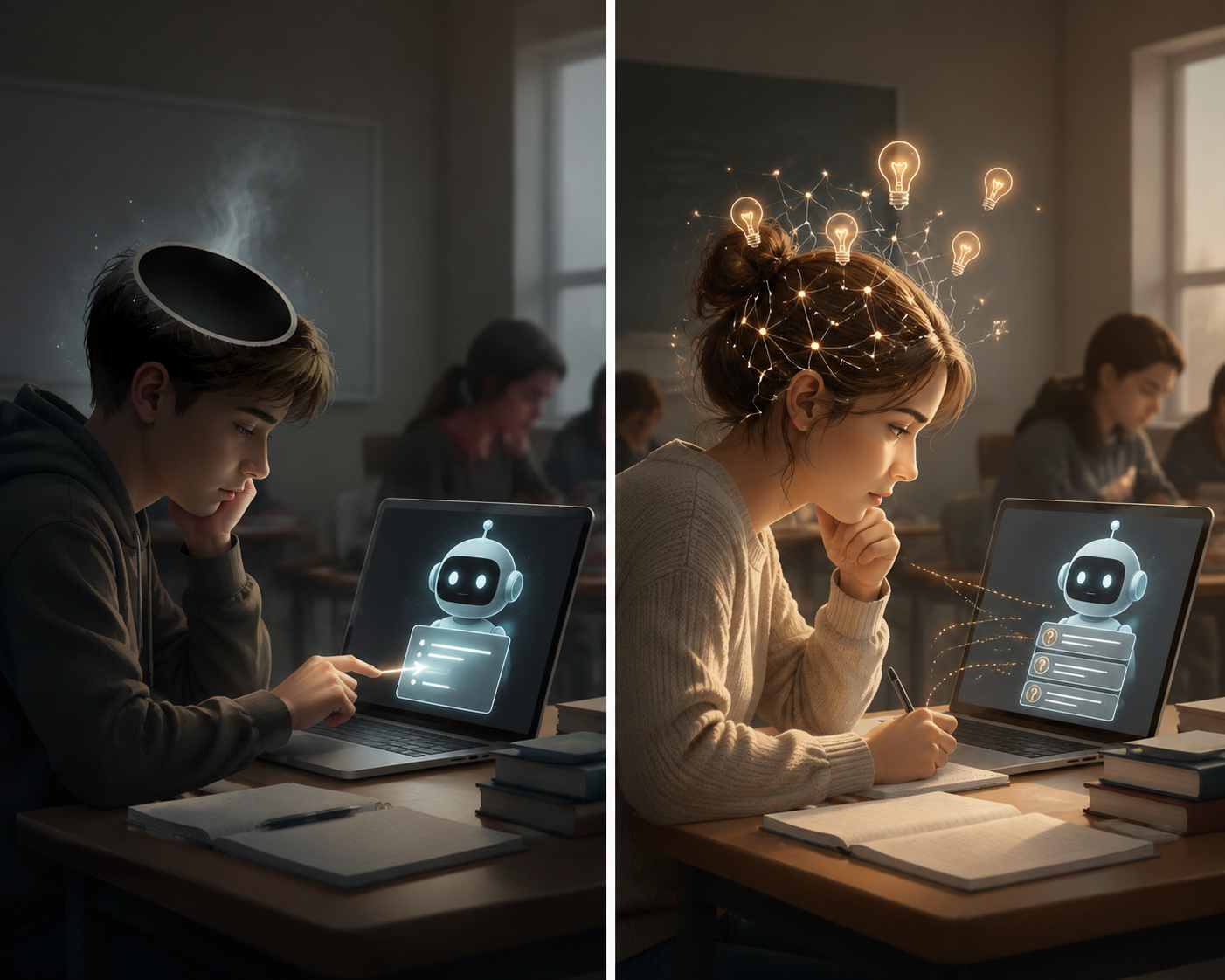
The more clinically useful question is what the student is doing cognitively while the AI is present. During skill-building, an AI system can remove the hard step by giving an answer, or it can preserve the hard step by forcing retrieval, reasoning, revision, and error correction. The same amount of device time can therefore represent very different developmental exposures.
The controlled study that makes duration look like the wrong variable
The strongest current evidence comes from a field experiment by Bastani and colleagues in high school mathematics. The study randomized about 1,000 Turkish high school students to one of three conditions: a control group, access to a GPT Base tool resembling unguarded ChatGPT, or access to a GPT Tutor tool built with teacher-designed guardrails. Students used the tools during practice, and the investigators then measured performance on an unassisted exam after the tool was removed.[1]
That last design choice matters. If the outcome had stopped at homework completion or practice accuracy, AI would have looked straightforwardly helpful. Students using GPT Base improved their practice scores by 48% relative to control. But when they later took an exam without AI, their scores were 17% lower than the control group. The students appeared to perform better while the tool was available and learned less in a way that became visible only when independent performance was tested.[1]
The GPT Tutor condition produced a different pattern. With pedagogical guardrails, students’ practice scores rose by 127%, and their unassisted exam scores were not significantly different from control. In other words, the harmful signal was not simply “AI exposure.” It appeared when the tool made it too easy to bypass the cognitive work that practice is supposed to require.[1]
| Study condition | What changed during practice | What happened when AI was removed |
|---|---|---|
| GPT Base | Practice scores increased by 48% | Unassisted exam scores decreased by 17% relative to control |
| GPT Tutor | Practice scores increased by 127% | Unassisted exam scores were not significantly different from control |
| Control | No AI tool during practice | Reference group for exam comparison |
For clinicians, the uncomfortable part of the finding is not that students used a chatbot. It is that assisted fluency could hide an emerging deficit. A student may look calmer, faster, and more accurate during practice while becoming less able to perform the same skill independently. That is the scenario a pediatrician, child psychiatrist, school nurse, or health officer can easily miss if the screening question is limited to grades, homework completion, or total screen minutes.

Why the unassisted outcome is the clinical signal
Learning tools often make performance look better before they make learning better. Calculators, answer keys, worked examples, and tutoring can all improve visible output during practice. The question is whether the learner is building a retrievable skill or merely producing a better artifact with external support. Bastani and colleagues separated those two possibilities by measuring both assisted practice performance and later unassisted exam performance.[1]
That separation is especially important in developmental settings because children and adolescents are still building the habits that later become independent study behavior. If a tool routinely supplies the next step before the student has attempted retrieval or reasoning, the student may experience less frustration and submit cleaner work. But the missing friction may be the very portion of practice that consolidates skill.
The GPT Tutor result prevents an overcorrection. It would be tempting to read the GPT Base finding as a case for simply reducing AI time. But the comparison group with guardrails used AI in the same general instructional context and did not show the same measured harm on the unassisted exam. The relevant distinction was not screen versus no screen; it was shortcut versus scaffold.[1]
A duration-only policy cannot see that difference. Thirty minutes of answer extraction during algebra practice is not cognitively equivalent to thirty minutes of guided hints that require the student to choose an approach, test it, and revise. Both may count as AI screen time. Only one preserves the learning step that the clinician should care about.
Adoption is rising, but surveys measure exposure and concern
The controlled mathematics experiment answers a narrow but important causal question. National survey data answer a different question: how common AI use has become and how young people feel about it. RAND’s American Youth Panel reported that 62% of U.S. youth ages 12 to 29 used AI for homework by December 2025, up from 48% in February 2025. The same report found that 67% believed AI harms critical thinking skills, up from about 57% ten months earlier.[2]
Those numbers are important for counseling because they show that AI homework use is no longer an edge case among adolescents and young adults. They also show that many young people share the concern adults are voicing. But the RAND data should not be made to carry more than they measure. A survey of use and beliefs does not establish cognitive impairment, and the panel’s age range does not directly capture the youngest elementary students who often sit at the center of screen-time legislation.[2]
The distinction matters in clinic. A teenager who believes AI may weaken critical thinking may be reporting a real risk, a moral concern absorbed from adults, an observation about classmates, or anxiety about school rules. That report deserves discussion. It is not the same kind of evidence as an unassisted learning outcome after random assignment.
Pediatric guidance has already moved away from counting minutes alone
The American Academy of Pediatrics’ 2026 policy statement on digital ecosystems is useful here because it reflects a broader clinical shift. Rather than returning to a fixed daily screen-time limit, the AAP emphasized a quality-based “5 Cs” framework: Child, Content, Calm, Crowding Out, and Communication. Reporting on the shift noted the difficulty of one-size-fits-all duration rules in a school environment where 90% of U.S. public schools have 1:1 devices.[3][4]
That does not mean time is irrelevant. Sleep displacement, physical inactivity, family conflict, and loss of offline peer interaction remain clinically meaningful. But AI in school adds a separate issue: the same device session may either crowd out thinking or structure it. A policy can cap minutes and still permit the student to outsource the central cognitive step during every permitted minute.
Families often prefer simpler levers because they are the levers available. Pew Research Center reported in October 2025 that 62% of parents said managing children’s screen time was a problem, while only 23% regularly used parental controls.[5] Those figures fit what clinicians often hear: parents want practical boundaries, but home monitoring tools are uneven, time-consuming, and poorly matched to school-assigned technology.
A pediatric conversation that only asks “How many hours?” may therefore feel reassuringly concrete while missing the school-based use parents cannot easily observe. A better screen history for AI asks what happens during homework: Does the student ask for the final answer? Does the system explain after the student attempts a solution? Are hints sequenced? Is the student required to show work? Does the teacher ever assess the skill without the tool?
What a scaffold has to preserve
The word “scaffold” is sometimes used loosely in education technology, but the Bastani comparison gives it practical content. A useful scaffold does not merely make the student’s answer look better. It controls when help appears, what kind of help is given, and whether the learner still has to generate the next move.
Harvard Graduate School of Education’s discussion of Ying Xu’s work makes a compatible, more conceptual point: AI can add to learning when it is designed to prompt reflection rather than simply provide answers.[6] That is not the same as a clinical outcome trial, and it should not be cited as proof that reflective AI improves long-term cognition. Its value is in naming the design direction that aligns with the controlled study: reflection, not replacement.
For a school health professional reviewing an AI tool, the relevant questions are not especially technical. They are instructional. Does the tool delay the answer long enough for retrieval? Does it ask the student to explain a choice? Does it respond to errors with prompts rather than substitution? Does it allow teachers to see whether the student repeatedly bypasses work? Does assessment include unassisted performance?
A tool that cannot answer those questions may still be useful for administrative tasks, accessibility support, brainstorming, or drafting under supervision. But during core skill acquisition, the burden of proof should be higher. The danger is not that AI appears on the screen. The danger is that it quietly removes the cognitive repetitions that instruction is supposed to protect.
The “cognitive stunting” metaphor is useful, but it is not a diagnosis
Brookings has proposed “cognitive stunting” as a way to think about AI-induced reductions in effortful thinking during childhood, drawing an analogy to pediatric monitoring of physical growth.[7] The phrase is attention-getting because it points to the right developmental worry: repeated loss of effortful thinking moments could plausibly affect the growth of independent critical thinking.
It also needs restraint. No current evidence demonstrates a longitudinal syndrome analogous to physical stunting from AI exposure. The Brookings framework is best treated as a hypothesis and monitoring lens, not a clinical label. Used carefully, it reminds educators and clinicians to look for lost opportunities to reason. Used carelessly, it can turn a plausible mechanism into a diagnosis before the developmental data exist.
That distinction is more than academic. Families already hear AI described as either a miracle tutor or a cognitive toxin. Neither framing helps a clinician decide whether a particular student’s use is harmful. The evidence supports a narrower and more useful judgment: AI is most concerning when it replaces the mental operations that practice is meant to strengthen, especially if the only outcomes being watched are assisted performance or completed assignments.
How clinicians can read school AI policies
Healthcare professionals are not usually the people drafting school procurement rules, but they are often asked to interpret the health and developmental implications. A duration cap may be administratively simple, and in some settings it may reduce crowding out of sleep, physical activity, or face-to-face interaction. For learning, however, duration is an incomplete proxy.
A more evidence-matched policy review asks three questions. First, when is AI introduced: before the student attempts the task, after an attempt, or only during revision? Second, what does the AI provide: a final answer, a worked solution, a hint, a question, or feedback on reasoning? Third, what outcome does the school measure when the AI is unavailable?
- If AI supplies answers during initial practice and the school measures only completed work, the policy is weakly aligned with the learning evidence.
- If AI provides sequenced hints, requires student reasoning, and preserves unassisted assessment, the policy is better aligned with the controlled findings.
- If AI is used for accessibility, translation, planning, or teacher feedback, the cognitive risk question may differ from the risk during skill acquisition.
- If a school reports only engagement, homework completion, or satisfaction, those outcomes should not be mistaken for independent learning.
This is where pediatric counseling can be concrete without becoming alarmist. A clinician can ask a family to bring examples of AI-assisted homework, not just a daily screen total. A school nurse can ask whether students are assessed without AI after AI-supported practice. A child psychiatrist evaluating school avoidance or anxiety can ask whether the student feels competent only when the tool is available. These are not policy prescriptions; they are better clinical questions.
What the evidence does not yet show
The evidence base is still young. The Bastani experiment is unusually informative because it used randomization, compared different AI designs, and tested unassisted performance. But it was conducted in Turkish high school mathematics with about 1,000 students and a specific generation of AI tool. It should not be generalized without caution to younger children, reading and writing instruction, special education, U.S. classrooms, or newer model architectures.[1]
RAND’s data show that AI homework use and concern about critical thinking are both widespread among surveyed youth, but they do not measure cognitive change directly.[2] The AAP’s 5 Cs framework reflects expert synthesis and a sensible move away from one-size-fits-all limits, but the framework itself is not a tested intervention.[3] The Brookings “cognitive stunting” concept identifies a plausible developmental concern, not a demonstrated longitudinal outcome.[7]
Those limits do not make the evidence unusable. They make the interpretation more precise. Current evidence is strong enough to say that duration-only AI screen time caps are poorly matched to the learning mechanism clinicians should be watching. It is not strong enough to assign a universal safe number of AI minutes, diagnose AI-related cognitive stunting, or assume that all AI-supported schoolwork has the same developmental meaning.
The practical standard is therefore simple but demanding: when AI is used during skill-building, ask whether it replaces retrieval, reasoning, and error correction, or whether it is structured to preserve those steps. The answer matters more than the clock.
References
- Generative AI without guardrails can harm learning: Evidence from high school mathematics, PNAS, 2025.
- RAND Research Report RRA4742-1, RAND Corporation, December 2025.
- Digital Ecosystems: Children and Adolescents Policy, Pediatrics, 2026.
- New AAP Screen Time Recommendations Focus Less on Screens, More on Family Time, EdSurge, February 5, 2026.
- How Parents Manage Screen Time for Kids, Pew Research Center, October 8, 2025.
- AI Can Add, Not Just Subtract, From Learning, Harvard Graduate School of Education, April 2026.
- Is it time to measure cognitive stunting?, Brookings.
Comments
Join the discussion with an anonymous comment.