
The most useful answer to “recommended daily coffee intake for heart health” does not start with antioxidants, roasting folklore, or another soft-focus claim that coffee drinkers seem to do well. It starts with a more unusual sequence: a hypothesis-free machine-learning search across three long-running cardiovascular cohorts pulled coffee into view, and a later randomized trial tested a clinically adjacent question rather than leaving the signal stranded in observational nutrition literature.
That distinction matters. Coffee is an everyday exposure, so even a small cardiovascular association can look important. It is also an exposure wrapped in habits, income, diet, sleep, smoking history, medication use, and self-report error. The claim deserves attention only if the evidence survives more than one evidentiary gate.
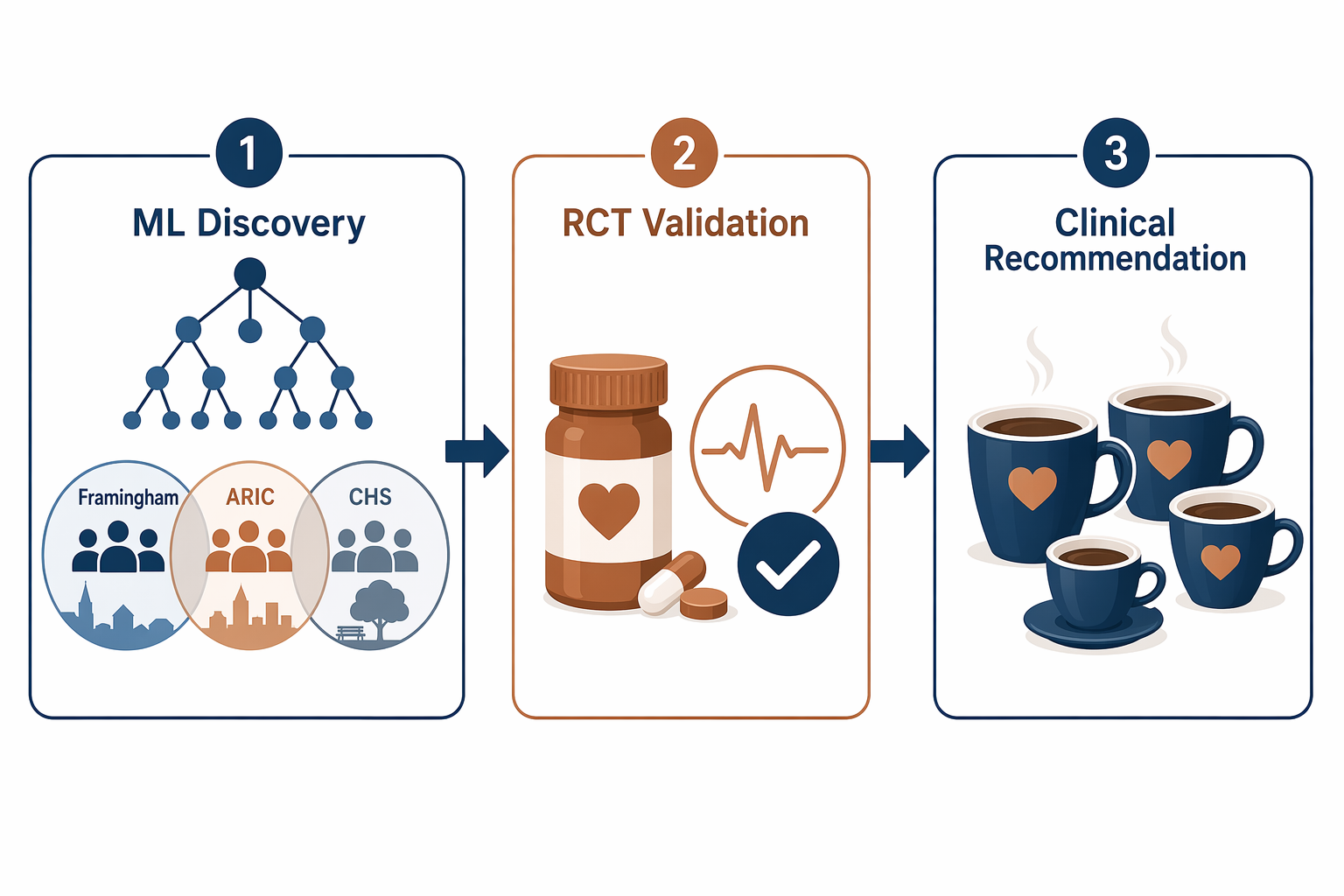
The Signal Was Not Preselected
The load-bearing study is Stevens et al., published in Circulation: Heart Failure in 2021. The investigators used random forest modeling with 10-fold cross-validation repeated five times across 204 variables in three major cohorts: the Framingham Heart Study, ARIC, and the Cardiovascular Health Study. The sample sizes were 2,071 in Framingham, 11,274 in ARIC, and 4,480 in CHS. Coffee emerged among the top dietary predictors associated with incident heart failure risk rather than being inserted as the favored exposure from the start.[1]
That does not make the model causal. Random forests can rank variables, handle nonlinearities, and expose patterns that conventional variable-by-variable thinking may miss. They do not erase confounding, fix exposure measurement, or transform cohort associations into prescriptions. Still, the way coffee surfaced is worth taking seriously because it was not merely a statistical decoration placed on an old nutrition headline.
| Cohort or analysis detail | What was reported |
|---|---|
| Framingham Heart Study | n=2,071; coffee associated with lower incident heart failure risk, HR 0.95 per cup/day |
| Cardiovascular Health Study | n=4,480; coffee associated with lower incident heart failure risk, HR 0.86 per cup/day |
| Dose categories reported in the analysis | 2 cups/day associated with HR 0.69; 3 or more cups/day associated with HR 0.71 for heart failure risk |
| Modeling approach | Random forest across 204 variables with 10-fold cross-validation repeated five times |
The shape of the result is clinically more interesting than a generic “coffee is good” line. In Framingham, the hazard ratio was 0.95 per cup per day; in CHS, it was 0.86 per cup per day. In the reported dose categories, 2 cups per day corresponded to a heart failure hazard ratio of 0.69, and 3 or more cups per day corresponded to 0.71.[1] The estimates are not identical across cohorts, which is exactly why the cross-cohort design matters. A signal that appears only once in one dataset is easy to overread. A signal that reappears across landmark cohorts earns a more careful second look.
The study still sits inside the usual constraints of observational epidemiology. Coffee intake was self-reported. Coffee drinkers may differ from non-drinkers in ways that are measured incompletely. Even with broad feature screening, residual confounding remains plausible. The correct inference is not that a random forest proved coffee prevents heart failure. It is that coffee became a credible candidate exposure for follow-up, with a direction and approximate dose range that were no longer easy to dismiss.
What the Randomized Trial Added
The DECAF randomized trial, reported by Wong et al. in 2025, tested daily caffeinated coffee in patients with atrial fibrillation and found a 39% reduction in recurrent AFib.[2] That trial does not directly prove primary prevention of heart failure in the general population. It also does not mean coffee is an antiarrhythmic drug. Its importance is narrower and more useful: a daily caffeinated coffee intervention produced a favorable cardiovascular rhythm outcome in a defined patient population.
That matters because arrhythmia has often been the cautionary cloud over caffeine discussions. Many patients have been told, formally or informally, to avoid coffee because palpitations feel temporally linked to caffeine. Symptoms deserve respect. But the randomized evidence complicates the blanket avoidance message, at least for the population studied in DECAF.
The trial is not a universal license. It was a single RCT in people with existing AFib, so generalizing from recurrent AFib to all cardiovascular outcomes requires restraint. But the direction of evidence is important: the cohort signal was not followed by trial evidence pointing the other way. For a nutrition exposure, that is already a higher bar than most “good news” claims clear.
Where the 2–4 Cup Range Comes From
The practical range that best fits the evidence is about 2–4 cups per day, roughly 200–400 mg of caffeine for many brewed coffees. The lower end is supported by the cohort dose pattern, where 2 cups per day was associated with lower heart failure risk. The upper end stays inside the American Heart Association’s current statement that up to 400 mg caffeine per day, approximately 3–5 cups of black coffee, is safe for most adults and associated with lower risk of several cardiovascular conditions.[1][3]
The AHA statement, published July 20, 2026, places the coffee findings inside a broader cardiovascular evidence base rather than treating one ML paper as decisive. It also cites UK Biobank analyses in which 2–3 cups per day were associated with 10–15% lower cardiovascular disease risk.[3] That is reinforcement, not a replacement for the discovery-to-trial sequence. UK Biobank can strengthen consistency, but it does not remove the observational limitations that come with dietary exposure data.
The American College of Cardiology’s 2022 messaging reached a broadly similar public-facing conclusion: daily coffee consumption may benefit the heart.[4] That kind of statement is useful for context, but it should not be mistaken for a patient-specific rule. The better clinical translation is bounded: for many adults who already tolerate coffee, moderate daily intake appears compatible with, and may be associated with, favorable cardiovascular outcomes.
What This Does Not Prove
The evidence does not prove that starting coffee will reduce heart failure risk in every non-drinker. It does not isolate caffeine from other coffee compounds. It does not tell us that espresso, paper-filtered drip coffee, French press, and boiled coffee are metabolically interchangeable. It does not settle the question for patients with severe hypertension, frequent symptomatic palpitations, pregnancy-related limits, sleep disruption, or medication interactions.
Mechanism talk can be tempting here. Coffee contains bioactive compounds, including polyphenols, chlorogenic acids, and trigonelline, that could plausibly contribute to vascular or metabolic effects. But the cohort and trial evidence cannot cleanly allocate benefit among caffeine, non-caffeine compounds, and correlated behaviors. A plausible pathway is not the same as a demonstrated clinical effect.
This is also where the machine-learning origin should be kept in its lane. The random forest analysis helped identify coffee as a candidate variable. It did not decide that clinicians should recommend coffee. For readers interested in that broader evidence problem, a related discussion of why most medical AI studies never reach clinical trials is a useful comparison point: most AI-discovered signals never get the kind of downstream clinical testing that would make them actionable.
The Caveats Are Part of the Recommendation
A defensible coffee recommendation has to include the patients for whom the average result may not apply. The most important qualifiers are caffeine metabolism, blood pressure severity, and preparation method.
CYP1A2 metabolism
Caffeine metabolism varies substantially, with CYP1A2 status often discussed as one contributor to faster or slower caffeine clearance. The AHA statement flags genetic variation in caffeine metabolism as an area requiring further research.[3] That is a polite but important boundary: a population-level intake range does not guarantee the same physiologic exposure after the same number of cups.
In practice, this means the patient who develops tremor, insomnia, palpitations, or marked blood pressure response at one cup is not “failing” to receive the benefit. They may simply be outside the comfortable exposure range captured by the average recommendation. The cup count is a rough proxy; the patient’s response is the clinical signal.
Severe hypertension
The cleanest exception in the current evidence is severe hypertension. The AHA statement notes that people with blood pressure at or above 160/100 who drink 2 or more cups per day may face doubled cardiovascular disease mortality risk.[3] That subgroup should not be swept into a general “coffee is heart healthy” message.
For patients with uncontrolled severe hypertension, the question is not whether coffee has favorable average associations in cohorts. The immediate question is whether caffeine is worsening pressure control or adding avoidable risk while treatment is being intensified. That is a different clinical problem from counseling a normotensive adult who already drinks filtered coffee without symptoms.
Filtered versus unfiltered coffee
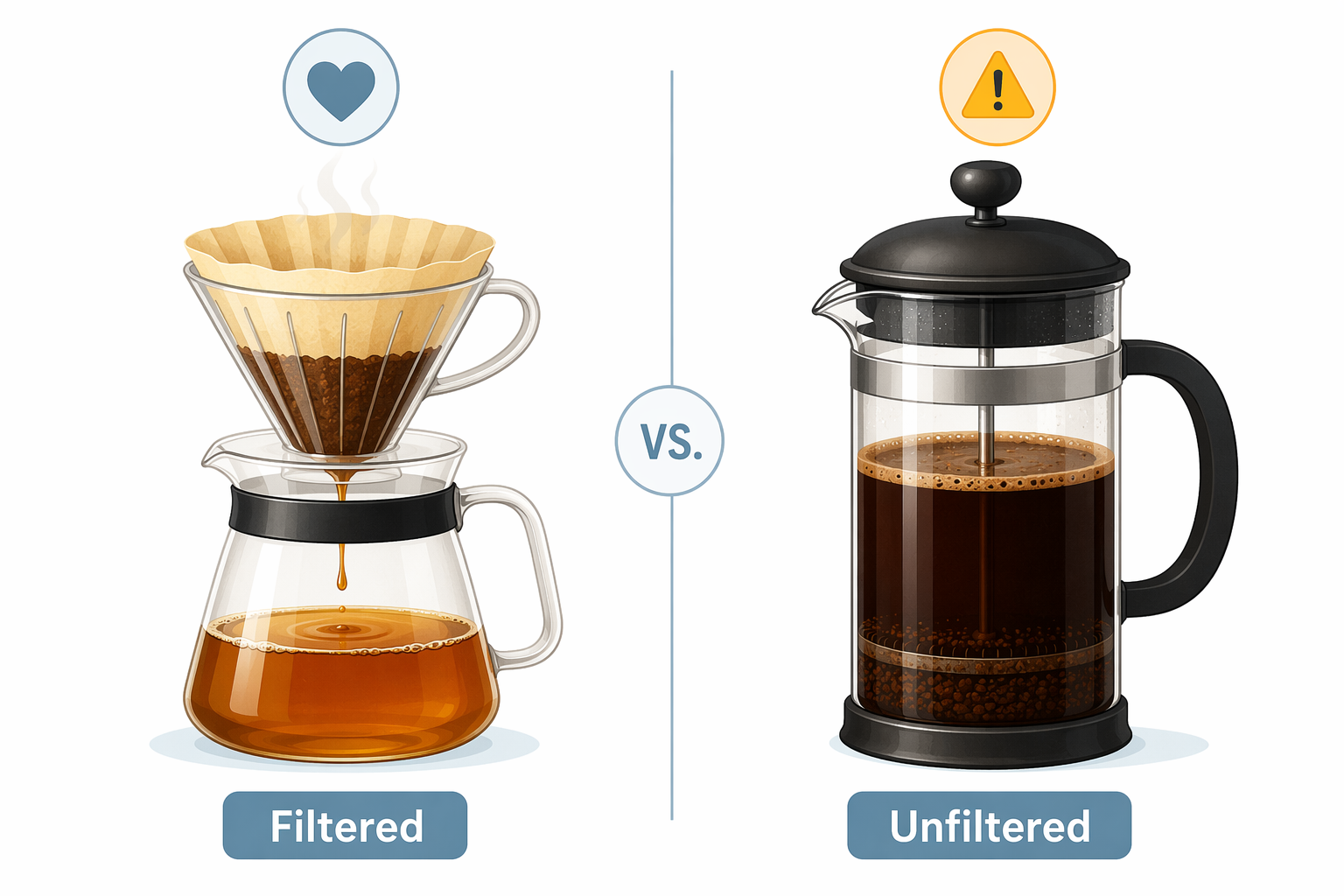
Preparation method is not a culinary footnote. Unfiltered coffee, including French press and boiled preparations, contains cafestol and kahweol, compounds that raise LDL cholesterol. The moderate-intake recommendation applies most directly to filtered coffee, where those diterpenes are reduced by paper filtration.
That distinction becomes more important in patients whose LDL cholesterol is already the dominant modifiable risk factor. A person can be inside the 2–4 cup range and still choose a preparation method that works against lipid goals. In that setting, switching the brew method may be more sensible than debating whether the cup count should be three or four.
A Bounded Clinical Answer
For most adults, the evidence-backed answer is moderate daily coffee intake: about 2–4 cups per day, roughly 200–400 mg caffeine, preferably filtered, and only if it is tolerated without sleep disruption, symptomatic palpitations, or problematic blood pressure response. This range is not built on one cheerful cohort association. It is supported by a hypothesis-free random forest signal across Framingham, ARIC, and CHS; a randomized trial showing lower recurrent AFib in a defined population; and broader cardiovascular statements that place moderate coffee intake within a favorable risk pattern.[1][2][3]
The recommendation stops where the evidence stops. It is weaker for non-drinkers being told to start for primary prevention. It is more cautious for slow caffeine metabolizers or patients with troublesome symptoms. It may be inappropriate in severe uncontrolled hypertension. And it should be filtered, not assumed equivalent across brewing methods. Within those boundaries, the 2–4 cup range is a reasonable cardiovascular recommendation rather than just another coffee headline.
References
- Association Between Coffee Intake and Incident Heart Failure Risk: A Machine Learning Analysis of the FHS, ARIC, and CHS, Circulation: Heart Failure, 2021.
- DECAF RCT — Wong et al. (2025, JAMA), ScienceDaily, 2025.
- Caffeinated Coffee and Cardiovascular Health: A Scientific Statement From the American Heart Association, Circulation, July 20, 2026.
- Good News for Coffee Lovers: Daily Coffee May Benefit the Heart, American College of Cardiology, 2022.
Comments
Join the discussion with an anonymous comment.