
The link between sleep duration and tau protein in Alzheimer's risk is easy to draw as a U-shaped curve and much harder to interpret at the bedside. Five hours and nine hours may both sit on the high-risk arms of that curve, but they probably do not mean the same biological thing. Short sleep has a plausible route into tau pathology through wakefulness, neuronal activity, phosphorylation changes, and reduced clearance. Long sleep, especially in older adults, may be less a behavior that drives disease than a signal that disease biology, sleep fragmentation, comorbidity, or altered arousal regulation is already present.
That distinction matters because tau is not a wellness endpoint. It is a core Alzheimer's disease pathology, measurable in cerebrospinal fluid and blood, and increasingly used to infer where a person may sit along an Alzheimer's biological continuum. The current evidence supports clinical attention to both sleep extremes, but it does not support treating both as interchangeable exposures.
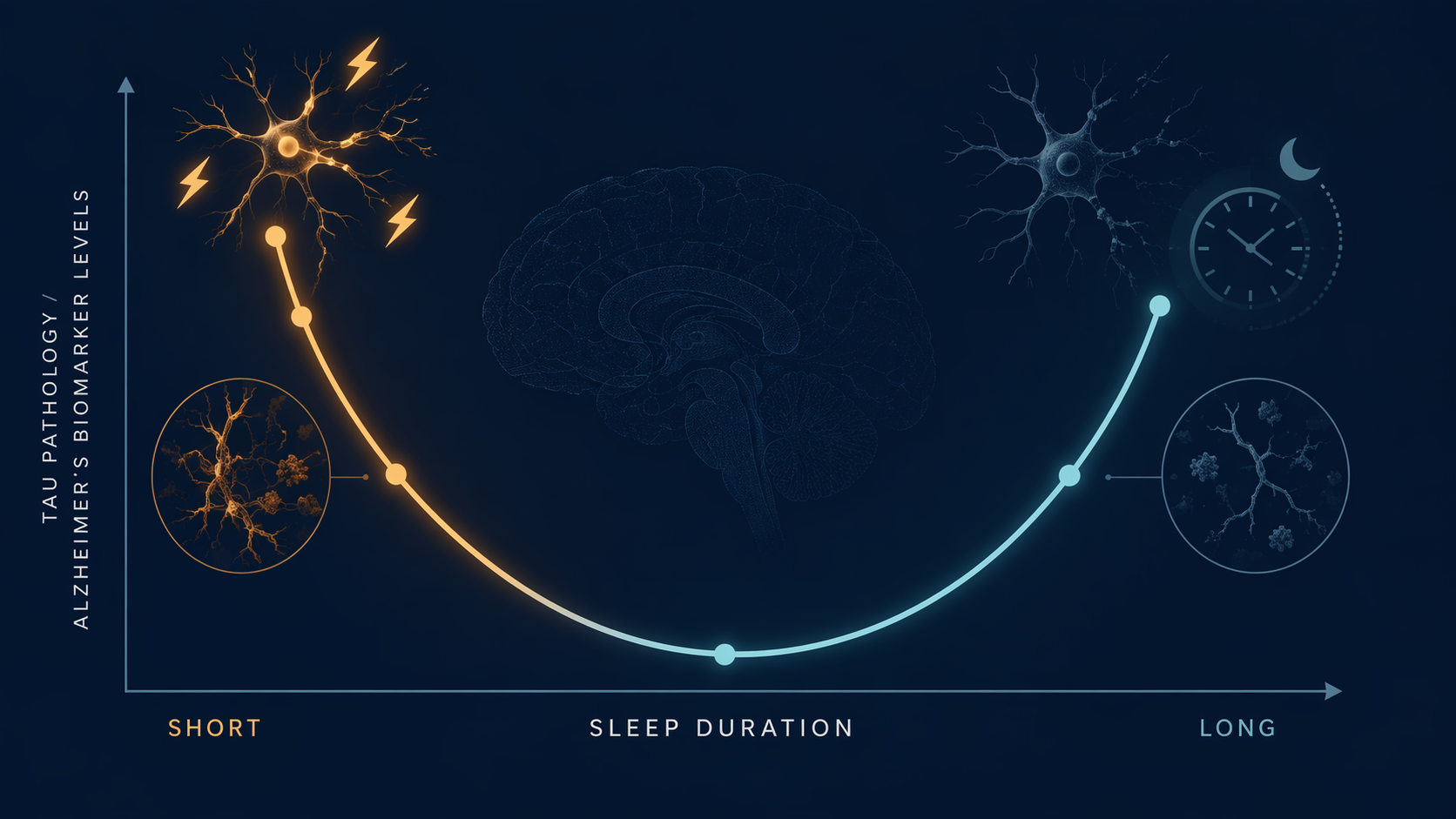
The same U-shaped curve can hide two different mechanisms
Across the sleep-duration literature, the cleanest summary is non-linear: both unusually short and unusually long sleep are associated with worse Alzheimer's-related outcomes. The definitions do not line up perfectly across studies. “Short” can mean anything from roughly 5 hours to 7 hours, while “long” often begins around 8 to 9 hours. That alone should slow down any attempt to translate a curve into a rule.
The tau-centered version of the curve has become more concrete because the two ends are now supported by different kinds of evidence. On the short-sleep side, experimental studies can perturb sleep and measure tau-related changes over hours. On the long-sleep side, the most important contemporary evidence comes from population biomarker work: long sleep duration is associated with higher plasma p-tau181, even after adjustment for major covariates, but causal direction remains unsettled.
| Sleep pattern | What the association suggests | Main caution |
|---|---|---|
| Short sleep or sleep deprivation | A plausible active contribution to tau release, phosphorylation changes, impaired clearance, and spread | Human experimental samples are small, and mouse tau-spread models require translational caution |
| Long sleep in later life | A possible marker of early neurodegeneration, altered sleep regulation, comorbidity, masked fragmentation, or clearance dysfunction | Reverse causation is a major concern, and independent replication of the newest plasma p-tau181 evidence is still pending |
Why short sleep has the stronger mechanistic case
The short-sleep arm of the curve has an unusually coherent mechanistic spine for a sleep finding. Holth and colleagues showed that tau in mouse brain interstitial fluid rose by about 90% during normal wakefulness and by about 100% during acute sleep deprivation. In the human component of the same work, one night of total sleep deprivation increased CSF tau by about 50%.[1] Those numbers do not prove that chronic short sleep causes Alzheimer's disease in humans, but they do show that tau is dynamically responsive to the sleep-wake state rather than merely passively accumulating over decades.
The wakefulness signal is biologically plausible because neuronal activity can influence extracellular tau. More waking time means more time in a state associated with higher interstitial tau, and sleep deprivation adds a stressor on top of that. The point is not that a single bad night creates Alzheimer's pathology. The point is that sleep loss can push tau biology in the wrong direction on a measurable timescale.
Holth et al. also moved beyond soluble tau concentration. In seeded mouse models, chronic sleep deprivation accelerated the spread of tau tangles across brain regions.[1] That part of the study is important because Alzheimer's disease is not just a disorder of tau concentration; it is also a disorder of anatomical propagation. Still, the species and model caveat is not cosmetic. A seeded mouse tau-spread experiment is not an aging human with vascular disease, medications, fragmented sleep, and mixed pathology.
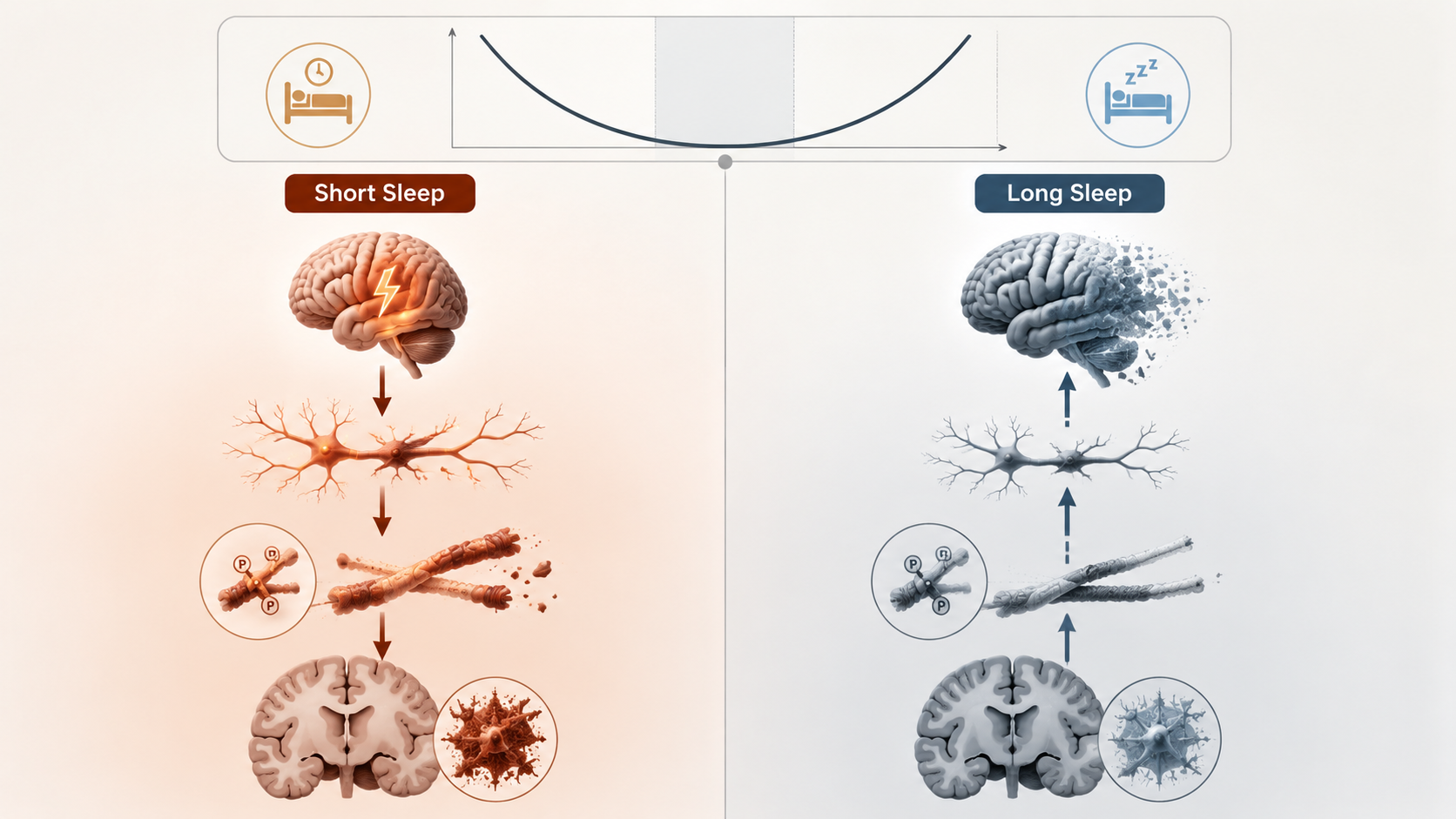
The human phosphorylation data sharpen the picture, though they do not enlarge it. Barthélemy and colleagues studied cognitively normal, amyloid-negative adults after one night of total sleep deprivation and found site-specific CSF tau phosphorylation changes: the pT217/T217 ratio increased by 15–20%, while pS202/S202 decreased.[2] That is the sort of detail that matters, because “tau went up” is a blunt statement. Different phosphorylation sites may map to different biological processes and stages of tau handling.
The restraint is just as important as the result. The Barthélemy study involved only 7–8 adults, aged 30–60, and it was conducted in cognitively normal amyloid-negative participants.[2] It is valuable as a mechanistic close-up, not as a population risk estimate. It tells us that acute sleep deprivation can alter human CSF tau phosphorylation in a site-specific way; it does not tell us how a 78-year-old with amyloid positivity, obstructive sleep apnea, and vascular burden will respond over years.
Clearance is the bridge, but not the whole story
Sleep is also a clearance state. Xie and colleagues reported that glymphatic clearance increased two-fold during sleep compared with wakefulness in adult mice, in work focused on metabolite clearance and amyloid-β.[3] Tau was not the central target of that paper, so it should not be cited as direct proof that sleep clears human tau in Alzheimer's disease. Its value is narrower and still useful: it gives a biological route by which sustained wakefulness or disrupted sleep could reduce the brain's opportunity to remove soluble waste products.
This is where a simple sleep-duration question becomes inadequate. A person reporting 8 hours in bed with repeated arousals may have less restorative sleep than a person reporting 7 consolidated hours. Conversely, a person reporting 5.5 hours may be describing lifelong short sleep, insomnia with distress, circadian misalignment, caregiving demands, depression, or untreated sleep apnea. Duration is a crude exposure when the biology likely depends on wake time, slow-wave sleep, fragmentation, oxygenation, circadian timing, and clearance dynamics.
Long sleep and plasma p-tau181: the newest signal is strong, but not settled
The long-sleep end of the U has been easier to dismiss as confounding, and harder to explain as a direct exposure. That changed somewhat with Young et al.'s 2026 Framingham Heart Study analysis, which reported non-linear associations between sleep duration and plasma p-tau181 in 2,410 participants. Sleep duration at approximately 8.5–9 hours or longer was associated with elevated plasma p-tau181, independent of age, sex, APOE ε4, and comorbidities.[4]
This is the most current load-bearing evidence for the long-sleep tau signal because it is large, biomarker-based, and directly addresses p-tau181 rather than relying only on dementia diagnosis. Plasma p-tau181 is also more specific to Alzheimer's-related tau biology than a general cognitive outcome. But the paper was published in May 2026, and independent replication is still pending.[4] A new, well-powered association is not yet a settled clinical law.
The central interpretive problem is reverse causation. Long sleep in an older adult may reflect early neurodegeneration affecting arousal systems, circadian regulation, mood, mobility, autonomic function, or daytime activity. It may also reflect fragmented sleep that is being counted as long sleep because the patient spends more time in bed. In that scenario, the long duration is not the injurious exposure; it is the clinical trace left by an already-changing brain.
There are other possibilities. Long sleep could mark inflammatory illness, medication burden, depression, sleep-disordered breathing, frailty, or reduced social and physical activity. It could also coexist with inefficient glymphatic function rather than compensate for it. The Framingham analysis adjusted for major covariates, which makes the finding harder to wave away, but adjustment is not the same as proving directionality.[4]
Dementia outcomes widen the frame, with age complicating the curve
Tau biomarkers are the sharper instrument, but dementia incidence studies show why clinicians should not ignore sleep extremes even when biomarkers are unavailable. In a 10-year follow-up study using ELSA data from 7,223 participants, Xiong and colleagues reported that sleeping more than 8 hours was associated with a 64% increased risk of dementia and a two-fold risk of Alzheimer's disease.[5]
The same study also reported an age interaction: short sleep was a risk factor in adults younger than 70, while it appeared protective in those aged 70 or older.[5] That finding should make anyone cautious about universal sleep-duration thresholds. In later life, reported duration may be entangled with survival effects, retirement schedules, health status, napping, time in bed, and changes in sleep architecture. A duration category that behaves one way before 70 may not behave the same way after 70.
Dementia incidence is not the same as tau pathology. Diagnosis occurs downstream of amyloid, tau, vascular injury, reserve, education, sensory loss, depression, medications, and clinical ascertainment. Still, the ELSA results fit the broader warning: long sleep in older adults deserves evaluation, and short sleep earlier in later adulthood may plausibly contribute to risk biology rather than merely accompany it.
Measurement may be where many sleep–tau interpretations go wrong
Sleep duration is deceptively simple. A clinic note may record “5 hours” or “9 hours,” but those numbers can come from self-report, a bed partner's estimate, a wearable device, actigraphy, polysomnography, or a rough answer given during a crowded visit. Self-reported duration and actigraphy-measured duration do not always represent the same construct. One is the patient's perception of sleep; the other is an estimate of rest-activity patterns. Neither automatically captures sleep stages, respiratory events, periodic limb movements, or glymphatic efficiency.
This matters most for the long-sleep arm. A patient may report 9 hours because they are asleep for most of that interval. Another may report 9 hours because they are in bed from 9 p.m. to 6 a.m. but awake repeatedly. A third may sleep 7 hours at night and nap for 2 more hours because daytime alertness is failing. These histories do not point to the same mechanism, and they should not be collapsed into the same biological interpretation.
The short-sleep arm has its own measurement traps. Chronic restriction, insomnia, circadian delay, untreated apnea, and caregiving-related sleep loss may all produce similar reported durations while differing in arousal burden, oxygenation, stress physiology, and daytime compensation. If the question is tau biology, the relevant exposure is probably not only clock time asleep.
APOE, sex, and subgroup findings are intriguing, not yet practice-changing
The next layer of the sleep–tau literature is likely to be subgroup biology. Stiver et al. reported an emerging precision-medicine signal in older women: in a sample of 45 participants, 86.7% of whom were non-Latinx White, longer sleep duration completely attenuated the association between APOE ε4 and tau.[6] That is a striking result, but its size and population structure limit how far it can travel.
The result is best read as a reminder that sleep duration may interact with genetic risk, sex, resilience, and resistance rather than acting as a uniform exposure across all older adults. It should not overturn the larger U-shaped interpretation, and it should not be used to reassure an APOE ε4 carrier that longer sleep is automatically protective. It does justify more careful cohort work in which sleep measurement, tau biomarkers, amyloid status, sex, APOE, and age are modeled together instead of treated as background variables.
What a clinician can reasonably do with this evidence
The clinically useful move is not to label every sleep extreme as Alzheimer's risk in the same way. It is to ask what kind of signal the extreme duration represents. Short sleep, especially when persistent, has enough mechanistic support to be treated as a plausible contributor to tau-relevant biology. Long sleep, particularly when new or increasing in an older adult, should raise suspicion for early disease biology, fragmented sleep, comorbidity, medication effects, depression, sleep-disordered breathing, or declining daytime function.
- For short sleep, the key clinical questions are duration, chronicity, insomnia symptoms, circadian timing, work or caregiving constraints, apnea symptoms, medication and stimulant use, and whether the patient is accumulating sleep debt.
- For long sleep, the key questions are whether the pattern is new, whether it reflects sleep or time in bed, whether naps are increasing, whether sleep is fragmented, and whether cognition, mood, mobility, or medical burden has changed.
- For either extreme, interpretation changes if sleep duration is self-reported rather than measured, if the patient is older, if APOE ε4 status is known, or if amyloid and tau biomarkers are available.
The current evidence supports a non-linear sleep–tau relationship, but it does not make sleep duration a standalone diagnostic test. Short sleep may plausibly push tau pathology through wakefulness-linked tau release, phosphorylation changes, impaired clearance, and possibly tau spread. Long sleep may often be a warning sign that neurodegeneration or another medical process is already altering sleep regulation. Both ends deserve attention in Alzheimer's risk assessment; neither should be interpreted without age, measurement method, fragmentation, comorbidities, and biomarker context.
References
- The sleep-wake cycle regulates brain interstitial fluid tau in mice and CSF tau in humans, Science, 2019
- Sleep deprivation affects tau phosphorylation in human cerebrospinal fluid, Annals of Neurology, 2020
- Sleep drives metabolite clearance from the adult brain, Science, 2013
- Non-linear associations between sleep duration and plasma p-tau181 in the Framingham Heart Study, Alzheimer's & Dementia, May 2026
- Impact of sleep duration and sleep disturbances on the incidence of dementia and Alzheimer's disease: A 10-year follow-up study, Psychiatry Research, 2024
- Stiver et al. study on resistance/resilience in older women, 2025
Comments
Join the discussion with an anonymous comment.