
A patient who has switched from regular soda to diet soda because of diabetes risk is asking a reasonable question when the new headline appears: should they stop? The 2025 ELSA-Brasil study on diet soda and cognitive decline deserves more than a shrug. It is a peer-reviewed Neurology prospective cohort study of 12,772 adults followed for roughly eight years, and it found faster cognitive decline among participants with the highest intake of low- and no-calorie sweeteners compared with those with the lowest intake.[1] That is clinically interesting. It is not the same as proving that diet soda causes dementia.
The most useful first answer is also the least headline-friendly one: high habitual intake of low- and no-calorie sweeteners can reasonably be discussed as something to reduce when practical, especially in middle-aged adults and patients with diabetes, but this study does not justify panic, moral blame, or a categorical ban. It also does not answer whether replacing sugar-sweetened beverages with diet beverages is better or worse for long-term brain health.

What ELSA-Brasil actually measured
ELSA-Brasil is not a small cross-sectional snapshot. The investigators used a large prospective cohort, assessed diet at baseline in 2008–2010, and followed participants with repeated cognitive testing over about eight years.[1] That design is one reason the study is worth taking seriously: exposure was measured before the observed cognitive change, and the outcome was decline over time rather than a single memory score.
The exposure was total intake of low- and no-calorie sweeteners, often abbreviated LNCS. The study compared participants by intake tertiles. Those in the highest tertile consumed a mean of 191 mg/day of LNCS, described as roughly comparable to one can of diet soda, while those in the lowest tertile consumed a mean of 20 mg/day.[1] This matters because the headline version often becomes “diet soda,” but the measured exposure was broader than one beverage category and included several sweeteners from foods and drinks.
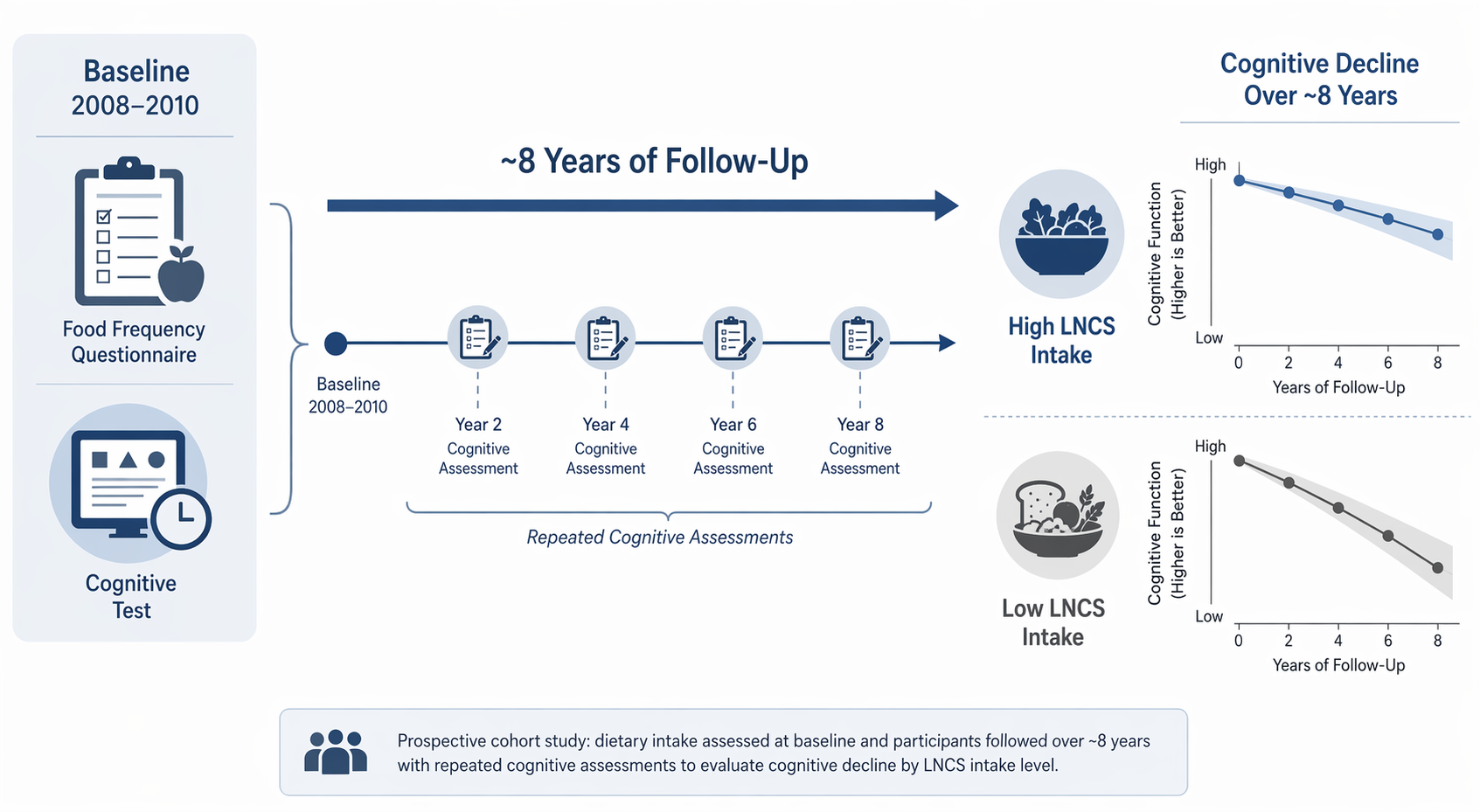
The main result was a faster rate of global cognitive decline in the highest-intake group. Compared with the lowest tertile, participants in the highest tertile had 62% faster global cognitive decline, which the authors translated to an estimated 1.6 years of additional brain aging.[1] The verbal fluency signal was larger: decline in verbal fluency was 173% faster in the highest tertile.[1] For clinicians, verbal fluency is not a trivial test-domain footnote; it can capture aspects of executive-linguistic function that patients and families notice when word-finding, retrieval speed, or conversational ease begins to change.
The individual-sweetener analysis also made the association harder to dismiss as a one-compound anomaly. Six of seven sweeteners examined were associated with faster decline: aspartame, saccharin, acesulfame-K, erythritol, sorbitol, and xylitol.[1] Tagatose was the exception, but intake was too low for robust analysis.[1] This pattern does not establish a shared biological mechanism. It does make the finding more noticeable than a result driven by a single uncommon ingredient.
The age and diabetes findings are where counseling gets more complicated
One of the most important subgroup findings was age. The association between LNCS intake and faster cognitive decline was present only in participants younger than 60 years; it was not significant in participants aged 60 years or older.[1] That is not what many patients will infer from a dementia-focused headline. The finding points more directly to midlife cognitive trajectory than to a simple late-life dementia warning.
The diabetes subgroup finding is also clinically important. In participants with diabetes, the association was stronger, with faster memory and global cognition decline.[1] This is precisely the group most likely to have been advised, often appropriately for glycemic reasons, to reduce sugar-sweetened beverages. If counseling turns this study into “you damaged your brain by choosing diet drinks,” it misses both the limits of the evidence and the clinical reality that patients are often making substitutions within a constrained metabolic risk profile.
A more careful interpretation is that high LNCS intake may be a marker, contributor, or both within a broader metabolic-risk pattern. The study adjusted for multiple factors, but adjustment is not a solvent that removes all confounding. Diabetes, obesity, diet quality, vascular risk, medication changes, and clinician-directed beverage substitution can cluster in ways that are difficult to separate observationally.
Why the study is notable but not causal
The central limitation is straightforward: this was an observational cohort, not a randomized trial.[1] No participant was randomly assigned to consume or avoid LNCS for cognitive-outcome testing. That means the study can show that higher intake was associated with faster decline, but it cannot determine whether the sweeteners caused the decline.
The single baseline food-frequency questionnaire deserves particular attention. Diet was assessed at baseline in 2008–2010, and that baseline measure was used to represent exposure over roughly eight years of follow-up.[1] In real life, patients change beverages after a diabetes diagnosis, weight gain, medication changes, pregnancy, retirement, physician advice, or a new diet plan. Some reduce diet soda. Some increase it after being told to cut sugar. A one-time dietary assessment cannot capture those shifts.
The timing also limits generalizability. LNCS consumption in Brazil during the 2008–2010 baseline period may not reflect current exposure patterns in 2026, and some sweeteners in the study were consumed at very low measured levels. Reported intakes included xylitol at 3 mg/day and erythritol at 0.1 mg/day, far below contemporary exposures in many markets.[1] When a measured exposure is that low, it is risky to translate the association directly to today’s larger servings, different product formulations, or concentrated use in “sugar-free” foods.
Reverse causation is not a technical quibble here. People at higher metabolic risk are more likely to choose diet beverages because they already have obesity, diabetes, prediabetes, or clinician advice to reduce sugar. Those same conditions are themselves associated with worse cognitive and vascular brain outcomes. If a person starts drinking diet soda because their metabolic risk has already increased, the beverage can look like the cause of later cognitive decline even when it is partly a response to the risk state.
That possibility does not erase the ELSA-Brasil finding. It does change the weight the finding can bear. A careful cohort can narrow the field of plausible explanations, but it cannot fully reconstruct why each participant chose diet beverages, what they replaced, and how their metabolic health changed after baseline.
How much do earlier studies support the signal?
ELSA-Brasil is not the first study to raise concern about artificially sweetened beverages and brain outcomes. In the Framingham Heart Study, a 2017 Stroke paper reported an approximately threefold higher dementia risk associated with daily diet soda consumption in a sample of about 4,000 participants.[2] That finding helped keep diet beverages in the cognitive-risk conversation, but it was also observational and vulnerable to many of the same interpretive problems.
More recently, NOMAS reported a 34% increased dementia risk per daily diet soda in 947 participants.[3] The part clinicians should not skip is that the association disappeared after excluding participants with obesity or diabetes.[3] That does not prove reverse causation, but it is exactly the kind of pattern that makes reverse causation plausible: once the metabolic-risk group is removed, the beverage signal weakens substantially.
Taken together, these studies make the ELSA-Brasil result less isolated. They do not convert association into causation. The recurring signal is enough to justify better studies and measured counseling, not enough to tell patients that a diet beverage has been proven to cause cognitive decline.
What the study does not answer about sugar replacement
The practical counseling question is rarely “diet soda or nothing?” It is often “diet soda or regular soda?” ELSA-Brasil does not provide a direct randomized comparison of LNCS beverages against sugar-sweetened beverages for cognitive outcomes.[1] That distinction matters most for patients with diabetes, obesity, or cardiometabolic risk, because replacing sugar-sweetened beverages may reduce sugar exposure even if the replacement is not biologically inert.
So the study should not be used to push a patient back toward high-sugar beverages. If the realistic options are multiple sugar-sweetened drinks per day versus some diet beverages while the patient works toward water, unsweetened tea, coffee without added sugar, or other lower-risk patterns, the counseling should preserve that harm-reduction frame. The unanswered question is not whether water is a reasonable default. It is whether LNCS, as used by real patients with metabolic risk, independently worsens cognition compared with the alternatives they would actually consume.
A clinically useful way to discuss the finding
Expert commentary has generally landed in a cautious rather than alarmist place. Neurology Today’s coverage emphasized the finding’s importance while discussing limitations, including the observational design and exposure measurement issues.[4] Medscape’s clinician-facing coverage similarly framed the result as a reason for caution rather than proof of harm.[5] Harvard Health summarized the study for patients in the same practical register: artificial sweeteners may be linked with faster decline, but the evidence does not settle causality.[6]
In an exam room, the response can be brief and honest:
- The study found an association between higher LNCS intake and faster cognitive decline, especially in adults younger than 60 and in participants with diabetes.
- It did not prove that diet soda or any specific sweetener caused the decline.
- It did not show that sugar-sweetened beverages are safer for the brain.
- If intake is high, reducing gradually is reasonable, particularly when the replacement is water or another unsweetened beverage rather than regular soda.
- Patients with diabetes should not interpret the study as a reason to abandon glucose-conscious dietary planning.
The “roughly one can of diet soda per day” comparison is memorable because the highest tertile averaged 191 mg/day of LNCS.[1] It should be used carefully. It gives patients a scale for the exposure, but it should not be inflated into a threshold at which harm begins. Tertiles are study categories, not biological cut points.
Where the evidence needs to go next
The next useful evidence will need to address both mechanism and confounding. The ELSA-Brasil team is conducting MRI analyses, with about 2,000 scans expected, to examine structural brain correlates.[1] Those data may help clarify whether higher LNCS intake tracks with measurable brain changes, but MRI associations will still need careful interpretation if exposure remains observational.
Randomized cognitive-outcome data would be more decisive, especially if trials compared realistic beverage substitutions in people with diabetes or metabolic risk rather than testing sweeteners in isolation. Until then, the honest conclusion is restrained: the ELSA-Brasil study is a serious prospective signal linking higher LNCS intake with faster cognitive decline, strongest in clinically relevant subgroups, but it cannot establish causality. For now, cautious reduction is defensible; certainty is not.
References
- Low- and No-Calorie Sweetener Consumption and Cognitive Decline: The ELSA-Brasil Study — Neurology, September 2025
- Sugar- and Artificially Sweetened Beverages and the Risks of Incident Stroke and Dementia — Stroke, 2017
- Diet Soda and Dementia Risk in the Northern Manhattan Study — Journal of Alzheimer's Disease, 2026
- Low- and No-Calorie Sweeteners Associated With Faster Cognitive Decline — Neurology Today
- Sugar Substitutes Not So Sweet for Brain Health? — Medscape
- Artificial sweeteners may speed declines in memory and thinking — Harvard Health
Comments
Join the discussion with an anonymous comment.