
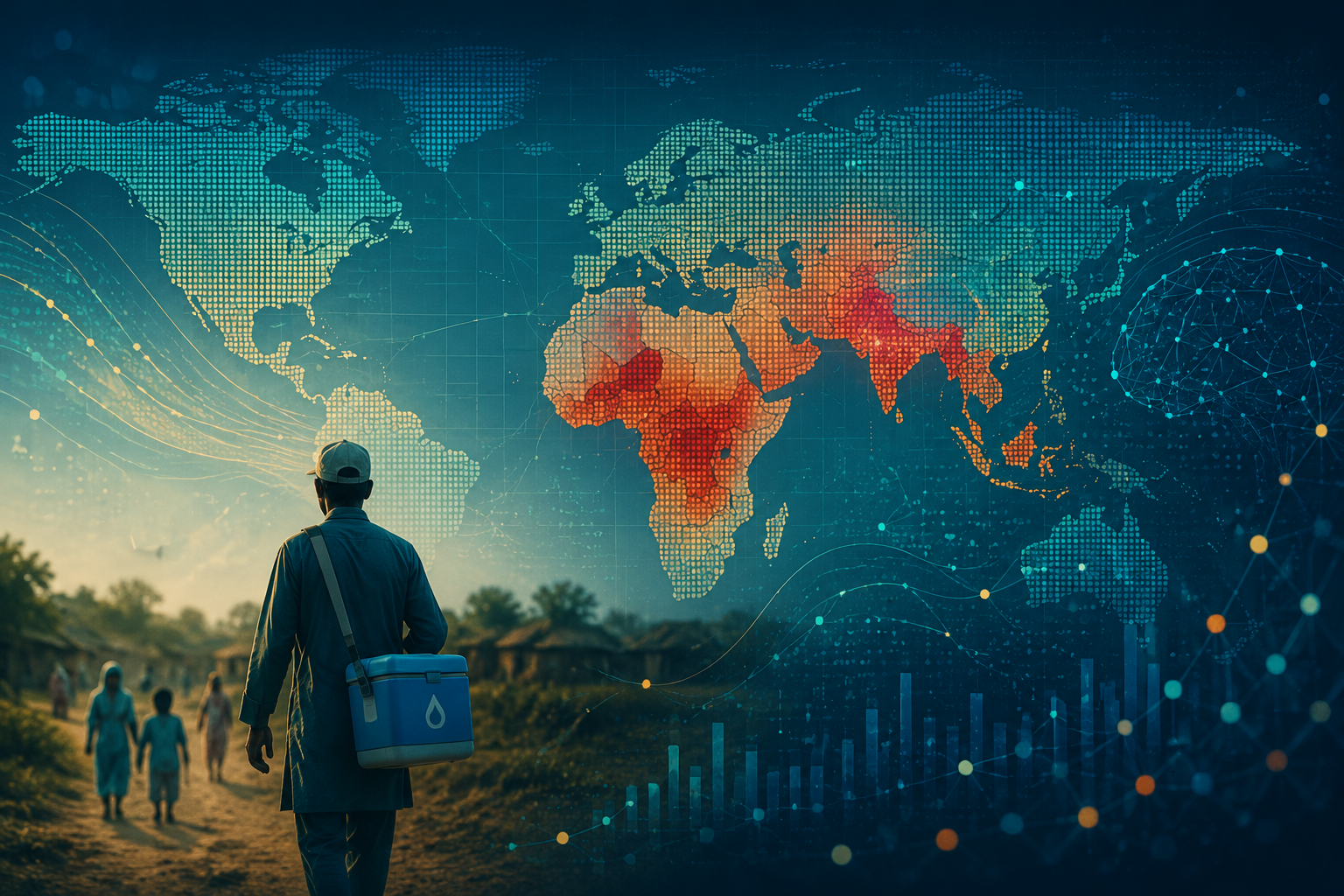
In polio eradication, a prediction is useful only if it arrives while there is still time to move vaccine, people, cold-chain capacity, supervision, and political attention. That is the practical setting for ai in polio eradication and vaccine research in 2026: circulating vaccine-derived poliovirus type 2, or cVDPV2, remains active across more than 15 countries, while paralysis still represents only a small visible fraction of infection. The widely used clinical rule of thumb is that roughly 1 in 200 to 1 in 1,000 poliovirus infections causes paralysis; the research brief for current context also frames the case-to-infection ratio at about 1:2,000. Either way, confirmed paralysis is a late and partial signal of transmission, not a complete picture of where virus is moving now.[1]
That gap between transmission and confirmation is where machine learning has become operationally interesting. Not because a model can make eradication easy, and not because an outbreak dashboard settles a response plan. The useful question is narrower: can a model help decide which districts should move to the top of the list before the next confirmed detection makes the answer obvious?
Operational deployment of the model
The clearest published example is the spatio-temporal model described by Voorman and colleagues in Vaccine in 2021. Developed with the Bill & Melinda Gates Foundation, the World Health Organization, and the London School of Hygiene & Tropical Medicine, the model was built for a specific operational task: predicting district-level cVDPV2 outbreak risk in time to support outbreak response vaccination strategies.[2]
The target matters. This was not a general exercise in classifying countries as safe or unsafe. The model estimated where cVDPV2 outbreaks were likely to occur at district resolution, using a Poisson/binomial modeling framework fitted to 2010-2020 data. For one-month-ahead prediction of cVDPV2 outbreak location, the reported area under the receiver operating characteristic curve was 0.96.[2]
An AUC of 0.96 is strong, but the more operationally important feature is what the model allowed GPEI to do. Beginning in June 2020, the Global Polio Eradication Initiative used the model to order districts by descending risk and help determine target populations for monovalent oral polio vaccine type 2 response campaigns, with response populations ranging from 400,000 to 4 million people per new detection.[2]
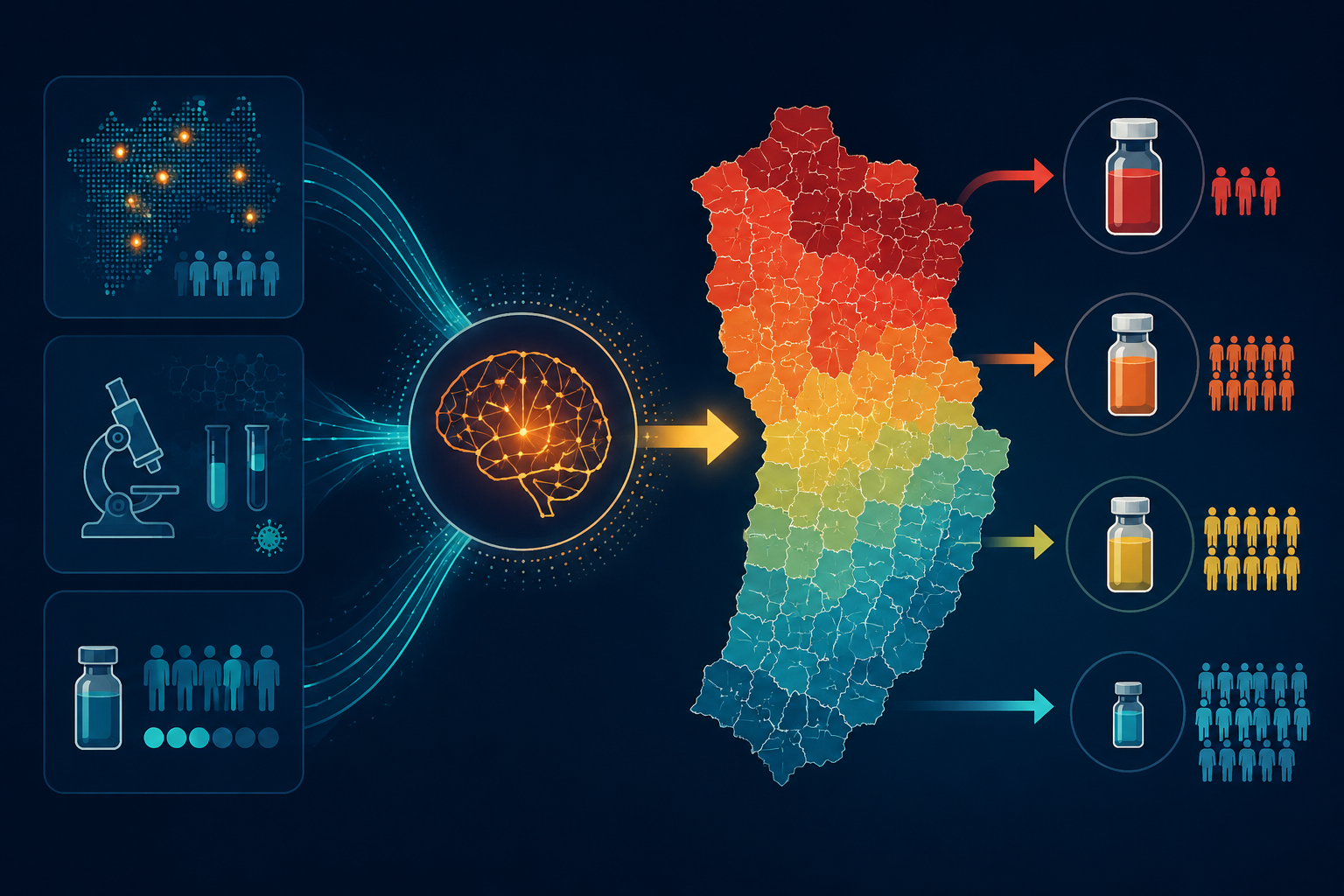
That is the point at which the evidence becomes more than a methods paper. A risk score became part of a response-sizing workflow. Districts were not merely colored on a map; they were ranked, and that ranking fed into decisions about how large a vaccination response should be. For national program managers and response planners, that is a different kind of claim than “the model performed well retrospectively.”
What the model was learning from
The strongest risk factor in the Voorman model was exposure proximity: how close a district was to recent or ongoing cVDPV2 activity. That finding is not surprising to anyone who has watched poliovirus move through gaps in immunity and surveillance, but it is still important. The model’s performance was not magic emerging from high-dimensional noise. It was built around information that has direct epidemiological meaning: where virus has been detected, where susceptible populations may remain, and where the next district in the chain may sit.[2]
That also explains why district-level resolution is valuable. A country-level risk category may help advocacy or global monitoring, but it is too blunt for outbreak response. A district-level model can separate neighboring areas that compete for the same scarce attention. It can make a response planner argue about a boundary, a population denominator, or an uncertain surveillance signal rather than argue from a national average.
The model also had to handle environmental surveillance, which is a powerful but unevenly distributed source of poliovirus detection. Voorman and colleagues reported that districts with environmental surveillance sites were about 7.5 times more likely to detect cVDPV2 than comparable districts without environmental surveillance.[2] That is both useful and dangerous information. Useful, because environmental detections can reveal circulation before paralysis appears. Dangerous, because a place that detects more virus may be a place with better surveillance rather than a place with proportionally more transmission.
A good operational model does not make that problem disappear; it gives teams a more disciplined way to confront it. If a district with strong environmental surveillance rises in the rankings, the team still has to ask whether it is seeing true excess risk, better detection, or both. If a district without environmental surveillance stays quiet, silence is not the same as reassurance.
Why the June 2020 deployment matters
There is a common weak version of AI outbreak writing: a model is trained, an accuracy metric is quoted, and the article ends before anyone has to decide what happens on Monday morning. The June 2020 GPEI use case is stronger because it connects prediction to allocation. The model helped order districts by risk, and those ordered districts informed the size of mOPV2 response populations.[2]
This is also where the limits become concrete. Ranking districts does not automatically create vaccine supply. It does not guarantee access to insecure settlements, improve campaign supervision, fix a delayed case investigation, or resolve disagreement between national and subnational teams. It can, however, reduce one kind of uncertainty: which areas deserve earlier attention when the response window is short and the evidence is incomplete.
| Operational question | What the model can contribute | What still requires field judgment |
|---|---|---|
| Where is risk likely to rise next? | District-level ranking based on recent outbreak patterns and covariates | Whether surveillance silence reflects low risk or weak detection |
| How large should the response population be? | Risk-ordered districts to support mOPV2 target population sizing | Vaccine availability, microplanning quality, access, and campaign feasibility |
| How should environmental detections be interpreted? | Adjustment for differences associated with environmental surveillance presence | Whether a detection signal reflects transmission intensity, surveillance sensitivity, or both |
The defensible conclusion is not that the model controlled outbreaks. The published evidence supports a more useful statement: by 2020, machine learning had entered a real GPEI decision workflow for cVDPV2 prioritization and response sizing, with strong reported discrimination for a clearly defined short-term prediction task.[2]
Adjacent models are promising, but not equivalent evidence
Other machine learning work in polio points in the same general direction, but it should not be treated as interchangeable with the GPEI deployment case.
Hemedan and colleagues published a hybrid whale optimization algorithm-random vector functional link model in Scientific Reports in 2020 for predicting vaccine-derived poliovirus outbreak incidence. The study used 2,448 serum samples from five cohorts in Lao PDR and reported about a 6% accuracy improvement over a traditional RVFL model.[3]
That is worth noting because it shows that ML methods were being tested against conventional alternatives in polio-related prediction tasks before the Voorman operational deployment was published. But it sits differently in the evidence stack. The reported accuracy improvement is a model-performance result; it is not the same as documentation that a global eradication program used the output to size vaccination campaigns.
A newer 2025 framework points toward another direction: using machine learning with acute flaccid paralysis surveillance data that combine clinical, laboratory, and vaccination information to improve early poliovirus outbreak detection. The available description is abstract-level, so it can support only a cautious claim: AFP-based ML pipelines are being explored for earlier case detection, but the public material available here is not enough to judge deployment, calibration, or field performance.[4]
The CDC automated regional mapping example is a different category again. It reportedly reduced polio report generation time from days to approximately one hour by using machine learning to automate regional mapping of disease.[5] That is a real operations gain if staff who once spent days assembling reports can review and act on maps much sooner. But faster report generation is not the same outcome as earlier outbreak interruption. It improves the workflow around surveillance and situational awareness; it should not be credited with epidemiological impact unless that impact is measured.
Utility depends on the system around the model
The hardest part of using machine learning in polio eradication is not producing a ranked map. It is deciding how much confidence to place in that map when the underlying surveillance system is uneven.
Polio surveillance is not a uniform sensor network. AFP surveillance, environmental sampling, laboratory confirmation, field investigation quality, and reporting timeliness vary across places and over time. The research brief notes that surveillance quality varies across the 28 priority countries. That kind of variation can make a model look precise in one setting and fragile in another, especially when districts with better detection appear to have more virus simply because they are more capable of finding it.
Data sparsity adds another problem. Eradication changes the modeling task by making the event rarer. That is the goal, but it leaves fewer recent positives for training and validation. A high-risk district may have little recent incidence precisely because transmission has not yet been detected there, because vaccination has reduced risk, or because surveillance is missing infections. The model can rank probabilities; it cannot turn sparse, delayed, or biased observations into perfect ground truth.

Then comes vaccine supply. The Voorman deployment is most compelling because it links risk ranking to mOPV2 target population sizing, but that also means the model enters a constrained resource problem. If supply is tight, the ranked list does not eliminate tradeoffs; it makes them explicit. A district just below the operational cutoff may still be epidemiologically concerning. A district above the cutoff may still be unreachable on the campaign schedule. A risk model can sharpen the argument, but it cannot make doses appear or vaccinators move safely through every route.
Campaign logistics are another source of slippage between prediction and impact. A model can indicate that a district should be included. The response still depends on microplans, settlement lists, team training, cold-chain performance, supervision, community engagement, and the ability to revisit missed children. In a fast-moving cVDPV2 response, weeks matter. So do the ordinary operational details that decide whether a planned target population becomes reached children.
The bounded conclusion
Machine learning has reached real operational utility in polio outbreak prediction, but the strongest evidence is concentrated in a specific use case: district-level cVDPV2 risk ranking used by GPEI beginning in June 2020 to support mOPV2 response population decisions.[2] That is enough to move the conversation past speculation. It is not enough to treat prediction as control.
The Voorman model gives the field a credible example of ML that escaped the retrospective-paper cycle. The Hemedan model shows earlier method development with reported performance gains. The AFP framework signals continuing movement toward richer early-detection pipelines, though publicly available details are limited. The CDC mapping case shows that automation can compress reporting timelines. Together, these examples describe a maturing toolset, not a substitute for eradication infrastructure.
The practical standard should be whether a model changes a decision before the window closes: which district is reviewed first, which response population is sized differently, which surveillance signal is escalated, which map reaches the incident team while there is still time to act. On that standard, the answer is yes, with conditions. Since 2020, ML has become useful decision support for polio response prioritization under uncertainty. Its value still depends on the surveillance, vaccine supply, and campaign systems that turn a risk ranking into vaccinated children.
References
- Polio This Week, Global Polio Eradication Initiative, July 15, 2026.
- Real-time prediction model of cVDPV2 outbreaks to aid outbreak response vaccination strategies, Vaccine, 2021.
- Prediction of the Vaccine-derived Poliovirus Outbreak Incidence: A Hybrid Machine Learning Approach, Scientific Reports, 2020.
- Machine learning framework for early detection of poliovirus outbreaks from AFP surveillance data, ScienceDirect, 2025.
- Centers for Disease Control and Prevention Reduce Polio Report Generation Time to 1 Hour Using Machine Learning to Automate Regional Mapping of the Disease, BestPractice.ai.
Comments
Join the discussion with an anonymous comment.