In Season 8 of Chicago Med, artificial intelligence was not a stray futuristic prop. A peer-reviewed content analysis found that 15 of the season’s 22 episodes included AI storylines, carried by a fictional “OR 2.0” system and watched by roughly 10.5 million weekly U.S. viewers. The study identified seven recurring ethics issues in those storylines: transparency, automation bias, responsibility gaps, hallucination, selective adherence, unequal access, and political dimensions of deployment.[1]
That is a different kind of evidence from a survey asking whether people like AI. It shows a mass-audience drama repeatedly staging the moral vocabulary of clinical AI before viewers ever sit in an exam room, attend a hospital technology briefing, or hear a medical school lecture on algorithmic oversight. For anyone thinking seriously about medical TV shows and healthcare education around AI, Chicago Med is no longer just an example of entertainment borrowing a hospital setting. It is one of the clearer cases we have of fiction doing public-facing AI ethics education at scale.
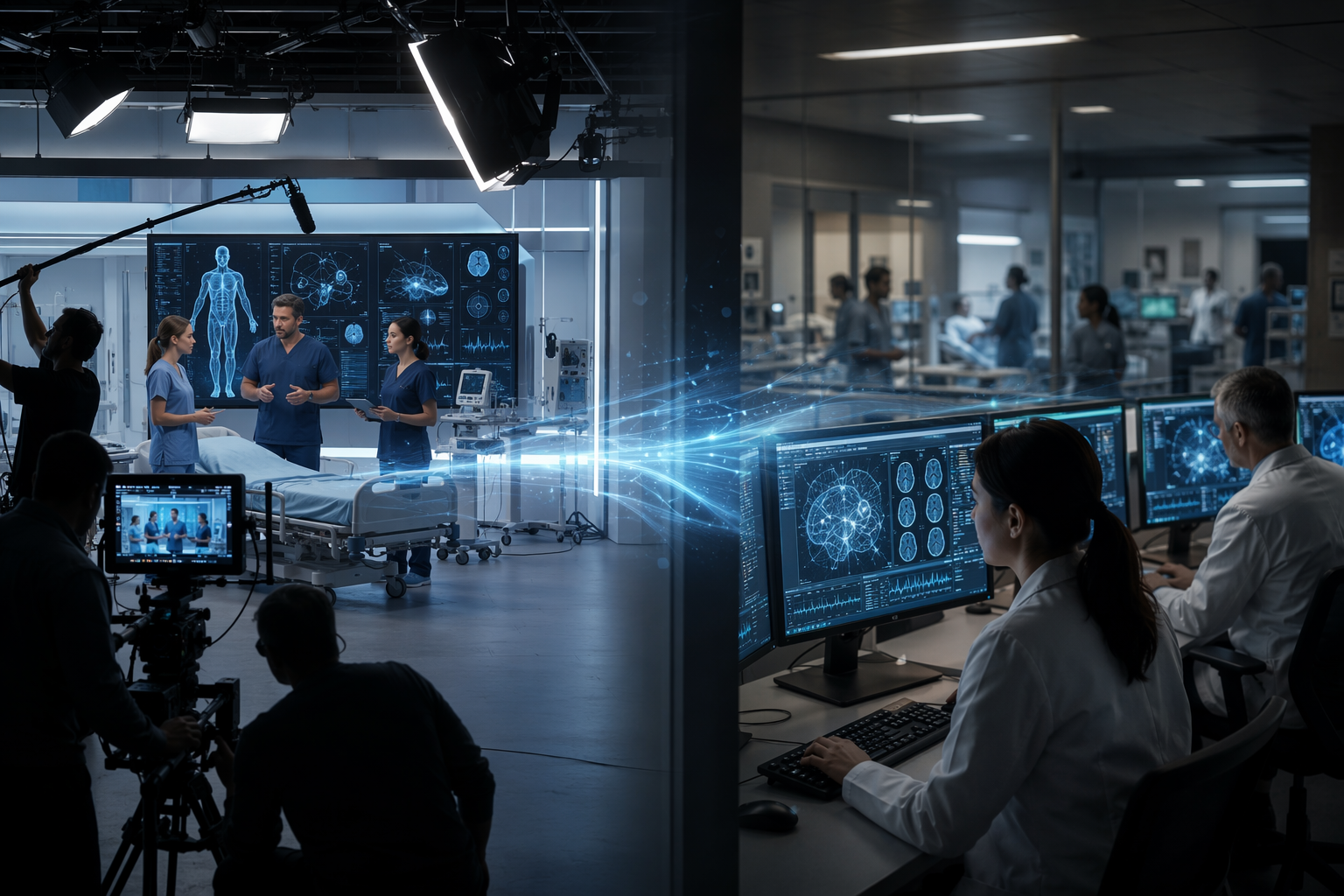
The important point is not that a drama “got AI right” or “got AI wrong” in a total sense. The more clinically relevant question is what kind of residue the portrayal leaves. Does the viewer come away thinking the system explains itself? That the physician can safely defer to it? That someone obvious will be responsible if it fails? That hallucination is dramatic, visible, and rare rather than subtle, mundane, and easily folded into documentation? Those expectations matter because they are often not presented to clinicians as media beliefs. They arrive as ordinary questions, suspicion, impatience, or reassurance that feels slightly misplaced.
What Chicago Med Teaches Without Calling It Teaching
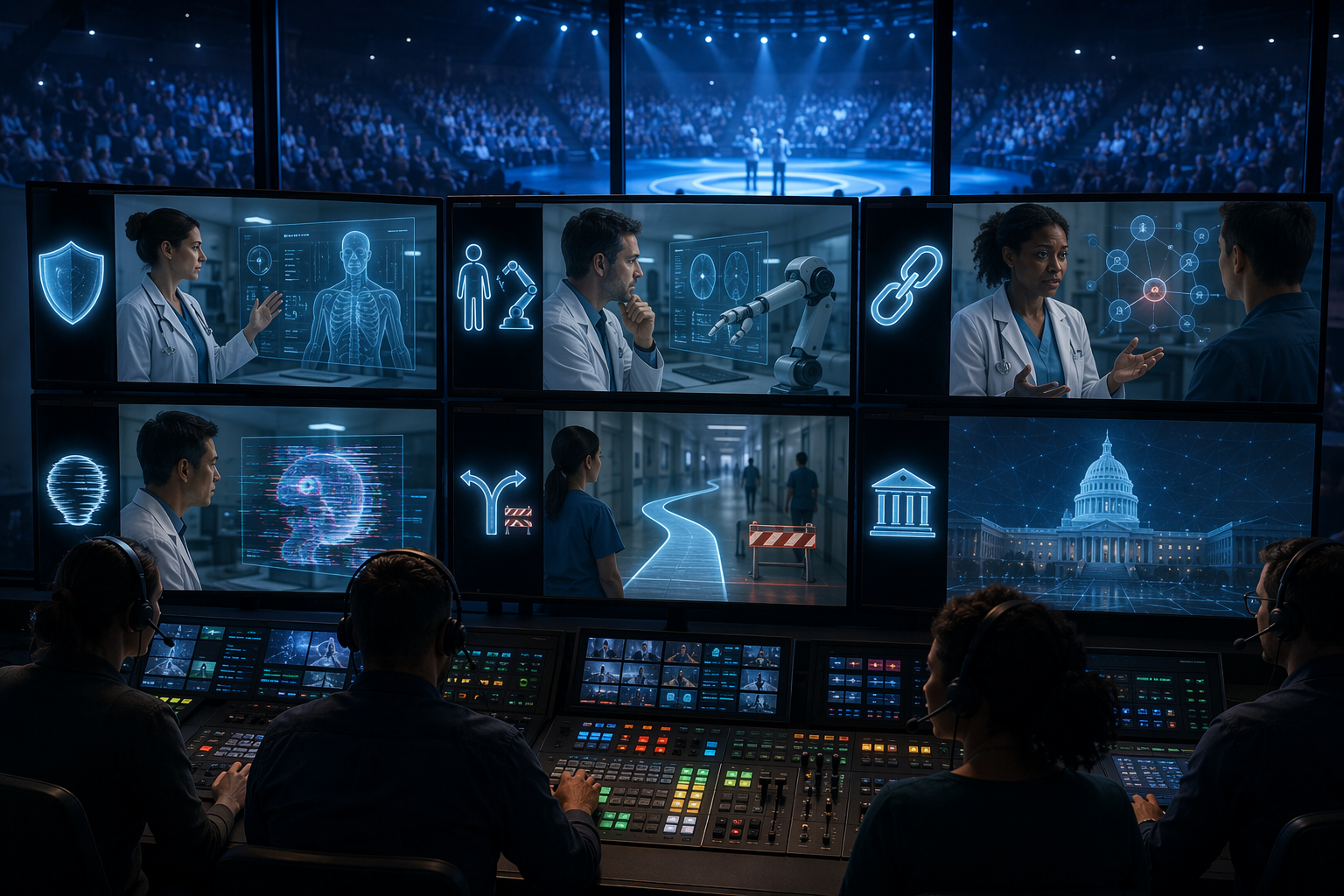
The “OR 2.0” storylines are useful because they bundle several AI problems that clinicians and hospital leaders already recognize, but they put them into scenes with faces, stakes, and blame. Transparency becomes a question of whether a physician can understand or challenge the system’s recommendation. Automation bias becomes a scene in which a human leans too heavily on the machine. A responsibility gap appears when the patient outcome is bad and no one can easily say whether the tool, the user, the institution, or the vendor owns the failure. Hallucination becomes narratively legible as a wrong or misleading AI output.[1]
Those are not trivial themes. In real hospitals, the work of AI governance often lives in documents, review committees, procurement language, model validation, local workflow redesign, and quiet escalation pathways. Television compresses that work into a conflict. The compression is not automatically irresponsible; a drama has to dramatize. But compression also changes what viewers believe is available in real time. A patient may expect the clinician to know exactly why a tool gave a recommendation. A trainee may expect an error to announce itself as an obvious system failure. A family member may assume that if AI touched the case, there must be a single accountable decision-maker ready to explain the whole chain.
The content analysis does not prove that Chicago Med changed patient behavior. It is not an audience-effects study. Its value is narrower and still substantial: it documents repeated AI ethics portrayals in a widely watched medical drama. That makes it reasonable to treat the show as part of the informal curriculum surrounding healthcare AI, while stopping short of claiming that it independently drives acceptance, refusal, or trust.
The Pitt Makes the Workflow Problem Feel Current
The newer example is The Pitt, whose second season put AI charting tools and a hospital cyberattack into central storylines. TIME framed those plots against a reported American Medical Association finding that about two-thirds of physicians use AI, while also noting the gap between vendor-style promises and clinical editing reality: vendor claims may suggest an 80% reduction in documentation time, but clinicians at Duke reportedly described savings closer to 1 to 2 minutes per encounter after editing.[2]
That distinction is exactly where popular portrayals can either help or harm. AI charting is easy to sell dramatically as relief: the physician talks, the note appears, the bottleneck loosens. The real version is more supervised. Someone still checks the note. Someone notices when a generated phrase overstates certainty, imports the wrong context, or makes the patient sound cleaner than the encounter was. The time saved is not the same as the work eliminated.
The Los Angeles Times interview with creator Scott Gemmill adds production context, including consultation with emergency physicians, but it should not be confused with independent evidence that the show’s AI depictions are accurate or effective as education.[3] It is useful for showing where the culture is moving: medical drama writers now treat AI documentation, cyber vulnerability, and hospital technology dependence as ordinary enough to build major plotlines around them. That alone tells clinicians something about what patients and trainees may soon assume is already happening everywhere.
Why Repetition Changes the Baseline
The mechanism does not require viewers to mistake drama for documentary. Repeated exposure can still shift what feels normal, likely, or professionally acceptable. Medical dramas are especially good at this because they place technology inside familiar emotional architecture: a patient deteriorates, a clinician decides, a system helps or misleads, and the outcome arrives before the hour ends.
The strongest analogical evidence comes from the so-called “Grey’s Anatomy effect,” which compared 290 fictional television trauma patients with 4,812 real trauma patients. The study found that television trauma patients were three times more likely to die than real trauma patients, at 22% versus 7%; three times more likely to go directly to the operating room, at 71% versus 25%; and that severely injured patients recovered 2.5 times faster on television.[4]
That study was about trauma, not AI. It should not be cited as proof that fictional AI systems alter patient behavior. Its relevance is more practical: it shows that medical dramas can systematically distort expectations about probability, timing, escalation, and recovery. AI portrayals can plausibly do something similar around explanation, reliability, autonomy, and accountability, even though the direct causal study has not yet been done.
This is where clinicians often meet the afterlife of television. A trauma team has to explain why a patient is not going straight to the OR. An oncologist has to explain why a genomic test does not produce a single clean answer. A primary care physician may soon have to explain why an AI-generated summary is not a second doctor, why a risk score is not a diagnosis, or why the institution permits one AI function while prohibiting another.
The Public Wants Assistance, Not Replacement
Public opinion already contains the same tension that dramas like Chicago Med and The Pitt tend to dramatize. A King’s College London survey of more than 2,000 UK adults found that roughly 80% supported AI use in medicine, while more than 70% rejected the idea of AI replacing doctors entirely.[5]
That is not a confused position. It is a boundary. People may welcome triage support, image assistance, documentation help, or pattern detection while still wanting a human clinician to interpret, contest, contextualize, and bear professional responsibility. Fictional medical AI often lives right on that boundary. The machine may be impressive enough to tempt reliance, but dangerous enough to require a clinician’s intervention before the closing credits.
For healthcare professionals, the practical risk is not simply that viewers become too enthusiastic or too fearful. The harder problem is selective expectation. A patient may want AI used when it promises speed, then reject it when it appears to dilute human attention. A clinician may find herself explaining that an ambient note tool is not making treatment decisions, or that a diagnostic model cannot be disclosed in the same way as a lab value because its development, inputs, and validation history are more complex than the drama made visible.
Trainees Are Not Outside the Audience
The educational issue is not limited to lay viewers. In a study of health sciences students, 49.6% reported watching medical dramas more than once a week, and 63.6% considered them important sources of bioethics information. The most watched shows in that sample were The Good Doctor at 47%, House MD at 41.4%, and Grey’s Anatomy at 38%.[6]
That finding makes “informal education” less metaphorical. Students do not enter ethics teaching as blank slates waiting for official frameworks. They may already have vivid cases in mind: the brilliant shortcut, the system no one understands, the physician who trusts the machine too much, the administrator who pushes adoption for reasons that are not primarily clinical. Formal instruction then has to do more than define bias or explain consent. It has to separate a memorable dramatic pattern from the slower institutional work of safe deployment.
Workforce skepticism also exists outside fiction. National Nurses United reported in 2024 that about two-thirds of unionized registered nurses believed AI undermines patient safety. That finding should be treated cautiously: as a signal that bedside staff concerns are real, not as proof that television is producing those concerns or that nurses are uniformly anti-AI. The distinction matters. Many objections from clinicians are not objections to computation; they are objections to unsafe implementation, inadequate staffing logic, opaque accountability, and being left to manage the consequences after a tool is purchased.
The Expectation Gap Shows Up in Ordinary Conversations
The clinical consequence is rarely a patient announcing, “My view of AI was shaped by a television drama.” It is more likely to sound like a request for the hospital’s “AI diagnosis,” a worry that a doctor is only following a computer, or a complaint that the technology should have prevented a delay. It may also appear as misplaced confidence: if AI is involved, the result must be more objective, more current, or less biased than human judgment.
Those assumptions are not solved by dismissing television. A viewer can learn a real ethical concern from a fictional scene and still misunderstand its operational form. Transparency is a real issue, but it does not always mean the clinician can display a simple explanation at the bedside. Automation bias is real, but it may show up as a small reduction in questioning rather than a dramatic surrender of judgment. Unequal access is real, but it may look like procurement differences, payer arrangements, rural infrastructure, or language coverage rather than a single villain deciding who gets the machine.
This is why the precise boundary of the evidence matters. We have direct content evidence that a major medical drama repeatedly portrayed AI ethics issues. We have timely journalistic evidence that newer dramas are incorporating AI charting and cyber vulnerability. We have empirical evidence that medical dramas can distort expectations in other clinical domains. We have public opinion data showing appetite for AI assistance but resistance to AI autonomy. We have student data showing that medical dramas are treated by many learners as bioethics material. We do not yet have a peer-reviewed study showing that AI storylines in medical dramas directly change patient behavior or clinical outcomes.
That absence should prevent overclaiming, not complacency. In practice, clinicians rarely get to choose whether a patient’s prior understanding came from a consent form, a news article, a social media clip, or a prime-time drama. They only see the expectation once it enters the room.
Clinicians Cannot Leave the Narrative Space Empty
A measured response does not require scolding patients for watching medical television or demanding that dramas become training videos. Fiction can raise the right questions in imperfect ways. Chicago Med deserves attention precisely because it brought transparency, bias, hallucination, access, and accountability into a popular format. The Pitt deserves attention because it reflects the current turn from speculative AI to workflow AI: charting, documentation, cybersecurity, and the promise of time saved.
The problem begins when the dramatized version becomes the only version a patient or trainee can picture. In real healthcare, AI is usually less cinematic and more consequential: a note draft that must be corrected, a triage flag that must be interpreted, a model output that fits one population better than another, a governance decision that determines whether a tool is used at all. The professional task is not to defeat the story. It is to supply the missing boundaries before expectation hardens into distrust.
Medical dramas now function as mass public education about AI in healthcare, even when no one involved calls them that. Healthcare professionals should expect those lessons to arrive in clinical conversations already partly formed: sometimes useful, sometimes distorted, often emotionally durable. Leaving that narrative space to television alone makes the later correction harder than it needs to be.
References
- Anatomy of responsible innovation: AI ethics and societal impact in the fictional medical drama Chicago Med — Nature Humanities & Social Sciences Communications, 2024. https://www.nature.com/articles/s41599-024-03810-y
- The Pitt Season 2 Tackles AI in Hospitals — TIME. https://time.com/7378075/the-pitt-season-2-ai-hospitals/
- The Pitt Season 2 Scott Gemmill — Los Angeles Times, 2026-01-08. https://www.latimes.com/entertainment-arts/tv/story/2026-01-08/the-pitt-season-2-scott-gemmill
- The “Grey’s Anatomy effect”: television portrayals of patients with trauma may cultivate unrealistic patient and family expectations after injury — World Journal of Surgery, 2018. https://pmc.ncbi.nlm.nih.gov/articles/PMC5887783/
- Doctors stay, AI assists: new study examines public perceptions of AI in healthcare — King’s College London, 2025. https://www.kcl.ac.uk/news/doctors-stay-ai-assists-new-study-examines-public-perceptions-of-ai-in-healthcare
- The role of medical dramas in the teaching of bioethics: a survey of health sciences students — BMC Medical Ethics, 2021. https://pmc.ncbi.nlm.nih.gov/articles/PMC8474903/
Comments
Join the discussion with an anonymous comment.