
The controversy over politicians’ health disclosures starts with a legal asymmetry that is easy to miss until a crisis makes it visible. The United States has a constitutional mechanism for removing an incapacitated president, but it has no federal law requiring elected officials to disclose medical conditions, and the 25th Amendment does not define “disability.” Nor has its Section 4 provision ever produced a standing evaluation body that routinely assesses presidential capacity before the country is forced into an emergency judgment.[1]
That gap matters because voters are not asking only for campaign theater. In a June 2025 Axios/Ipsos poll reported by CBS Austin, 81% of Americans favored a legal requirement for presidents to undergo cognitive testing and publicly share the results; roughly three-quarters said politicians are not forthcoming about their health. The poll reportedly surveyed about 1,100 people, but the available figure comes through secondary media reporting rather than a directly reviewed Ipsos topline, so it should be treated as a strong signal of public demand rather than a fully inspectable dataset.[2]
The practical question is not whether the public deserves a president’s complete chart, a senator’s medication list, or a representative’s psychiatric notes. It is why a political system that can delegate nuclear authority, war powers, emergency powers, appropriations, confirmations, and classified briefings still relies so heavily on voluntary disclosure, campaign pressure, informal physician letters, and the tolerance of staff who may already know something is wrong.
What the law requires now
Under federal law, elected officials are not required to disclose medical conditions simply because they hold office. A president, member of Congress, governor, mayor, or city council member may choose to release records, authorize a physician statement, answer questions, or say almost nothing. Campaigns may make health an issue. Journalists may press. Opponents may speculate. None of that is the same as a statutory disclosure requirement.
The 25th Amendment, ratified in 1967, addresses succession and presidential inability. Its most contentious tool is Section 4, which allows the vice president and a majority of the Cabinet, or the vice president and “such other body as Congress may by law provide,” to declare that the president is unable to discharge the powers and duties of the office. But the amendment does not define disability, does not mandate periodic testing, and has never activated the alternative “body” that Congress is permitted to create.[1]
That design leaves several unresolved questions. Is the relevant threshold loss of consciousness, severe cognitive impairment, psychiatric instability, medication effects, an acute medical crisis, or something else? Who gathers clinical information? Who examines the president? Who distinguishes a partisan allegation from a genuine capacity problem? Who acts when the people closest to the president have the strongest incentives to minimize impairment?
The amendment can work when incapacity is obvious and the political actors are willing to act. It is much less useful when the problem is intermittent, progressive, disputed, or concealed by the same inner circle that controls access to the official.
The Raskin proposal tries to build the missing mechanism
In April 2026, Rep. Jamie Raskin introduced legislation to create a 17-member Commission on Presidential Capacity under Section 4 of the 25th Amendment. The proposal would draw members from retired statespersons, physicians, and psychiatrists, including four psychiatrists selected by congressional leaders. It is a bill, not enacted law, but it is notable because it tries to operationalize the part of the amendment that has remained mostly theoretical for nearly six decades.[3]
The proposal does not solve every problem. A commission can still become a political battlefield. Physicians and psychiatrists can still disagree about capacity. A president can still resist examination. Congress can still split along partisan lines. But the bill shifts the debate from vague concern about “fitness” toward an institutional question: what standing process should exist before an acute constitutional confrontation?
| Current system | Capacity-focused reform would try to add |
|---|---|
| No federal health disclosure mandate for elected officials | A defined process for presidential capacity review |
| 25th Amendment permits action after inability becomes politically actionable | A standing body that can be designated under Section 4 |
| Physician statements are usually voluntary and controlled by the official or campaign | A more structured role for clinicians selected through a public process |
| Public debate often collapses health, age, diagnosis, and performance into one argument | A narrower focus on ability to discharge official powers and duties |
The distinction is important. Medical disclosure and capacity review are related, but they are not identical. A person can have a serious diagnosis and remain capable of serving. Another person can have no disclosed diagnosis and still be unable to perform essential duties. A capacity process has to ask what the office requires, what evidence exists, what impairments are relevant, whether any condition is temporary or reversible, and who has authority to decide.
That narrower frame is more defensible than a general demand for total medical transparency. It also better matches the constitutional problem. The public does not need every lab value to know whether an official can execute the office. But the public should not have to wait for aides, family members, or political allies to admit incapacity after governing has already been distorted around it.
Concealment has been a governing pattern, not a rare aberration
The history of political health disclosure in the United States is less a steady march toward transparency than a series of forced adjustments after concealment becomes impossible to ignore. The details differ, and retrospective medical claims should be handled cautiously, but the institutional pattern is consistent: the circle around a powerful official often has reason to protect the office, the person, the agenda, or the campaign, even when outsiders need to understand the impairment.
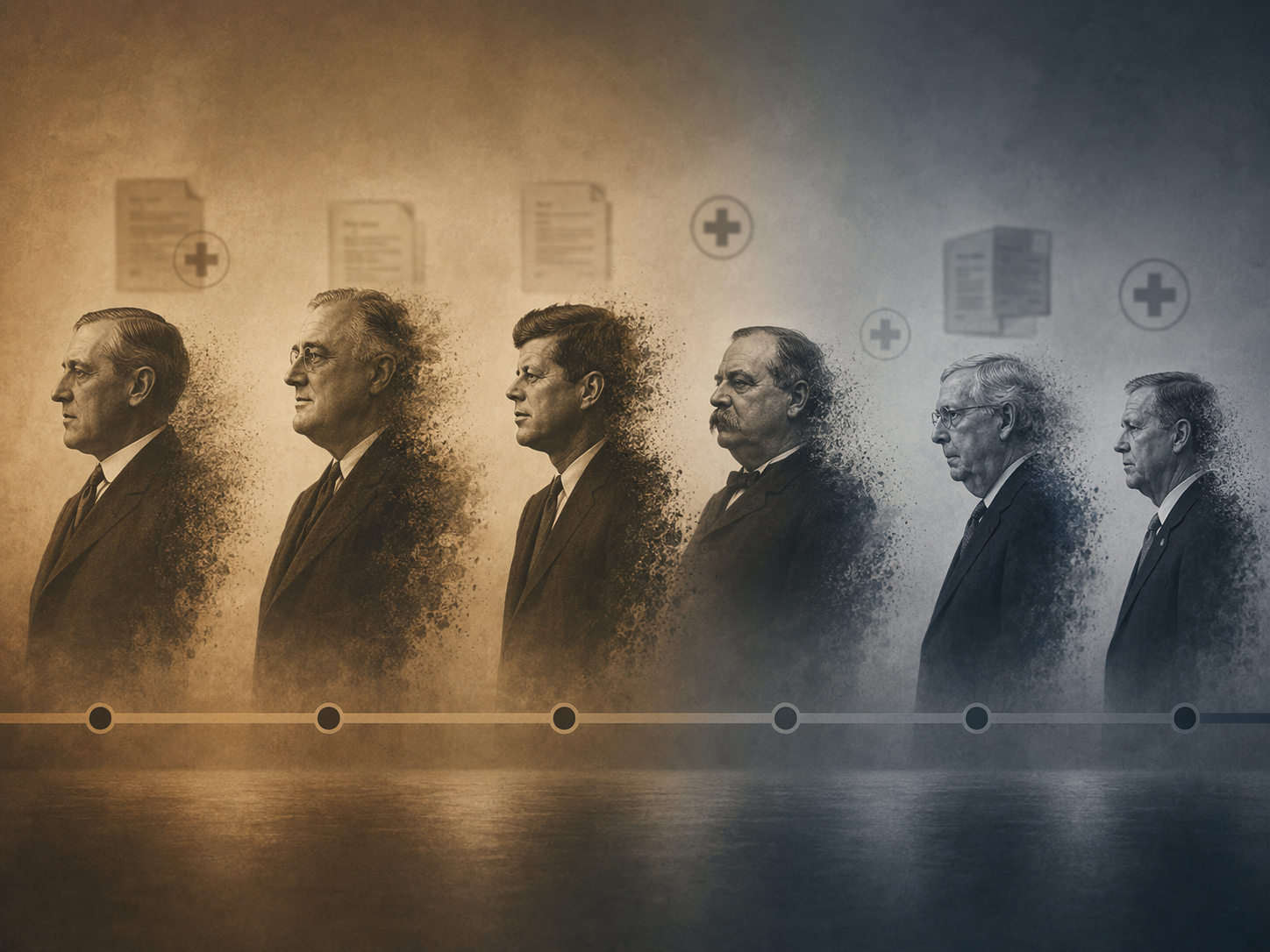
Woodrow Wilson’s 1919 stroke remains the clearest example of incapacity becoming a private management problem. Research discussed by The Conversation describes how Wilson’s physician, wife, and secretary concealed the severity of his condition for 18 months. The issue is not merely that the public was denied information about a president’s health. It is that governance continued through an improvised inner circle while the formal system lacked a clear way to assess and respond to disability.[4]
Franklin D. Roosevelt’s health during the 1944 campaign shows a different version of the same problem. Accounts discussed by Marc Siegel, MD, in The Hill describe severe hypertension and congestive heart failure being concealed as Roosevelt sought a fourth term. The clinical labels matter less than the political arrangement: voters were asked to make a decision without information that was plainly relevant to presidential endurance during wartime.[5]
John F. Kennedy’s Addison’s disease and Grover Cleveland’s secret cancer surgery occupy the same lineage of selective disclosure. They are often retold as colorful episodes in presidential medicine, but their institutional significance is more prosaic. Each case shows how a medical fact can be treated as politically dangerous private information until later disclosure makes the earlier public account look curated, incomplete, or false.[6]
The 1992 Paul Tsongas campaign is remembered as a disclosure turning point because Tsongas, a cancer survivor, released medical records while running for president. When his cancer later returned after the campaign, the episode changed expectations around candidate health records. It did not create a law. It created a norm, and norms are weakest when the political cost of compliance is high.[6]
More recent examples show that opacity is not confined to presidential history. Sen. Mitch McConnell’s public freezing episodes raised questions about acute neurologic or other medical causes, but the public record remained limited. Rep. Tom Kean Jr. reportedly missed more than 100 votes since March 2025 while citing only an unspecified medical issue. Neither example justifies diagnosis from a distance. Both show how little formal disclosure is required even when absence or visible symptoms directly affect representation.[1]
The media has not only uncovered concealment; it has sometimes helped maintain it
Health secrecy does not persist only because officials refuse to talk. It also persists because aides, physicians, families, parties, and journalists settle into a shared understanding of what will not be pressed too hard. Clementson’s research, cited in The Conversation, describes historical media complicity in treating presidential health problems as privileged personal information rather than information tied to public capacity.[4]
That does not mean every rumor deserves publication or every stumble deserves a diagnostic panel. It means the press has often accepted the privacy frame even when the facts at issue were not merely intimate; they were operational. Who is actually making decisions? Is the official receiving briefings? Are staff rerouting work? Are votes being missed? Is a physician statement addressing capacity, or merely asserting that the official is “in good health”?
The last question is especially important because physician letters in politics can sound clinical while functioning as political documents. They may omit the relevant denominator, avoid functional detail, or reassure without explaining what was assessed. In clinical settings, precision matters: what test, what indication, what limitation, what follow-up? Public-office medicine often tolerates much looser language.
Privacy is still a real constraint
The strongest argument for health disclosure is institutional accountability. The strongest argument against blanket disclosure is that politicians remain patients. The AMA Journal of Ethics framed presidential health and mental competency as a balance between the public’s right to know and legitimate privacy concerns, not as a simple rule that public office erases confidentiality.[7]
Mental health records make the problem sharper. Harvard Medical School bioethics analysis has treated presidential mental health disclosure as a question about the limits of patient confidentiality when the patient holds extraordinary state power, including nuclear authority. That framing is useful because it does not pretend the stakes are ordinary, but it also does not convert psychiatric privacy into a free-for-all.[8]
There are clinical reasons for caution. Cognitive symptoms can reflect dementia, but they can also reflect reversible or treatable conditions such as hypothyroidism, vitamin B12 deficiency, sleep apnea, depression, medication effects, infection, dehydration, or metabolic disturbance. A demand for cognitive testing may be reasonable as a screening proposal, but a screening result is not the same as a diagnosis, and a diagnosis is not automatically the same as incapacity.
Psychiatric commentary from afar raises another boundary. The Goldwater Rule constrains psychiatrists from offering professional diagnoses of public figures they have not personally examined and from whom they lack consent. Public debate will always include lay judgments about performance, temperament, and acuity. Clinicians should be more careful. A capacity system that depends on actual examination and defined evidence is stronger than one that depends on televised speculation.
Disclosure should follow capacity, not curiosity
The policy problem becomes clearer once the disclosure question is narrowed. The relevant standard should not be whether a condition is embarrassing, politically damaging, or interesting. It should be whether the condition, treatment, symptoms, or functional limitation bears on the ability to perform the powers and duties of the office.
That approach would treat different information differently. A remote orthopedic surgery with no current functional effect is not the same as recurrent unexplained loss of awareness. A treated chronic condition with stable function is not the same as a progressive impairment that staff are quietly accommodating. A mental health history alone is not proof of incapacity; active symptoms that interfere with judgment, attention, impulse control, or reality testing would raise a different set of questions.
A capacity-focused framework would also ask for the right kind of documentation. A useful physician statement would not need to expose every private detail. It could state what domains were assessed, whether the official can perform essential duties, what limitations exist, whether those limitations are temporary, and when reassessment is expected. The public interest is strongest where medical facts intersect with constitutional function, voting representation, or decision authority.
This is where the 81% cognitive-testing figure has political force but limited clinical specificity. It shows that required testing and disclosure are no longer fringe demands.[2] It does not tell Congress which instrument to use, how often to test, what threshold matters, whether results should be public in full, or how to prevent cognitive screening from becoming a blunt age-based weapon. A law built only around public appetite would be easy to abuse. A law built around capacity could be harder to evade and harder to misuse.
Why demand has not become law
The lack of a disclosure mandate is not simply an oversight. It reflects constitutional caution, privacy law instincts, partisan mistrust, medical uncertainty, and the self-interest of officeholders who may not want rules that could later apply to them. Congress can rail against secrecy in the abstract while hesitating to create a process that might be used against its own leaders.
There is also a separation-of-powers problem. Rules for presidential capacity implicate the executive branch, Congress, the vice presidency, physicians, and voters. Rules for members of Congress raise different questions about representation, attendance, committee work, and voting. A single national disclosure law for every elected office would likely be overbroad. A presidency-specific capacity body, such as the Raskin proposal, is narrower because the 25th Amendment already gives Congress a textual place to act.[3]
Bipartisan interest has surfaced, though not yet as enacted reform. In 2023, Sen. Bill Cassidy, a Republican senator from Louisiana and a gastroenterologist, argued that Congress should require medical record disclosure from top federal officials. The significance is not that one physician-lawmaker resolved the issue; it is that the concern is no longer easily dismissed as a partisan tactic or a media obsession.[9]
Still, proposed disclosure rules immediately run into implementation questions. Which officials count as “top” federal officials? Full records or physician summaries? Physical health, cognitive health, psychiatric health, or functional capacity? Annual disclosure, campaign-cycle disclosure, or event-triggered review? Public release, confidential review, or both? Without answers, transparency can become either symbolic or invasive.
The defensible endpoint is mandated review, not total exposure
The United States has lived with a disclosure regime that depends on voluntary candor, adversarial journalism, campaign incentives, and the willingness of physicians to say more than their politically powerful patients may want said. That arrangement has repeatedly failed in the same direction: toward delay, reassurance, and concealment until the medical problem becomes too large to manage privately.
The better reform path is not to declare that elected officials have no medical privacy. It is to identify the health information legitimately tied to capacity, create a process for assessing it, and make that process less dependent on the goodwill of the official being assessed. The Raskin Commission proposal is only a proposal, and any final statute would need safeguards against partisan misuse, overdiagnosis, and psychiatric speculation. But it points toward the right institutional question: who decides capacity, using what evidence, before incapacity has already been normalized by everyone close enough to see it?
References
- No federal law requires any elected official to disclose medical conditions; 25th Amendment disability standard remains undefined, Straight Arrow News, san.com
- Axios/Ipsos poll on presidential cognitive testing and politician health transparency, CBS Austin, June 2025, CBS Austin
- Raskin introduces legislation for a 17-member Commission on Presidential Capacity, House Judiciary Committee, April 2026, House Judiciary Committee
- Clementson research on media complicity in concealing presidential health problems, The Conversation, The Conversation
- Marc Siegel, MD, discussion of Franklin D. Roosevelt’s concealed cardiovascular disease during the 1944 campaign, The Hill, The Hill
- Historical overview of presidential candidate health disclosures and the Paul Tsongas turning point, TIME, TIME
- Presidential health and mental competency ethical framework, AMA Journal of Ethics, 2000, AMA Journal of Ethics
- Bioethics analysis on whether presidents should be required to share mental health records, Harvard Medical School Bioethics, Harvard Medical School Bioethics
- Bill Cassidy argument for requiring medical record disclosure from top federal officials, The Guardian, 2023, The Guardian
Comments
Join the discussion with an anonymous comment.