
The Paradox: AI Alone Outperforms Physician-AI Teams
A randomized trial published in JAMA Network Open in 2024 delivered a result that unsettled many in the medical community. At three academic medical centers — Stanford, Beth Israel Deaconess, and UVA — 50 physicians were asked to diagnose complex clinical vignettes under three conditions: using conventional resources, using ChatGPT as a diagnostic aid, and letting ChatGPT work entirely on its own. The outcomes were stark.
ChatGPT alone achieved a median diagnostic accuracy of 92%. Physicians using conventional resources scored 74%. Physicians using ChatGPT scored 76% — barely above the group that had no AI assistance at all. The difference between AI alone and both physician groups was statistically significant. Co-lead author Ethan Goh captured the surprise: "Our study shows that ChatGPT has potential as a powerful tool in medical diagnostics, so we were surprised to see its availability to physicians did not significantly improve clinical reasoning."
The trial also found a modest efficiency gain: physicians using ChatGPT completed case assessments about a minute faster on average (519 seconds vs 565 seconds). But the accuracy penalty — a 16-percentage-point drop compared to AI alone — raises a fundamental question about how AI should be integrated into clinical workflows.
Root Causes: Why Physician-AI Teams Underperform
The finding that adding a human physician to the diagnostic process reduces accuracy is counterintuitive, but it has plausible explanations rooted in cognitive psychology and interaction design. Three factors appear to drive the effect.
Automation Neglect and Under-Reliance
An MIT-Harvard study on chest X-ray interpretation found that radiologists systematically undervalued correct AI predictions. When the AI flagged a finding accurately, physicians sometimes dismissed it — a phenomenon known as automation neglect. This is the mirror image of automation bias (over-relying on AI); in this case, physicians trusted their own judgment over the AI even when the AI was correct. The result was a final diagnosis that was less accurate than what the AI would have produced alone.
Confirmation Bias in AI Interaction
When physicians receive an AI suggestion that aligns with their initial differential, they may accept it uncritically. When the AI suggests something unexpected, they may reject it without sufficient consideration. This asymmetric filtering means the AI's value is only partially realized — physicians tend to accept confirmatory outputs and discard disconfirming ones, even when the disconfirming output is correct.
Lack of Prompt Training and Interaction Design
The JAMA Network Open trial did not provide physicians with formal training on how to prompt ChatGPT effectively. Without instruction on prompt engineering, trust calibration, or understanding the model's failure modes, physicians used the tool in ad hoc ways. Lead UVA author Andrew Parsons noted: "These results likely mean that we need formal training in how best to use AI." The current generation of large language models requires specific interaction patterns to produce reliable outputs — patterns that are not intuitive to most clinicians.
- Automation neglect: physicians undervalue correct AI predictions, especially when they conflict with initial impressions
- Confirmation bias: AI outputs that confirm existing hypotheses are accepted; disconfirming outputs are rejected
- Prompt skill gap: clinicians lack training in how to structure queries for optimal AI performance
- Poor interface design: most AI tools present outputs in ways that do not support efficient verification or override decisions
Corroborating Evidence: Beyond the Landmark Trial
The JAMA Network Open trial is not an isolated finding. A growing body of evidence across multiple clinical domains reinforces the pattern that human-AI collaboration is more complex than simply putting a physician and an AI system in the same workflow.
The Swedish Mammography Trial: AI as a Triage Tool
The largest real-world deployment of AI in breast cancer screening to date — a Swedish trial involving 80,000 women — found that AI-assisted screening detected 20% more breast cancers while reducing radiologist workload by nearly half. Critically, this trial used AI as a triage tool, not as an autonomous diagnostic system. The AI flagged cases that required urgent review and cleared cases that were highly likely to be normal. Radiologists then focused their attention on the flagged cases.
The Takita et al. (2025) Meta-Analysis
A comprehensive meta-analysis published in npj Digital Medicine in March 2025 by Takita and colleagues examined 83 studies comparing generative AI diagnostic performance with physicians. The pooled AI diagnostic accuracy was 52.1% (95% CI: 47.0-57.1%). No significant difference was found between AI and physicians overall (p=0.10) or between AI and non-expert physicians (p=0.93). However, AI models were significantly inferior to expert physicians by 15.8 percentage points (p=0.007).
The meta-analysis also revealed important methodological concerns: 76% of the included studies were at high risk of bias according to the PROBAST tool. Only 17 of 83 studies directly compared AI with physicians in the same clinical task. The most evaluated models were GPT-4 (54 articles) and GPT-3.5 (40 articles), meaning the evidence base is heavily weighted toward earlier-generation models.
| Study / Source | Key Finding | Context and Caveats |
|---|---|---|
| Goh et al., JAMA Network Open (2024) | ChatGPT alone 92% vs physicians+ChatGPT 76% vs physicians alone 74% | Three academic centers; complex vignettes; no prompt training provided |
| Swedish mammography trial (80,000 women) | 20% more cancers detected; 50% workload reduction | AI used as triage tool, not autonomous system; screening context only |
| Takita et al., npj Digital Medicine (2025) | Pooled AI accuracy 52.1%; AI inferior to experts by 15.8 pp (p=0.007) | 83 studies; 76% high risk of bias; most studies used GPT-4 or GPT-3.5 |
| MIT-Harvard chest X-ray study | Radiologists undervalued correct AI predictions (automation neglect) | Single modality; may not generalize to other imaging types |
| Stanford-Harvard State of Clinical AI (2026) | AI excels at prediction at scale; struggles with diagnostic reasoning under uncertainty | Narrative synthesis of 2025 publications; not independently re-verified |
AI's Weakness: Patient Information Gathering
A Harvard-Stanford study found that AI diagnostic accuracy plummeted from 82% to 63% when it conducted patient interviews directly. This suggests that AI's current strength lies in analyzing structured clinical data — lab results, imaging, documented histories — rather than in the nuanced, interactive process of history-taking. The implication for workflow design is clear: AI should be deployed where it adds value (data analysis, pattern recognition) and not where it introduces error (patient interaction, context gathering).
Alternative Workflow Models: Rethinking Human-AI Collaboration
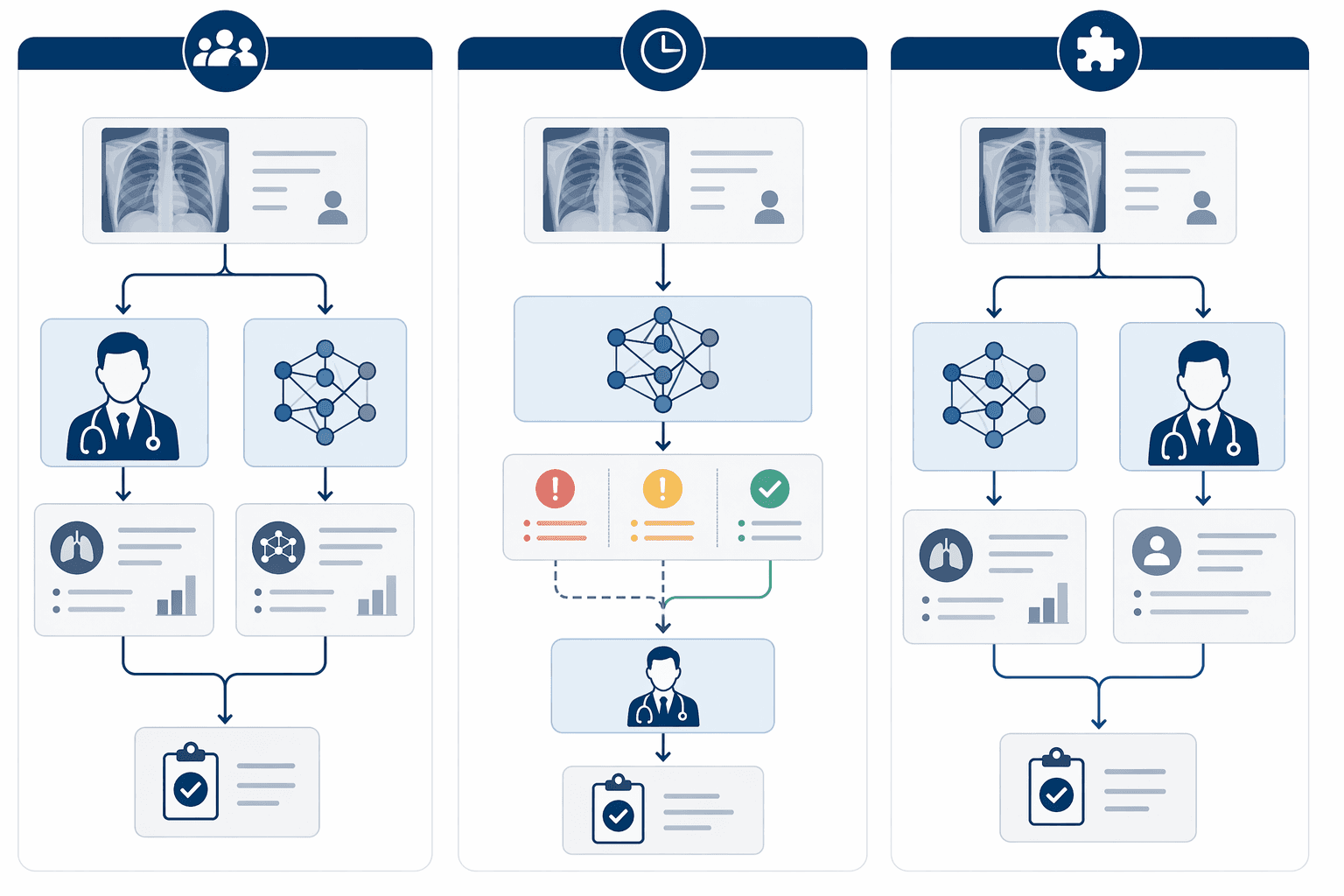
The evidence suggests that the default model of human-AI collaboration — side-by-side review of every case — may be suboptimal. Several alternative models have emerged from both research and real-world deployment, each with distinct trade-offs.
| Model | How It Works | Best Evidence | Key Risk |
|---|---|---|---|
| AI-first triage | AI screens all cases; only flagged cases go to physician review | Swedish mammography trial (20% more cancers, 50% workload reduction) | AI may miss subtle findings in cases it clears as normal |
| Sequential processing | AI pre-processes data and generates preliminary findings; physician makes final decision | Common in radiology AI deployments; reduces reading time | Physician may over-rely on AI preliminary read (automation bias) |
| Task specialization | AI handles image analysis or data pattern recognition; physician focuses on patient context and history | Supported by evidence that AI struggles with patient interviews (accuracy drop from 82% to 63%) | Requires clear boundaries and workflow integration |
| Parallel review (current default) | Physician and AI review every case independently; physician sees AI output before finalizing | JAMA Network Open trial (AI alone 92% vs physician+AI 76%) | Automation neglect and confirmation bias reduce combined accuracy |
The AI-first triage model has the strongest real-world evidence base, particularly from the Swedish mammography trial. It leverages AI's strength — rapid, consistent screening at scale — while preserving physician judgment for the cases that most need it. The task specialization model aligns with evidence that AI and physicians have complementary strengths: AI excels at pattern recognition in structured data, while physicians excel at contextual reasoning and patient interaction.
Implications for Clinical Workflow Design and Medical Training
The AI-alone paradox has practical implications that extend beyond academic debate. For clinical leaders and health IT decision-makers, the findings suggest that the current approach to AI integration — deploying tools and expecting physicians to use them effectively without training or workflow redesign — is unlikely to succeed.
Formal Training in AI Use
The JAMA Network Open trial provided no training on how to use ChatGPT effectively. In clinical practice, this is analogous to giving a physician a new diagnostic tool without an instruction manual. Health systems should invest in structured training programs that cover:
- Prompt engineering: how to structure queries for specific clinical tasks
- Trust calibration: when to accept AI outputs and when to override them
- Failure mode awareness: understanding the types of errors the AI is prone to make
- Output verification: how to independently verify AI-generated findings
Workflow Redesign Around AI Strengths
The Stanford-Harvard State of Clinical AI report (2026) found that AI excels at prediction at scale — for example, wearable vital signs predicting deterioration 8-24 hours before standard alerts — but struggles with diagnostic reasoning under uncertainty, where AI systems performed closer to medical students than experienced physicians. Workflow design should reflect these strengths and weaknesses: deploy AI for screening, triage, and pattern recognition at scale; reserve diagnostic reasoning and patient interaction for physicians.
Integrating AI Literacy into Medical Education
Medical schools and residency programs have been slow to incorporate AI literacy into their curricula. The evidence that AI alone can outperform physician-AI teams — and that the bottleneck is human interaction design — makes a compelling case for formal AI education as a core competency, not an elective. Clinicians need to understand not just what AI can do, but how to interact with it effectively.
Limitations and Counterarguments
The AI-alone paradox is a provocative finding, but it must be interpreted with appropriate caution. Several limitations and counterarguments deserve attention.
Limited Generalizability of the Core Trial
The JAMA Network Open trial was conducted at three academic medical centers with 50 physicians using a single AI model (ChatGPT) on complex clinical vignettes. The results may not generalize to community hospitals, different AI tools (such as GPT-4o, Claude 3 Opus, or Gemini 1.5 Pro), or real clinical workflows where downstream management decisions are involved. The Takita et al. meta-analysis found that models like GPT-4o, Claude 3 Opus, and Gemini 1.5 Pro showed no significant difference compared to expert physicians — suggesting that newer models may close the gap.
Distinction Between Screening and Autonomous Diagnosis
The Swedish mammography trial is often cited as evidence that AI can outperform physicians, but it used AI as a triage tool, not an autonomous diagnostic system. The distinction matters: AI-assisted screening (where AI flags cases for physician review) is fundamentally different from AI working alone (where AI makes final diagnostic decisions). The evidence supports the former; the latter remains largely untested in real-world settings.
Methodological Concerns in the Evidence Base
The Takita et al. meta-analysis found that 76% of included studies were at high risk of bias. Only 17 of 83 studies directly compared AI with physicians in the same clinical task. Nearly half of published AI studies tested models using exam-style questions; only 5% used real patient data, according to a 2025 JAMA analysis cited in the Stanford-Harvard report. The evidence base is still maturing, and many of the most-cited studies have significant methodological limitations.
Rapid Model Evolution
The Takita et al. meta-analysis covers studies published through June 2024, meaning it does not capture the latest GPT-4o, Claude 3.5, or Gemini 2.0 model iterations. AI capabilities are advancing rapidly, and findings based on earlier-generation models may not hold for current systems. Health systems should treat published evidence as a snapshot, not a permanent assessment.
For readers interested in a deeper dive into the meta-analytic evidence on AI diagnostic performance, see our . For examples of how AI is being deployed in real clinical settings, see our .
Comments
Join the discussion with an anonymous comment.