
The first clinical mistake with AI in postpartum fitness and recovery is treating every “personalized” app as if it answered the same question. A postpartum core program that adjusts workouts after a symptom check-in is not doing the work of a pelvic floor exam. A wearable study that detects physiologic changes across pregnancy is not clearing someone for impact. A hospital monitoring platform with FDA clearance is not the same category as a consumer subscription that serves pre-recorded exercise videos in a smarter order.
That distinction matters because postpartum recovery is not ordinary fitness with a sleep-deprived schedule. During delivery, the pelvic floor stretches by about 250%, and by 38 weeks of pregnancy the abdominal wall has stretched by about 115%.[1] Running can expose the body to ground reaction forces of roughly 1.6 to 2.5 times bodyweight.[1] Those loads land on tissues that may still be recovering, while sleep, feeding, pain, bleeding, mood symptoms, and childcare make the usual “readiness” signals harder to interpret.
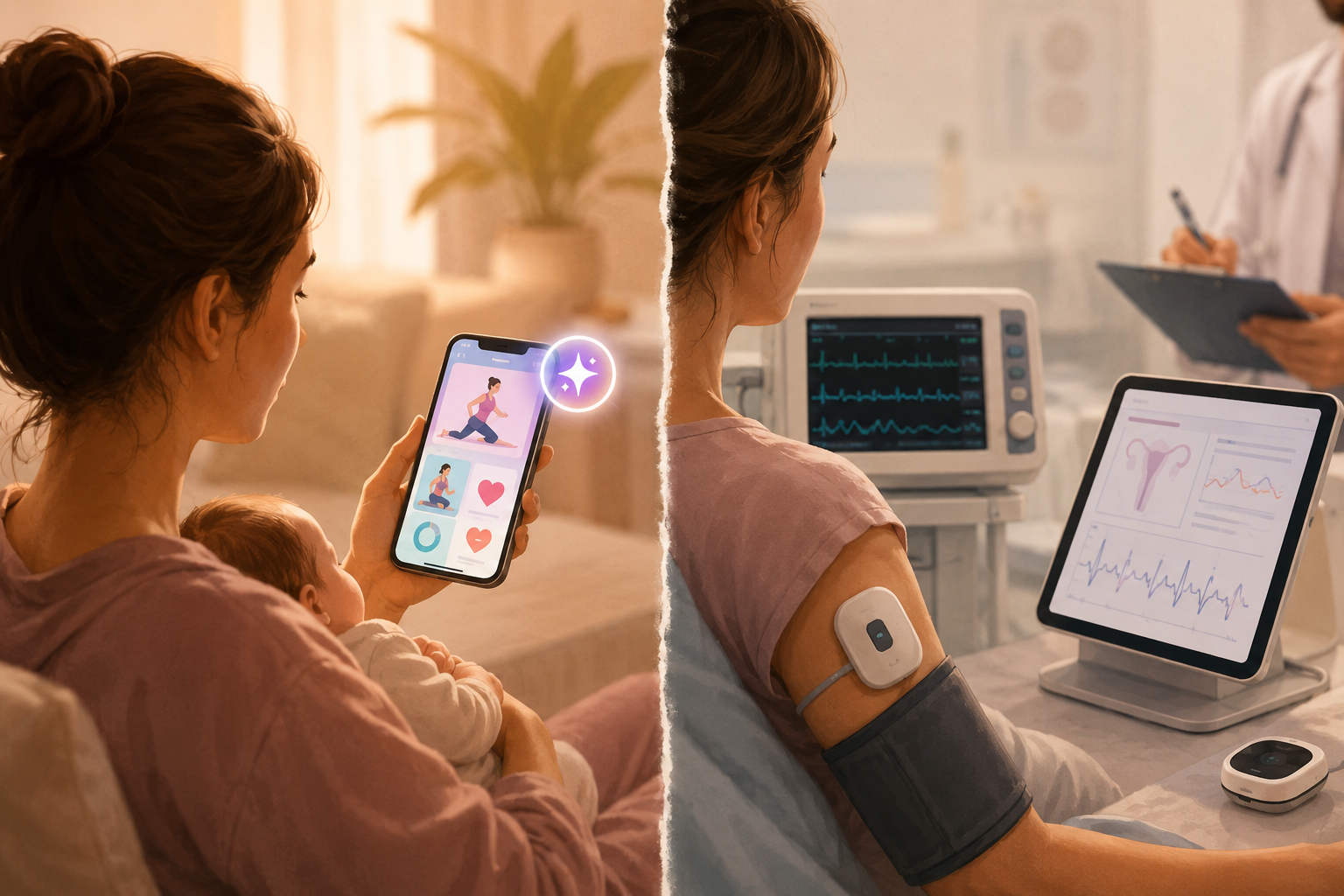
So when a patient asks whether an AI postpartum fitness app is safe, the useful answer does not start with whether the interface looks sophisticated. It starts with what the system is actually measuring, what it is allowed to claim, and whether it has been validated for postpartum bodies rather than generalized from wellness engagement data.
The App Store Is Not a Clinical Pathway
The most direct evidence on the consumer app environment is not flattering. A 2021 assessment of 54 free pregnancy and postpartum physical activity apps using the Mobile App Rating Scale found a mean quality score of 3.06 out of 5. None of the apps set exercise goals aligned with ACOG or ACSM guidelines.[2] The review looked at apps available in January 2020, so it cannot describe every current product, but the finding is still a useful warning: the marketplace has been much better at delivering content than at translating clinical guidance into safe, guideline-aligned exercise progression.
This is the gap clinicians feel in practice. A patient may arrive after completing a “postpartum core” track, reporting that the app said she was ready to advance. The app may have asked about pain, bleeding, fatigue, or urinary leakage. It may have adjusted intensity. It still has not palpated a linea alba, observed pressure management during a loaded task, assessed pelvic floor contraction and relaxation, screened for prolapse symptoms in context, or watched what happens when breath-holding meets a stroller lift.
Consumer apps can support adherence, and that should not be dismissed. Reminders, short sessions, symptom prompts, and progressive sequencing can help someone move when the alternative is doing nothing. But convenience is not diagnostic validity. A product can be useful for behavior change and still be the wrong tool for determining whether a patient is ready for running, heavy lifting, jumping, or higher-pressure abdominal work.
| Product or tool type | Typical data used | Clinical question it can reasonably address | Status to keep separate |
|---|---|---|---|
| Consumer postpartum fitness app | User profile, goals, symptoms, completion history, sometimes wearable inputs | How to sequence wellness exercise content and reminders | Wellness product unless diagnostic validation and regulatory status are shown |
| Generative AI education chatbot in a trial | Approved education materials, chatbot interactions, trial outcomes | Whether AI-supported education improves knowledge, loneliness, or access | Research setting, not proof of fitness clearance |
| Maternal monitoring wearable | Physiologic signals such as uterine EMG, heart rate, sleep, or vital signs | Whether monitored signals predict or identify clinical risk | Trial, observational research, or regulated device depending on product |
| FDA-cleared maternal-fetal monitoring platform | Clinical-grade monitored maternal and fetal signals | Remote monitoring and clinical alerts within the cleared indication | Regulated medical device, still not a postpartum exercise assessment |
What Consumer “AI” Usually Means in Postpartum Fitness
In consumer postpartum fitness products, AI usually means smarter personalization rather than clinical assessment. The system may sort workouts by delivery history, postpartum week, reported symptoms, training goals, cycle phase, fatigue, or prior engagement. That can be helpful. It can also sound more clinically capable than it is.
Programs such as Every Mother, Expecting & Empowered, Juna, Bloom Method, Sweat, Peloton, Budy, Wild.AI, MomsLab, or PostBirthFit tend to live in this wellness category unless they can show something stronger: diagnostic validation, postpartum-specific clinical outcomes, transparent decision logic, and appropriate regulatory status. A symptom-aware sequence from a movement library is not equivalent to evaluating diastasis recti, pelvic floor function, prolapse signs, scar mobility, breathing mechanics, or load tolerance.
The clinical problem is not that these tools exist. The problem is when the language of “AI-powered recovery” blurs three different claims: the app keeps the patient engaged, the app individualizes exercise content, and the app knows whether the patient’s tissues and symptoms can tolerate the next load. Only the first two are plausible for most consumer products. The third requires evidence that is rarely present in the marketing page.
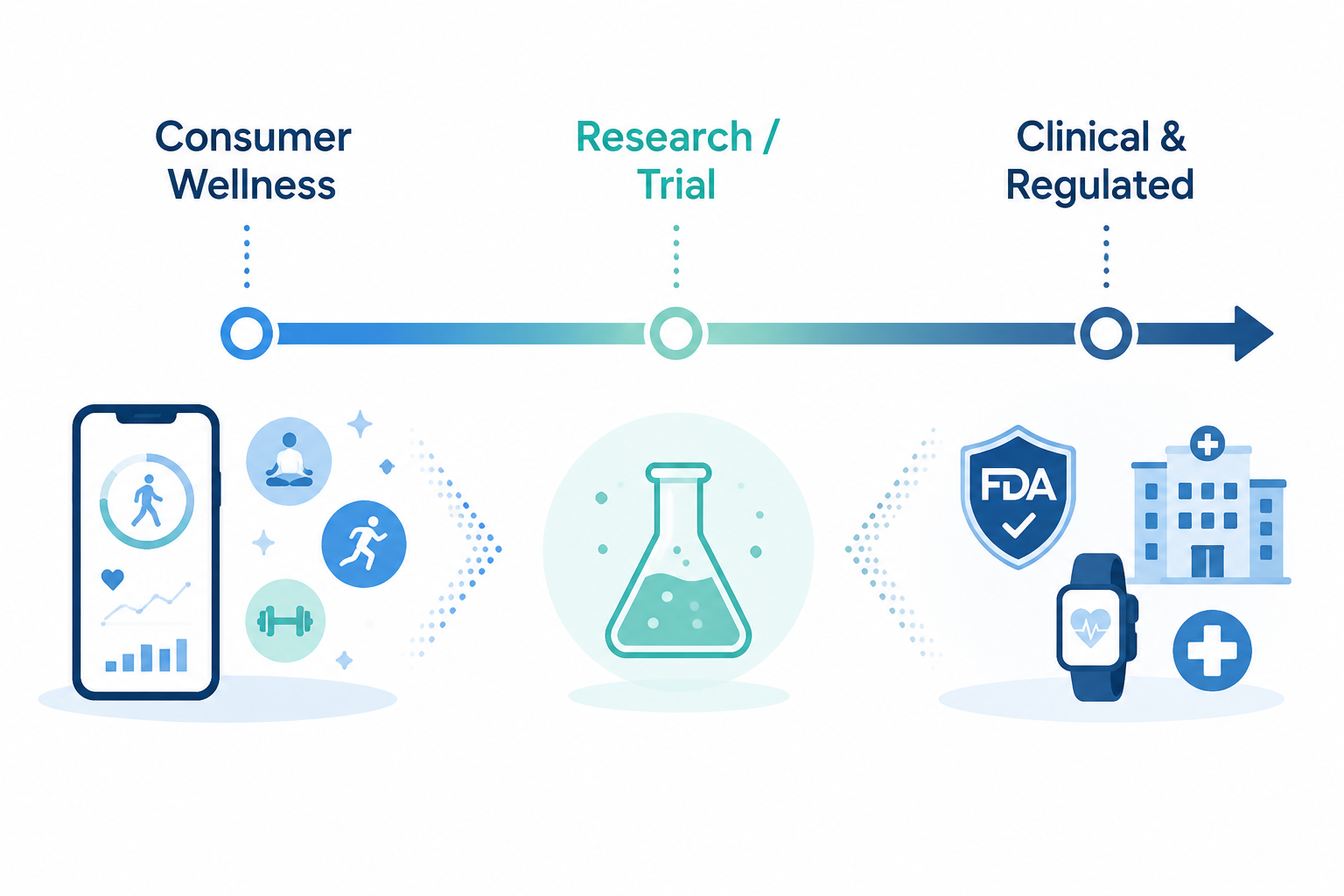
The More Serious AI Work Is Happening Elsewhere
The clinically interesting work in AI for postpartum recovery is not limited to exercise apps. It is showing up in education, monitoring, risk prediction, and physiologic research. These tools still need careful reading, but they are asking narrower clinical questions than “which workout should come next?”
PEARL: Generative AI for Pelvic Floor Education, Not Exercise Clearance
The PEARL trial at UC San Diego is a randomized controlled trial testing a generative AI chatbot for postpartum pelvic floor education. The protocol lists 130 primiparous women, a four-week intervention, and outcomes including pelvic floor knowledge measured by the Prolapse and Incontinence Knowledge Questionnaire and loneliness measured by the UCLA Loneliness Scale. The intervention uses retrieval-augmented generation on UCSD Health-approved large language models, with estimated completion in November 2026.[3]
That design is much closer to a clinical question than a generic chatbot wrapped around postpartum advice. It asks whether AI can improve knowledge and support, not whether it can diagnose pelvic floor dysfunction or prescribe impact progression. Until results are published, it should be read as a serious trial in progress, not as evidence that generative AI is ready to replace postpartum pelvic floor counseling.
Baymatob Oli: A Wearable Looking for Hemorrhage Risk Signals
Baymatob’s Oli is not a fitness product. It is a wearable sensor system studying uterine electrical activity and fatigue signals to predict postpartum hemorrhage. Coverage of the trial at Woman’s Hospital in Baton Rouge described participation in a multicenter global study and noted a reported Louisiana hemorrhage rate of 12%, compared with about 4% nationally.[4] That disparity explains why a predictive tool would matter: earlier recognition could change who is watched more closely and when escalation happens.
But the clinical question is specific. A tool studying postpartum hemorrhage risk is not assessing readiness for planks, loaded carries, or running. It belongs in the “maternal safety monitoring” conversation, not the consumer fitness conversation, even though both may use wearables and AI language.
Sibel Health: Cleared Monitoring Still Has Boundaries
Sibel Health’s ANNE Maternal platform has FDA 510(k) clearance as a wireless maternal-fetal monitoring system with AI-enabled alerts.[5] That regulatory status matters. It means the product has been reviewed within a defined medical device pathway, unlike consumer wellness apps that may imply clinical sophistication without clearance.
Clearance still does not make it a postpartum fitness evaluator. A maternal-fetal monitoring indication does not automatically extend to pelvic floor recovery, abdominal wall function, or return-to-impact decisions. Regulatory status answers one question: what has this device been cleared to do? It does not grant the device authority over every adjacent postpartum decision.
PowerMom and Wearables: Useful Signals, Narrow Conclusions
The Scripps Research PowerMom work is a good example of promising evidence that still needs precise language. In a study published in eBioMedicine in August 2025, researchers analyzed wearable data and found that heart rate, sleep, and related signals tracked with hormone fluctuations across pregnancy. The study drew from more than 5,600 participants, but the complete longitudinal analytic subset was 108 individuals. Heart rate rose 9.4 beats per minute above pre-pregnancy baseline, and pregnancies with adverse outcomes showed different heart-rate trajectories.[6]
That is clinically interesting because it shows consumer wearable signals can reflect real physiologic change. It does not mean a smartwatch readiness score can clear a postpartum runner. Fragmented sleep, nighttime feeding, pain, anxiety, illness, and recovery demands can distort the meaning of heart-rate variability or recovery scores. A wearable may flag a pattern worth discussing; it should not override symptoms, tissue findings, or clinical judgment.
Apple’s wearable behavior model research points in the same direction. A report described 92% pregnancy detection accuracy using more than 2.5 billion hours of wearable behavioral data.[7] That is adoption-scale pattern recognition, not postpartum rehabilitation validation. Detecting pregnancy-related behavioral change and determining safe exercise progression after birth are different tasks.
Where AI May Actually Help Postpartum Recovery
The defensible uses of AI in postpartum recovery are narrower and more useful than the hype. AI can help triage education questions, monitor physiologic patterns, identify patients whose data drift toward risk, and extend support between visits. Those functions fit the reality of postpartum care, where patients often have symptoms before they have access to a specialist.
Machine-learning work on postpartum depression prediction using sleep and activity patterns is one example. Models using wearable-derived behavior signals have been studied for identifying postpartum depression risk, though such work should be interpreted as risk prediction research rather than diagnosis by device.[8] A clinician can use that kind of signal as a reason to ask better questions sooner. It should not become a silent label applied without context, consent, or follow-up capacity.
The same principle applies to fitness. If an app notices that symptoms worsen after higher-pressure core work, or that sleep disruption and reported heaviness cluster around attempted impact days, that pattern may be useful. The value is in bringing a trend to the surface. The danger is pretending the trend is a completed assessment.
A practical clinician-facing version of AI in postpartum fitness would not simply ask, “Can we personalize workouts?” It would ask: Can the tool detect when symptoms are worsening? Can it prompt referral instead of progression? Can it distinguish adherence problems from intolerance? Can it show the clinician what changed, rather than hiding decisions inside a black box?
The Privacy Question Belongs in the Clinical Evaluation
Reproductive health data are not ordinary wellness data. A postpartum app may collect delivery history, feeding status, bleeding, pain, sexual symptoms, incontinence, mood, sleep, medication use, menstrual data, and exercise behavior. If AI features depend on aggregating or analyzing those inputs, clinicians should ask where the data go, who can access them, whether they are used for advertising or model development, and how deletion works.
The 2023 Federal Trade Commission action involving Premom is the cautionary precedent: the agency alleged that the fertility app shared sensitive health information with third parties after telling users it would not share health information without their consent.[9] That case does not prove every postpartum fitness app mishandles data. It does show why “AI personalization” should trigger a data-governance conversation, not just a feature demo.
How to Read an AI Postpartum Fitness Claim
When a patient brings in an AI postpartum fitness app, the clinician does not need to become a software auditor. The first pass can be direct.
- Ask what the tool measures: symptoms, engagement, wearable signals, video movement, physiologic sensors, or clinician-entered data.
- Ask what the tool claims: motivation, education, workout sequencing, risk prediction, diagnosis, monitoring, or clearance.
- Ask whether postpartum validation exists: not general fitness validation, not pregnancy-only validation, and not user satisfaction alone.
- Ask whether it aligns with clinical guidance: especially progression, symptom response, referral triggers, and contraindications.
- Ask about regulatory status: FDA clearance for a specific indication is different from wellness marketing or app-store availability.
- Ask what happens when the patient reports red flags: pelvic heaviness, urinary or fecal leakage, pain, bleeding changes, dizziness, wound concerns, or escalating fatigue.
If the answer to those questions is vague, the app may still be usable as a low-risk adherence aid, but not as a clinical decision-maker. A reasonable recommendation might sound like this: use it for reminders and gentle movement if symptoms stay quiet, but do not use its progressions as clearance for impact, heavy lifting, or unresolved pelvic symptoms.
For clinicians who want the broader technology landscape beyond exercise, AI postpartum recovery monitoring is the adjacent conversation: remote monitoring, chatbots, and risk detection are often more clinically mature than app-based fitness personalization.
The Usable Judgment
AI already has plausible roles in postpartum recovery: education, monitoring, risk detection, research, and support between visits. Some of the most serious work is happening in regulated devices and clinical trials, not in consumer workout apps. That does not make consumer apps worthless. It makes their role narrower.
For now, most AI in postpartum fitness and recovery should be treated as wellness personalization unless the product can show diagnostic validity, postpartum-specific evidence, guideline alignment, and appropriate regulatory status. Personalization can help a patient keep moving. It cannot examine tissue, diagnose pelvic floor dysfunction, clear impact, or replace the clinician who has to make the return-to-load decision when symptoms do not match the app’s green light.
References
- Maximizing Recovery in the Postpartum Period: A Rehabilitation Timeline, PMC.
- Assessment of Mobile Apps for Physical Activity During Pregnancy and Postpartum, PMC, 2021.
- PEARL: Postpartum Engagement through AI for Recovery and Loneliness, ClinicalTrials.gov.
- Woman’s Hospital part of global study to predict postpartum hemorrhage, WAFB, May 2026.
- Sibel Health Receives FDA 510(k) Clearance for ANNE Maternal, PRNewswire.
- Scripps Research PowerMom study on wearable signals and pregnancy hormones, Scripps Research, September 2025.
- Apple WBM pregnancy detection report, bigr.io.
- Postpartum depression prediction via wearables, PMC.
- FTC Takes Action Against Premom Fertility App for Deceptive Privacy Claims, Federal Trade Commission, 2023.
Comments
Join the discussion with an anonymous comment.