
In player injury recovery, AI is useful only if it improves a decision that already has consequences: which athlete needs risk modification before injury, which rehab load is tolerable this week, and whether return to sport is defensible when strength, symptoms, mechanics, and exposure history do not all point in the same direction. That is the practical question behind AI-supported player injury recovery in sports medicine—not whether a model can classify a pattern, but whether the classification changes care.
The current evidence is uneven across that pathway. Risk prediction and load monitoring have the strongest footing, especially where biomechanical, kinetic, and workload variables are combined. Rehabilitation monitoring is plausible and increasingly supported by wearable data, but its best signals still need careful interpretation. Return-to-sport prediction is the most tempting application and the least ready to stand on its own.
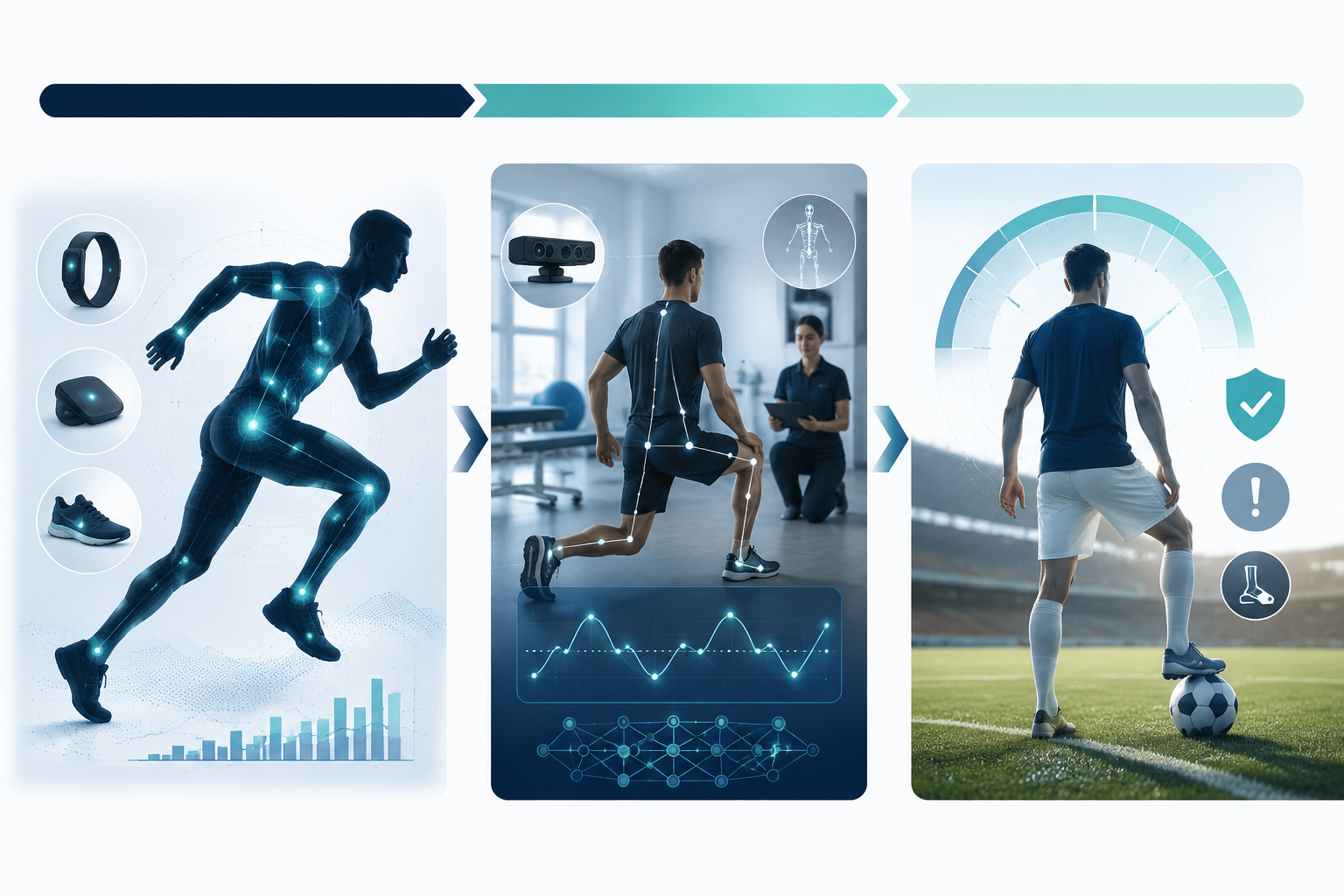
| Recovery phase | Decision AI is trying to support | Current evidence signal | Main clinical caution |
|---|---|---|---|
| Before injury | Who needs risk modification or load adjustment? | Strongest support for biomechanical risk screening and training-load optimization | Risk classification is not the same as a tested prevention protocol |
| During rehabilitation | Is the athlete tolerating progression, or are mechanics drifting? | Moderate support from wearable-assisted monitoring and movement-pattern detection | Sensor noise, model generalization, and clinical thresholds remain uneven |
| Near return to sport | Is the athlete ready for sport-specific exposure? | Preliminary, injury-specific findings | Premature clearance carries a different cost than a missed research classification |
The Evidence Base Is Growing, But Translation Is the Bottleneck
A 2025 scoping review of AI in sports biomechanics included 73 studies and gives the clearest view of the field’s shape. The quality distribution was not weak overall: 47.95% of studies were rated high methodological quality, 42.47% moderate, and 9.59% low. The problem was not that every model was flimsy. The problem was that validation and implementation lagged behind model development: only 43.84% had adequate validation, 89% used wearables for motion capture, only 15% validated sensors against gold-standard motion analysis, and just 7% connected AI motion analysis to actual injury-prevention protocols.[1]
That 7% figure matters in a rehab room. A staff member does not simply need to know that an athlete sits in a higher-risk cluster. They need to know whether the next action is a reduced sprint exposure, a change in eccentric loading, a technical intervention, a delayed progression, or closer monitoring. If the model stops at classification, the clinician still carries the hard part of the decision.
Commercial interest is moving faster than that clinical translation. One market estimate cited in a sports-medicine AI overview valued the AI athlete recovery optimization market at about $895.3 million in 2025 and projected it to reach $9.6 billion by 2035, with an estimated CAGR of about 26.8%.[2] That may describe investment momentum, but it does not establish that AI systems reduce missed games, reinjury, or unsafe clearance across sports.
Before Injury: Risk Prediction Has the Clearest Clinical Use Case
The strongest case for AI in player injury recovery starts before the athlete is injured. That may sound like prevention rather than recovery, but in sports medicine the recovery pathway often begins with the athletes who were never fully robust: the player returning from a prior hamstring strain, the runner whose workload is rising faster than tissue capacity, or the field-sport athlete whose movement profile changes late in a congested training block.
Hamstring injury prediction is the most concrete example. Random forest models integrating kinematic, kinetic, and workload variables have been reported to predict hamstring injuries with roughly 85% prospective accuracy, and that finding is included in the 2025 scoping review’s synthesis of AI biomechanics evidence.[1] The important feature is not the algorithm label. It is the combination of movement and exposure variables, which is closer to how clinicians already think about injury risk than a single screening test.
A separate review of AI and wearable sensors reported that wearable-plus-AI sensor fusion models reached injury-risk prediction accuracy close to 90% in training-load optimization tasks.[3] That is a promising direction because load is modifiable. A model that flags a rising risk state during a week of sprint, jump, or high-speed running exposure can in principle be tied to a practical adjustment. The remaining question is whether teams actually make that adjustment in a consistent protocol and whether the adjustment reduces injury without unnecessarily suppressing performance training.
A 2024 systematic review also found AI-based injury risk prediction methods achieving clinically relevant accuracy across multiple sports.[4] The phrase “clinically relevant” should be read carefully. It supports the idea that AI risk models can provide useful screening information; it does not mean each model has been prospectively tested as part of a prevention program in the environment where it would be used.
This is where AI fits best today: as a risk-screening and load-monitoring layer that helps staff decide who needs a closer look. It can prioritize attention after a long training week, flag an athlete whose movement and workload profile no longer resembles their baseline, or help a multidisciplinary team focus a conversation. It should not be treated as an automated instruction to hold a player out.
What a Useful Risk Output Should Change
For a risk model to matter clinically, it should change at least one part of the prevention plan. A vague red-yellow-green dashboard is rarely enough. The staff need to know whether the alert is driven by workload, asymmetry, movement variability, fatigue-related mechanics, prior injury context, or a sensor artifact. Those drivers point to different responses.
- If workload is the main signal, the decision may involve modifying acute exposure rather than changing the rehab exercise menu.
- If mechanics are changing under fatigue, the decision may involve technique work, altered drill sequencing, or closer monitoring late in sessions.
- If asymmetry is persistent during high-speed tasks, the decision may involve delaying a progression even when gym-based strength looks acceptable.
- If the signal is sensor instability, the correct action may be to repeat measurement rather than adjust the athlete’s plan.
The 2025 scoping review’s sensor-validation gap is therefore not a technical footnote. When 89% of studies use wearables but only 15% validate sensors against gold-standard motion analysis, clinicians have to ask whether a detected movement change reflects the athlete, the device, the placement, the session context, or the model pipeline.[1]
During Rehabilitation: Wearables Can Make Progression More Visible
Rehabilitation monitoring is where AI becomes attractive for a different reason. The athlete is no longer just a risk profile. They are moving through graded exposure: pain-modulated loading, strength restoration, running progression, change of direction, sport-specific drills, contact or competition rehearsal. The useful question is whether the athlete is adapting to that progression or compensating around it.
Wearable-assisted models can help because they observe repeated movement outside the lab. Long short-term memory networks have identified deviations in running mechanics that preceded injury by an average of 2.5 training sessions before symptom emergence.[5] That finding is clinically interesting because symptoms are often late signals. A runner or field athlete may report feeling fine while stride mechanics, loading patterns, or variability have already shifted.
The same finding should not be overread. Detecting a pre-symptom deviation is not the same as proving that intervention at that moment prevents injury. It does suggest a useful monitoring role: when an athlete in rehab begins to look mechanically different during a running progression, the staff may review recent load, sleep, soreness, surface, footwear, drill selection, and prior injury pattern before adding intensity.
IMU-based load estimation shows both the appeal and the limitation. Trunk-mounted inertial measurement units combined with random forest models have estimated lower-extremity joint loads during running with about 12% mean error.[5] For broad monitoring, that may be useful. For subtle return-to-running decisions after a high-stakes injury, a 12% error reminds the clinician not to treat the estimate as a direct substitute for force-plate, motion-capture, or careful clinical examination when those are needed.
There are also more ambitious claims around recovery duration and reinjury. One commercial overview cites a study in which AI-enabled rehabilitation monitoring shortened lower-extremity musculoskeletal injury recovery by about 30%, but that figure is secondary-source reporting and should be verified against the original study before being treated as generalizable.[2] The 2025 scoping review cites integrated AI monitoring systems associated with about a 23% reduction in reinjury rates in professional settings.[1] Those numbers are encouraging, but they are not yet enough to say that AI rehabilitation platforms reliably shorten recovery across injuries, levels of play, and care models.
A more defensible use is narrower: AI can help staff see whether the athlete’s movement response to rehab is stable, improving, or drifting. That may reduce dependence on single-session impressions. It may also catch a pattern that a tired staff member misses after watching multiple athletes through similar drills. The output still has to be reconciled with pain, tissue healing stage, sport demands, psychological readiness, and the clinician’s examination.
The same logic applies to adjacent athlete-health monitoring. Wearables and forecasting tools can support decisions when the risk is environmental rather than musculoskeletal, such as athlete exposure during wildfire smoke; the common thread is not the condition, but whether AI-enabled sensing gives staff actionable information instead of another dashboard to babysit. A related discussion is available in AI tools for athletes during wildfire smoke.
Near Return to Sport: The Consequences Make the Evidence Standard Higher
Return-to-sport decisions are where AI is most likely to be oversold. A model can look impressive when it classifies successful and unsuccessful return after the fact. The harder test is whether it improves clearance decisions prospectively, in real time, with an athlete, coach, surgeon, and performance staff all carrying different pressures.
The hamstring literature offers a useful but narrow signal. Machine-learning models assessing multiple biomechanical variables reportedly predicted successful return to sport after hamstring injury with 84% accuracy, compared with 64% for conventional strength testing.[6] That comparison supports the idea that multidimensional biomechanical assessment may outperform isolated strength testing for this injury context.
It does not justify a broad claim that AI can clear athletes after injury. Hamstring return is not ACL return, concussion return, tendon return, bone stress return, or shoulder return. Each has different tissue constraints, sport demands, recurrence patterns, and failure costs. Even within hamstring injury, a model’s usefulness depends on the population, sport, testing tasks, time from injury, and how “successful return” was defined.
The practical role for AI near clearance is decision support, not decision replacement. It can identify residual movement deficits that strength testing misses. It can compare current mechanics with prior baselines. It can show whether high-speed, fatigue-state, or sport-specific tasks expose a problem that controlled testing does not. But the final decision still has to account for medical diagnosis, healing biology, sport role, exposure plan, athlete confidence, and the consequences of being wrong.
What Clinicians Should Ask Before Trusting an AI Recovery Tool
The most important implementation questions are not about whether a vendor uses machine learning. They are about whether the system has been tested in a way that matches the decision in front of the clinician.
- Was the model prospectively validated in a setting similar to the team, clinic, sport, and level of play?
- Does the output connect to a specific prevention, rehab, or return-to-sport protocol?
- Were the sensors validated against an appropriate reference standard for the movement being measured?
- Does the model explain which variables are driving the alert, or does it only provide a score?
- Has the tool shown an effect on clinical outcomes, or only on classification accuracy?
- Who is responsible for acting on the alert, documenting the decision, and explaining uncertainty to the athlete?
Those questions separate a decision-support layer from a research artifact. A high-performing model that creates ambiguous alerts after every session can make staff chase noise. A less glamorous model that reliably flags workload changes, explains its drivers, and fits into an agreed response protocol may be more useful.
Where the Field Stands in 2026
AI is already most credible in sports medicine player injury recovery as an adjunct for risk screening and load monitoring. That is where the evidence is most developed, the data streams are closest to current practice, and the decision can often be framed as “look closer” or “adjust exposure” rather than “clear or do not clear.”
Rehabilitation monitoring is increasingly plausible, especially when wearable data can show whether mechanics are changing across repeated sessions. The evidence supports interest, not complacency. Sensor validation, thresholds for action, and proof that intervention improves outcomes remain the work that matters.
Return-to-sport prediction remains preliminary. Injury-specific findings are useful, and multidimensional biomechanical models may add information beyond conventional tests. But clearance decisions need stronger prospective validation and clearer translation into sport-specific recovery protocols before AI can carry more than a supporting role.
References
- Artificial Intelligence in Sports Biomechanics: A Scoping Review on Wearable Technology, Motion Analysis, and Injury Prevention. PMC, 2025.
- AI within Sports Medicine: Can Recovery Times Be Improved?. SentiSight.
- Artificial intelligence and wearable sensors in sports injury risk prediction. PMC, 2026.
- A Comprehensive Review of Injury Risk Prediction Methods. PMC, 2024.
- Using Artificial Intelligence-Enhanced Sensing and Wearable Technology in Sports Medicine. PMC.
- AI is Helping Sports Medicine Reach New Levels, But It's Not a Slam Dunk Yet. CU Anschutz.
Comments
Join the discussion with an anonymous comment.