
The question usually arrives before the committee agenda catches up. A patient’s family member asks whether an AI scanner would have found the stroke sooner. A board member forwards a news item after the reported July 2026 stroke deaths of actress Wai Ching Ho and musician Shaun Glass. An administrator asks whether the hospital is “behind” if it has not purchased an AI stroke platform. Those are understandable questions. They are also easy to answer badly.
Celebrity health events can change public behavior. The American Heart Association has described how public disclosures by well-known figures have been followed by increases in hotline calls, web traffic, screening interest, and sometimes policy attention, although that evidence is about celebrity health disclosures broadly rather than stroke deaths specifically.[1] The July 2026 names circulating in death listings should be treated as an attention window, not as epidemiology; the Wikipedia deaths list is crowd-sourced and any individual listing should be checked against an obituary before publication or institutional messaging.[2]
Still, the clinical question is real: during a short period of heightened concern after celebrity stroke deaths, what can clinicians responsibly say about AI stroke detection? The honest answer is narrower than the sales pitch and more useful than dismissal. AI stroke detection can shorten important steps in the acute stroke workflow. It has not yet proven that it improves 90-day functional recovery.
Where AI actually enters the stroke chain
Most deployed AI stroke tools are not household prevention devices and they are not substitutes for calling emergency services when symptoms begin. They sit inside the hospital’s acute imaging and notification pathway. A patient arrives, undergoes CT and often CTA, images are processed, a suspected finding such as a large-vessel occlusion is flagged, and the right people are notified quickly enough to make treatment decisions.
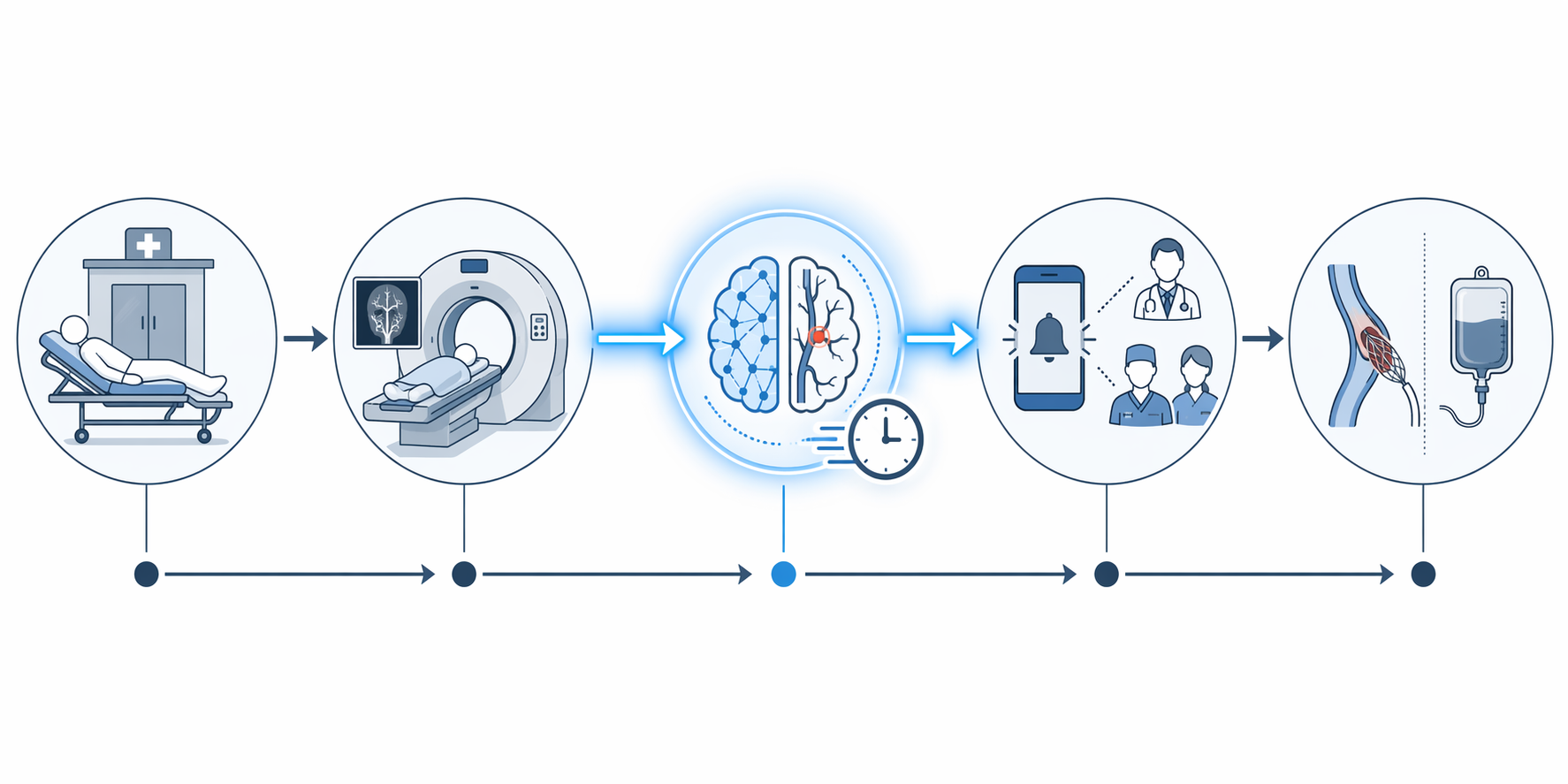
That sounds modest until one has watched the minutes disappear. The emergency physician is handling several unstable patients. The radiologist is reading across modalities. The neurologist may be covering more than one site. The interventional team cannot prepare for a thrombectomy it does not yet know is coming. A notification that reaches the right group earlier can change whether the team is assembling while the patient is still in imaging or only after several human handoffs.
| Workflow point | What AI may change | What it does not decide by itself |
|---|---|---|
| CT/CTA image review | Prioritizes or flags suspected acute findings for review | Final diagnosis, clinical eligibility, and treatment choice |
| Large-vessel-occlusion triage | Alerts stroke, radiology, and neurointerventional teams sooner | Whether the patient should undergo thrombectomy |
| Team notification | Reduces delay between scan availability and team awareness | Whether staffing, transfer, consent, or comorbidities permit treatment |
| Door-to-groin or treatment interval | May compress downstream preparation time | Whether faster workflow produces better long-term function in a given population |
This is the right place to talk about the best-supported benefit: time. A 2026 synthesis of AI stroke detection evidence reports door-to-notification reductions in the 30% to 52% range, with a summarized estimate of 43% faster notification across multiple studies.[3] The same synthesis describes the Martinez-Gutierrez stepped-wedge trial as showing an 11.2-minute reduction in door-to-groin time, while not showing a statistically significant improvement in 90-day functional outcomes.[3]
That distinction matters. Door-to-notification is a workflow endpoint. Door-to-groin time is closer to treatment. Ninety-day functional outcome is what patients and families usually mean when they ask whether the technology “worked.” A system can improve the first two without proving the third, especially when baseline stroke systems are already fast, sample sizes are limited, patient selection varies, and post-acute recovery depends on factors far beyond image triage.
For readers who want the longer evidence trail, ClinicalMind has a focused discussion of why AI stroke detection saves time but not outcomes and a separate review of peer-reviewed evidence for AI stroke detection in ERs. Those are the articles to read before turning a public awareness moment into a capital request.
The public education gap is larger than the product conversation
The most actionable number in this discussion may not come from an AI paper at all. The CDC reports that only 38% of Americans know all five stroke symptoms. It also identifies stroke as the fifth leading cause of death in the United States and reports nearly 800,000 strokes each year.[4] A health system that uses a celebrity death news cycle only to discuss software procurement is missing the simpler and more immediate opportunity: people still do not reliably recognize the event that has to trigger the entire care pathway.
That does not make AI irrelevant. It puts AI in its proper sequence. Public awareness gets a person to act. EMS routing, emergency triage, imaging access, radiology review, neurology evaluation, and procedural readiness determine what happens next. AI can help once the patient is inside the imaging workflow; it cannot repair a two-hour delay at home caused by symptom uncertainty or wishful waiting.
This is also why clinicians should be careful with the word “prevention” in public-facing conversations. AI stroke detection is not primary prevention. It does not treat hypertension, prescribe anticoagulation, stop smoking, or manage diabetes. In the acute setting, it is a detection and triage accelerator. If a hospital is using the awareness window to improve stroke awareness after celebrity deaths, the message should separate symptom recognition, risk-factor control, emergency response, and in-hospital AI triage rather than blending them into one reassuring technology story.
What to say when administrators ask whether the hospital needs AI stroke detection
A reasonable institutional answer starts with the local stroke chain, not the vendor list. Where are the delays? Is the recurring problem image availability, radiologist recognition, neurologist notification, transfer coordination, interventional team activation, or documentation after the decision has already been made? The same AI alert can be valuable in one setting and mostly decorative in another.
Products such as Viz.ai, RapidAI, Aidoc, and Brainomix are often discussed in this category, and regulatory clearance matters when a hospital evaluates a specific tool. ClinicalMind’s summary of the Viz.ai Stroke AI FDA device record is a useful starting point for that kind of review. But clearance, adoption, and clinical effectiveness are different claims. A cleared triage tool may be safe enough for its indicated use and still need local validation to show that it changes the hospital’s own workflow.
Secondary sources have claimed that only 20% to 30% of U.S. stroke centers use AI stroke detection, but that figure needs primary-source verification before it should appear in a board packet or grant application.[3] The direction of the claim is plausible — adoption is uneven — but the exact percentage should not be treated as settled just because it is useful in a procurement argument.
A more defensible evaluation asks for a short list of local measures before and after implementation: scan-to-alert time, alert-to-neurologist acknowledgment, door-to-needle time where relevant, door-to-groin time for thrombectomy candidates, transfer acceptance time, false alert burden, after-hours performance, and subgroup performance. The tool should also be reviewed against the hospital’s staffing model. An alert that fires quickly but reaches an already overloaded group without clear role assignment can create noise rather than speed.
The limitations belong in the first conversation, not the fine print
The main reason to be frank about limitations is not legal caution. It is operational trust. Stroke teams stop trusting tools that over-alert, under-detect important cases, or perform differently from what was implied during rollout. Patients and families also deserve a clear boundary: the AI may help the team see and notify faster; it is not a guarantee that a stroke will be found, treated, or reversed.
The 2026 technology synthesis reports miss rates ranging from 3% to 15% depending on stroke type and location, and false-positive rates ranging from 5% to 25% across platforms.[3] Because those figures come through a secondary synthesis, they should be verified against the underlying studies before being used as definitive institutional benchmarks. The clinical point, however, is familiar: small strokes, subtle findings, and posterior circulation presentations are harder environments for automated detection than a conspicuous large-vessel occlusion.
Equity claims require the same discipline. The synthesis reports sensitivity differences of 4 to 7 percentage points lower for Asian and Hispanic populations, attributed to training-data gaps.[3] That is concerning enough to prompt due diligence, but it should not be repeated without context, source review, and local performance monitoring. If a hospital deploys AI stroke detection, it should know whether performance is stable across the populations it actually serves.
There is also the false-positive burden. A false alert is not just an abstract specificity problem. It pages people, changes priority queues, may pull a neurologist into an urgent review, and can desensitize a team if the signal-to-noise ratio is poor. In a mature program, false positives are not a reason to abandon AI automatically; they are a reason to measure alert quality, escalation pathways, and who carries the workload.
How to use the awareness spike without overstating the evidence
The best professional response to public concern has two parts. First, make the public-facing message simpler and earlier: know stroke symptoms, act immediately, and do not wait for symptoms to declare themselves politely. The CDC’s 38% symptom-awareness figure is enough to justify repeating that message without embarrassment.[4]
Second, make the internal technology conversation more precise. If the hospital already has AI stroke detection, clinicians can explain where it sits in the pathway and what metrics the program follows. If the hospital does not, the awareness moment can justify a workflow review, not a shortcut around it. The procurement question should be: which measurable delay are we trying to reduce, and what evidence suggests this tool reduces that delay in a setting like ours?
Some health systems describe AI stroke tools as part of broader stroke operations rather than standalone miracles. Henry Ford Health, for example, has publicly discussed AI use in stroke care as a way to support faster identification and coordination, while still embedding it within physician-led clinical workflows.[5] That is the right tone. AI is most credible when described as infrastructure for a team, not as a replacement for the team.
The unfinished outcomes question should remain visible. The 2026 synthesis describes DETECT and FAST-AI randomized trials as ongoing, with results expected in the 2027–2028 window, and notes that no completed randomized trial has yet proven a statistically significant improvement in functional outcomes.[3] Until those results arrive and are interpreted carefully, the strongest claim is still a workflow claim.
That claim is not trivial. In stroke care, minutes matter operationally, emotionally, and sometimes biologically. Faster notification can mean a team is ready sooner, a transfer is discussed earlier, or an interventionalist is pulled in before another avoidable handoff. But the public question after a celebrity death is usually more personal: would this have changed the outcome? For now, the responsible answer is that AI stroke detection can help hospitals move faster once the patient reaches imaging, but it has not yet proven better long-term recovery.
References
- Celebrities can spark change when they speak up about their health, American Heart Association, December 13, 2024
- Deaths in 2026, Wikipedia
- How Accurate Is AI Stroke Detection? Speed vs. Doctors (2026), Articsledge
- Stroke Facts, Centers for Disease Control and Prevention
- How AI is helping improve stroke outcomes at Henry Ford Health, American Medical Association
Comments
Join the discussion with an anonymous comment.