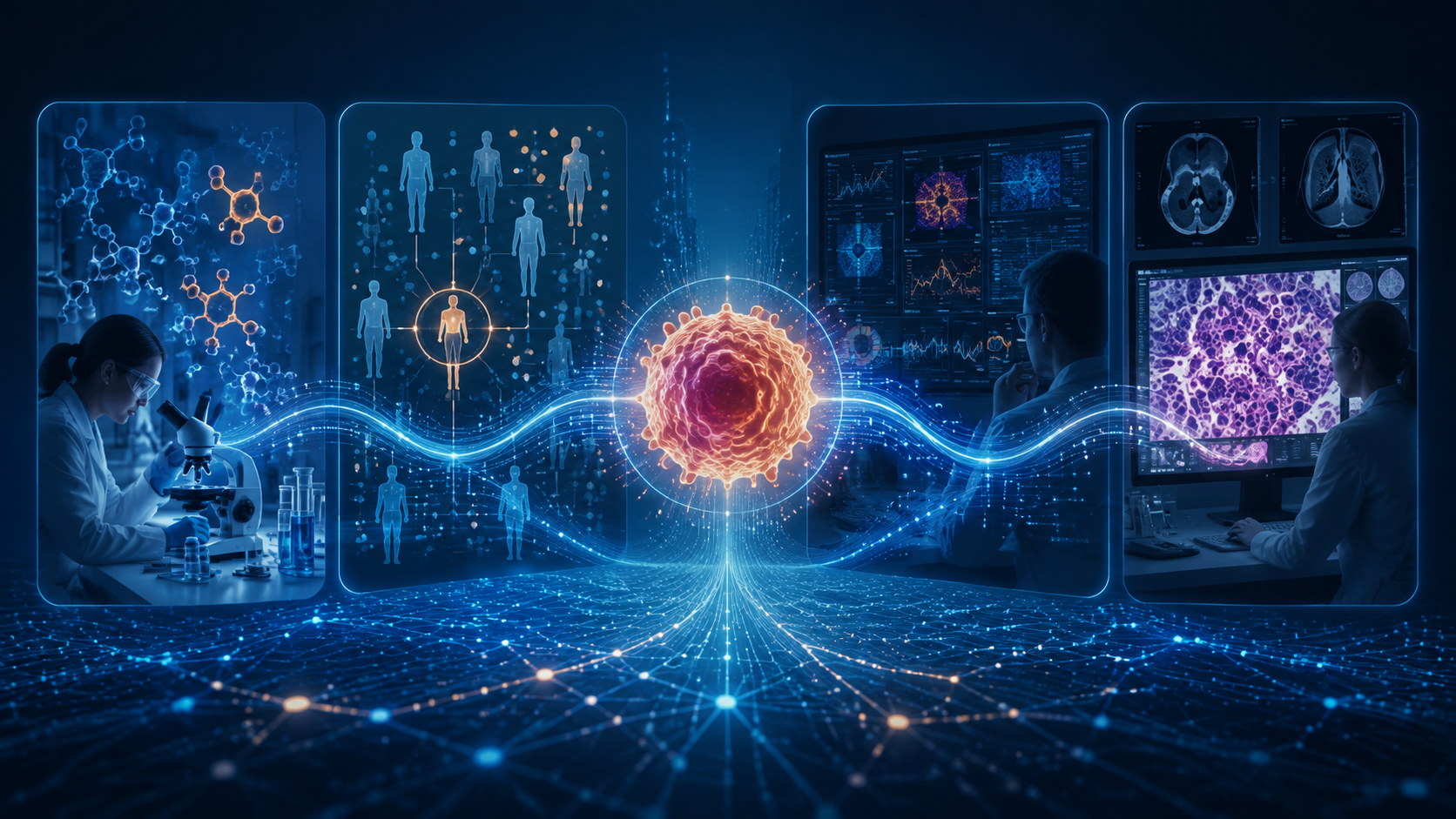
The most important cancer treatment updates in 2026 are not coming from one spectacular AI breakthrough. They are coming from a quieter convergence: AI systems are now being tested or used across drug discovery, trial matching, treatment selection, pathology, radiology, and regulatory review. That matters because oncology work has always been an exercise in reconciliation — molecular results against imaging, trial criteria against messy records, treatment guidelines against recurrence risk, and patient timelines against the speed of evidence.
The claim needs discipline. AI has become an infrastructure layer across the oncology pipeline by Q3 2026, but the strength of evidence differs sharply by task. Trial matching has some of the clearest operational evidence. Pathology, radiology, and treatment-selection models show credible movement toward multimodal decision support. Drug discovery has crossed a meaningful clinical-trial threshold, but no AI-discovered cancer drug has yet received FDA approval as of July 20, 2026.
Why 2026 Feels Different
Oncology has seen many AI demonstrations over the past decade: a model reading images, a classifier predicting mutation status, a platform ranking trial options. What is different now is not that every tool has matured equally. It is that AI is appearing at several points where cancer care already strains under volume, complexity, and time pressure.
| Pipeline domain | What AI is being asked to do in 2026 | Evidence signal |
|---|---|---|
| Drug discovery | Design or prioritize molecules and expand clinical-stage pipelines | AI-designed molecules entered clinical trials; approval evidence still absent |
| Clinical trial matching | Parse patient records and trial criteria to reduce manual screening burden | Reported screening-time reductions and review-level performance above common accuracy thresholds |
| Treatment selection and adaptation | Integrate clinical, molecular, radiographic, and longitudinal treatment data | Emerging multimodal subtype and dosing support; readiness varies by use case |
| Pathology and radiology | Flag visual patterns, recurrence risk, nodules, or molecular status from images | Task-specific performance signals, including comparisons with existing risk scores |
| Regulatory review | Prepare reviewers to evaluate AI-integrated oncology submissions | FDA programmatic activity; not proof of clinical benefit |
The backdrop is large enough to justify serious attention. A Cancer Research Institute 2026 report cites an estimated 2.1 million new cancer cases in the United States in 2026, a 34% decline in the cancer death rate since 1991, and a 70% five-year survival milestone for the 2015–2021 American Cancer Society cohort.[1] Those figures do not show that AI caused better outcomes. They do show why oncology is a high-stakes proving ground: small improvements in matching, stratification, or diagnostic interpretation can affect a very large clinical population.
Drug Discovery Has Momentum, Not Yet Proof of Patient Benefit
AI-designed molecules entering clinical trials in 2026 is a milestone worth taking seriously. It means the technology has moved beyond retrospective target ranking or chemistry demonstrations into the regulated, expensive, failure-prone world of human testing. Drug Target Review also reported an estimated $2.6 billion AI drug discovery market and more than 173 AI-originated programs in clinical stages.[2]
Those are momentum signals, not outcome signals. Market size does not measure survival, progression-free survival, response durability, toxicity reduction, or approval probability. A clinical-stage program count says that companies and sponsors are advancing AI-originated assets; it does not tell a tumor board whether a patient should receive one. For a deeper evidence framing of this gap, the distinction between acceleration and proven clinical utility is also central to AI drug discovery evidence.
The cleanest 2026 interpretation is therefore narrow: AI has become important to oncology discovery pipelines, and at least some AI-designed candidates have reached clinical testing. The more consequential claim — that AI-discovered oncology drugs improve patient outcomes or outperform conventionally discovered drugs after FDA review — remains unproven as of mid-2026.
Trial Matching Is Where Workflow Evidence Becomes Hard to Ignore
Clinical trial matching is less glamorous than molecule design, but it sits closer to a daily oncology failure point. A patient may have a rare biomarker, prior lines of therapy, organ-function constraints, travel limitations, and a narrow treatment window. A coordinator or clinician then has to reconcile all of that against inclusion and exclusion criteria written in protocol language. Miss the match, and the theoretical trial option is functionally unavailable.

This is why the trial-matching evidence in the 2026 npj Precision Oncology review deserves more weight than a generic claim that AI can “personalize care.” The review describes tools such as TrialGPT, MatchMiner, and OncoLLM reducing screening time by 25% or more, with systematic reviews reporting accuracy, sensitivity, and specificity consistently exceeding 80%.[3] Those metrics map onto actual clinical operations: fewer hours spent reading charts and protocols, fewer eligible patients lost in the paperwork, and more defensible triage before a human makes the final call.
The performance measures also matter because trial matching is not a single-score problem. High sensitivity helps avoid missing patients who might qualify. Specificity helps prevent coordinators from wasting time on patients who plainly do not. Accuracy is useful, but only after asking what counts as a correct match and whether the source data include the messy facts that determine eligibility: prior toxicities, washout periods, measurable disease, sequencing reports, and rapidly changing performance status.
A 25% reduction in screening time is not a surrogate for survival. It is still clinically meaningful if it occurs in the right setting. Oncology trial offices operate under finite staffing, and a screening queue is not neutral; patients are waiting while disease progresses, slots close, or travel windows disappear. The strongest case for trial-matching AI in 2026 is therefore operational and access-oriented, not therapeutic in the direct pharmacologic sense.
Implementation remains the unglamorous hinge. A useful matcher has to read from the EHR without creating another abstraction burden, preserve a traceable rationale for why a trial was surfaced, and allow trial staff to correct the model without turning every correction into a bespoke IT ticket. It also has to make uncertainty visible enough for oncologists to explain why a trial is being considered, ruled out, or held pending missing documentation.
Treatment Selection Is Moving Toward Multimodal Judgment
Cancer treatment selection rarely depends on one clean variable. A genomic alteration may matter differently by tissue type. A radiographic pattern may change the urgency of treatment. Pathology may refine grade, subtype, or recurrence risk. Prior toxicity may narrow the feasible options. AI becomes clinically interesting when it helps assemble these fragments into a more precise decision, rather than merely adding another score to the chart.
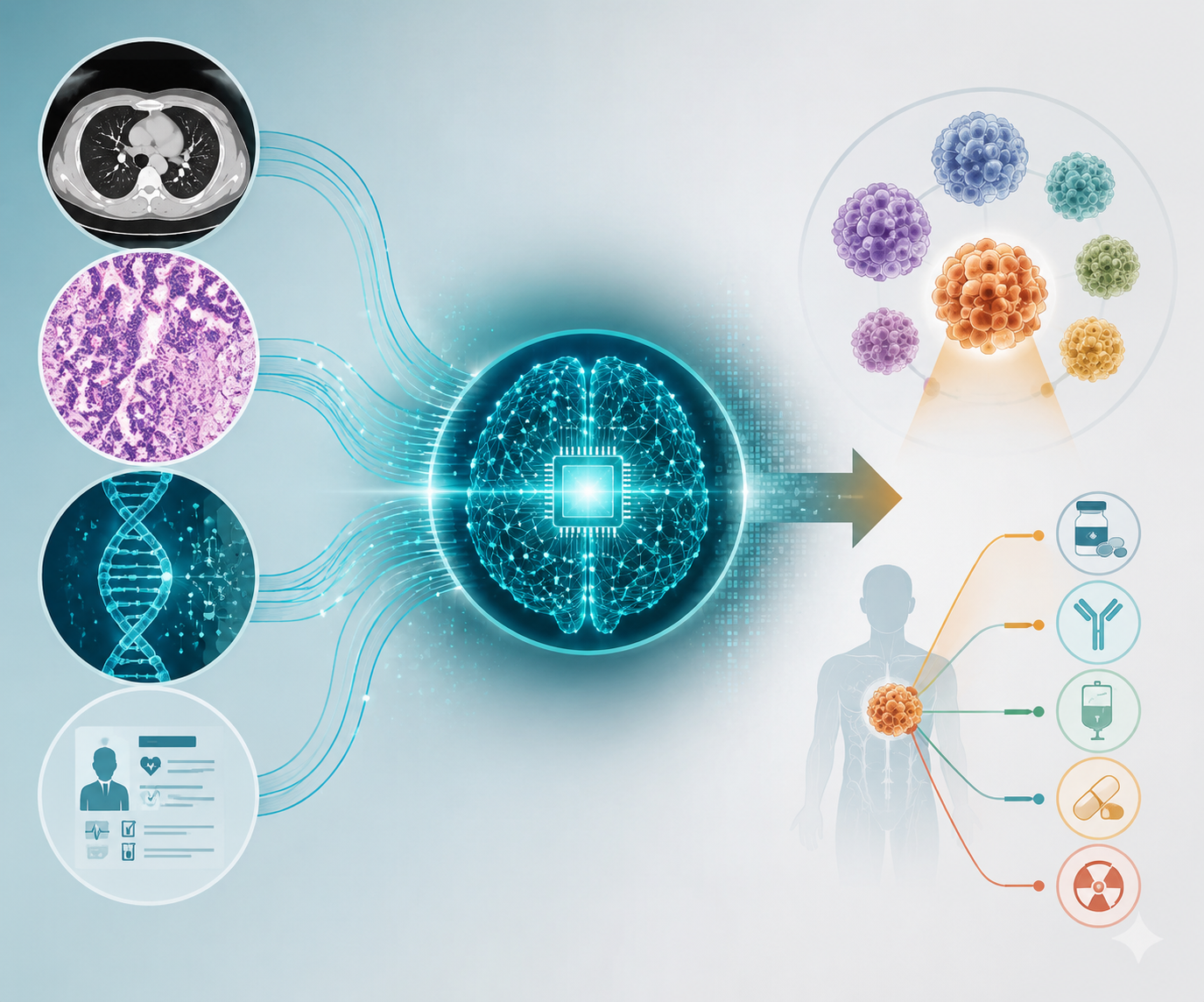
AACR expert forecasts for 2026 point to multimodal AI models integrating clinical, radiographic, and molecular data to subdivide historically monolithic cancers, including pancreatic cancer and glioblastoma, into more actionable subtypes.[4] That is a materially different claim from saying AI “chooses treatment.” The near-term value is in making heterogeneity more visible: identifying groups that may behave differently, respond differently, or deserve different trial designs.
ASCO Breakthrough 2026 coverage also highlighted CURATE.AI-style platforms for dynamic treatment adaptation.[5] The idea is clinically attractive because many oncology decisions are sequential. Dose, schedule, and combination choices evolve as tumor markers, imaging, symptoms, and adverse events change. A dynamic model can, in principle, help clinicians adjust therapy based on a patient’s observed response rather than relying only on population averages fixed at treatment start.
The unresolved question is how far these systems can move from support to responsibility. Subtype discovery is not the same as validated treatment assignment. Dynamic dosing support is not the same as demonstrating superior outcomes in a prospective trial. A model can clarify patterns that clinicians should see; it can also introduce recommendations whose rationale is difficult to communicate at the bedside if validation is thin or local data drift from the development cohort.
This is where oncology informatics work becomes clinical work. Model outputs must fit into tumor board review, molecular tumor board documentation, pharmacy workflows, consent discussions, and monitoring plans. If the output arrives as a black-box treatment suggestion without provenance, confidence intervals, comparable cases, or missing-data flags, it will either be ignored or overtrusted. Neither outcome counts as transformation.
Pathology and Radiology Are Stronger When the Task Is Specific
The most credible image-AI claims in oncology are usually not sweeping declarations that a model reads cancer better than physicians. They are narrower: a model discriminates pulmonary nodules, predicts microsatellite instability from pathology slides, or improves recurrence-risk modeling for a defined disease setting.
Dana-Farber’s 2026 review of cancer-related breakthroughs highlighted several such examples: multimodal breast cancer recurrence models that outperformed standard clinical risk scoring at SABCS 2025, AI for pulmonary nodule discrimination, and deep learning approaches predicting MSI status from pathology slides.[6] These are the kinds of tasks where comparison matters. A recurrence model should be judged against existing clinical risk scoring, not against an imaginary world with no risk tools. A pulmonary nodule model should be judged by whether it improves discrimination in the population where radiologists and pulmonologists actually face uncertainty.
Pathology is especially sensitive to how AI is inserted. A slide-level flag can help a pathologist find an area of interest or prompt molecular testing consideration. It can also create review burden if false positives cluster in predictable artifacts or if the model was trained on staining, scanning, or population patterns that do not match the local lab. The clinical question is not whether AI can see pixels; it is whether the system changes diagnostic reliability, turnaround time, triage, or downstream treatment selection without hiding failure modes.
Radiology faces a parallel issue. A nodule classifier may be useful if it reduces unnecessary follow-up, prioritizes suspicious findings, or supports earlier workup in a measurable way. But “detects cancer” is too crude a claim for practice. Thresholds, pretest probability, incidental findings, and reporting workflow determine whether a model helps or simply adds another alert to an already crowded queue.
Regulation Is Catching Up to AI-Integrated Oncology
Regulatory capacity is now part of the story. The FDA Oncology Center of Excellence launched its Oncology Artificial Intelligence Program in 2023, and the program has been operationalized through 2026 to train reviewers on AI methodologies and streamline review of AI-integrated oncology applications.[7] That is a stabilizing signal: AI is no longer peripheral to the kinds of submissions oncology reviewers expect to see.
It is not, by itself, evidence that any particular AI system improves cancer outcomes. Review literacy helps the agency ask better questions about data provenance, algorithm updates, validation cohorts, intended use, and postmarket performance. It does not substitute for prospective evidence, appropriate endpoints, or clear accountability when a model changes clinical behavior. The broader policy landscape for generative and predictive systems in health care is tracked in the 2026 healthcare AI evidence and policy landscape.
The Evidence Bar Should Change by Use Case
The wrong way to evaluate oncology AI in 2026 is to ask whether “AI works” in cancer treatment. The better question is what decision the system touches, what harm follows from error, and what evidence would be enough for that decision.
- For trial matching, the key evidence includes sensitivity, specificity, accuracy, time saved, missed-eligibility audits, and human override review.
- For treatment selection, the key evidence includes prospective validation, endpoint relevance, subgroup stability, and whether the model changes therapy in a way clinicians can justify.
- For dynamic dosing, the key evidence includes safety monitoring, response-adapted performance, toxicity outcomes, and clear rules for clinician control.
- For pathology and radiology, the key evidence includes comparison with standard clinical risk tools or diagnostic workflows, not just standalone model metrics.
- For drug discovery, the key evidence ultimately remains clinical: approvals, patient outcomes, toxicity profiles, and evidence that AI-originated assets add value beyond expanding the pipeline.
This domain-specific standard also protects useful AI from being dismissed because another part of the field is immature. A trial-matching tool that reliably reduces screening burden should not have to wait for an AI-discovered drug approval to be useful. Conversely, a growing AI-originated oncology pipeline should not be allowed to borrow clinical credibility from workflow tools that have clearer operational evidence.
Data infrastructure is the quiet dependency underneath most of these systems. Multimodal oncology models need clinical notes, structured treatments, molecular results, imaging, pathology, and outcomes to align across institutions. That raises familiar problems: data quality, missingness, consent, governance, interoperability, and whether smaller or under-resourced centers can participate. Approaches such as federated learning may help some collaborations avoid centralizing sensitive data, but they do not remove the need for careful validation across sites; the practical use cases are mapped in federated learning across clinical medicine.
A Calibrated 2026 Read
By Q3 2026, AI is no longer an accessory topic in cancer treatment updates. It is part of how new molecules are being generated, how patients are being matched to trials, how tumors are being subdivided, how dosing strategies are being explored, how images and slides are being interpreted, and how regulators are preparing to review AI-integrated submissions.
The strongest near-term clinical case is not that AI cures cancer. It is that AI can reduce certain frictions in oncology’s evidence pipeline: screening patients faster, surfacing eligibility more consistently, integrating multimodal data, and supporting more specific diagnostic or risk tasks. The weakest claims are the ones that treat discovery speed, market growth, or model novelty as if they already equal therapeutic benefit.
Several 2026 oncology developments also require status-as-of dating. Pending regulatory decisions and phase 3 readouts, including ivonescimab’s November 2026 PDUFA date and mRNA-4157 phase 3 results, may shift the landscape after publication.[1] Those moving targets are another reason to separate infrastructure maturity from outcome proof: AI has become real oncology infrastructure across discovery, matching, selection, and diagnostics, while the most consequential claims still require prospective outcomes, approvals, real-world validation, and careful monitoring after deployment.
References
- Cancer in 2026: How Immunotherapy Is Reshaping the Odds, Cancer Research Institute
- 2026: the year AI stops being optional in drug discovery, Drug Target Review
- The role of AI in oncology: present applications and future horizons, npj Precision Oncology
- Experts Forecast Cancer Research and Treatment Advances in 2026, American Association for Cancer Research
- ASCO Breakthrough 2026 wrap-up, CancerNetwork
- Ten Cancer-Related Breakthroughs Giving Us Hope in 2026, Dana-Farber Cancer Institute
- OCE Oncology Artificial Intelligence Program, U.S. Food and Drug Administration
Comments
Join the discussion with an anonymous comment.