
The useful promise of AI in player safety and turf injury prevention is not that a model can look at a field and declare it safe or unsafe. The harder, more practical problem is joining information that has usually been separated: surface hardness and wear, athlete acceleration and deceleration, contact or non-contact mechanism, footwear, weather, maintenance history, and video-derived movement patterns. A Monday morning injury review rarely fails because nobody cares about the surface. It fails because the surface data, athlete-load data, and clinical context often live in different places.
That distinction matters because the turf question is clinically important and scientifically contested. NFLPA-cited data from 2012 to 2018 reported a 32% higher rate of non-contact knee injuries and a 69% higher rate of non-contact foot and ankle injuries on artificial turf than on natural grass; the same discussion cites a broader 28% higher rate of non-contact lower-extremity injury on artificial turf.[1] Mack et al. reported a 16% increase across all lower-extremity injuries on artificial turf in a study published in the American Journal of Sports Medicine.[2] In NCAA football, posterior cruciate ligament tears have been described as approximately three times more likely on artificial turf.[3]
Those findings are enough to explain why athletes, athletic trainers, and field managers keep returning to the issue. They are not enough to prove that any specific AI system can prevent turf-related injuries. The evidence chain is longer: measure the surface, connect that measurement to the athlete’s exposure and movement, interpret risk at the individual level, change something before an injury, and then show that the injury rate moved for reasons plausibly tied to that intervention.
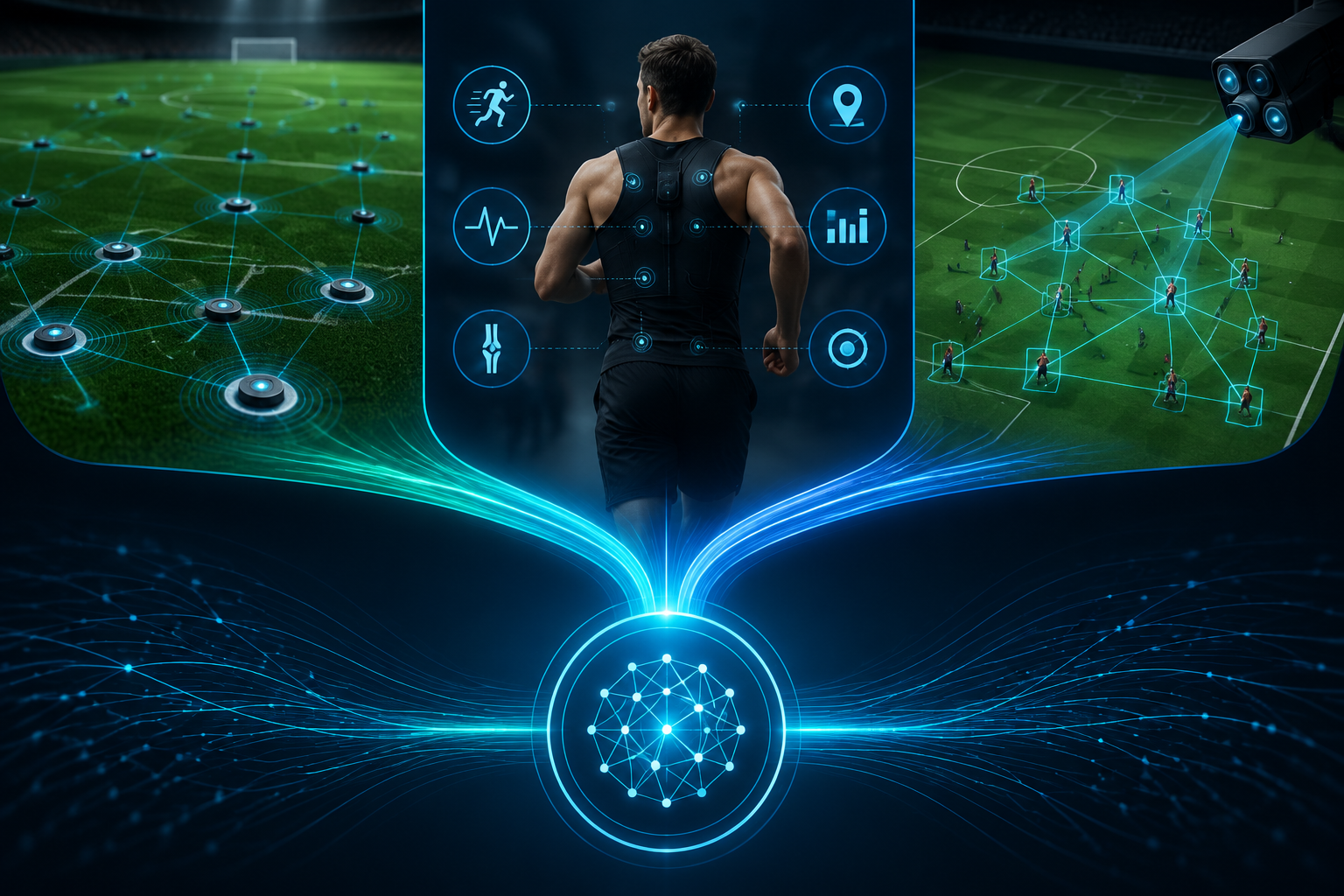
What AI Is Actually Connecting
A playing surface is not a single exposure. It changes by field zone, age, use, weather, maintenance, and the type of movement being performed on it. A hard landing area, a worn cutting lane, and a high-load practice block are different problems even when they all appear under the word “turf.” AI becomes relevant when those differences can be measured repeatedly and matched to athlete behavior instead of being reconstructed after the fact.
One route is smart field monitoring. FieldTurf describes its SmartTeam Project as a multi-institutional, multi-year effort over three years that collects millions of data points by linking athlete biometrics such as heart rate, speed, player load, and head impacts with real-time surface conditions from FieldTurf Genius sensors.[4] The important feature is not the brand name. It is the attempt to put field condition and athlete exposure into the same time-stamped record.
Another route is computer vision inspection. Turf-management systems are being described for tasks such as detecting wear patterns, surface irregularities, and damage that could increase injury risk.[5][6] This is a different kind of measurement from a periodic walk-through. A facility crew may know where the stressed zones are, but computer vision can make those observations more consistent, more frequent, and easier to compare over time. That does not turn every worn patch into a proven injury mechanism. It does create a record that can be paired with practices, games, and athlete movement.
The athlete side of the bridge comes from GPS-IMU systems, optical tracking, and video. Wearable platforms such as Catapult-style GPS-IMU systems track player load, acceleration, and deceleration, which are the kinds of variables that can be aligned with surface condition data. The limitation is just as important: no published study has shown that combining those wearable measures with turf data has caused a direct reduction in turf-specific injuries.
For readers who want the broader wearable-AI evidence without making this turf article carry all of that background, ClinicalMind’s analysis of AI wearables for sports injury prediction covers the gap between model performance, data quality, compliance, and clinical readiness. The turf-specific question adds another layer: even if a load model works well, it still has to show that surface properties improve the interpretation in a way that changes decisions.
From Separate Measurements to a Risk Model
A usable surface-athlete model needs a common clock. If a field sensor records surface hardness in one zone, a wearable records repeated high-intensity decelerations in that same zone, and video shows an athlete cutting with a particular trunk and knee position, then the injury review has moved beyond general complaints about turf. The staff can ask whether a specific exposure pattern existed before symptoms, whether other athletes experienced similar loads in the same area, and whether maintenance or training changes are reasonable.
| Data stream | What it can add | What it cannot prove by itself |
|---|---|---|
| Smart field sensors | Surface condition trends such as hardness readings or localized changes over time | That a measured field condition caused a specific injury |
| Wearable GPS-IMU systems | Player load, acceleration, deceleration, and exposure volume | That the surface altered injury risk unless surface data are integrated and validated |
| Computer vision and video | Movement patterns, contact context, and field-zone review | That a predicted movement-risk pattern would have been prevented by changing the field |
| Integrated AI models | Multi-factor risk estimates using athlete, surface, and contextual data | A causal reduction in turf-specific injuries without outcome validation |
The NFL’s Digital Athlete platform is the largest public example of this integrated direction. AWS has described the system as processing approximately 6.8 million video frames and 500 million data points per week across all 32 teams, using computer vision and machine learning to identify injury-risk patterns.[7] Public reporting has also described the NFL’s use of AI to support injury prediction, with surface type included as one variable among many rather than as the sole explanation.[8]
That last clause deserves weight. Surface type inside a multi-factor model is not the same thing as a turf injury prevention system. The model may find that risk rises when a particular athlete’s recent workload, movement profile, position demands, and playing context align. Surface may strengthen or weaken that signal. But unless the model’s output leads to an intervention and injury outcomes are tracked against a meaningful comparator, the system remains a risk-management tool rather than proof of prevention.
This is where operational usefulness can arrive before clinical certainty. A staff might use integrated data to move a drill away from a worn zone, adjust a player’s exposure after a high deceleration week, flag a field section for maintenance, or review whether a cluster of complaints corresponds to a measurable surface change. Those decisions can be sensible even when they do not yet amount to evidence that AI has reduced turf-specific injury rates.
Why the Turf Evidence Still Has to Be Read Carefully
The strongest surface-injury statistics are epidemiologic. They compare injury rates across surfaces and injury types. They do not isolate every factor that matters on a given play: cleat selection, weather, previous tissue capacity, fatigue, contact mechanics, field age, infill condition, or the specific artificial turf system. That does not make the numbers irrelevant. It means they should be used as a reason to investigate and monitor, not as a shortcut around mechanism.
The NFLPA-cited figures on non-contact knee and foot or ankle injury are especially hard to ignore because they focus on injury types where the surface plausibly matters more than it would in a collision injury.[1] The AJSM finding of higher lower-extremity injury rates on artificial turf points in the same direction.[2] The NCAA PCL signal adds another specific injury category to the concern.[3] Together, they justify a serious surface-safety program. They do not establish that “artificial turf” is a uniform exposure or that AI has already solved the attribution problem.
There is also disagreement over interpretation. The NFL and NFLPA have not always read the surface data the same way, and some industry-funded work has reported no significant difference between surfaces. The controversy over slit-film surfaces shows why a broad turf-versus-grass label can become too blunt. If one artificial surface type, maintenance state, or field age behaves differently from another, a model trained on generic surface labels may miss the practical variable that actually matters.
For AI, that creates both an opportunity and a trap. The opportunity is granular measurement: not just turf or grass, but field zone, surface condition, athlete exposure, movement, and time. The trap is treating more variables as if they automatically settle causation. A model can learn patterns that help staff prioritize review, yet still fail when moved to another league, surface system, sensor vendor, or athlete population.
Prediction Is Not Prevention
Sports injury prediction models have improved, but their evidence base is uneven. A 2025 BJSM scoping review of 38 studies found that Random Forest and XGBoost were among the highest-performing machine-learning methods, with reported AUC values ranging from 0.57 to 0.95; only 18% of studies used model explainability techniques.[9] A 2026 IJMI scoping review of 59 studies found persistent problems including limited external validation, non-standardized measurement, and inconsistent reporting.[10]
Those weaknesses are not academic housekeeping. They affect whether an athletic trainer should trust a model’s alert. Injury is a rare event, so class imbalance can make models look better than they are if performance is not reported carefully. Small cohorts make it easier to find patterns that do not travel. Device heterogeneity matters because data from different wearables are not always interchangeable; performance can degrade by more than 25% when data from five different devices are integrated. If the model is already unstable before surface data are added, turf-specific interpretation becomes even more fragile.
Sponsor-funded or retrospective claims also need to be held at the right distance. Zone7’s reported 72% injury detection rate came from a retrospective, 11-team, sponsor-funded study that was not peer reviewed. That may be interesting product evidence, but it is not independent clinical validation. Similarly, reports that the NFL cut concussions by 17% in 2024 should not be attributed to AI alone because rule changes, equipment improvements, and protocol changes were also part of the environment.[11]
Regulatory status is another useful guardrail. No FDA-cleared or CE-marked AI injury prediction systems were identified for this discussion. The systems discussed here are best understood as research tools, performance platforms, and operational safety aids, not regulated medical devices. That does not make them useless; it does mean their outputs should not be treated as diagnoses or as validated medical clearance decisions.
What an Organization Can Reasonably Infer in 2026
By Q3 2026, the most defensible claim is that AI can make the surface-athlete relationship more measurable. Smart field sensors can document changing surface conditions. Computer vision can make field inspection and movement review more consistent. Wearables can quantify load, acceleration, and deceleration. Integrated models can place surface type or surface condition beside player history, workload, position, and movement data.
The less defensible claim is that AI monitoring has been shown to reduce turf-specific injuries. No published study has demonstrated a direct causal path from smart field sensing to AI risk prediction to intervention to lower turf injury rates. Published syntheses have associated AI-informed injury prevention strategies broadly with injury reductions ranging from 23% to 42%, but that is not the same as proving turf-specific prevention through integrated surface monitoring.[12]
The practical middle ground is where many sports medicine and field operations teams already live. A model alert might prompt a review of a player’s recent exposure. A cluster of high-load decelerations in one field zone might prompt surface testing or maintenance. Video may clarify whether an ankle injury followed contact, a slip, a planted cut, or a fatigue-related movement change. Each action is modest. Together, they replace argument by memory with review by linked evidence.
That linked evidence should also protect field staff from unfair blame. If surface readings are stable, the high-risk signal may be workload, footwear, fatigue, or contact mechanics. If athlete load is ordinary but the same field zone shows abnormal wear or hardness, the maintenance question becomes more urgent. AI is useful here because it can keep several explanations open long enough for the right one to be tested.
The Standard That Matters
For player safety, the standard should be traceability. A system should be able to show what surface condition was measured, which athlete exposure or movement pattern made that condition relevant, what risk interpretation followed, who reviewed it, what intervention occurred, and whether injuries changed over time. Without that chain, a dashboard can look sophisticated while leaving the same old turf-versus-grass argument untouched.
AI has moved the conversation forward by making the surface less abstract and the athlete less isolated from the environment. It has not yet delivered direct evidence that AI monitoring reduces turf-specific injuries, and it has not settled the scientific dispute over artificial turf versus natural grass. The strongest current position is disciplined: AI is a promising integration layer for player safety, not a validated answer to the turf injury debate.
References
- More NFL Injuries Raise Concerns About Artificial Turf, Forbes, 2025
- Lower extremity injury rates on artificial turf, American Journal of Sports Medicine, 2019
- Lower Extremity Injuries on Grass vs. Turf, SportsMedReview
- FieldTurf SmartTeam Project, FieldTurf
- AI in Sports Turf Management, Covermaster
- Artificial Intelligence in Sports: Enhancing Health and Safety, RawStadia
- Building a Digital Athlete, AWS
- NFL uses AI to predict injuries, AP News, 2025
- BJSM scoping review — ML approaches to injury risk prediction, British Journal of Sports Medicine, 2025
- IJMI scoping review — AI in identifying risk factors in sports injuries, International Journal of Medical Informatics, 2026
- How AI Helped the NFL Cut Concussions by 17%, Success.com
- AI in football: mitigating injury risk, Sportsmith
Comments
Join the discussion with an anonymous comment.