
When an injured athlete asks when they can safely return, the useful answer is rarely a single date. A rehabilitation team may be deciding whether the athlete can jog, rejoin non-contact training, tolerate match play, return to pre-injury level, or remain available without recurrence. That distinction matters for AI in sports injury recovery and return prediction, because a model that predicts one of those outcomes is not automatically predicting the others.
The current evidence is promising, but it is still closer to research-grade decision support than bedside authority. In the most directly relevant systematic review, Yuan et al. screened 56 studies and included 11 machine learning studies on return to sport after athletic injury. Sample sizes ranged from 32 to 1,611, the most commonly used algorithms included Random Forest, support vector machines, logistic regression, and XGBoost, and reported AUCs ranged from 0.57 to 0.96. Tree-based ensemble models often led the field, but no included study had prospective external validation.[1]
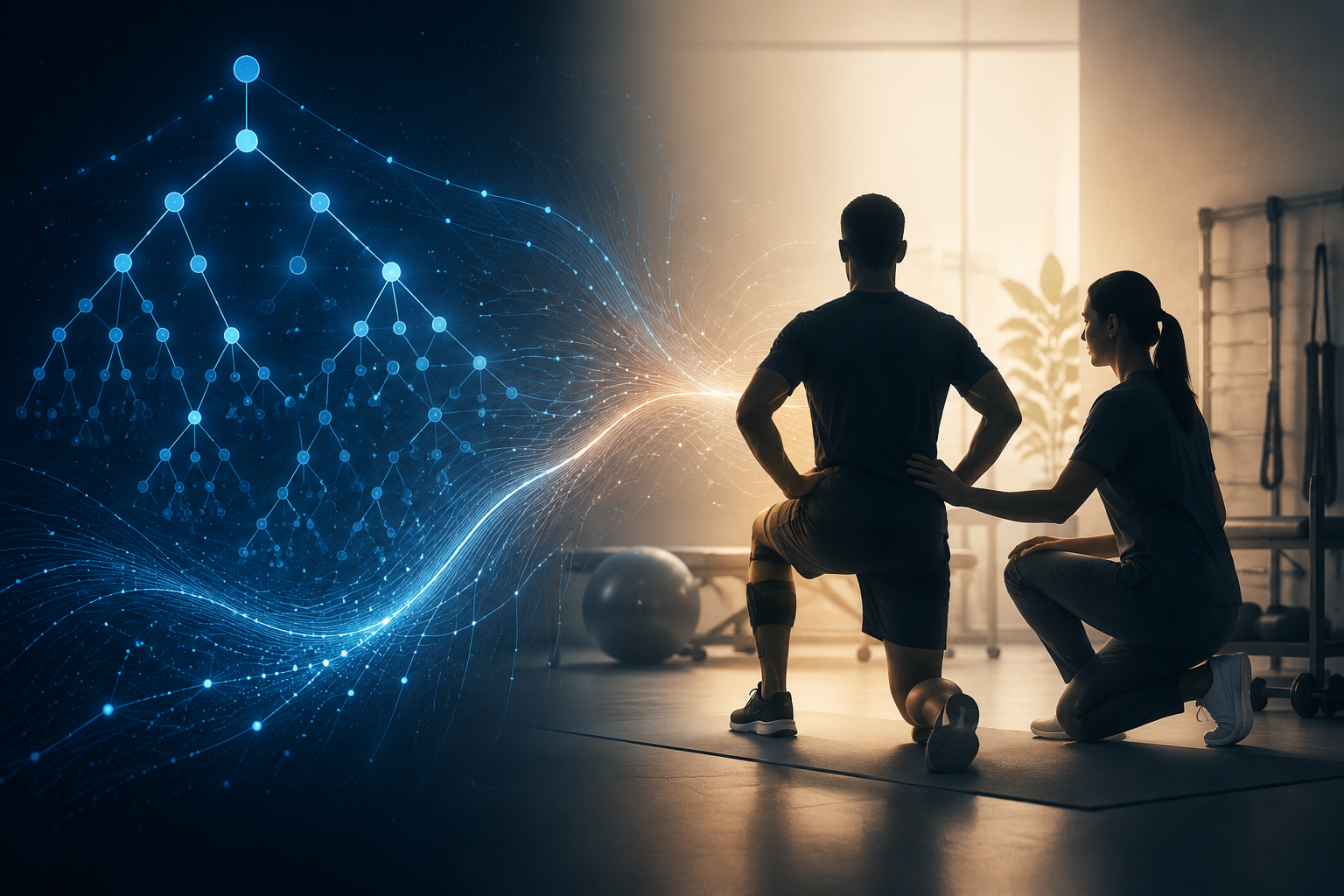
That last clause does more work than it may appear to do. Internal validation can show whether a model finds patterns in the dataset it was given. It cannot show whether the same model will behave well when a different clinic, sport, injury mix, therapist, surgeon, or athlete population uses it. For return-to-sport decision-making, that is not a statistical nicety. It is the difference between a model that helps frame a discussion and one that can safely influence clearance.
The best AUCs come from a fragile evidence base
The headline result from Yuan et al. is easy to summarize and easy to overread. Random Forest and XGBoost were among the strongest reported performers, and tree-based ensemble methods were the top-performing approach in 64% of the reviewed return-to-sport prediction studies. Across studies, AUCs reached as high as 0.96, with sensitivity ranging from 0.24 to 1.00 and specificity from 0.76 to 0.94.[1]
| What the RTS review found | Why it matters clinically |
|---|---|
| 56 studies screened; 11 included | The direct evidence base is still small. |
| Sample sizes ranged from 32 to 1,611 | Small cohorts are vulnerable to overfitting and unstable estimates. |
| Random Forest used in 55%, support vector machines in 45%, logistic regression in 55%, XGBoost in 36% | The field is comparing familiar model families, not a single standardized approach. |
| AUC ranged from 0.57 to 0.96 | Performance varies from weak discrimination to excellent discrimination. |
| Two studies reached excellent performance at ≥0.90; four reached good performance at 0.80–0.89 | High performance exists, but it is not the usual finding. |
| No prospective external validation | Clinical transportability remains unproven. |
AUC is useful, but it can be deceptively tidy in this setting. A model with a strong AUC may still miss too many athletes who are not ready if sensitivity is unstable, or may classify readiness under an endpoint that a clinician would not consider sufficient for clearance. Yuan et al. reported only two studies with excellent performance and four with good performance; the remaining studies fell below those thresholds.[1] That distribution should keep the high-end AUCs from becoming the whole story.
The sample-size problem is not cosmetic. An RTS dataset with dozens of athletes may contain strong local patterns: one surgical protocol, one league, one therapist’s progression rules, one sport’s competition calendar, or one injury subtype. A flexible model can learn those patterns very well. Whether it has learned a clinically reusable signal is a separate question.
This is where return-to-sport prediction differs from broader injury-risk prediction. Injury-risk models ask who is more likely to get injured under future exposure. RTS models ask whether an already injured athlete will reach a recovery or participation outcome after rehabilitation. The two problems share variables, but they do not share the same target. A workload spike may help explain injury risk; it does not, by itself, define readiness to compete after reconstruction, tendon injury, or muscle strain.
That distinction is worth preserving because the sports AI literature is often discussed as if prediction were one category. Readers looking for the broader validation problem in injury prediction can compare this RTS evidence with related concerns in Why AI in Sports Injury Prevention Still Lacks Validation. The overlap is real, but the clinical decision is not the same.
Return to sport is not one endpoint
The most important limitation in the current RTS modeling literature may be the one most easily hidden by a performance metric: the outcome itself. Yuan et al. found wide variation in how studies defined return to sport, including symptom resolution, functional status, competitive level, participation status, and rehabilitation duration.[1]
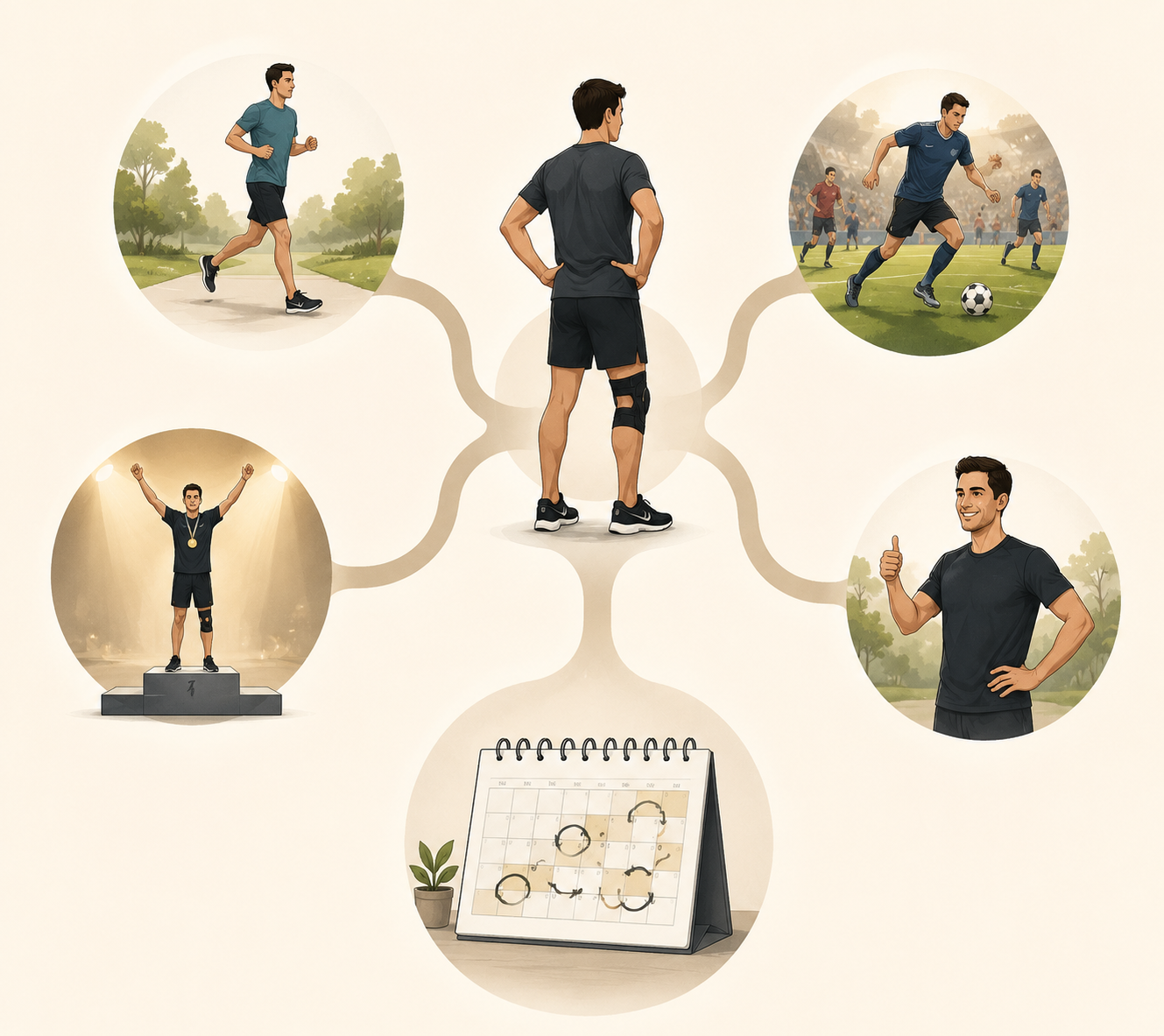
Those are not interchangeable labels. Symptom resolution may mean the athlete reports less pain or swelling. Functional status may mean a performance test or rehabilitation milestone has been met. Participation status may mean the athlete has re-entered training or competition in some form. Competitive level asks whether the athlete returned to the previous standard of play. Rehabilitation duration treats time itself as the predicted outcome. A model trained on one target can be clinically misleading if its output is interpreted as another.
Consider a hypothetical example. A model estimates a high probability of “RTS” by 6 months because, in its training data, RTS meant return to any level of sport participation. The athlete and coach may hear that as readiness for full competitive load. The surgeon may hear it as biological recovery. The physiotherapist may still be looking at strength asymmetry, movement quality, confidence, and exposure progression. Nothing in the AUC tells the team which meaning of RTS was silently chosen.
This is not a complaint about terminology for its own sake. The cost of ambiguity is borne after the paper ends: by the athlete who is cleared too early, the clinician who must explain uncertainty, and the staff member who has to translate a probability into training restrictions. A return-to-light-participation model may still be useful. It just should not be promoted as a return-to-match-play model.
What the models may be missing
Most RTS prediction models still lean heavily toward physical, clinical, and performance variables. That is understandable: range of motion, strength, injury type, surgery details, and sport-specific function are easier to structure than confidence, fear, sleep, stress, recovery context, and social pressure. But the imbalance is clinically awkward because rehabilitation teams routinely weigh those softer variables, even when they do not enter them into a dataset.
Yuan et al. reported that only 18% of included studies incorporated psychological variables. In one study, adding psychological factors such as fear of reinjury improved AUC only from 0.57 to 0.60.[1] That small gain should not be read as evidence that psychology does not matter. It may instead reflect crude measurement, insufficient sample size, timing of assessment, or a mismatch between the psychological instrument and the outcome being predicted.
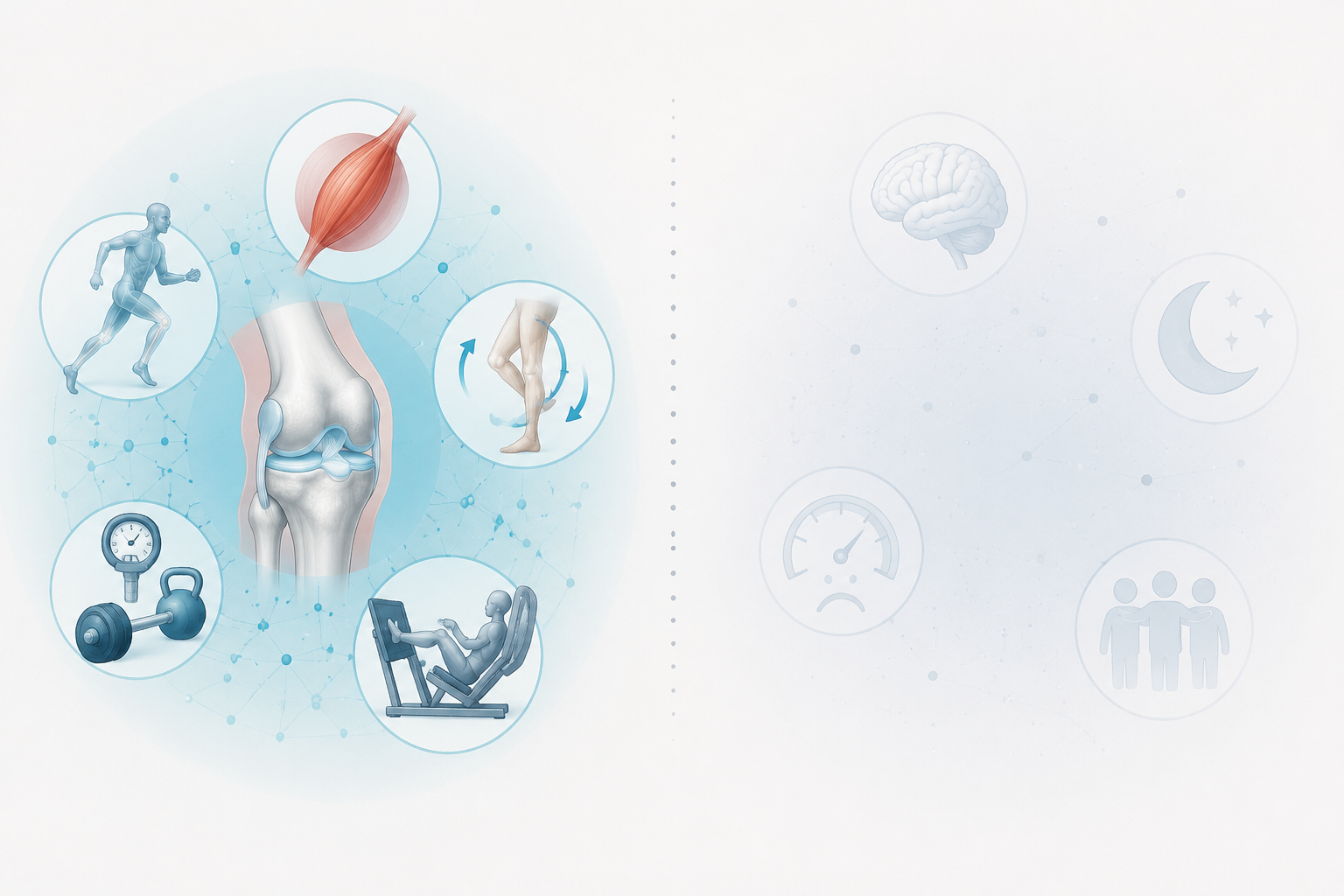
Related injury-prediction studies help explain why this gap deserves attention, even though they should not be treated as direct RTS evidence. In a 2025 study of 800 Chinese university football players, Ma et al. tested 10 algorithms across 18 features and reported that an SVM model achieved 95.6% accuracy and 99.2% ROC-AUC for injury risk prediction. SHAP analysis ranked stress level, sleep duration, and balance ability as the top predictors, with importance values of 0.10, 0.09, and 0.08; lifestyle factors ranked above all traditional physical fitness indicators.[2]
That result is informative, not transferable. Ma et al. used a 50:50 balanced class distribution, whereas real-world injury rates are often lower, and the study predicted injury risk rather than return-to-sport readiness.[2] A model that performs impressively in a balanced injury-risk dataset may not retain that performance when asked to classify recovery milestones in a rehabilitation population. Still, the prominence of sleep and stress fits what many clinicians already track informally.
The same point appears in narrower prevention work. Ayala et al. studied 96 professional soccer players and developed an alternating decision tree model for hamstring strain injury with an AUC of 0.87; sleep quality was the most important predictor.[3] Bowen et al. found that spikes in acute:chronic workload ratio were associated with a 5–7 times greater injury rate in English Premier League players.[4] These studies do not validate RTS models, but they suggest that workload, sleep, stress, balance, and lifestyle context are not peripheral to athletic health.
For RTS prediction, the next useful question is not simply whether to add more variables. It is whether models can represent the recovery state that clinicians actually care about: tissue healing, functional capacity, sport exposure, symptoms, psychological readiness, and the environment into which the athlete is returning. Wearable and monitoring systems may eventually help with the dynamic parts of that picture, but the data-collection promise should be kept separate from current RTS validation. For more on that monitoring side, see How ready are AI wearables for sports injury prediction?.
Where machine learning can help now
The practical role for current models is narrower than the strongest reported AUCs imply. They can help organize variables, expose how a team is weighting risk factors, identify patterns that are difficult to see manually, and support research on which recovery signals matter. They may also make uncertainty more explicit: instead of saying an athlete “looks close,” a team can ask which features are driving a model toward or away from a given RTS outcome.
That is useful, but it is not the same as clearance. A clinician still has to ask whether the model’s endpoint matches the decision at hand, whether the athlete resembles the training population, whether the validation was internal or external, and whether the model includes the recovery-context variables that are likely to matter for this case. If the answer is unclear, the model output should be treated as a starting point for discussion, not as a rule.
A clinically usable RTS prediction model would need at least four things the current literature does not yet provide consistently: standardized outcome definitions, larger and more representative samples, better integration of psychological and lifestyle factors, and prospective external validation. Until those become routine, Random Forest and XGBoost performance should be read as evidence of technical promise under constrained study conditions, not as proof that machine learning can decide when an athlete is ready to return.
References
- From injury to comeback: A systematic review of machine learning models predicting return to sport in athletes, Digital Health, 2026.
- SHAP-based interpretable machine learning for injury risk prediction in university football players, Scientific Reports, 2025.
- A Preventive Model for Hamstring Injuries in Professional Soccer, PubMed, 2019.
- Spikes in acute:chronic workload ratio associated with 5–7 times greater injury rate in English Premier League players, 2020.
Comments
Join the discussion with an anonymous comment.