
Wildfire-smoke sports postponements are no longer being treated as a late-game judgment call reserved for obviously hazardous air. Oregon’s June 2026 youth-sports framework moved the clinical trigger earlier: at AQI 51–100, the “moderate” range, children with asthma, heart disease, diabetes, respiratory disease, or other underlying conditions are already supposed to take added precautions; at AQI 151 or higher, youth outdoor activities are to be canceled or moved indoors. [1]
That matters because “moderate” has often sounded like a tolerable sideline inconvenience. In a clinic, it is not hard to see why that language fails. A 12-year-old forward with exercise-induced bronchospasm, a football lineman taking repeated high-minute exposures through warmups and scrimmage, and an older official with coronary risk factors are not experiencing the same event as a healthy adult walking across a parking lot.
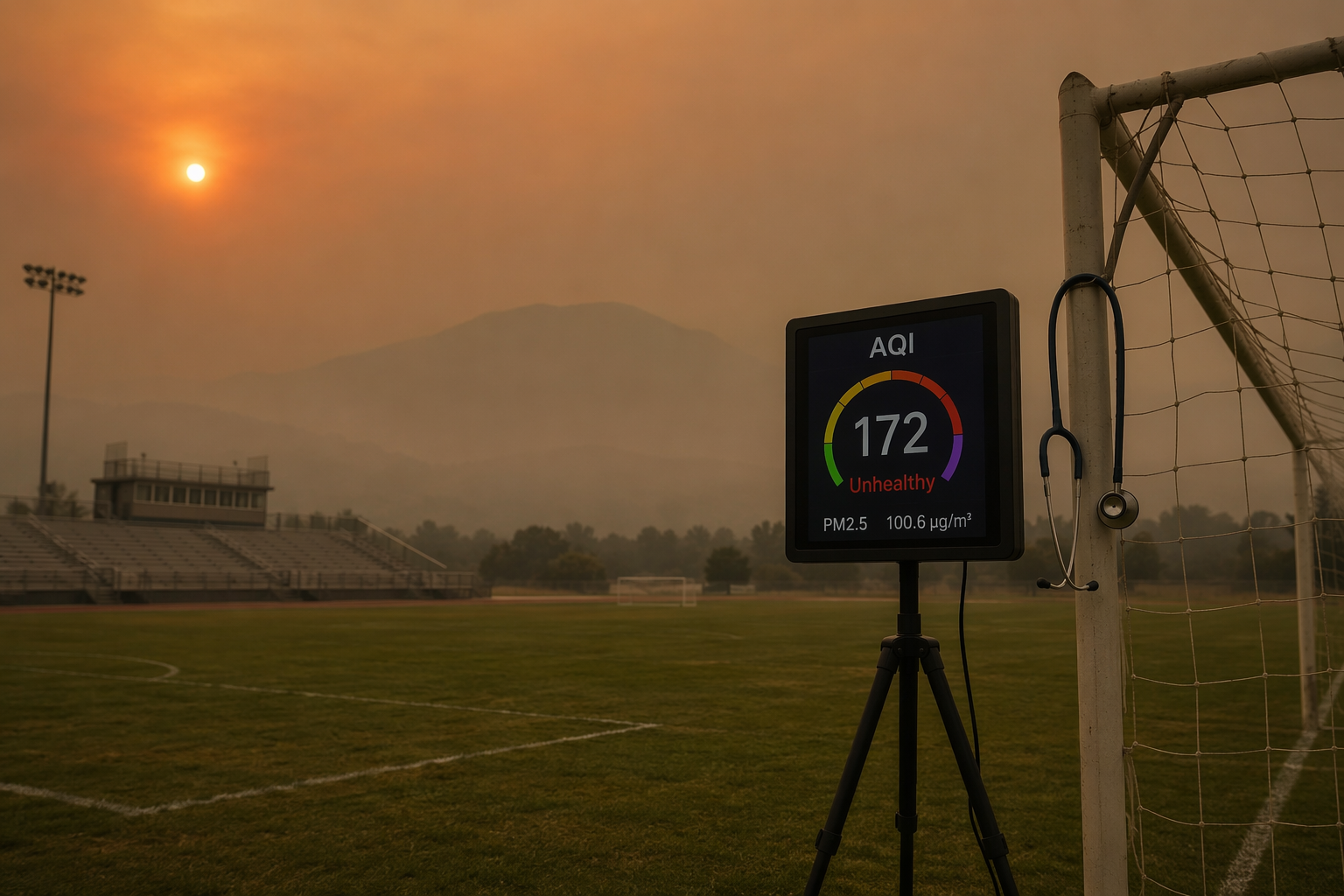
The same operational problem is now visible at the highest end of sport. Reporting around the 2026 World Cup has raised questions about wildfire-smoke contingency planning for major matches, while noting that plans remained unclear in public coverage as of July 2026. [2] A global tournament and a local youth league do not need identical rules, but they share one uncomfortable feature: once athletes, coaches, parents, broadcasters, and ticket holders are already in place, vague advice becomes hard to enforce.
Why Smoke During Sport Is a Different Exposure
AQI categories are useful for public communication, but athletic exposure changes the dose. During exertion, ventilation rises, mouth breathing increases, and the athlete spends less time filtering air through the nose. A practice that lasts two hours in smoky conditions is not just “being outside.” It is repeated high-volume inhalation during physiologic stress, often by people who are trying to ignore symptoms because performance and selection are on the line.
That distinction is clinically important because wildfire smoke is not simply a visible version of ordinary urban haze. It contains fine particulate matter small enough to reach deep airways, plus a changing mixture of combustion products determined by what burned, how hot it burned, and how the plume aged. The practical point for sport is not that every smoky day is automatically catastrophic. It is that the same AQI number can hide different toxicology and different physiologic demand.
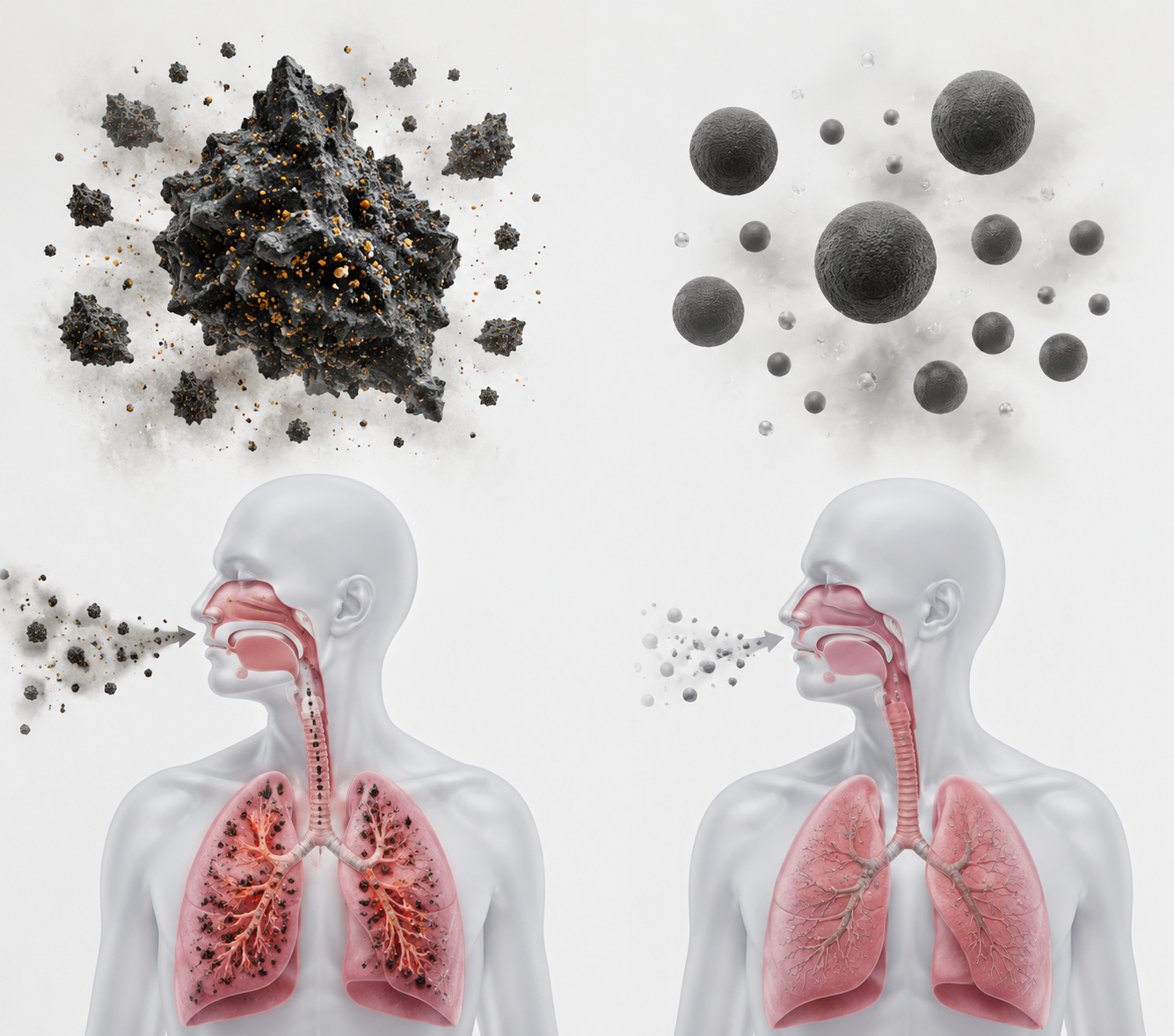
Aguilera and colleagues quantified that problem in Southern California by comparing wildfire-specific PM2.5 with non-wildfire PM2.5. They found wildfire PM2.5 was estimated to be 3 to 10 times more potent for respiratory hospital admissions per 10 µg/m³ increase, with respiratory hospitalizations rising 1.3% to 10% for wildfire-specific PM2.5 compared with 0.67% to 1.3% for background PM2.5. [3] That does not prove every field decision should use a separate wildfire index. It does mean that applying generic particulate assumptions to a wildfire plume can understate respiratory risk.
For clinicians, this is where the postponement question becomes sharper. If the pollutant is more biologically potent and the athlete is deliberately increasing minute ventilation, then waiting until air quality reaches a visibly severe category may be too late for some populations. Oregon’s move into the moderate AQI range for medically vulnerable children is cautious, but it is not clinically random.
The Cardiovascular Signal Is Hard to Dismiss
Smoke policy in sport is often discussed as if the only relevant question is whether an athlete can breathe comfortably. That is too narrow. The cardiovascular data are the evidence that should make sports organizations more careful about treating wildfire smoke as a nuisance condition.
The American Heart Association has highlighted research finding that same-day emergency department visits for heart attacks increased 42% during dense wildfire smoke days. [4] Separately, American Heart Association coverage of a 2020 Journal of the American Heart Association study reported that breathing heavy wildfire smoke may increase the risk of out-of-hospital cardiac arrest by up to 70%. [5] The latter estimate comes from a specific California wildfire period, so it should not be casually exported to every region, age group, or sport. But it is the wrong kind of signal to ignore on a sideline filled with adults as well as athletes.
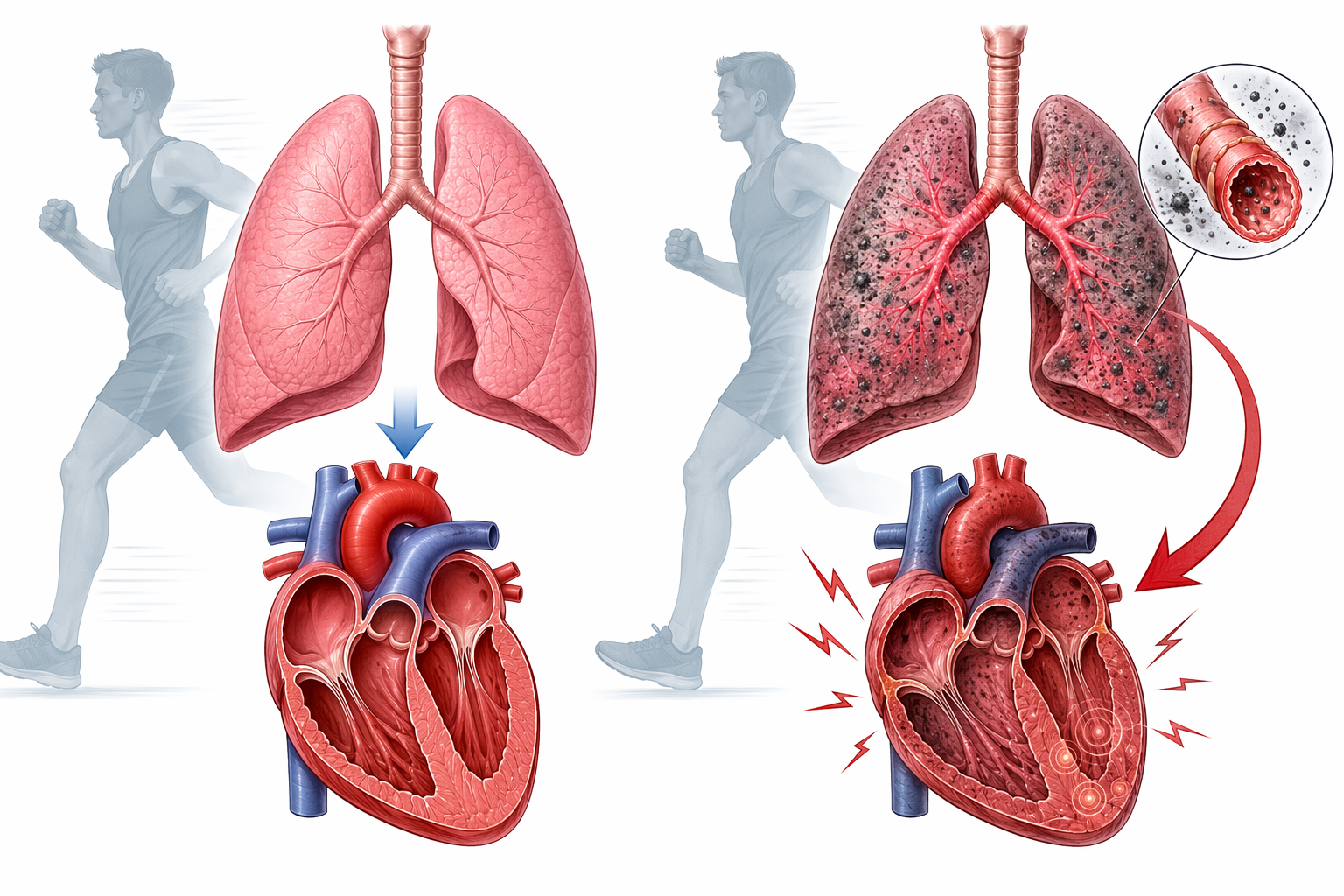
The mechanism is plausible enough to matter even when the exact threshold remains uncertain. Fine particles can trigger airway inflammation, systemic inflammatory responses, autonomic changes, endothelial dysfunction, and thrombogenic effects. Add maximal or near-maximal exertion, dehydration, heat, stimulant use, or underlying coronary disease, and the event is no longer only about cough, wheeze, or eye irritation.
This does not make every athlete a cardiac patient. It does change who belongs in the risk frame. Officials, coaches, event workers, marching-band participants, and medically vulnerable spectators may share the same smoke exposure without the conditioning, monitoring, or substitution options available to athletes. A postponement threshold that looks conservative from the roster sheet may look less conservative from the medical tent.
Pediatric Risk Is the Weak Point in Loose Thresholds
The pediatric evidence gives Oregon’s 2026 youth threshold its strongest clinical footing. Hutchinson and colleagues, studying wildfire smoke and asthma emergency department visits, found the largest increases among children aged 0–5, including a 243% increase among children aged 0–1. [6] Infants are not playing soccer in smoky conditions. The point is broader: developing airways and pediatric respiratory physiology can show outsized vulnerability during wildfire events.
Youth-sport policy has to account for that vulnerability before the child looks distressed. Children may underreport chest tightness because they want to keep playing, do not have the language to describe early bronchospasm, or assume symptoms are normal exertion. Coaches and parents may disagree about whether a child “seems fine.” Athletic trainers are then asked to convert ambiguity into a go-or-no-go decision in real time.
That is why “use caution” is weak policy language when applied to children with known respiratory or cardiac conditions. It sounds flexible, but in practice it can transfer responsibility to the person least able to overrule the game: the trainer on the sideline, the volunteer coach, or the parent trying not to disappoint a team. Oregon’s AQI 51–100 caution category for children with underlying conditions gives that person a firmer basis for modifying activity earlier. [1]
Cognition Belongs in the Injury Conversation
The least familiar argument for postponement may be cognitive, but it should not be dismissed. EPA Science Matters coverage of research using Lumosity data reported that attention span declined within hours of PM2.5 exposure, including at moderate AQI levels. [7] That finding is not a direct sports-injury trial. It does not prove that smoke causes missed tackles, concussions, or late reaction times in a specific league.
Still, the implication is clinically relevant. In high-speed sports, attention and reaction time are safety variables, not luxuries. A small decrement that might be tolerable during a quiet cognitive task may matter more when an athlete is tracking a ball, anticipating contact, responding to a play call, or avoiding a collision. This is a narrower claim than saying smoke directly causes injuries. It is enough to justify including neurocognitive performance in risk assessment when air quality is already borderline.
What Oregon’s Framework Actually Solves
Oregon’s 2026 guidance is useful because it separates populations and actions instead of pretending one sentence can cover all outdoor activity. The framework identifies AQI 51–100 as a caution zone for children with underlying health conditions, escalates restrictions as air worsens, and sets AQI 151 or higher as the point for canceling or moving youth outdoor activities indoors. [1]
| Policy question | Why it matters clinically |
|---|---|
| Who is participating? | Children, athletes with asthma or cardiac disease, and older officials do not share the same baseline risk. |
| How hard will they exert? | High ventilation during practice or competition changes inhaled dose compared with ordinary outdoor presence. |
| What pollutant is driving the AQI? | Wildfire PM2.5 may carry different respiratory potency than background PM2.5. |
| Who has authority to stop play? | A clear threshold protects clinicians and trainers from being isolated in a disputed judgment call. |
The hard cancellation threshold at AQI 151 also reduces a common sideline failure: negotiating obvious risk because the game has already started. Once a threshold is explicit, the trainer does not need to win a debate about whether a wheezing athlete is tough enough, whether the wind might shift, or whether a tournament schedule can absorb a delay.
The framework does not solve every clinical problem. It is youth-focused, state-specific, and still depends on local measurement, communication, and compliance. It also cannot fully individualize risk for every diagnosis or event intensity. But as a decision architecture, it is more defensible than waiting for visibly severe smoke and then asking each school or league to improvise.
The Patchwork Problem Clinicians Inherit
There is no federal sports standard that tells every clinician, school district, professional league, and event organizer when wildfire smoke requires postponement. Oregon’s youth framework now sits beside other jurisdictional and organizational approaches, including California OSHA’s AQI 151 trigger, Washington’s AQI 201 trigger, and Canadian Football League use of AQHI 7 as a reference point, as summarized in the available policy comparisons.
That heterogeneity is not just administrative clutter. It changes the medical conversation. A clinician covering a high school tournament may be operating under one state’s health guidance; a club team crossing a border may encounter another; a professional event may have league rules, venue rules, broadcast pressures, and collective-bargaining considerations layered on top. The athlete’s airway does not become less reactive because the jurisdiction changed.
Internal protocols should therefore document more than the AQI number. They should record the population covered, the expected exertion level, the pollutant context when known, the local policy being applied, and the reason for any modification or cancellation. That documentation is not paperwork for its own sake. It is how clinicians show that a decision was anchored in the actual risk group rather than in pressure from the loudest stakeholder.
For readers needing the physiologic background in more depth, why exercising in wildfire smoke poses unique health risks is the closer companion question. The postponement decision is the operational end of that same clinical chain.
Elite Athletes Are Not a Simple Exception
Elite competition complicates threshold setting because the exposure, physiology, and resources differ from youth sport. Professional athletes may have better conditioning, closer medical surveillance, and more experience recognizing performance changes. They may also generate higher ventilation, sustain more intense workloads, and face stronger incentives to minimize symptoms.
AP reporting in July 2026 described expert disagreement between Christopher Carlsten at the University of British Columbia and Andrew Halayko at the University of Manitoba over whether elite athletes may have adaptive pulmonary capacity or remain vulnerable in ways that argue against assuming protection. [2] That is a real uncertainty, not a detail to smooth over.
The practical conclusion is modest. Elite athletes should not automatically be treated as fragile simply because the event is high-profile, but they also should not be presumed safe because they are fit. Their risk assessment should account for sport intensity, duration, substitution rules, medical monitoring, preexisting asthma or cardiac risk, heat load, and the feasibility of delaying play. Youth athletes and elite professionals may need different operational thresholds, but that difference should be explicit rather than assumed.
Where the Evidence Supports Earlier Postponement
The strongest case for postponement or cancellation appears when several conditions stack: wildfire-driven PM2.5 rather than routine haze; children or athletes with asthma, cardiac disease, diabetes, or other underlying conditions; sustained exertion; limited substitution or rest; and a setting where the person asked to enforce precautions lacks authority unless a written threshold exists.
- For youth with underlying conditions, Oregon’s AQI 51–100 caution threshold is clinically plausible because pediatric vulnerability and exertional dose both move risk earlier than generic public messaging suggests.
- For youth outdoor activity at AQI 151 or higher, hard cancellation or indoor relocation is supported by the convergence of respiratory, cardiovascular, and operational concerns.
- For adults with cardiac risk factors, wildfire smoke should be treated as more than an airway irritant, especially during heavy exertion or dense smoke periods.
- For elite athletes, the evidence does not yet justify a single universal threshold that ignores sport, workload, monitoring, and individual disease history.
Clinicians do not need to pretend the evidence is cleaner than it is. The cardiac arrest estimate is tied to a specific wildfire period. The cognitive findings are not direct injury-outcome studies. The elite-athlete question remains disputed. Oregon’s framework is not a national rule. Those caveats matter.
They do not erase the direction of the evidence. Wildfire PM2.5 appears more potent for respiratory harm than background PM2.5; pediatric asthma signals are strong enough to justify earlier caution; cardiovascular findings make smoke relevant to more than lungs; and cognitive data add a safety concern in sports where attention protects bodies from collision. In 2026, tighter postponement thresholds are defensible, especially for youth and medically vulnerable athletes. Until a federal standard exists, the clinician’s job is to document the population, exertion level, local policy, and uncertainty clearly enough that the decision can stand when the air, the schedule, and the sideline all get uncomfortable. [1][3][4][5][6][7]
References
- OHA updates guidance for youth outdoor activities during wildfire smoke air pollution events, Oregon Health Authority, June 8, 2026.
- 2026 World Cup’s contingency plans for wildfire smoke risks remain unclear, AP / NEWS10.
- Wildfire smoke impacts respiratory health more than fine particles from other sources: observational evidence from Southern California, Nature Communications, 2021.
- Where there’s smoke, there’s fire and heart health risks, American Heart Association, May 2025.
- Breathing heavy wildfire smoke may increase risk of out-of-hospital cardiac arrest, American Heart Association.
- The impact of wildfires on air quality and emergency department visits for asthma in Washington state, PLoS Medicine, 2018.
- Fighting haze: Effects of wildfire smoke and particulate matter on brain function, U.S. Environmental Protection Agency.
Comments
Join the discussion with an anonymous comment.