
 Prior Authorization AI Tools (Insurer and Provider Sides)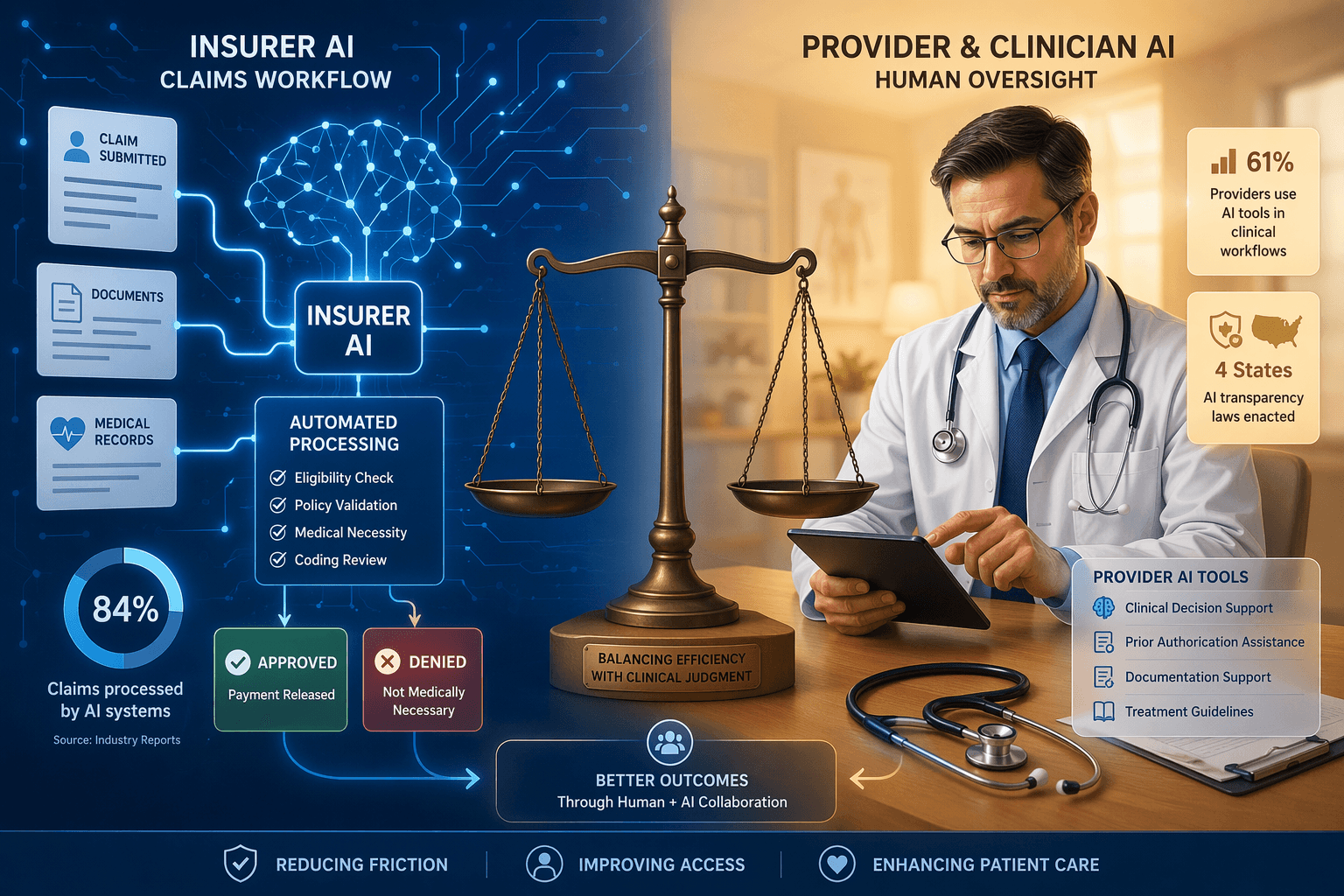
Introduction: The Two-Sided Prior Authorization AI Arms Race
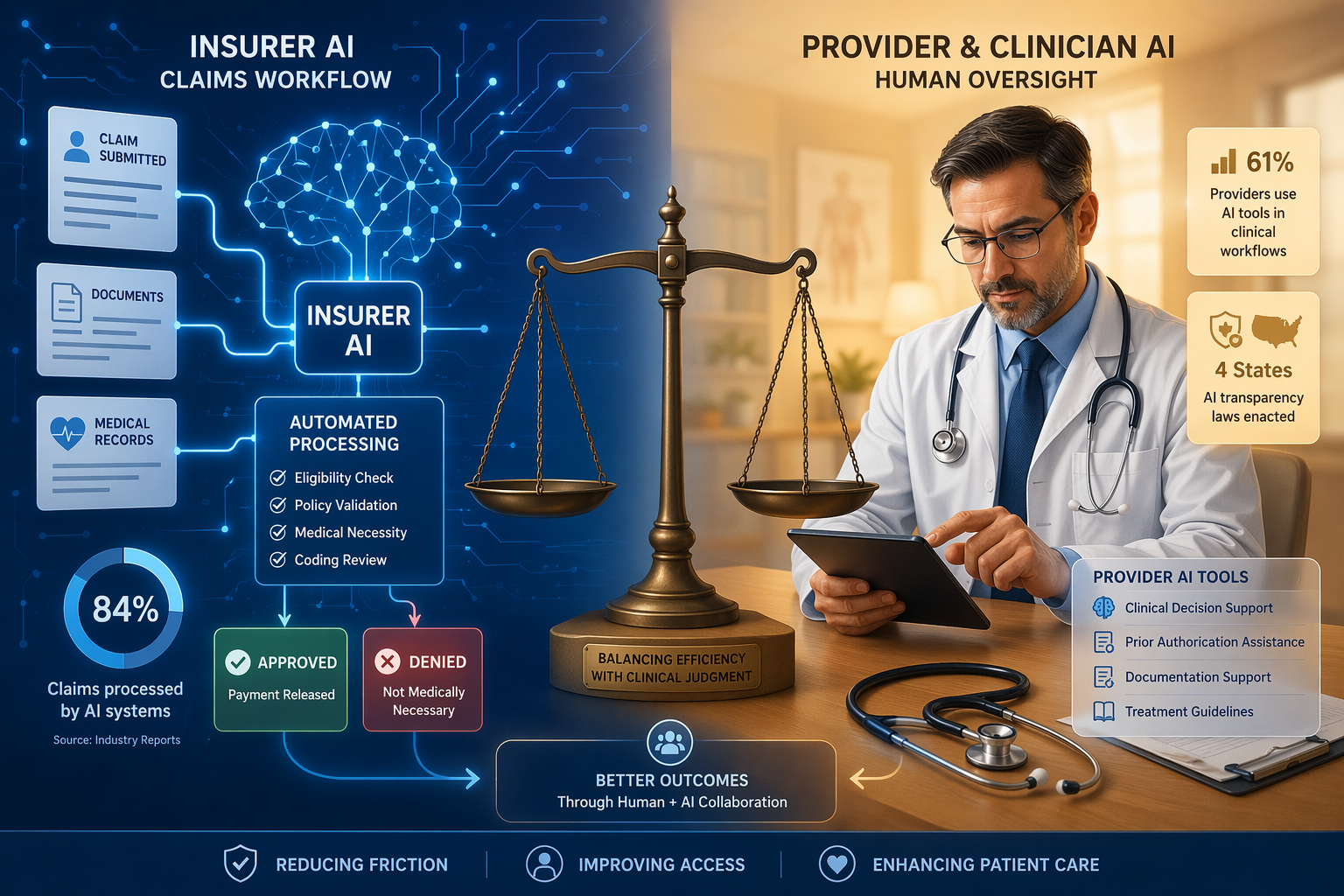
Prior authorization has become the central battleground for artificial intelligence in healthcare administration. A November 2024–January 2025 NAIC survey of 93 insurance companies across 16 states found that 84% of health insurers now use AI or machine learning in some capacity. Among large insurers specifically, 37% deploy AI for prior authorization, 44% for claims adjudication, and 56% for utilization management, according to a separate 2024 NAIC survey cited in the Stanford HAI policy brief. These figures represent a rapid escalation from just a few years ago, and they capture only one side of the equation.
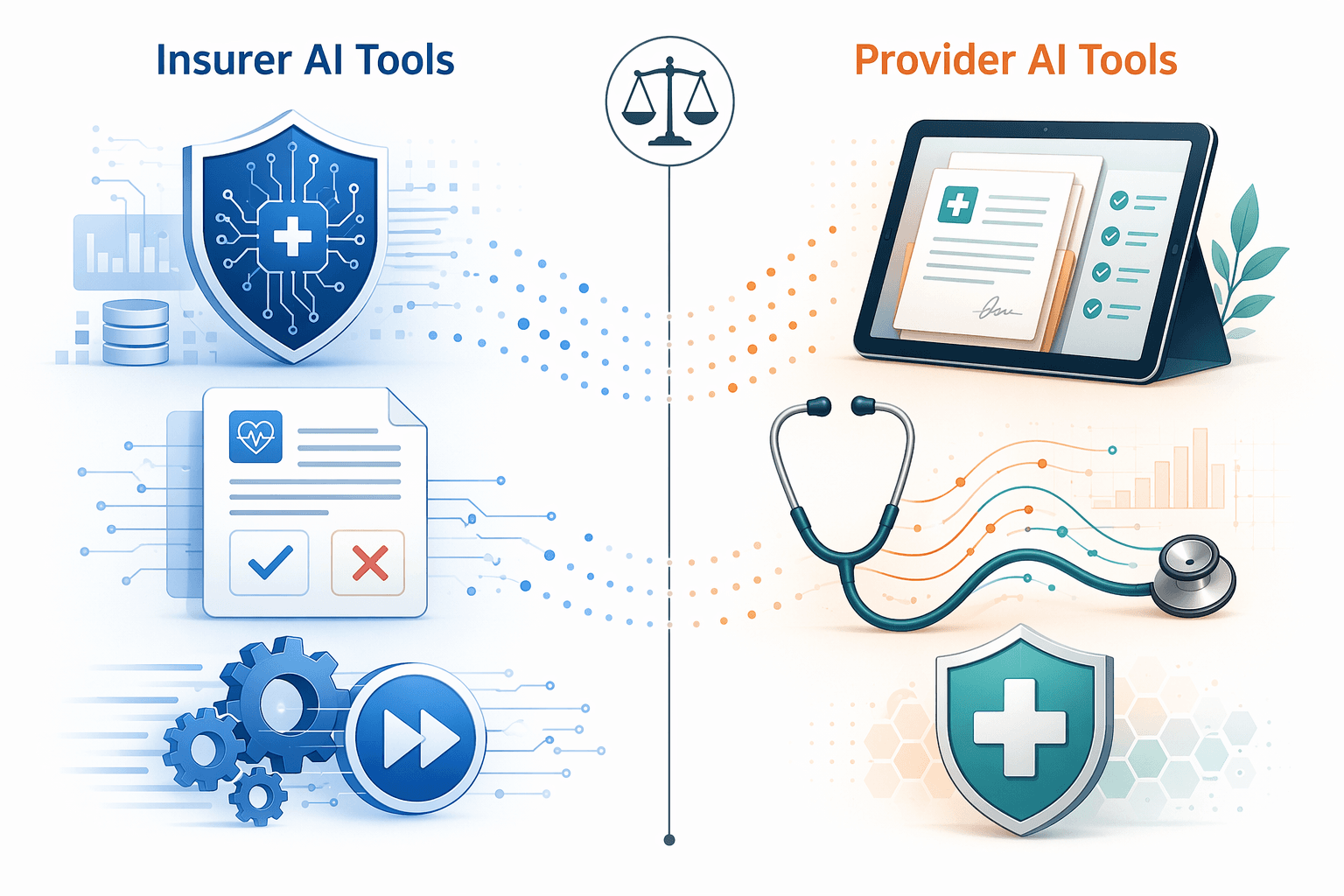
The other side is provider organizations — hospitals, physician groups, and health systems — that are increasingly adopting their own AI tools to counter insurer-side automation. The result is a symmetric competitive dynamic that Mello et al. (Health Affairs, January 2026) describe as an "AI arms race" in utilization review. Their review of online vendor offerings in June 2025 identified at least 18 distinct AI tools targeting either insurers or providers for prior authorization and related processes.
This article profiles the specific AI tools on both sides of that arms race — what they do, who they serve, and how they interact — then examines the controversy, regulatory response, and transparency gaps that are reshaping the vendor landscape. It is designed for health policy researchers, regulatory professionals, and health system administrators who need an evidence-grounded understanding of a market that is evolving faster than the rules meant to govern it.
Insurer-Side AI Tools: Accelerating Approvals and Flagging Denials
The insurer-side vendor ecosystem is the more mature of the two markets. These tools are marketed to health plans to support prior authorization, concurrent review, and claims decisions. Their stated value proposition is efficiency: faster processing times, reduced administrative burden, and more consistent application of coverage criteria. But critics — and a growing body of evidence — argue that some of these tools are designed to flag potentially deniable cases at rates that would be unsustainable under human-only review.
The table below summarizes the major insurer-facing AI tools identified in the Health Affairs vendor review and other sources.
| Tool | Vendor | Primary Function | Deployment Context |
|---|---|---|---|
| AuthAI | Availity | Real-time prior authorization decisions using AI to match requests against payer policies | Integrated into Availity's provider network; used by multiple health plans |
| Clinical Intelligence | Cohere Health | AI-driven prior authorization with clinical decision support and automated review | Deployed by health plans; also a participant in CMS WISeR model in Texas |
| nH Predict / InterQual AutoReview | Optum (UnitedHealth Group) | Predictive analytics for post-acute care; automated medical necessity review | Used by UnitedHealthcare; subject to Senate investigation over denial rates |
| Facets | TriZetto (Cognizant) | Core administrative platform with AI modules for claims and utilization management | Widely deployed across health plans as an enterprise system |
The most controversial of these tools is Optum's nH Predict. A 2024 Senate committee report found that nH Predict produced denial rates up to 16 times higher than typical for post-acute care. UnitedHealth Group, which owns Optum, has disputed the characterization, noting that its digital prior authorization tool reports a 96% approval rate overall. The discrepancy highlights a central tension in the insurer-side market: aggregate approval statistics can mask dramatically different outcomes for specific patient populations or care settings.
Cohere Health's Clinical Intelligence platform represents a different approach. Rather than flagging denials, it uses AI to match prior authorization requests against payer policies in real time, aiming to approve appropriate requests faster. The company is a participant in the CMS WISeR model (Wasteful and Inappropriate Service Reduction), which launched January 1, 2026, in six states. Under WISeR, Cohere Health uses AI-enhanced prior authorization review for select Medicare Fee-for-Service items including nerve stimulators and cervical fusions. The model is notable because it is the first CMS Innovation Center model where technology innovators — not providers or payers — are the only participants.
Provider-Side AI Tools: Fighting Denials and Securing Approvals
The provider-side AI market has grown in direct response to insurer-side automation. These tools help hospitals and physician groups navigate the prior authorization process more efficiently, identify requests likely to be denied, and generate appeal letters when denials occur. The Health Affairs vendor review identified at least five distinct provider-facing tools, and the market has expanded since June 2025.
| Tool | Vendor | Primary Function | How It Counters Insurer AI |
|---|---|---|---|
| Authorization Manager | Waystar | AI-powered prior authorization workflow automation and denial prediction | Flags requests likely to be denied before submission; automates resubmission |
| Authorization Advisor | AKASA | Generative AI for prior authorization documentation and payer communication | Drafts authorization requests optimized for specific payer AI criteria |
| Denials Appeals Assistant | Epic Systems | AI-assisted appeal letter generation within the Epic EHR workflow | Integrates directly into provider EHR; generates evidence-based appeals |
| GPT-based tools | Doximity | AI-powered clinical documentation and communication for prior authorization | Helps physicians draft medical necessity letters quickly |
| AI Appeals Platform | Counterforce Health | Automated appeal generation using payer-specific denial patterns | Learns from insurer denial patterns to craft more effective appeals |
Waystar's Authorization Manager is among the most widely deployed provider-side tools. It uses AI to predict which prior authorization requests are likely to be denied, allowing provider staff to address documentation gaps before submission. The tool also automates the resubmission process for denied requests. Waystar's platform processes a significant volume of healthcare transactions, and its AI capabilities are designed to counter the very insurer-side algorithms that generate denials.
AKASA's Authorization Advisor takes a different approach, using generative AI to draft authorization requests that are optimized for specific payer criteria. The tool learns from each payer's historical approval patterns — including those driven by AI — and adjusts the language and supporting documentation accordingly. This represents a direct AI-to-AI interaction: a provider-side generative model crafting submissions designed to pass an insurer-side predictive model.
Epic's Denials Appeals Assistant is particularly significant because of Epic's dominant market share in hospital EHR systems. By embedding AI-powered appeal generation directly into the clinical workflow, Epic reduces the friction that typically prevents providers from appealing denials. Given that Medicare Advantage plans approved more than 93% of prior authorization requests from 2019 to 2023 but overturn rates on appeal reached 82%, the ability to efficiently generate appeals is a critical capability for provider organizations.
The Controversy: Physician Concerns, Class Actions, and Overturn Rates
The two-sided AI arms race has generated significant controversy, driven by three converging factors: physician concern about denial rates, class-action litigation against major insurers, and the striking gap between initial denial and appeal outcomes.
Physician Concerns
An AMA survey of 1,000 practicing physicians found that 61% are concerned that health plans' use of AI is increasing prior authorization denials. Nearly half (49%) ranked oversight of payers' use of AI in medical necessity determinations among the top three priorities for regulatory action. The survey also found that 29% of physicians reported that prior authorization led to a serious adverse event for a patient, and 94% said prior authorization negatively impacts clinical outcomes. Physicians complete an average of 39 prior authorizations per week, consuming 13 hours of physician and staff time.
Class-Action Litigation
The most prominent legal challenge is the federal class action against UnitedHealthcare, Estate of Gene B. Lokken et al., which alleges that the AI model used to deny care had a 90% error rate. A February 2025 court decision partially denied the motion to dismiss, allowing the case to proceed. Similar litigation has been filed against Cigna and other major insurers. These cases center on the allegation that AI tools are making medical necessity determinations without meaningful human review, in violation of state insurance laws and ERISA fiduciary duties.
The Overturn Rate Gap
The most damning statistic in the debate is the 82% overturn rate on appeal in Medicare Advantage plans. If more than 8 out of 10 appealed denials are overturned, it raises fundamental questions about the clinical validity of the initial denial decisions. The Health Affairs paper notes that in ACA Marketplace plans, denial rates reached 20%, with fewer than 1% of denials appealed — but nearly half of those appeals resulted in reversals. The low appeal rate itself is a concern: if providers lack the resources or tools to challenge denials, the system systematically undercounts inappropriate denials.
Regulatory Response: State AI-Denial Bans, CMS Rules, and Federal Preemption Tension
The regulatory landscape for AI in prior authorization has shifted dramatically in 2025 and early 2026. Four distinct regulatory developments are reshaping the vendor market.
State AI-Denial Bans
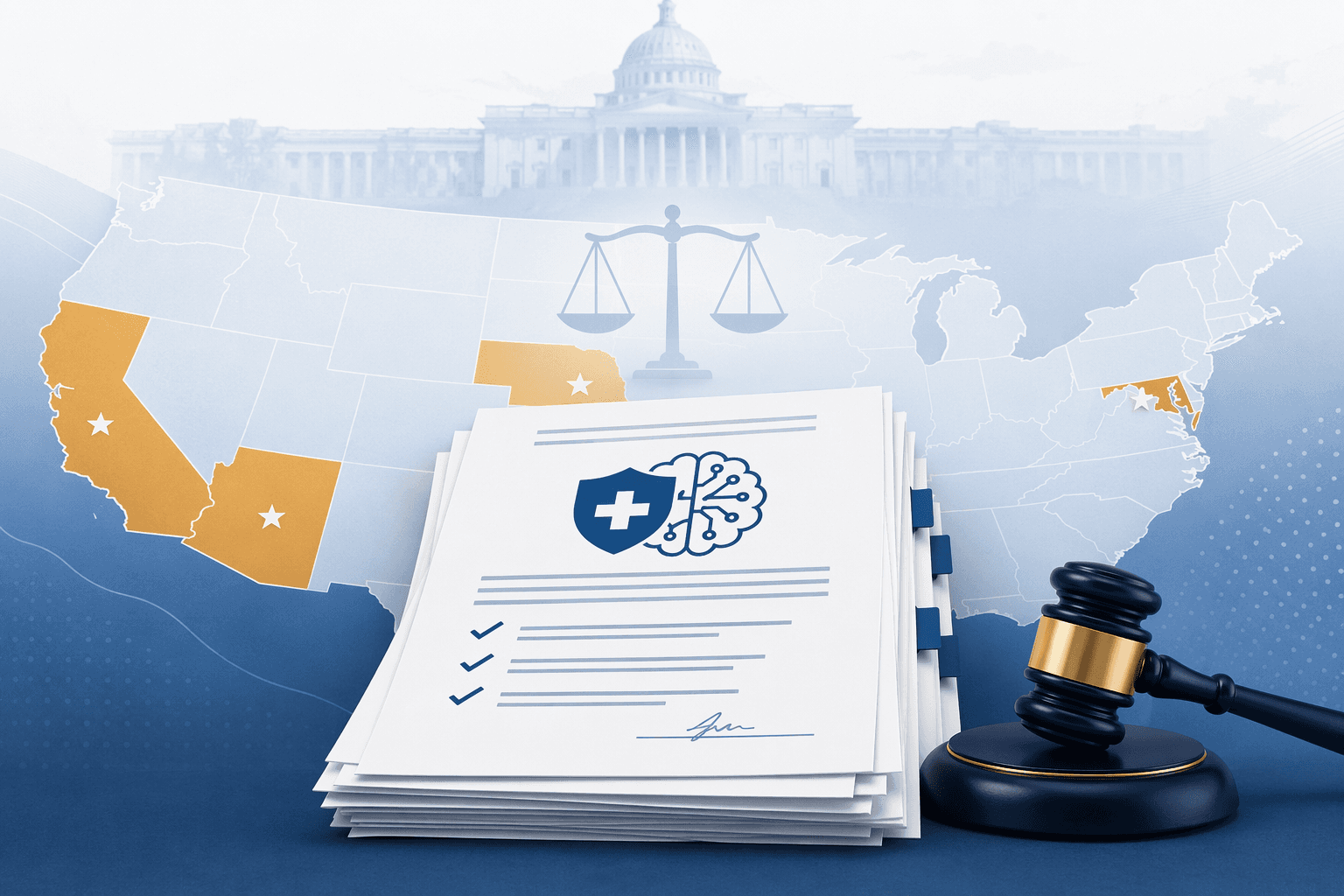
According to a KFF analysis (May 2026), four states passed laws in 2025 explicitly prohibiting AI from being the sole basis for medical-necessity denials: Arizona (HB 2175), Maryland (HB 820), Nebraska (LB 77), and Texas (SB 815). California's SB 1120, effective January 2025, requires that final medical necessity determinations be made only by licensed clinicians and mandates periodic assessment of AI tools. At least 25 states have issued guidance based on the NAIC's 2023 model bulletin on AI governance.
| State | Law | Effective Date | Key Provision |
|---|---|---|---|
| California | SB 1120 | January 2025 | Final medical necessity determinations only by licensed clinicians; periodic AI tool assessment |
| Arizona | HB 2175 | 2025 | Prohibits AI as sole basis for medical-necessity denials |
| Maryland | HB 820 | 2025 | Prohibits AI as sole basis for medical-necessity denials |
| Nebraska | LB 77 | 2025 | Prohibits AI as sole basis for medical-necessity denials |
| Texas | SB 815 | 2025 | Prohibits AI as sole basis for medical-necessity denials |
CMS Transparency Rules
CMS transparency rules effective March 2026 require public disclosure of prior authorization approval and denial metrics for Medicare Advantage, Medicaid managed care, CHIP, and ACA Marketplace plans. This is a significant development for the vendor landscape: for the first time, insurers will be required to publish standardized data on how many requests are approved, denied, and overturned on appeal. These metrics will make it possible to compare AI-driven versus human-driven outcomes — at least at the plan level.
CMS WISeR Model
The CMS WISeR model, which launched January 1, 2026, represents a different regulatory approach: rather than restricting AI, it uses AI-enhanced prior authorization review to reduce wasteful spending. The model operates in six states (Arizona, New Jersey, Ohio, Oklahoma, Texas, Washington) and covers select Fee-for-Service items. Participants include Cohere Health (Texas), Genzeon Corporation (New Jersey), Humata Health (Oklahoma), Innovaccer Inc. (Ohio), Virtix Health LLC (Washington), and Zyter Inc. (Arizona). The model's structure — where technology innovators are compensated based on a share of averted expenditures — creates a financial incentive to scrutinize requests, which Jones Day notes creates tension with state laws limiting AI in utilization management.
Federal Preemption Tension
The Trump administration's AI Framework, released March 2026, proposes preempting state AI laws — including the AI-denial bans passed in 2025. The KFF analysis notes that ERISA would likely preempt state AI laws for self-insured plans in any case, but the federal preemption proposal goes further, potentially applying to fully insured plans as well. This creates significant uncertainty for vendors on both sides: if state AI-denial bans are preempted, the regulatory pressure on insurer-side tools diminishes; if they survive, demand for provider-side appeals tools will likely grow.
The Transparency Gap: What We Don't Know About AI-Driven Denials
Despite the rapid deployment of AI tools across the prior authorization ecosystem, fundamental data gaps remain. The Stanford HAI policy brief reports that more than one-quarter of large insurers do not document model accuracy or test for bias, and about 40% have not adopted accountability practices for AI in prior authorization and claims adjudication. This means that for a substantial portion of AI-driven decisions, there is no systematic tracking of whether the AI is making correct determinations.
The opacity of AI algorithms compounds the problem. When a denial is generated by an AI tool, the provider and patient often have no way to understand what factors drove the decision. The Health Affairs paper identifies "opacity of AI predictions" as a core concern, noting that even when a human is nominally "in the loop," the human reviewer may lack the context or authority to meaningfully override the AI recommendation. The paper describes these arrangements as "toothless 'humans in the loop'" — a phrase that captures the gap between regulatory requirements and operational reality.
The CMS transparency rules that took effect in March 2026 are a step toward closing this gap, but they have limitations. The required disclosures are at the plan level, not the decision level, and they do not distinguish between AI-driven and human-driven denials. Without decision-level attribution, it remains impossible to directly compare the accuracy of AI-driven versus human-driven prior authorization outcomes.
Outlook: How Regulation and Litigation Will Reshape the Vendor Landscape
The AI arms race in prior authorization is unlikely to slow, but its trajectory will be shaped by three interacting forces: regulation, litigation, and market dynamics.
First, the CMS transparency rules create a new accountability mechanism. Insurers that publish high denial rates or low overturn rates will face pressure from regulators, providers, and the public. This may incentivize more conservative use of AI-driven denial tools — or, alternatively, more sophisticated tools that generate denials that are harder to overturn on appeal. The direction depends on how plans respond to public scrutiny.
Second, the tension between state AI-denial bans and federal preemption creates regulatory uncertainty that affects vendor investment decisions. If state laws survive, demand for provider-side appeals tools will likely grow, as providers seek to maximize their ability to challenge denials. If federal preemption prevails, the regulatory advantage shifts back to insurer-side tools, potentially accelerating their deployment.
Third, the class-action litigation against UnitedHealthcare and Cigna creates a parallel accountability mechanism. If plaintiffs prevail, the cost of using AI to deny care could increase substantially, potentially reshaping the business case for insurer-side tools. The Estate of Gene B. Lokken case, with its allegation of a 90% error rate, is particularly significant because it directly challenges the clinical validity of AI-driven denials.
For provider-side vendors, the outlook is clearer. The 82% overturn rate on appeal creates a structural demand for tools that help providers navigate the appeals process. As more providers adopt AI-powered appeals tools, the arms race dynamic intensifies: insurers respond by refining their denial algorithms, providers respond by improving their appeals algorithms, and the cycle continues.
The fundamental uncertainty is whether this arms race will lead to better outcomes for patients or simply entrench a costly, opaque system where the outcome of a prior authorization request depends more on which AI tools are deployed on each side than on the clinical merits of the case. The evidence so far — 82% overturn rates, 16x higher denial rates from specific algorithms, and widespread physician concern — suggests that the system is not yet serving patients well. Whether regulation, litigation, or market forces can correct that trajectory is the defining question for the vendor landscape in 2026 and beyond.
Comments
Join the discussion with an anonymous comment.