
 AWS Health AI Portfolio
Scope and Positioning: AWS in Healthcare AI
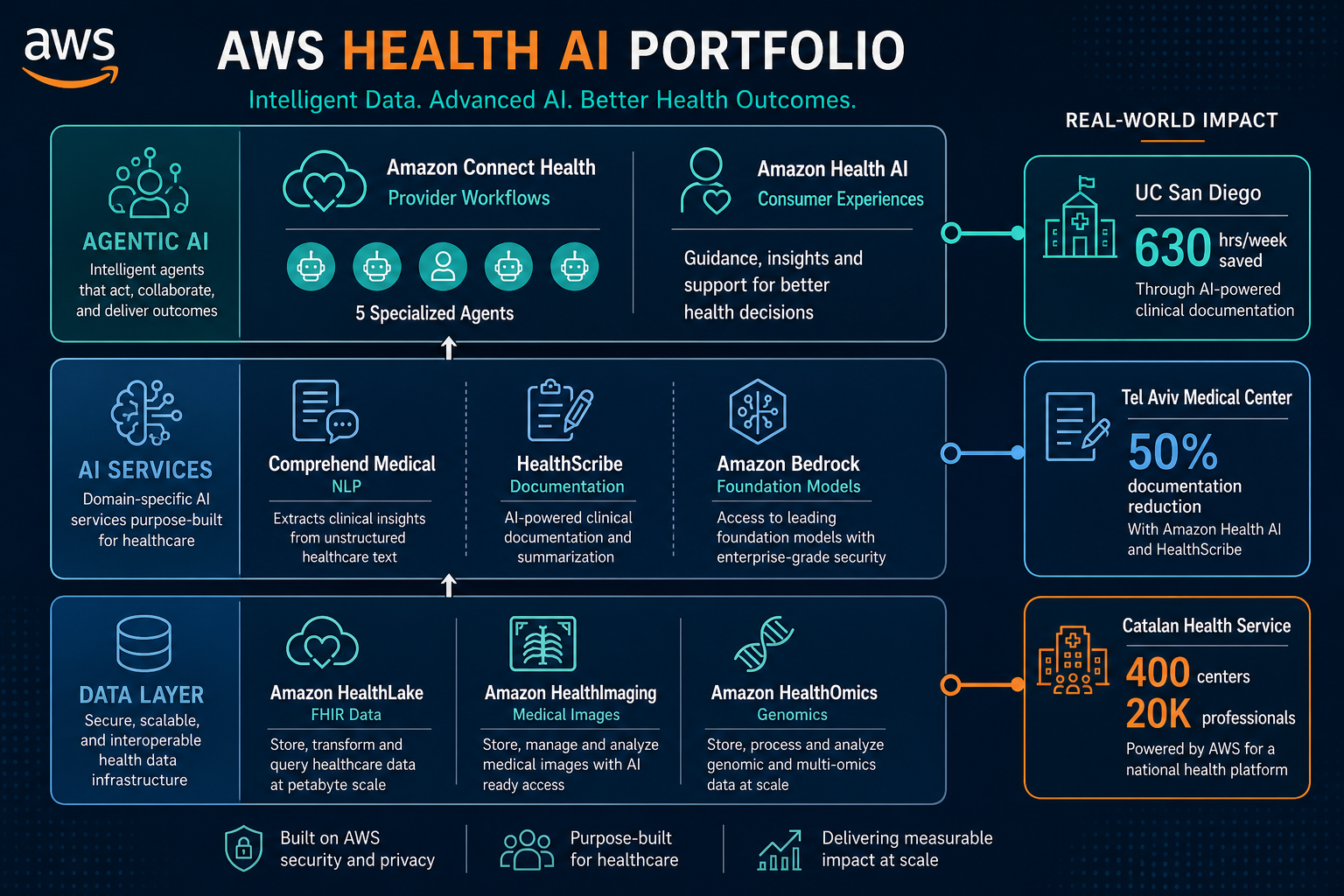
Amazon Web Services has assembled what is arguably the most vertically integrated health AI stack among the major cloud providers. Unlike point-solution vendors that address a single clinical workflow, AWS offers a portfolio that spans the full data-to-decision pipeline: purpose-built data infrastructure for FHIR, medical imaging, and genomics; natural language processing for unstructured clinical text; generative AI for clinical documentation; and a new generation of agentic AI systems for both provider workflows and consumer health engagement. For health IT professionals and health system decision-makers evaluating cloud platforms, understanding how these services interconnect — and where the evidence for their real-world impact stands — is essential for procurement and deployment planning.
This profile covers six purpose-built AWS healthcare AI services — HealthLake, HealthImaging, HealthOmics, Comprehend Medical, HealthScribe, and Amazon Connect Health — plus the consumer-facing Amazon Health AI agent. It draws on AWS documentation, public announcements, and reported deployment metrics from health systems including UC San Diego Health, Tel Aviv Sourasky Medical Center, and the Catalan Health System. Where data comes from vendor sources without independent peer-reviewed validation, that distinction is explicitly noted.
The Data Layer: HealthLake, HealthImaging, and HealthOmics
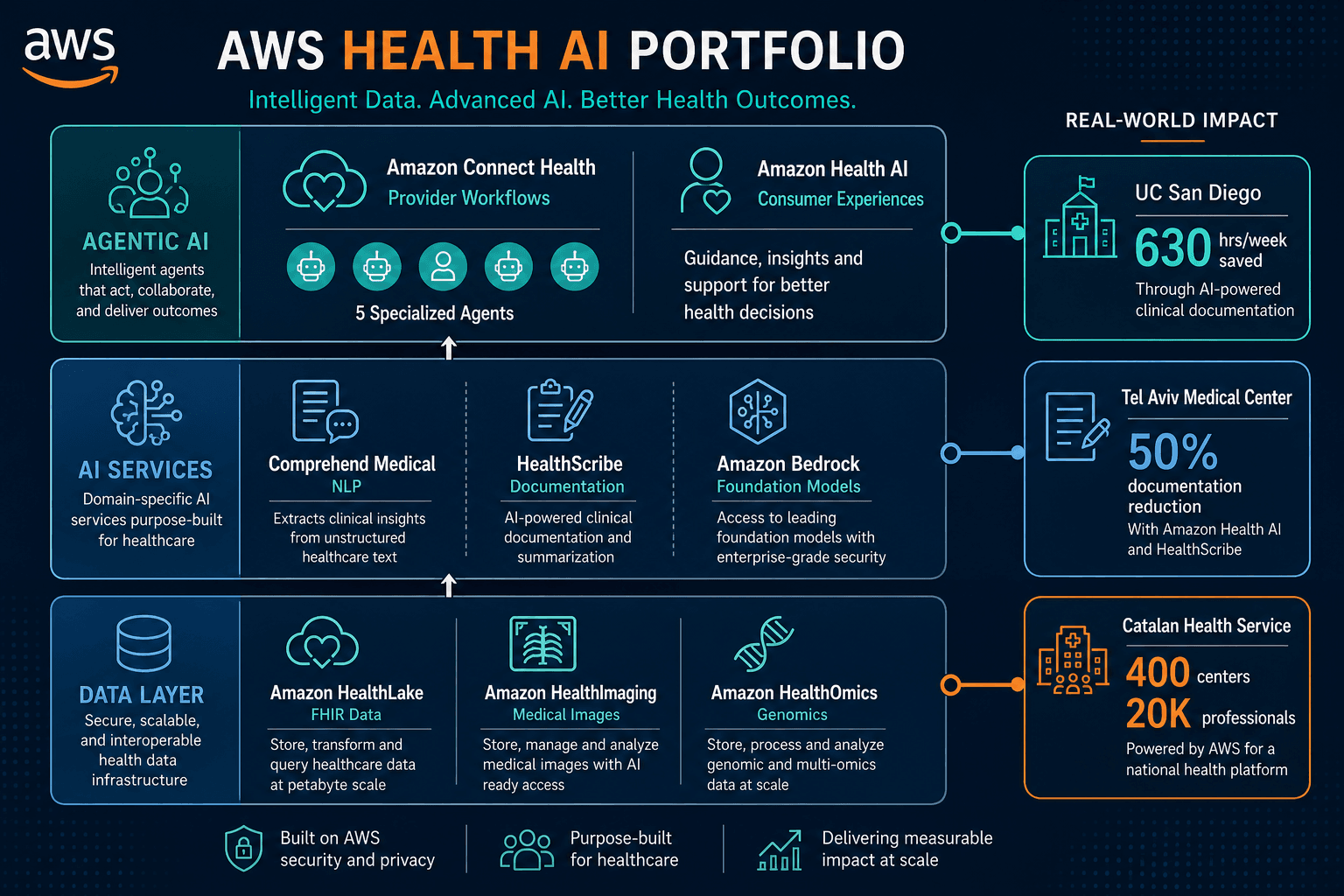
AWS's healthcare AI stack rests on a data infrastructure layer designed for the three major data types in clinical AI: structured clinical data (FHIR), medical images (DICOM), and genomics data. These services are not AI applications themselves but the foundation on which AI models operate.
AWS HealthLake
HealthLake is a HIPAA-eligible service that provides a FHIR-based data lake for aggregating, transforming, and querying clinical data from multiple sources. Its most recent addition, announced in March 2026, is a data transformation agent (currently in preview) that converts CCDA documents to FHIR R4 resources in seconds using AI-assisted template customization. The agent includes out-of-the-box templates for CCDA 2.1 to FHIR R4 and supports natural language template editing — for example, a user can instruct it to "skip medications entered in error" without writing custom code. This capability directly addresses one of the most persistent interoperability pain points in healthcare IT: the conversion of legacy CCDA documents into modern FHIR-based data models.
HealthLake is available in US East (N. Virginia), US East (Ohio), US West (Oregon), Asia Pacific (Mumbai), Europe (London, Ireland), and Asia Pacific (Southeast Sydney).
AWS HealthImaging and HealthOmics
HealthImaging provides cloud-based storage and analysis for medical images at petabyte scale, supporting DICOM workflows and enabling AI model training on imaging data without the overhead of managing on-premises PACS infrastructure. HealthOmics, meanwhile, is purpose-built for genomics data processing, supporting workflows like secondary analysis, variant calling, and population-scale genomics studies. Together, these three services create a unified data plane that allows AI applications — whether AWS-built or third-party — to access structured clinical records, imaging data, and genomic information within a single compliance boundary.
- HealthLake: FHIR-based clinical data lake with AI-assisted CCDA-to-FHIR transformation
- HealthImaging: Cloud-native medical image storage and analysis at petabyte scale
- HealthOmics: Purpose-built genomics data processing for population-scale studies
NLP and Clinical Data Extraction: Amazon Comprehend Medical
Amazon Comprehend Medical is a HIPAA-eligible natural language processing service that extracts structured medical information from unstructured clinical text — including doctor's notes, radiology reports, clinical trial documents, and discharge summaries. It links extracted entities to standard medical ontologies including ICD-10-CM, RxNorm, and SNOMED CT, making it suitable for downstream applications that require coded data.
Key use cases for Comprehend Medical include:
- Claims automation: extracting diagnosis codes, procedure codes, and medication information from clinical notes to accelerate revenue cycle workflows
- Population health analysis: identifying cohorts of patients with specific conditions or medication regimens from unstructured clinical text across large populations
- Adverse event detection: scanning clinical notes and radiology reports for potential adverse drug reactions or complications
- Clinical trial matching: extracting patient characteristics from unstructured records to identify candidates for specific trial protocols
Comprehend Medical is one of the more mature services in the AWS health AI portfolio, having been available since 2018. Its ontology linking capability — mapping extracted entities to standardized coding systems — distinguishes it from general-purpose NLP services that return raw entities without clinical coding context.
Clinical Documentation: From HealthScribe to Amazon Connect Health Ambient Documentation
AWS entered the clinical documentation space in 2023 with the launch of HealthScribe, a generative AI service that automatically creates clinical notes from patient-clinician conversations. HealthScribe generates summarized notes with sections including chief complaint, history of present illness, assessment, and treatment plan, with each claim traceable to specific points in the conversation transcript.
With the launch of Amazon Connect Health in March 2026, AWS has expanded its documentation capabilities significantly. The ambient documentation feature within Connect Health builds on HealthScribe's foundation but extends from note generation to integrated task execution — generating billing-ready visits within minutes, according to AWS. The service supports 22 or more clinical specialties and includes a clinician-in-the-loop review process, meaning the AI generates a draft note that the clinician reviews and approves before it enters the medical record.
AWS now recommends Amazon Connect Health for the latest ambient documentation experience, positioning HealthScribe as the earlier-generation service. For organizations evaluating ambient AI documentation tools, the key difference is that Connect Health's ambient documentation is part of a broader agentic AI platform rather than a standalone note-generation service.
| Feature | HealthScribe (2023) | Connect Health Ambient Documentation (2026) |
|---|---|---|
| Note generation | Yes — structured clinical notes with transcript references | Yes — expanded to billing-ready visits |
| Specialty support | Limited at launch | 22+ specialties |
| Clinician review | Yes — draft reviewed before entry | Yes — clinician-in-the-loop |
| Task integration | Standalone note generation | Integrated with scheduling, coding, patient insights |
| Evidence mapping | Transcript references | Every output linked to source transcript |
| AWS recommendation | Earlier generation | Current recommended ambient documentation service |
Agentic AI: Amazon Connect Health and Amazon Health AI
AWS's most significant healthcare AI move in early 2026 was the launch of two agentic AI systems: Amazon Connect Health for provider workflows and Amazon Health AI for consumers. Both represent a shift from passive AI tools that generate outputs for human review to active AI agents that execute multi-step tasks within clinical and consumer health workflows.
Amazon Connect Health: Provider-Facing Agentic AI
Amazon Connect Health, launched on March 5, 2026, is a purpose-built agentic AI solution with five distinct agent capabilities:
- Patient verification (generally available): Automates identity verification during patient calls, reducing the time staff spend on this task
- Appointment management (preview): Handles scheduling, rescheduling, and cancellations; AWS notes the scheduling tool is trained on frustrated patient interactions and complex cases for appropriate escalation
- Patient insights (preview): Generates pre-visit summaries by aggregating data from across the patient record
- Ambient documentation (generally available): Generates clinical notes from patient-clinician conversations, supporting 22+ specialties
- Medical coding (preview): Automates the assignment of medical codes from clinical documentation
Connect Health is built on Amazon Connect, which handles more than 16 million interactions daily according to AWS. The trust and safety architecture includes evidence mapping — every output is linked to its source transcript — and a multi-step evaluation framework that combines supervised fine-tuning, reinforcement learning, an LLM-as-judge system, and clinician-in-the-loop review. Naji Shafi, GM and director of healthcare AI at AWS, stated in a Healthcare Dive interview that the scheduling tool is specifically trained on frustrated patient interactions and complex cases to ensure appropriate escalation to human staff.
Amazon Health AI: Consumer-Facing Health Assistant
Amazon Health AI is a consumer-facing agentic health assistant that launched in January 2026 for One Medical members and expanded to all US consumers in March 2026. It uses a multi-agent architecture with four agent types: a core agent that coordinates the overall interaction, sub-agents that handle specific tasks (lab result explanation, prescription management, appointment booking), auditor agents that verify the accuracy of outputs, and sentinel agents that monitor for safety issues.
Key capabilities include:
- Accessing medical records via health information exchanges (all major regional HIEs, according to Dr. Andrew Diamond, CMO of One Medical)
- Explaining lab results in plain language
- Managing prescription refills and medication questions
- Booking appointments with One Medical or partner health systems
- Connecting users to a national primary care network — a differentiator highlighted by Diamond in a Fierce Healthcare interview
Amazon Health AI is HIPAA-compliant with encryption, and Amazon states that patient health information is not used for Amazon Ads or general merchandise marketing. Eligible US Prime members receive five free direct-message care visits (valued at up to $145), and One Medical membership is available at $99 per year for Prime members (50% off the standard $199). The service has been evaluated on hundreds of thousands of synthetic clinical scenarios, according to AWS. Health system partners include Rush, Cleveland Clinic, Montefiore, and Hackensack Meridian Health.
| Dimension | Amazon Connect Health | Amazon Health AI |
|---|---|---|
| Target user | Healthcare providers and health systems | Consumers (patients and general public) |
| Launch date | March 5, 2026 | January 2026 (One Medical); March 2026 (all US) |
| Agent architecture | Five specialized agents (verification, scheduling, insights, documentation, coding) | Multi-agent: core, sub-agents, auditor agents, sentinel agents |
| Key capabilities | Patient verification, appointment management, ambient documentation, medical coding | Lab result explanation, prescription management, appointment booking, HIE integration |
| Evaluation framework | Supervised fine-tuning, RL, LLM-as-judge, clinician-in-the-loop | Hundreds of thousands of synthetic clinical scenarios; multi-layered evaluation |
| Compliance | HIPAA-eligible, built on Amazon Connect | HIPAA-compliant; PHI not used for advertising |
Security, Compliance, and Trust Infrastructure
For health systems evaluating cloud platforms, security and compliance certifications are often the first gate. AWS offers more than 146 HIPAA-eligible services, meaning organizations can build and deploy AI applications within a compliance boundary that covers data storage, processing, and AI model inference. Beyond HIPAA, AWS holds FHIR R4 certification, SOC 2 and SOC 3 reports, HITRUST CSF certification, and GDPR compliance — covering the major regulatory frameworks for US and European healthcare deployments.
A specific trust infrastructure component relevant to generative AI is Bedrock Guardrails, which AWS reports blocks up to 88% of harmful content. For healthcare AI applications where hallucination risk and patient safety are paramount, this guardrail capability provides a layer of protection that sits between the foundation model and the clinical output. AWS also won Best in KLAS for Public Cloud for two consecutive years, a vendor-reported metric that may carry weight in procurement evaluations.
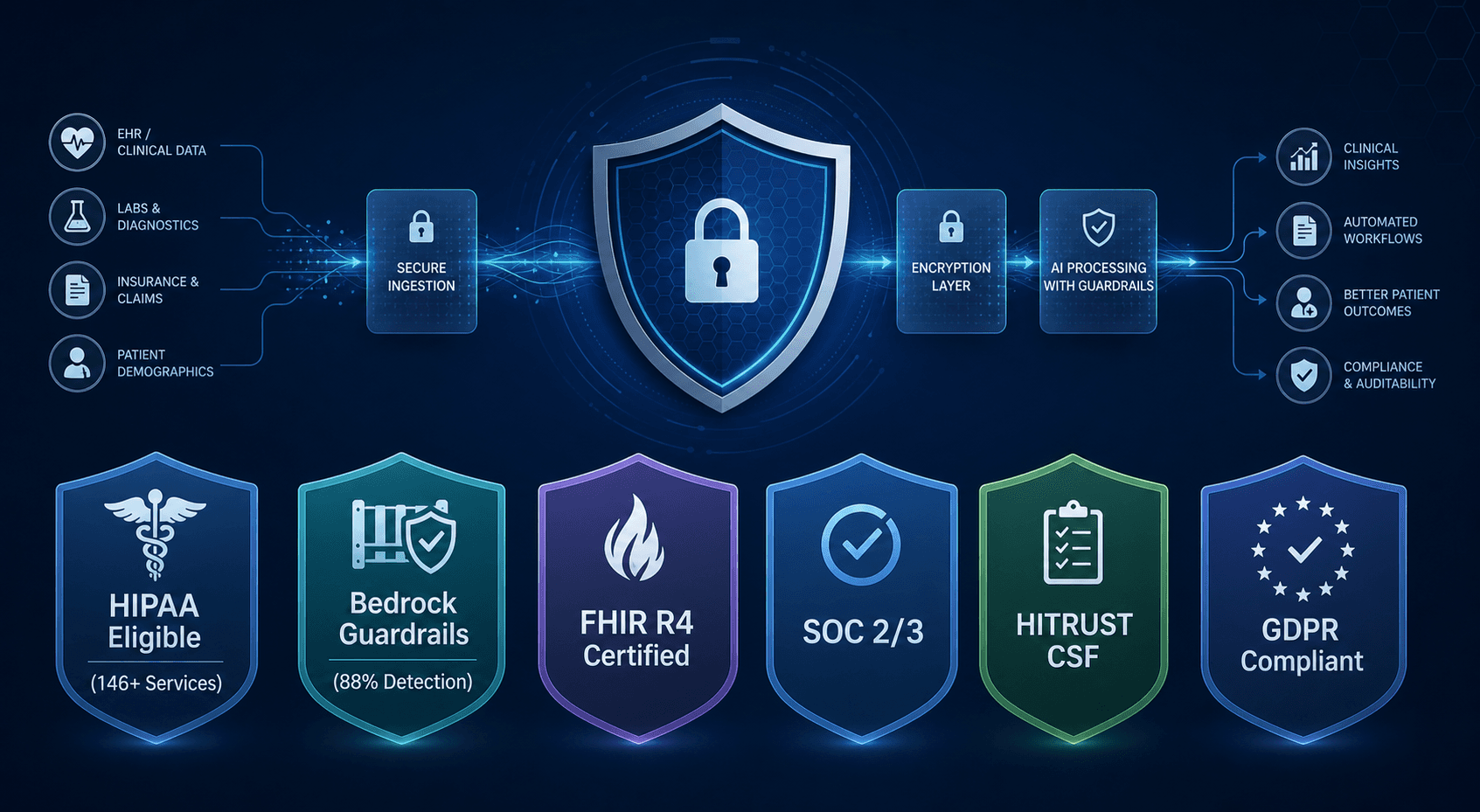
- 146+ HIPAA-eligible services covering compute, storage, AI/ML, and analytics
- Bedrock Guardrails: up to 88% harmful content detection for generative AI outputs
- FHIR R4 certification for health data interoperability
- SOC 2/3, HITRUST CSF, and GDPR compliance
- Best in KLAS for Public Cloud (two consecutive years, per AWS)
Real-World Outcomes and Deployment Evidence
The following table summarizes reported deployment metrics from health systems using AWS health AI services. These figures come primarily from AWS announcements and public blog posts; independent peer-reviewed validation is not yet available for most of these metrics, a caveat that should be weighed when evaluating procurement decisions.
| Organization | Service Deployed | Reported Outcomes | Source |
|---|---|---|---|
| UC San Diego Health | Amazon Connect Health | 1 minute saved per call; 630 hours/week diverted from patient verification; 30% call abandonment reduction (up to 60% in some departments); handles 3.2M patient interactions annually | AWS announcement / About Amazon |
| One Medical | Ambient documentation (HealthScribe/Connect Health) | 1M+ ambient documentation visits | About Amazon |
| Netsmart | Amazon Connect Health ambient documentation | 275% increase in ambient documentation adoption across 1,300+ client organizations | About Amazon |
| Catalan Health System | AXIA genAI virtual assistant (via Health AI Hub) | Deploying across 400 primary care centers for 20,000 professionals | AWS Health AI Hub |
| Tel Aviv Sourasky Medical Center | Health AI Hub solutions | 50% reduction in documentation time; 30% improvement in treatment plan optimization; 40% faster guideline review; 25% better clinical trial matching | AWS Health AI Hub |
| IKIM (University Hospital Essen) | Health AI Hub (CellOnCloud) | Built pathology AI in 72 hours | AWS Health AI Hub |
Additionally, the Health AI Hub — which serves Europe, the Middle East, and Africa — reports partner solution metrics including ALMA (98% accuracy, used by 20,000+ clinicians), PhenoXtractor (90% accuracy, 70% faster analysis), UpHill Acute (up to 40% faster time-to-treatment), and Owkin K Navigator (20x faster discovery across 26M+ articles). These figures are vendor-provided and should be evaluated with the same methodological scrutiny.
Competitive Landscape and Differentiation
AWS's primary competitors in the healthcare AI platform space are Microsoft (with Cloud for Healthcare and Nuance DAX Copilot) and Google Cloud (with Healthcare API and Vertex AI for healthcare). Each offers a different architectural approach and set of trade-offs.
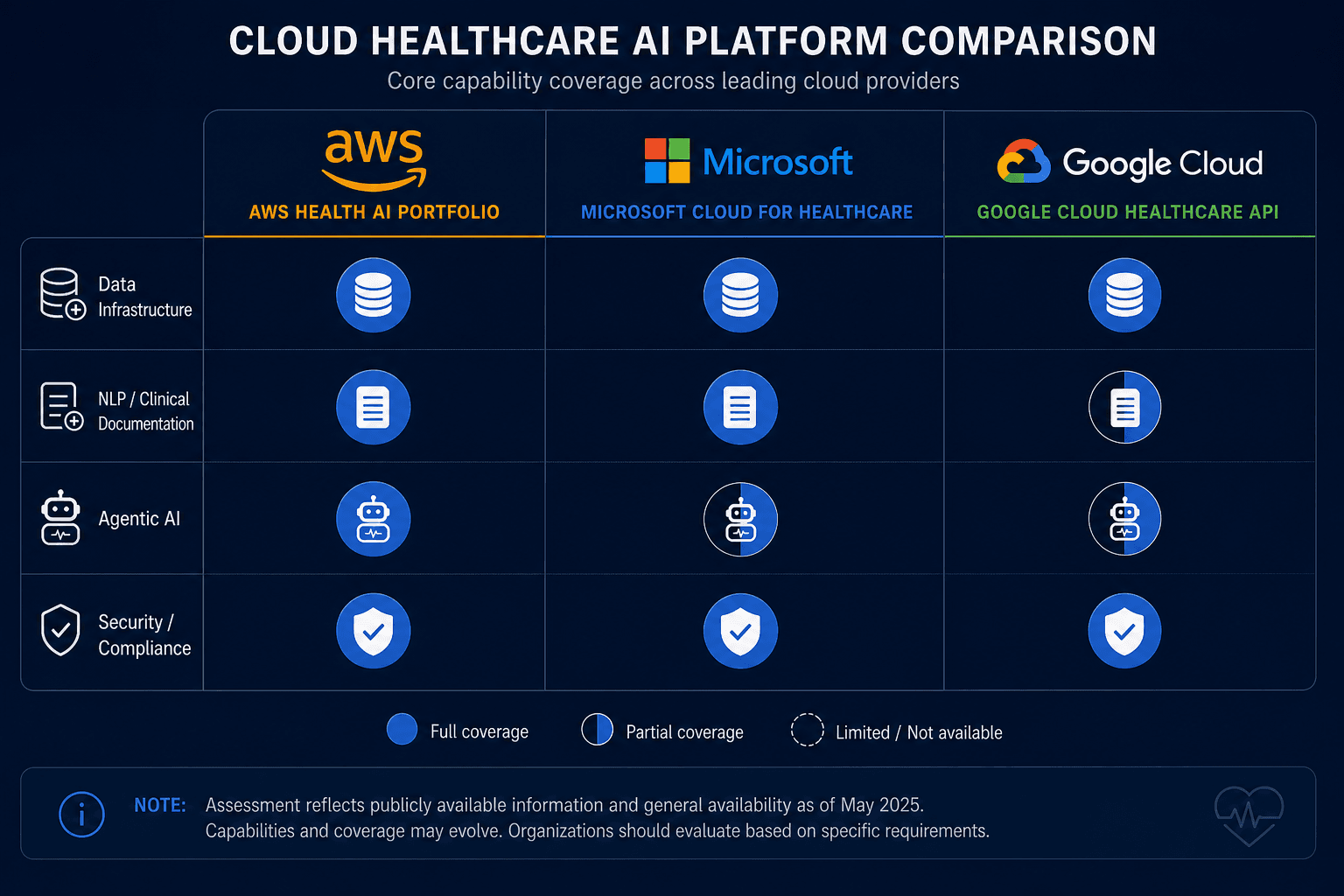
AWS's differentiation lies in its vertically integrated stack approach. Rather than offering individual point solutions that require separate integration work, AWS provides a unified platform where data infrastructure (HealthLake, HealthImaging, HealthOmics), NLP (Comprehend Medical), documentation (HealthScribe/Connect Health), and agentic AI (Connect Health, Health AI) share a common compliance boundary and data model. For health systems already using AWS for general cloud infrastructure, this integration reduces the friction of deploying AI applications.
Microsoft's approach, centered on Nuance DAX Copilot and Azure Health Data Services, is strongest in ambient clinical documentation — Nuance has a longer track record and deeper EHR integrations than AWS's HealthScribe/Connect Health offering. For a detailed comparison, see our Microsoft Dragon Copilot (Nuance DAX Copilot): Platform Profile for Enterprise Ambient AI Clinical Documentation. Google Cloud's Healthcare API and Vertex AI offer strong capabilities in medical imaging AI and genomics, but its healthcare NLP and agentic AI offerings are less developed than AWS's.
For a broader analysis of the competitive landscape including startups and EHR vendors, see The Competitive Landscape of AI in Healthcare 2026: Big Tech, Startups, and the EHR Counteroffensive.
| Capability Area | AWS Health AI | Microsoft Cloud for Healthcare | Google Cloud Healthcare API |
|---|---|---|---|
| Data infrastructure | HealthLake (FHIR), HealthImaging, HealthOmics | Azure Health Data Services (FHIR, DICOM, genomics) | Healthcare API (FHIR, DICOM, HL7v2) |
| NLP / clinical extraction | Comprehend Medical (ICD-10, RxNorm, SNOMED CT) | Azure AI Health Insights, Nuance Dragon Ambient eXperience | Healthcare Natural Language API (limited ontology linking) |
| Clinical documentation | HealthScribe → Connect Health ambient documentation (22+ specialties) | Nuance DAX Copilot (deep EHR integration, longer track record) | Vertex AI for healthcare (less developed documentation offering) |
| Agentic AI (provider) | Amazon Connect Health (5 agents: verification, scheduling, insights, documentation, coding) | Microsoft Copilot for Healthcare (limited agentic capabilities) | Vertex AI Agent Builder (healthcare-specific agents in early stages) |
| Agentic AI (consumer) | Amazon Health AI (multi-agent, HIE-connected, launched 2026) | No dedicated consumer health AI agent | No dedicated consumer health AI agent |
| Security/compliance | 146+ HIPAA-eligible services, Bedrock Guardrails, FHIR R4, HITRUST | Azure compliance portfolio, HIPAA, HITRUST | Google Cloud compliance, HIPAA, HITRUST |
Limitations and Caveats
Several important caveats should inform any evaluation of AWS's health AI portfolio:
- Recency of agentic AI services: Amazon Connect Health and Amazon Health AI launched in Q1 2026. Long-term real-world evidence for these services is limited, and the reported outcomes from UC San Diego Health, One Medical, and Netsmart come from AWS's own announcements rather than independent peer-reviewed studies.
- Vendor-provided metrics: The deployment metrics cited in this profile — including the 630 hours/week saved at UC San Diego Health and the 50% documentation reduction at Tel Aviv Sourasky — are vendor-reported. Health systems should request detailed methodology documentation and consider independent validation before making procurement decisions.
- Enterprise vs. consumer distinction: Amazon Health AI is a consumer product from Amazon Health Services, not from AWS. While it runs on AWS infrastructure and is part of the broader ecosystem, enterprise-focused readers evaluating AWS services for health system deployment should treat it as a separate offering with different data handling and compliance considerations.
- Regional availability: The Health AI Hub is focused on Europe, the Middle East, and Africa, and may have different availability timelines and feature sets compared to US-deployed services. The HealthLake data transformation agent is in preview and available in select regions.
- Methodology disclosure: Some vendor-provided metrics — such as "20% or more productivity gains" from the Health AI Hub landing page — lack specific methodology disclosure. These should be treated as directional indicators rather than verified outcomes.
Comments
Join the discussion with an anonymous comment.