
 Startups vs. Incumbents in Medical AI
The Disruption Thesis: Startups Captured 85% of GenAI Healthcare Spend
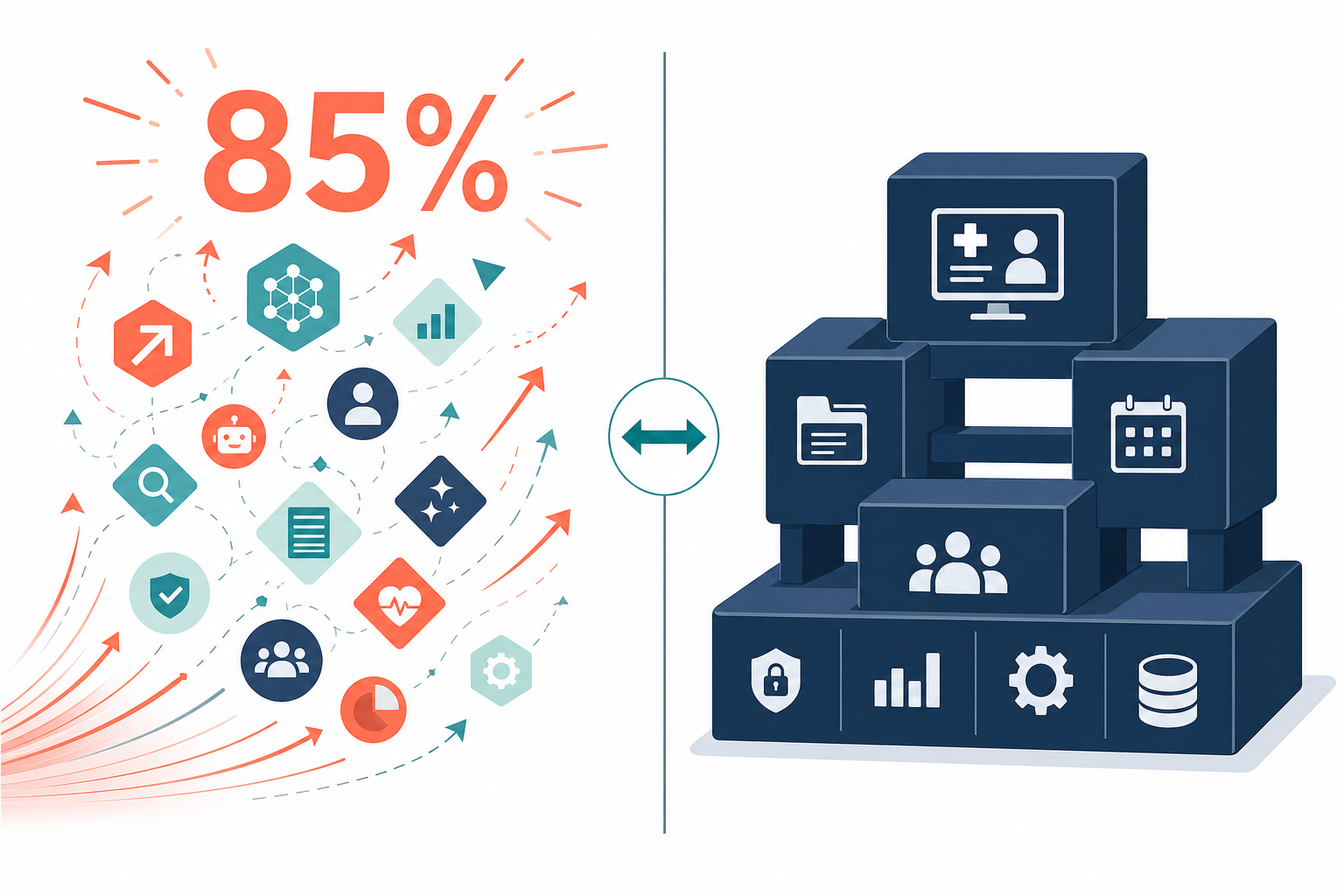
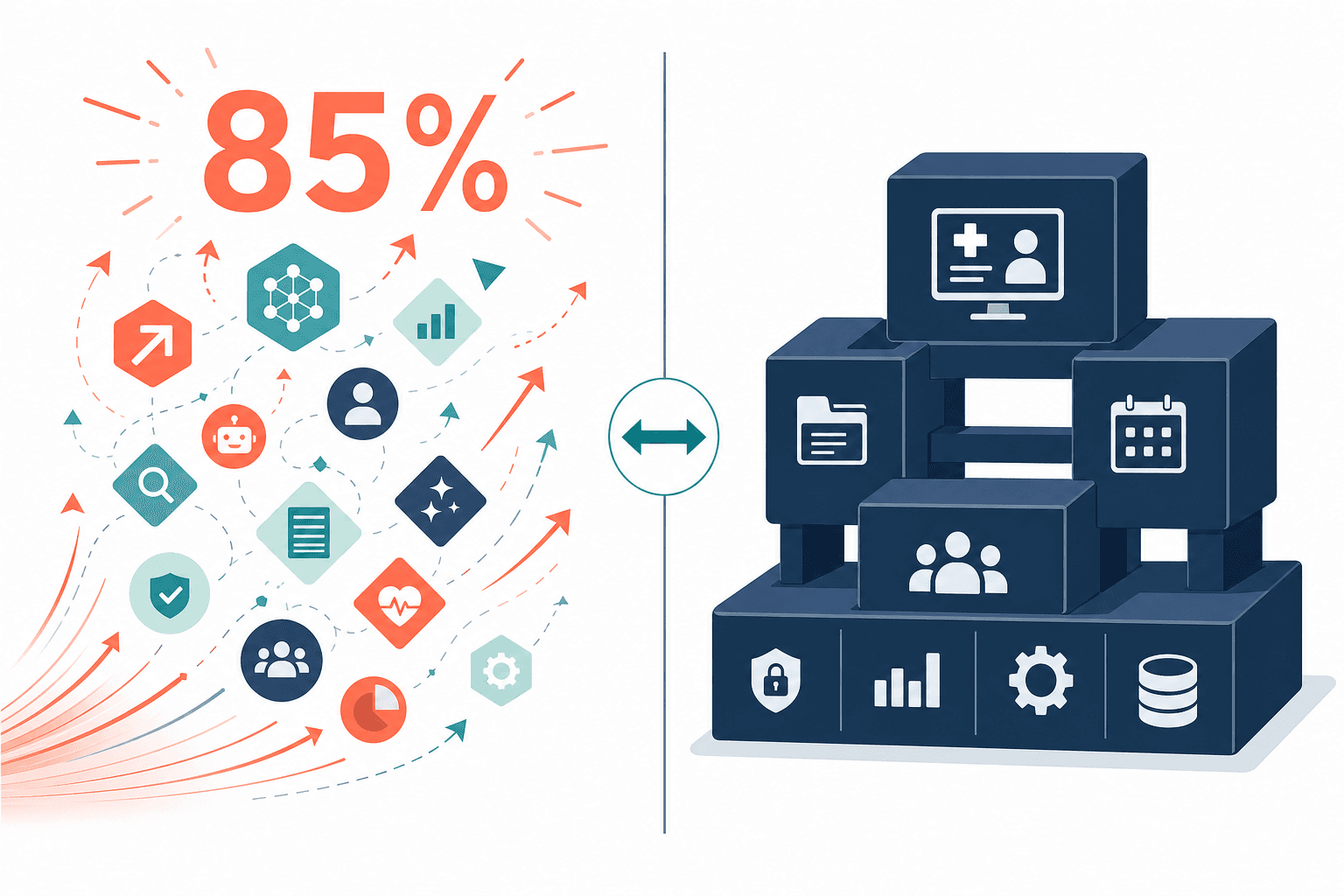
In 2025, a fundamental shift in the healthcare AI market became undeniable. According to a survey of more than 700 healthcare executives conducted by Menlo Ventures, 85% of all generative AI healthcare spending flowed to startups rather than to established EHR vendors or big technology companies. Total healthcare AI spending reached $1.4 billion, nearly triple the 2024 figure, and adoption of domain-specific AI tools jumped to 22% of organizations — a 7x increase year over year.
These numbers tell a clear story: AI-native companies have won the first phase of the market. They identified acute clinical and administrative pain points — ambient documentation, chart review, revenue cycle friction — and built purpose-built solutions that outperformed the generic AI features embedded in legacy EHR platforms. But the headline spend figure masks a more complicated competitive reality. While startups captured the majority of new AI dollars, health system customers consistently report that they prefer to buy AI tools from their existing EHR vendor for most use cases. The tension between where the money is going and where customer loyalty sits defines the current market.
This article examines the startup-versus-incumbent dynamic from both sides: how AI-native companies built their lead, which categories each camp dominates, how EHR incumbents are responding, and what switching-cost data tells us about whether the startup advantage will hold. For health IT strategists and procurement leads evaluating make-versus-buy and build-versus-partner decisions, the next two to three years will be defined by this competitive tension.
How Startups Won: AI-Native Architecture, Velocity, and the Wedge Strategy
Startups did not capture 85% of generative AI spend by accident. They exploited structural advantages that incumbents, constrained by decades of legacy architecture and long release cycles, could not match. Three factors explain their success.
AI-Native Architecture
Companies like Abridge, Ambience, and Suki built their technology stacks from the ground up around large language models and modern cloud infrastructure. They were not retrofitting AI onto a database schema designed in the 1990s. This architectural freedom allowed them to achieve higher accuracy in ambient scribing, faster inference times, and more seamless integration with modern APIs. Incumbents like Nuance, whose DAX Copilot runs on Microsoft's Azure AI infrastructure, have closed some of this gap, but the architectural debt of legacy EHR systems remains a drag on innovation speed.
Product Velocity
Startups ship features in weeks, not quarters. They can iterate on model performance, user interface, and workflow integration without the change-control processes that govern EHR platform updates. In a market where model capabilities are improving monthly, this velocity advantage is decisive. Abridge, for example, went from founding in 2018 to capturing 30% of the ambient scribing market by 2025 — a pace no EHR vendor has matched.
The Wedge Strategy
Most successful healthcare AI startups did not try to replace the EHR. Instead, they identified a single, high-pain-point use case — ambient scribing, chart review, prior authorization — and built a best-in-class solution for that one problem. Ambient clinical documentation became the archetypal wedge. The market grew to $600 million in 2025, making it the largest single AI spend category. By solving documentation burden, startups gained a foothold in the clinical workflow without needing to displace the EHR itself.
| Company | Ambient Scribing Market Share (2025) | Category Position |
|---|---|---|
| Nuance (DAX Copilot) | 33% | Incumbent (Microsoft) |
| Abridge | 30% | Startup |
| Ambience | 13% | Startup |
| Other startups (Suki, Freed, etc.) | 24% | Startup |
The table shows that Abridge and Ambience together (43%) have nearly matched Nuance's long-standing dominance in a category Nuance effectively owned for decades. This is the wedge strategy in action: solve one problem so well that clinicians demand the tool, then expand into adjacent use cases.
Category-by-Category Breakdown: Where Startups Lead and Where Incumbents Hold
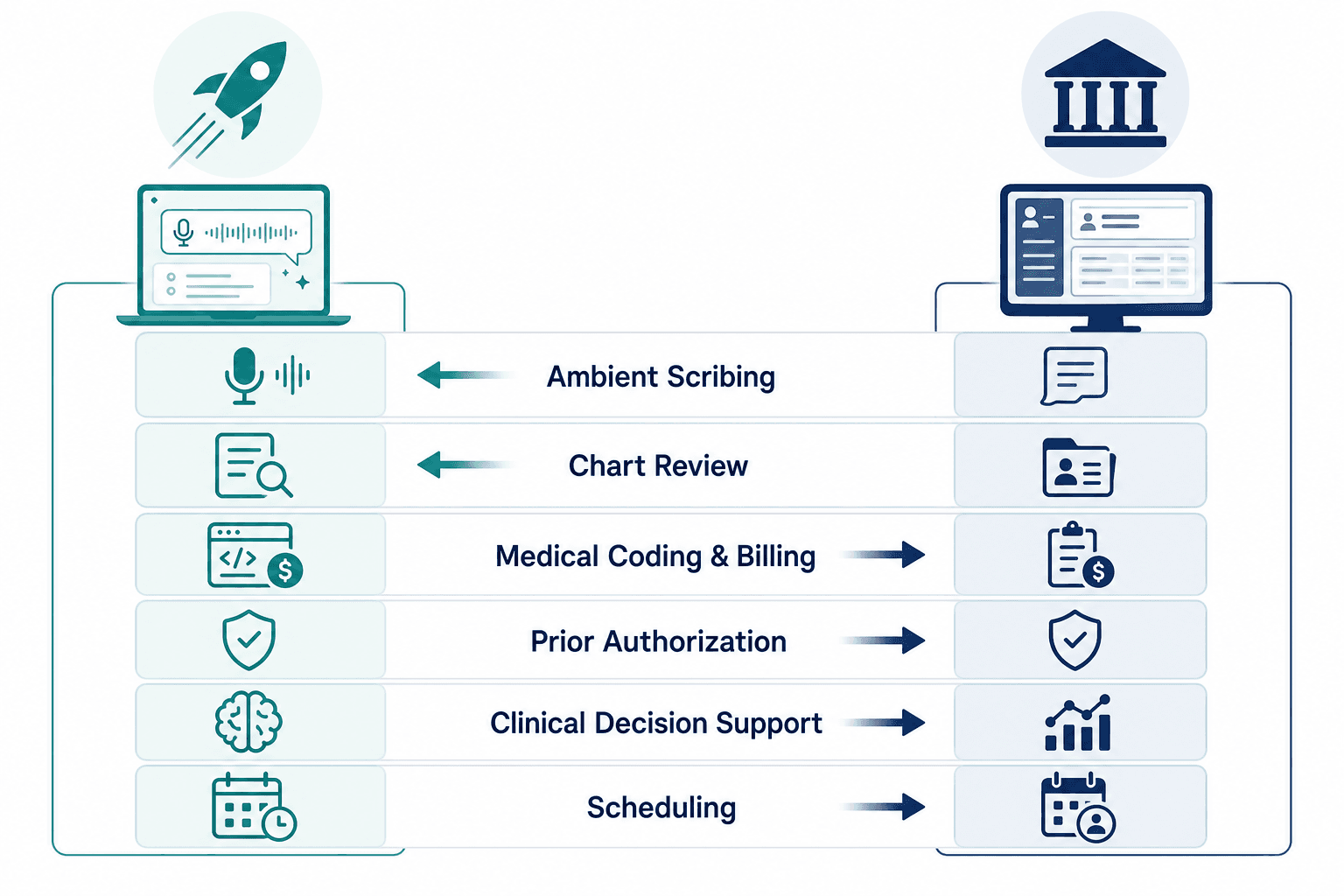
The startup advantage is not uniform across all healthcare AI use cases. The Menlo Ventures survey data reveals a clear split: startups lead in two categories, while incumbents hold the advantage in six others. Understanding this distribution is critical for procurement teams deciding whether to buy from a startup or wait for an EHR-native solution.
| Use Case | Dominant Side | Key Reason |
|---|---|---|
| Ambient Scribing | Startups | Best-in-class accuracy; wedge entry point |
| Chart Review / Summarization | Startups | AI-native architecture; fast iteration |
| Medical Coding & Billing | Incumbents | Deep EHR workflow integration required |
| Prior Authorization | Incumbents | Tied to revenue cycle and payer connections |
| Clinical Decision Support | Incumbents | Requires access to full patient record |
| Patient Scheduling | Incumbents | Native to EHR scheduling modules |
| Patient Navigation | Incumbents | Requires longitudinal patient data |
The pattern is instructive. Startups dominate categories where the AI task is relatively self-contained — transcribing a conversation, summarizing a chart — and does not require deep integration with the EHR's transactional data model. Incumbents dominate categories where the AI must read from and write back to the EHR's core clinical and financial records. Prior authorization, for example, is not just an AI problem; it is a workflow problem that requires the AI to interact with payer portals, benefit verification systems, and the EHR's order management module. Incumbents control those integration points.
For a broader view of the company landscape across these categories, see our Healthcare AI Companies: A Structured Landscape Overview, which profiles the major players in each segment.
The Incumbent Counteroffensive: Epic, Oracle Health, and athenahealth Strike Back
EHR incumbents did not remain passive while startups captured the AI narrative and the spending. In 2025 and early 2026, the three largest EHR vendors — Epic, Oracle Health, and athenahealth — all introduced their own ambient scribing capabilities directly embedded in their platforms. This is the most direct threat to the startup wedge strategy.
Epic's Built-In Ambient Scribe
Epic, which controls roughly one-third of the U.S. acute care EHR market, launched its own ambient documentation feature in 2025. The feature is natively integrated into the Epic workflow — no separate login, no data leaving the Epic ecosystem, no additional procurement process. For health systems already on Epic, the built-in scribe eliminates the integration friction and security review that comes with deploying a third-party startup tool. The cost is typically bundled into the existing Epic subscription, making it difficult for startup pricing to compete on a total-cost-of-ownership basis.
Oracle Health and athenahealth
Oracle Health (formerly Cerner) and athenahealth have followed similar paths, embedding AI features into their respective platforms. Oracle Health's AI capabilities include ambient scribing, clinical summarization, and revenue cycle automation. athenahealth's offerings target the ambulatory market with AI-assisted documentation and coding. These moves signal that incumbents view AI not as a separate product category but as a feature of the core EHR platform — a framing that, if accepted by customers, could marginalize standalone startup tools.
The incumbent advantage goes beyond the product itself. EHR vendors control the clinical workflow, the data access layer, and the procurement relationship. When a health system evaluates an AI tool, the EHR vendor's IT team is already in the room. Startups must win a separate procurement process, pass a security review, negotiate a data-sharing agreement, and integrate with an EHR that may change its API terms at any time. Incumbents face none of those barriers.
Switching Costs and Stickiness: Why 67% of Ambient Scribe Users May Switch
The most counterintuitive finding in the Menlo Ventures data is this: despite startups capturing the majority of AI spend, 67% of outpatient providers currently using ambient scribes say they are likely to switch vendors within the next three years. The ambient scribing market, which startups have worked so hard to win, is not yet sticky.
Several factors drive this churn risk:
- Integration depth: Many startup ambient scribes operate as overlay tools that require clinicians to copy-paste notes into the EHR. Native EHR scribes eliminate this step, creating a significantly better user experience.
- Feature gaps: As incumbents add AI features, startup tools that only solve one problem face pressure to expand their feature set or risk being replaced by a bundled alternative.
- Pricing dynamics: Incumbent AI features are often included in existing platform fees, making them effectively free at the margin. Startup tools carry separate per-provider or per-encounter pricing that is easy for procurement to question.
- Data portability costs: Ambient scribes generate structured clinical notes that become part of the patient record. Switching vendors means retraining models on new note formats, reconfiguring EHR integrations, and potentially losing historical note quality.
What creates stickiness on the startup side? The answer is workflow embedding and data network effects. Startups that integrate deeply enough that clinicians cannot easily extract their notes and switch without workflow disruption have a retention advantage. Abridge, for example, has invested heavily in EHR-native integration — its tool writes directly into the note field in Epic, rather than requiring a copy-paste step. That integration depth raises switching costs.
For health IT strategists, the switching-cost data has a clear implication: do not assume that today's market share distribution will persist. The ambient scribing category, in particular, is likely to see significant vendor turnover as incumbent-native tools mature and as startups either deepen their integration or get displaced.
Outlook: What the Next 2–3 Years Look Like for the Competitive Landscape
The healthcare AI market is still early. With 22% adoption and $1.4 billion in spending, the vast majority of health systems have not yet deployed domain-specific AI tools at scale. The competitive picture remains fluid, and the next two to three years will determine whether startups maintain their spend lead or incumbents recapture the market through platform bundling.
Several trends will shape the outcome:
- Incumbent AI feature velocity: If Epic, Oracle Health, and athenahealth continue to ship AI features at their current pace, the window for startup wedge strategies will narrow. The ambient scribing category is the test case — if incumbents can match startup quality within two years, the wedge disappears.
- Startup expansion beyond the wedge: The most successful startups are already expanding into adjacent categories. Abridge is adding chart summarization and coding assistance. Ambience is moving into prior authorization. The question is whether they can build platform breadth before incumbents catch up on quality.
- Procurement consolidation: Health systems are beginning to consolidate AI vendor relationships, preferring fewer platform vendors over many point solutions. This trend favors incumbents and large startups that can offer multiple AI capabilities under one contract.
- Regulatory and data access dynamics: FDA clearance trends, interoperability mandates, and data-sharing policies will affect both sides. Startups that achieve regulatory first-mover advantages — like Aidoc's first FDA clearance for a foundation model-powered clinical AI device in February 2025 — may build moats that incumbents cannot quickly cross.
The most likely scenario is not a winner-take-all outcome but a segmented market: startups continue to lead in self-contained AI tasks (ambient scribing, chart review, AI agents for patient communication), while incumbents dominate categories that require deep EHR integration (coding, billing, prior authorization, CDS). The ambient scribing category itself may split, with startup tools retaining market share in ambulatory settings where integration depth matters less, while incumbent-native tools dominate in hospital systems where workflow embedding is paramount.
For procurement teams, the strategic implication is clear: do not lock into long-term contracts with either startups or incumbents until the switching-cost dynamics settle. Favor vendors that offer deep EHR-native integration (which raises their switching costs) and avoid tools that require manual data transfer between systems (which lowers yours. The next two years will bring significant vendor churn, and the health systems that maintain procurement flexibility will be best positioned to benefit from the competition.
Comments
Join the discussion with an anonymous comment.