
Introduction: 2026 as the Inflection Year — From Pilots to Accountability
If 2024 was the year of experimentation and 2025 was the year of cautious deployment, then 2026 is the year the healthcare AI industry grew up. The summit circuit this year was not dominated by breathless demonstrations of prototype capabilities or speculative roadmaps. Instead, the conversations that filled conference halls from Anaheim to London to New Delhi centered on a far more mature set of concerns: governance, regulation, the hard work of production deployment, and the measurable outcomes that separate tools that matter from tools that merely impress.
This intelligence briefing synthesizes the major events of the 2026 AI in healthcare summit season. It maps the landscape of key summits, identifies four cross-cutting themes that emerged across them, and translates the consensus into strategic recommendations for health system executives, digital health strategists, policy professionals, and researchers. The core thesis is straightforward: the 2026 summit season reveals a decisive shift from exploration to accountability. Governance is no longer a compliance checkbox — it is infrastructure. The innovation-to-production gap is the defining operational challenge. Ambient clinical intelligence has become the breakout application with documented ROI. And the framework for the entire conversation — evaluation, regulation, and continuous monitoring — has been set by the JAMA Summit Report.
The 2026 AI in Healthcare Summit Landscape Map
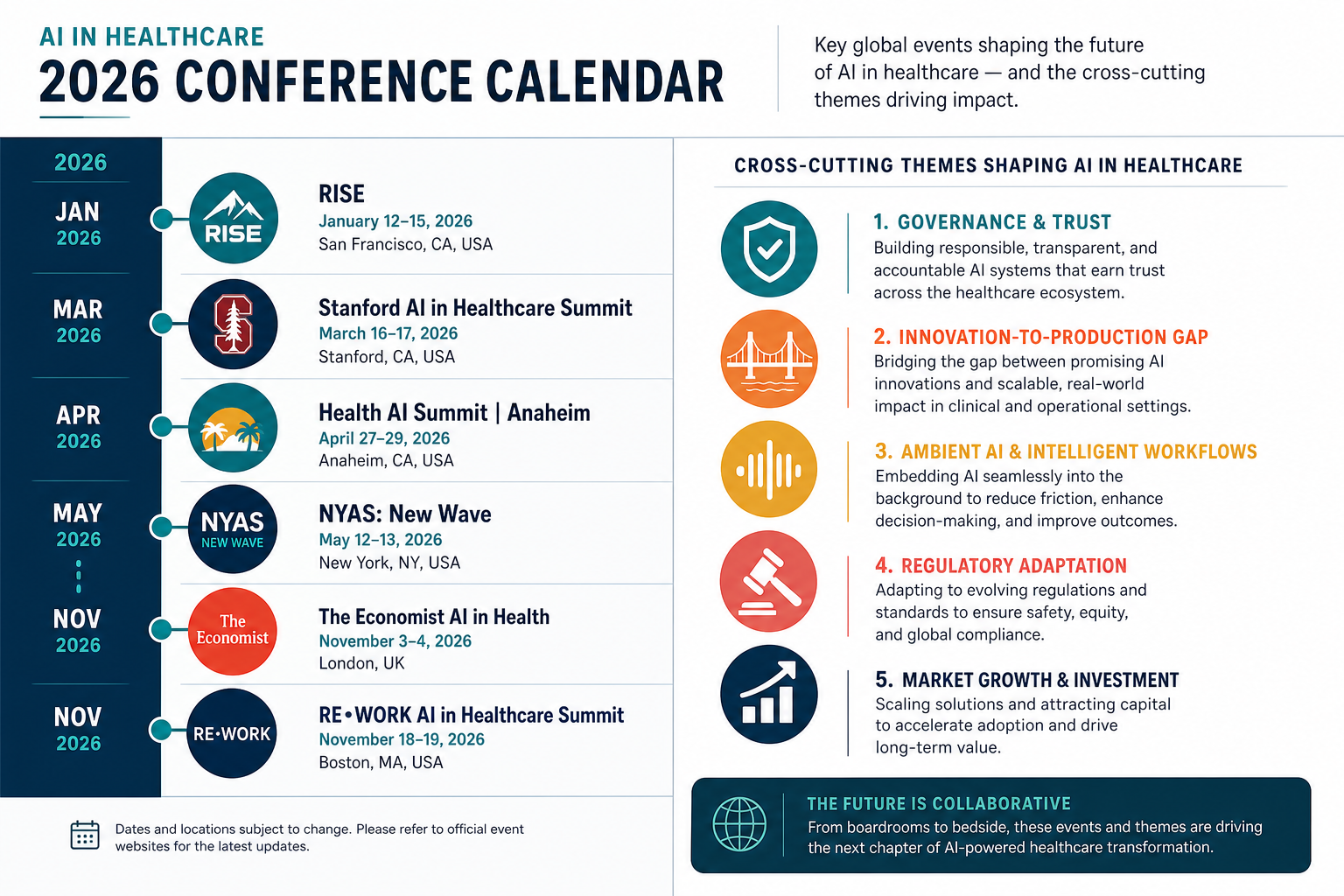
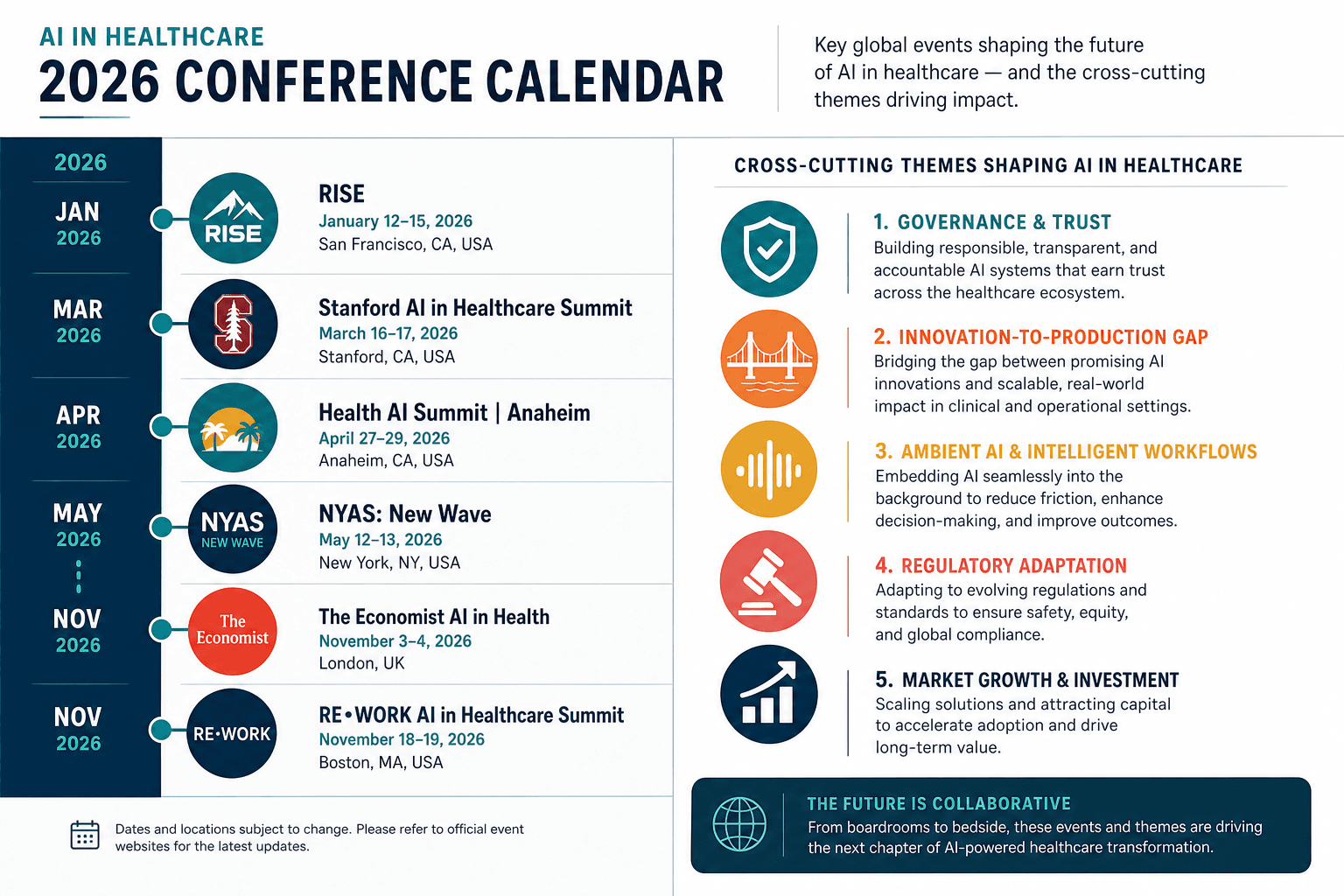
The 2026 summit calendar was dense, with at least ten major events spanning North America and Europe, each serving a distinct audience. The table below provides a structured overview of the most significant summits, their primary focus, and defining moments.
| Summit | Dates & Location | Primary Audience | Defining Sessions / Insights |
|---|---|---|---|
| RISE AI in Health Care Summit | Jan 21–23, Anaheim, CA | Health plan leaders, payers, compliance officers | AI Governance, Risk, and Compliance session featuring Louisiana Blue and CityBlock; Washington Watch on federal AI policy |
| Stanford AI Healthcare Conference | Mar 26–27, Palo Alto, CA | Clinicians, researchers, health IT leaders | Keynote by Microsoft Research on virtual patients; workshops on privacy-aware models and translating predictive analytics into workflows |
| Health AI Summit | Apr 8–9, Anaheim, CA | Hospital executives, AI developers, regulators | Case studies on real-world AI deployment; generative AI for workflow and patient engagement; speakers from Mayo Clinic, Amazon, Microsoft |
| NYAS New Wave of AI in Healthcare | May 12–13, New York, NY | Scientists, clinicians, policy experts | Cutting-edge research on reshaping diagnosis and care delivery; ethical and regulatory considerations |
| HealthAI Global Governance Forum | Feb 2026 (pre-summit to India AI Impact Summit), New Delhi | Global health leaders, policymakers, international organizations | Operationalizing AI governance principles; regulatory adaptation including MHRA AI Airlock sandbox; 240+ participants from 50+ countries in 2025 edition |
| ACI Healthcare AI Summit | 2026 (dates TBD), US | Legal, regulatory, and compliance professionals | Special two-part FDA focus on market access pathways; EU AI Act implications; co-chaired by Northwell Health and White & Case |
| Economist AI in Health Summit | Nov 4, London, UK | C-suite executives, policymakers, pharma leaders | 50+ speakers from 23 sectors across 31 countries; central question of scaling AI; MHRA Chief Executive and German Federal Ministry of Health featured |
| RE•WORK AI in Healthcare & Pharma Summit | Nov 17–18, Boston, MA | Pharma, health systems, technology vendors | Empowering clinicians through AI; speakers from Merck, AstraZeneca, Intermountain Health; topics include speech recognition, personalized medicine, NLP |
Several observations stand out from this landscape. First, the audience segmentation is sharp: payers had their own dedicated summit at RISE, legal and compliance professionals had the ACI summit, and global health governance had the HealthAI Forum. This specialization signals that AI in healthcare is no longer a single conversation — it is a set of distinct, stakeholder-specific dialogues. Second, the geographic spread is notable: while North America dominated, the Economist summit in London and the HealthAI Forum in New Delhi indicate that the conversation is genuinely international, with different regulatory frameworks and deployment realities shaping the agenda.
Cross-Cutting Theme #1: Governance as Infrastructure — Not a Compliance Checkbox
The single most prevalent theme across the 2026 summit season was governance. Not as a footnote or a regulatory afterthought, but as a foundational requirement for any serious AI deployment. This represents a marked shift from previous years, where innovation and capability demonstrations dominated agendas.
At the RISE AI in Health Care Summit, governance was the organizing principle. The summit, designed specifically for health plan leaders, featured a pre-summit workshop on AI Regulatory and Compliance Issues led by leaders from Cantex Continuing Care Network and Mayo Clinic. A flagship session, "AI Governance, Risk, and Compliance: Aligning Innovation with Accountability," featured Jordan Krouse, Manager of Data Science at Louisiana Blue, and Rafi Cices, Head of Risk Adjustment, Coding & Billing at CityBlock. The session was not about what AI could do — it was about how to build the organizational structures to ensure it does the right thing. Louisiana Blue also presented a separate case study on its journey to custom AI application development, demonstrating that governance is not a barrier to innovation but a prerequisite for it.
The ACI Healthcare AI Summit approached governance from the legal and regulatory angle, with a "Special Two-Part FDA Focus" on market access pathways for AI-enabled devices and in-depth roundtables on AI governance. Co-chaired by the Deputy General Counsel of Northwell Health and partners from White & Case, the summit treated governance as a cross-functional discipline requiring legal, clinical, and technical expertise.
The HealthAI Global Governance Forum brought a global south perspective to the governance conversation. The 2025 edition in Nairobi drew 240+ participants from more than 50 countries, and 100% of respondents said they would attend future editions. Sessions covered operationalizing AI governance principles, capacity strengthening, and regulatory adaptation — including the UK MHRA's AI Airlock sandbox. The 2026 Forum served as an official pre-summit to the India AI Impact Summit, signaling that governance is not a developed-world luxury but a global imperative.
AI is being adopted at remarkable speed in the health care sector, but our systems for evaluating and regulating it haven't kept pace.
That assessment, from Stanford professor Michelle Mello, a co-author of the JAMA Summit Report, captures the sentiment that ran through nearly every governance session in 2026. The consensus is clear: organizations that treat governance as a compliance checkbox will find themselves unable to scale. Those that treat it as infrastructure — investing in AI governance boards, continuous monitoring systems, and cross-functional oversight — will have the foundation needed for responsible deployment.
Cross-Cutting Theme #2: The Innovation-to-Production Gap — Why Prototyping Is Easy, Scaling Is Hard
If governance was the most discussed theme, the innovation-to-production gap was the most candidly discussed problem. Across multiple summits, speakers and attendees acknowledged that generative AI has made prototyping deceptively easy — and that this ease is creating a dangerous illusion of progress.
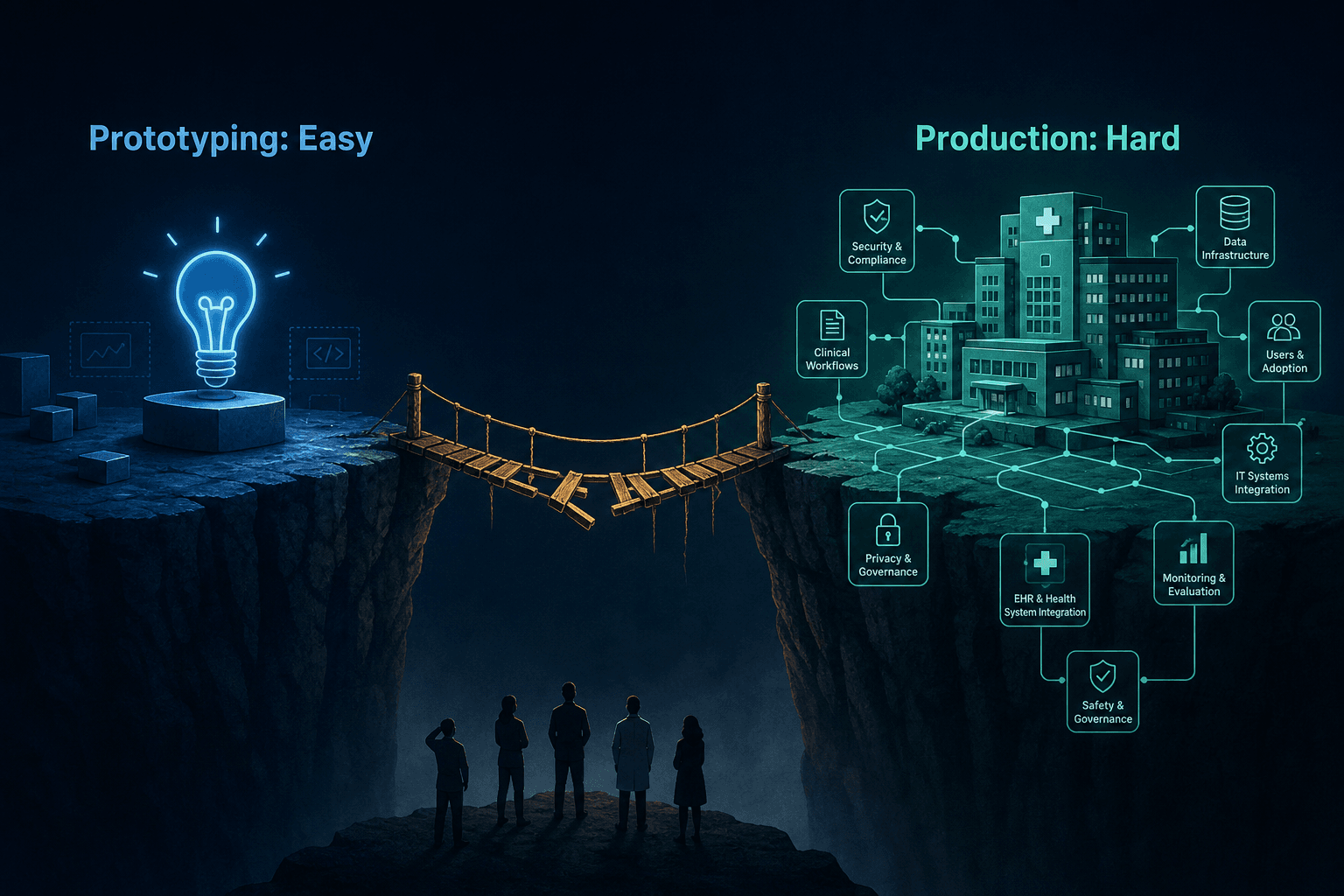
At the Hakkoda AI in Healthcare Summit (May 2025, but its insights carried directly into 2026 discussions), a panelist delivered a blunt assessment: "Gen AI makes it super easy to prototype anything, but I see leaders making decisions like 'one person did that in an hour, I don't need a team' and genuinely not understanding the gap to get to the product phase." The summit reported that AI technology penetration had reached approximately 40% within two years, but the gap between prototype and production-ready deployment remained the single biggest barrier.
The Economist AI in Health Summit framed its entire 2026 edition around this question: why, despite rapid advances, have so few health systems scaled AI effectively? With 50+ speakers from 23 sectors across 31 countries, the summit brought together perspectives from health systems, regulators, pharma, and technology vendors to diagnose the problem. The 2025 edition had already drawn 389 attendees from 271 unique companies, indicating that this question resonates across the industry.
The Stanford AI Healthcare Conference addressed the gap through its T.H.I.N.K. theme (Technology in Healthcare: Integration, Networks, and Knowledge). Workshops on translating predictive analytics into clinical workflows and building privacy-aware AI models directly tackled the operational challenges of moving from research to practice. The conference's emphasis on integration and networks reflected a growing recognition that AI tools fail not because the algorithms are flawed, but because they are "disconnected from the workflow" — a finding echoed in the JAMA Summit Report.
At the Define Ventures AI + Healthcare Summit (co-hosted with Sutter Health), one executive captured the infrastructure challenge with a memorable analogy: "Putting AI on top of a fax machine doesn't give you better care. We need to eliminate the fax machine first." The summit also featured OpenAI co-founder Greg Brockman, who emphasized that "there is no finish line with developing and innovating generative AI" — a reminder that the technology itself is moving faster than the organizational capacity to absorb it.
Cross-Cutting Theme #3: Ambient Clinical Intelligence as 2026's Breakout Application
While governance and scaling challenges dominated strategic discussions, one application area stood out for its consistent validation across summits: ambient clinical intelligence (ACI). AI-powered ambient scribes — tools that listen to patient-clinician conversations and automatically generate clinical documentation — were repeatedly cited as the most mature and impactful use case in 2026.

At the Hakkoda Summit, ambient clinical intelligence was described as a game-changer. A panelist noted: "Ambient is the first time where the objective has just been 'make the days easier.' We have quotes from tons of physicians saying, 'I get to go home on time. I get to go to my kids' soccer games. I get joy back into seeing patients.'" This focus on clinician well-being and work-life balance — not just efficiency or cost savings — represents a significant shift in how ROI is measured for AI tools.
The Snowflake Summit 2026 reinforced this finding with data on agentic AI adoption. A survey presented at the summit found that 64.5% of healthcare organizations surveyed have adopted, are experimenting with, or plan to implement agentic AI within 6-12 months. Jesse Cugliotta, Global Head of Healthcare & Life Sciences at Snowflake, stated: "Nobody gets into medicine because they love paperwork. Agentic AI is one of the first technology waves that allows clinicians to get closer to operating at the top of their license." This aligns directly with the ambient scribe use case, where the AI handles documentation burden so clinicians can focus on clinical reasoning and patient interaction.
The Stanford AI Healthcare Conference featured Microsoft Research's Hoifung Poon on "Towards Virtual Patients: AI for Accelerating Medical Discovery," while the Health AI Summit included sessions on generative AI for workflow and patient engagement, with speakers from Microsoft, Amazon, and Rad AI — all companies with significant ambient AI offerings.
For readers seeking a deeper understanding of this application, ClinicalMind offers several relevant resources: the full capability landscape of ambient clinical intelligence, the analysis of ambient AI beyond scribing to decision support, and the platform profile of Microsoft Dragon Copilot (Nuance DAX Copilot), a leading ambient AI documentation platform.
Cross-Cutting Theme #4: The JAMA Summit Framework — Evaluation, Regulation, Monitoring
If any single document provided the intellectual framework for the 2026 summit season, it was the JAMA Summit Report on Artificial Intelligence, published in October 2025. Convened by Stanford HAI and featuring 65+ co-authors including Michelle Mello of Stanford Law and Medicine, the report concluded that "AI will disrupt every part of health and health care delivery" and called for alignment among developers, systems, payers, regulators, and patients on three pillars: evaluation, regulation, and monitoring.
The report's key recommendations include:
- Expanded FDA oversight of AI/ML-enabled medical devices, moving beyond the current 510(k)-dominant framework to ensure that tools are evaluated for clinical effectiveness, not just technical performance
- Continuous evaluation systems that treat AI as a "learning health ecosystem" — not a one-time clearance event but an ongoing process of monitoring, updating, and re-evaluating as models and clinical contexts evolve
- Governance as infrastructure, embedding AI oversight into the organizational fabric of health systems rather than treating it as a separate compliance function
- Augmentation over automation, emphasizing that AI should support clinical decision-making rather than replace it, with clear roles for human oversight
The report's influence was evident across the summit circuit. At the Stanford AI Healthcare Conference, Nigam H. Shah, Chief Data Scientist at Stanford Health Care and a prominent voice in AI evaluation, spoke on AI quality, reliability, and equity — directly reflecting the JAMA framework's emphasis on continuous evaluation. The conference's workshops on translating predictive analytics into clinical workflows addressed the report's call for tools that are integrated into clinical practice, not bolted on.
The Economist AI in Health Summit featured Mihaela van der Schaar, Professor for AI and Medicine at the University of Cambridge, and Lawrence Tallon, Chief Executive of the MHRA — both of whom are central to the regulatory evolution that the JAMA report calls for. The summit's framing question — why scaling AI is so difficult — is precisely the problem the JAMA framework seeks to address by establishing standards for evaluation and monitoring.
The HealthAI Global Governance Forum extended the JAMA framework to the global context, with sessions on regulatory adaptation and international cooperation. The forum's focus on capacity strengthening in low- and middle-income countries addressed a gap in the JAMA report — how to ensure that evaluation and monitoring frameworks work across diverse health systems with varying levels of digital maturity.
Market Context: $50.7B and 295 FDA Clearances — The Numbers Behind the Narrative
The summit conversations did not happen in a vacuum. The quantitative backdrop for 2026 is striking, and it helps explain both the urgency and the caution that characterized the year's events.
| Metric | Value | Source / Notes |
|---|---|---|
| Global AI in healthcare market (2025) | $36.67B | Grand View Research estimate; other sources range from $2.87B (Polaris) to $21.66B (MarketsandMarkets) |
| Global AI in healthcare market (2026 projected) | $50.70B | Grand View Research projection; methodology varies by source |
| FDA AI/ML device 510(k) clearances (2025) | 295 | Innolitics analysis; 221 unique manufacturers; 96% via 510(k) pathway |
| Radiology share of FDA clearances | 71.5% (211 devices) | Dominant specialty; cardiovascular (8.8%) and neurology (4.7%) follow |
| Median FDA clearance time | 142 days | 24% of devices cleared in under 90 days |
| Manufacturers with single clearance | 183 | Indicates a thriving startup ecosystem with many first-time entrants |
The 295 FDA AI/ML device clearances in 2025 represent a significant acceleration. Shanghai United Imaging Healthcare led all manufacturers with 10 clearances, while 183 manufacturers had a single clearance — a sign that the barrier to entry for AI medical devices is lowering, but also that the market is becoming crowded with tools that may or may not have robust clinical evidence behind them.
The dominance of radiology (71.5% of all clearances) is consistent with the historical pattern, but it also raises questions that were discussed at multiple summits. When will AI tools in other specialties — cardiology, neurology, pathology — reach similar levels of regulatory maturity? And how will the FDA's evolving approach to predetermined change control plans (PCCPs), which were used in 10% of 2025 clearances, affect the pace of innovation in non-radiology fields?
For a deeper understanding of the vendor ecosystem driving these numbers, ClinicalMind's competitive landscape analysis for 2026 provides a detailed breakdown of the major players, from Big Tech to startups to EHR vendors. The category-based analysis of top AI healthcare companies offers a complementary view of the companies that are shaping the market.
Strategic Recommendations for Attendees and Decision-Makers
The 2026 summit season produced a clear set of strategic imperatives for healthcare organizations. The following recommendations translate the year's consensus themes into actionable guidance for executives, strategists, and policy professionals.
- Build governance infrastructure now, not later. The RISE Summit and ACI Summit both demonstrated that governance is the foundation for scaling AI, not a barrier to it. Organizations should establish cross-functional AI governance boards that include clinical, legal, compliance, and technical leadership. The JAMA Summit Report's framework provides a ready-made structure for this work.
- Invest in data foundations before AI applications. The innovation-to-production gap is, at its core, a data infrastructure problem. Organizations that have clean, well-structured, interoperable data will be able to deploy AI tools far more rapidly than those that do not. The "fax machine" analogy from the Define Ventures Summit is a reminder that AI cannot fix broken workflows — it can only amplify them.
- Prioritize ambient clinical intelligence and prior authorization automation. These two use cases emerged from the summit season as the most validated applications with measurable ROI. Ambient AI reduces documentation burden and improves clinician satisfaction, while AI-driven prior authorization addresses a major source of administrative cost and delay. ClinicalMind's analysis of the administrative AI paradox provides important context on the risks of poorly implemented automation.
- Prepare for regulatory evolution, not revolution. The JAMA Summit Report's call for expanded FDA oversight is likely to result in gradual, not sudden, changes. Organizations should monitor the FDA's evolving approach to PCCPs and the EU AI Act's implementation, but should not expect a regulatory upheaval. The NLP in clinical documentation reference guide offers foundational knowledge for teams working with AI-driven documentation tools.
- Adopt a continuous evaluation mindset. The JAMA framework's emphasis on treating AI as a "learning health ecosystem" means that organizations need systems for monitoring model performance, detecting drift, and re-evaluating tools as clinical contexts change. This is not a one-time procurement decision but an ongoing operational capability.
- Engage with the global conversation. The HealthAI Global Governance Forum and the Economist Summit demonstrated that AI in healthcare is a global issue with different regulatory frameworks and deployment realities. Organizations that limit their perspective to a single jurisdiction will miss important lessons from other markets.
The 2026 summit season made one thing clear: the era of AI experimentation in healthcare is over. The questions that dominated this year's events — How do we govern this? How do we scale this? How do we measure whether it actually works? — are the questions of a maturing industry. Organizations that treat these questions as strategic priorities rather than afterthoughts will be best positioned to capture the value that AI offers, while avoiding the pitfalls that come with deploying powerful tools without adequate infrastructure.
Comments
Join the discussion with an anonymous comment.