
The short answer to “what is the focused ultrasound Parkinson’s treatment evidence?” is yes, there is real evidence for selected uses, but it is narrower than the clearance story can make it sound. Exablate Neuro is an interventional lesioning device, not a clinical-AI tool or a wellness-adjacent “noninvasive” therapy. The clinically relevant question is not whether the device entered the FDA record; it did. The question is which target, which Parkinson’s indication, which trial design, how durable the motor response appears to be, and what permanent or persistent neurologic tradeoffs travel with the lesion.

This appraisal is evidence review, not treatment guidance. For readers who know our Parkinson’s FDA-versus-evidence work from the neuropacs appraisal or the AIDP evidence appraisal, the same discipline applies here, but the scoring logic changes. Prediction-model concerns such as dataset shift and external validation give way to interventional-device concerns: randomization, sham credibility, attrition, selection criteria, durability, target-specific adverse events, and whether open-label data are being asked to carry claims they cannot support.
The FDA timeline is real, but it is only the doorway
Exablate Neuro’s regulatory history is not in dispute. The problem starts when the existence of a clearance is treated as if it were a single, target-agnostic proof of clinical efficacy. Parkinson’s focused ultrasound is not one intervention. A unilateral thalamic lesion for tremor, a pallidal lesion for dyskinesia or motor complications, a subthalamic lesion, and staged bilateral lesioning raise different evidence and counseling questions.
| Regulatory event | What the event establishes | What it does not establish by itself |
|---|---|---|
| P150038, 2016 essential tremor approval | Exablate Neuro entered the FDA PMA record for medication-refractory essential tremor. | It does not prove Parkinson’s-specific efficacy. |
| December 2018 tremor-dominant Parkinson’s clearance | The FDA record expanded into Parkinson’s tremor treatment. | It does not settle evidence quality for other Parkinson’s targets or motor complications. |
| PMA supplement S014, decision date October 29, 2021 | The FDA record includes a unilateral GPi pallidotomy expansion for Parkinson’s based on NCT03319485.[1] | It does not turn a single target’s evidence into a blanket focused-ultrasound verdict. |
| PMA supplement S037B, approval date July 3, 2025 | The FDA approved a staged bilateral pallidothalamic tractotomy supplement.[2] | It does not remove the need to weigh cumulative bilateral adverse-event risk. |
That distinction matters because the device’s commercial story has moved faster than the highest-certainty evidence. The strongest Parkinson’s focused-ultrasound trials are small randomized sham-controlled studies. Newer expansion claims, especially staged bilateral lesioning, lean more heavily on open-label, single-arm evidence, where expectation effects, selection effects, and adverse-event ascertainment become harder to separate from the treatment signal.
A lesion is “noninvasive” only in the incision sense
MRI-guided focused ultrasound concentrates acoustic energy on a small deep-brain target. The attraction is obvious: no implanted pulse generator, no extension leads, no burr-hole hardware left behind. But the intended therapeutic act is still ablation. The target tissue is lesioned. If the lesion produces speech, gait, balance, sensory, or weakness effects that persist, the fact that no incision was made is not the fact the patient lives with.
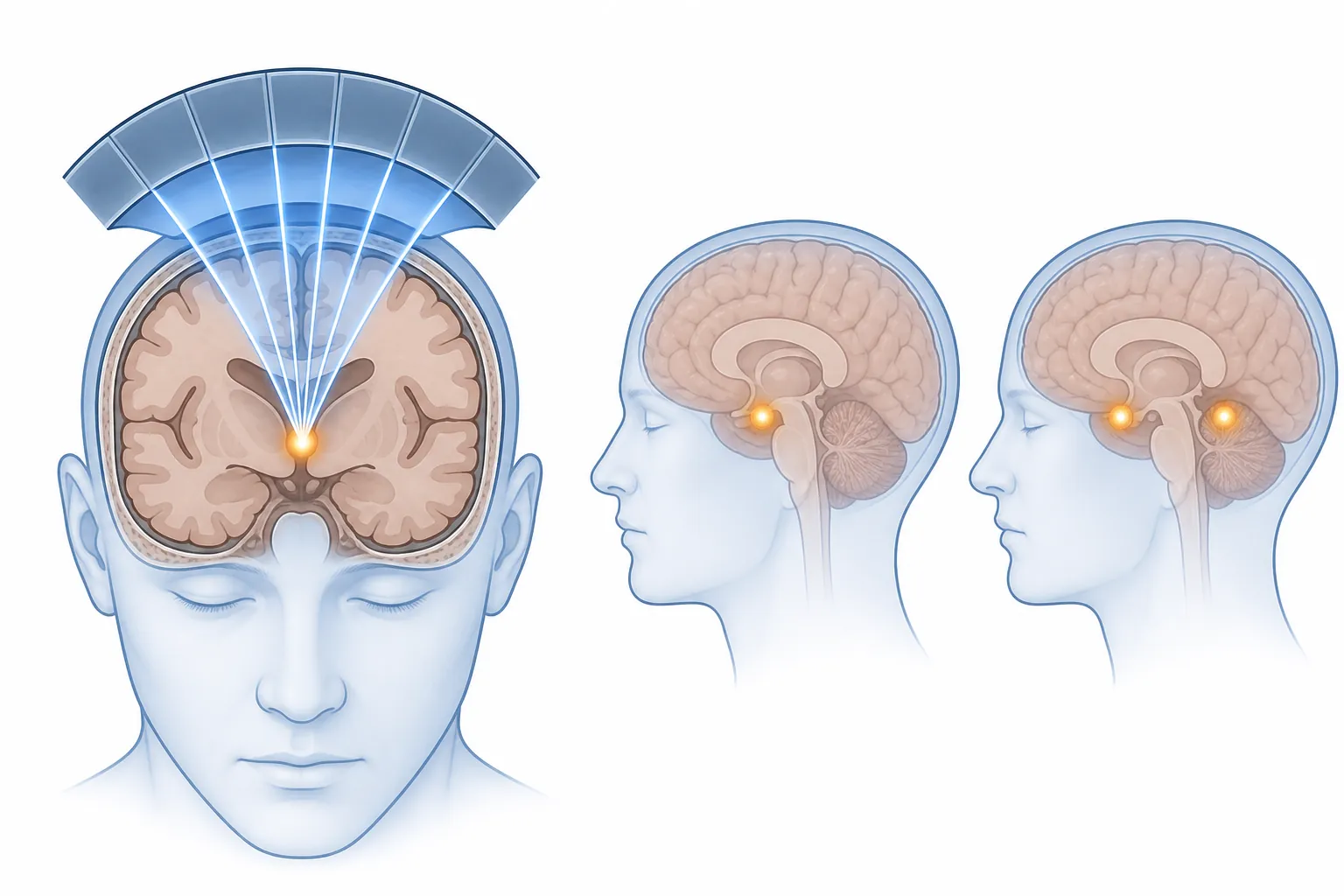
This is also why unilateral and bilateral treatment should not be blended together. A unilateral lesion may be acceptable to a carefully selected patient with asymmetric symptoms. A staged bilateral strategy asks a different question: what happens when benefit accumulates, but so does neurologic risk?
The per-indication crosswalk
The most useful procurement view is not “focused ultrasound: yes or no.” It is a crosswalk from the cleared use to the best matching clinical evidence and the adverse-event signal that should appear in consent conversations.
| Parkinson’s use or target | FDA / guidance status in the supplied record | Best evidence highlighted here | Design strength | Evidence verdict |
|---|---|---|---|---|
| Tremor-dominant Parkinson’s, unilateral thalamotomy | December 2018 Parkinson’s tremor clearance in the Exablate Neuro FDA record | Bond 2017 randomized sham-controlled trial, n=27; on-medication tremor improved 62% in the active group vs 22% in the sham group, p=0.04.[3] | Randomized, sham-controlled, small | Real signal for selected tremor-dominant patients; limited by size and target specificity. |
| Subthalamotomy for asymmetric Parkinson’s motor features | NICE later addressed MRI-guided focused ultrasound subthalamotomy under special arrangements rather than routine adoption | Martínez-Fernández 2020 randomized trial, n=40; treated-side MDS-UPDRS III difference of 8.1 points at 4 months, p<0.001.[4] | Randomized, sham-controlled, small | Important efficacy signal, but not a broad Parkinson’s device verdict; generalizability and adverse-event counseling remain central. |
| Unilateral GPi pallidotomy for advanced Parkinson’s motor complications | PMA supplement S014, decision date October 29, 2021, based on NCT03319485.[1] | Krishna 2023 randomized trial, n=94; response at 3 months was 69% with active treatment vs 32% with sham, a 37-percentage-point difference, p=0.003.[5] | Randomized and sham-controlled, but blinding integrity was imperfect | Clinically important signal, with caution because the trial’s own blinding data and secondary-endpoint results limit overconfident claims. |
| Staged bilateral pallidothalamic tractotomy | PMA supplement S037B, approval date July 3, 2025.[2] | Dalvi 2026 single-arm open-label trial, n=54 unilateral then 40 bilateral; median bilateral upper/lower-extremity MDS-UPDRS III fell from 33.0 to 21.0, a 32% median improvement, p<0.0001.[6] | Single-arm, open-label | Motor improvement is paired with a higher and more persistent treatment-related adverse-event burden; the evidence bar should be treated as lower than for the sham-controlled trials. |
The three sham-controlled trials are strong enough to matter and too small to overread
A sham-controlled design deserves credit in procedural neurology. It is difficult to build, difficult to enroll, and ethically harder than comparing two pills. The Parkinson’s focused-ultrasound evidence base has three trials that should be treated as the core controlled evidence: Bond 2017, Martínez-Fernández 2020, and Krishna 2023.
Bond 2017: a tremor signal, not a whole-disease signal
Bond and colleagues studied medication-refractory, tremor-dominant Parkinson’s disease in a randomized clinical trial of focused ultrasound thalamotomy. The trial was small, with 27 participants, but the primary motor tremor result moved in the expected direction: on-medication tremor improved 62% in the active-treatment group and 22% in the sham group, with p=0.04.[3]
That result supports the narrow claim: focused ultrasound thalamotomy can reduce tremor in selected patients with tremor-dominant Parkinson’s disease. It does not support a broad claim that focused ultrasound treats Parkinson’s disease as a syndrome, slows disease progression, or substitutes for evidence on pallidal, subthalamic, or bilateral targets.
Martínez-Fernández 2020: meaningful motor improvement, strict selection
The NEJM subthalamotomy trial by Martínez-Fernández and colleagues enrolled 40 patients and reported an 8.1-point between-group difference in treated-side MDS-UPDRS III at 4 months, favoring focused ultrasound, with p<0.001.[4] That is not a cosmetic endpoint. MDS-UPDRS III is a clinician-rated motor examination, and a treated-side improvement can be clinically visible in an asymmetric motor disorder.
The caution is built into the design. This was a small, selected trial, and subthalamic lesioning is not interchangeable with thalamic tremor lesioning or pallidal lesioning. If a value-analysis committee hears this trial presented as generic focused-ultrasound Parkinson’s proof, it should pull the claim back to the target and population actually studied.
Krishna 2023: the pivotal-looking trial with the blinding problem
The Krishna 2023 NEJM trial is the controlled study most likely to appear in a polished GPi pallidotomy discussion. It enrolled 94 patients and reported a 3-month response in 69% of patients assigned to focused ultrasound ablation and 32% assigned to sham, a 37-percentage-point difference with p=0.003.[5] Those are clinically meaningful numbers.

The same paper also shows why the word “sham” cannot be allowed to do all the work. Among actively treated patients, 95% correctly believed they had received active treatment, and investigators guessed 79% of active assignments correctly.[5] That does not erase the trial. It does mean the study should not be treated as cleanly blinded in the way a reader might assume from the design label alone.
The authors’ own cautions are also important. They stated that longer and larger trials were needed, and the secondary MDS-UPDRS II endpoint did not meet conventional statistical significance, with P=0.06.[5] In a procurement file, those details belong next to the response rate, not in a footnote.
The staged bilateral story is where the adverse-event burden becomes hardest to soften
The July 2025 staged bilateral supplement is commercially important because it moves the story beyond unilateral lesioning. The evidence presented in the supplied record, however, is not another randomized sham-controlled trial. The key 2026 Lancet Neurology report was a single-arm, open-label trial: 54 patients received unilateral treatment and 40 proceeded to bilateral treatment.[6]
The motor result is real enough to take seriously. Median bilateral upper- and lower-extremity MDS-UPDRS III improved from 33.0 to 21.0, a 32% median improvement, with p<0.0001.[6] But the adverse-event signal is no longer a peripheral issue. Treatment-related adverse events increased from 39% after unilateral treatment to 55% after bilateral treatment; at 12 months, 25% of patients had persistent moderate-to-severe events involving speech, gait, or balance, and one patient had severe persistent anarthria.[6]
That is the counseling center of gravity. A patient may reasonably value a motor improvement enough to accept risk. A hospital committee may reasonably support access for a rigorously selected subgroup. But the evidence verdict cannot treat bilateral focused ultrasound as merely a scaled-up version of unilateral treatment. The trial itself recommends rigorous selection and counseling.[6]
A small JAMA Neurology 2024 staged bilateral subthalamotomy pilot points in the same direction. In 6 patients, off-medication motor scores improved 52.6%, but speech disturbance occurred in 4 of 6 patients and was mild-persistent in 2.[7] A six-patient pilot cannot define frequency for routine practice, but it is enough to keep cumulative bilateral speech risk on the table.
Meta-analyses help, but they do not replace the pivotal-trial read
Recent systematic reviews and meta-analyses generally support the existence of motor benefit after MRI-guided focused ultrasound in Parkinson’s disease, while also emphasizing heterogeneity, small studies, target differences, and the need for careful risk-of-bias interpretation.[8][9] That is useful as a comparative layer. It is not a substitute for separating thalamotomy, subthalamotomy, pallidotomy, and staged bilateral tractotomy.
The risk-of-bias issue is not abstract. In this evidence base, trial populations are selected, many data come from specialized groups, and the pivotal studies were industry-funded. Sponsorship is not proof of misconduct. It is a transparency factor that changes how aggressively a committee should look for independent replication, blinded outcome assessment, durable follow-up, and complete adverse-event reporting.
Generalizability also deserves a more prominent place than it usually gets in device pitches. Eligibility criteria in this literature include constraints such as adequate skull density ratio, age thresholds, levodopa responsiveness for some indications, and other selection filters. The result is an evidence base about patients who could get through screening, not all patients with Parkinson’s disease who might ask about “no surgery” treatment.
The DBS comparison should stay at the evidence level
The common comparison is deep brain stimulation versus focused ultrasound. It is a legitimate clinical discussion, but the evidence should not be overstated. The supplied evidence record does not include a randomized head-to-head trial showing that focused ultrasound is equivalent or superior to DBS for Parkinson’s disease.
The VA Evidence Synthesis Program report rated the evidence comparing bilateral DBS with unilateral MR-guided focused ultrasound as low certainty, with a signal that bilateral DBS may be better for tremor and quality of life.[10] Low certainty means exactly that: not a final comparative verdict. Still, it is enough to prevent “comparable to DBS” from being treated as a settled claim.
There is also a practical asymmetry. DBS is implanted and carries hardware, surgical, programming, and maintenance burdens, but stimulation can be adjusted and in some respects reversed or discontinued. Focused ultrasound avoids implanted hardware, but the therapeutic mechanism is irreversible lesioning. That asymmetry belongs in patient counseling and procurement review, not just in a lifestyle comparison chart.
NICE’s “special arrangements” stance fits the evidence better than routine enthusiasm
NICE HealthTech guidance HTG734, published December 18, 2024, recommends MRI-guided focused ultrasound subthalamotomy for moderate to advanced Parkinson’s disease only under special arrangements for interventional procedures.[11] That is not a rejection of the technology. It is a governance signal: evidence exists, but selection, consent, audit, and expert oversight remain part of responsible use.
That stance is closer to the primary evidence than the simplified claim that FDA clearance equals clinical proof. A hospital adopting or expanding focused ultrasound for Parkinson’s is not just buying a device. It is accepting responsibility for target selection, multidisciplinary review, adverse-event surveillance, and a consent process that makes “permanent lesion” as audible as “no incision.”
Evidence scorecard for focused ultrasound in Parkinson’s
| Question a committee should ask | Current evidence answer | Procurement-level implication |
|---|---|---|
| Is there evidence supporting focused ultrasound for selected Parkinson’s indications? | Yes. The strongest evidence comes from three small randomized sham-controlled trials: Bond 2017, Martínez-Fernández 2020, and Krishna 2023.[3][4][5] | Do not dismiss the modality as unsupported; do not generalize the evidence beyond target and population. |
| Which Parkinson’s evidence is randomized and sham-controlled? | Tremor-dominant thalamotomy, subthalamotomy, and GPi pallidotomy each have small controlled trial evidence in the supplied record.[3][4][5] | These are the trials to read before accepting efficacy claims. |
| Which expansion rests on open-label single-arm evidence? | Staged bilateral pallidothalamic tractotomy is supported here by a single-arm open-label trial, despite a real motor improvement signal.[6] | Treat the certainty as lower than the sham-controlled evidence. |
| Where is blinding a specific concern? | In Krishna 2023, 95% of actively treated patients and 79% of investigator guesses correctly identified active treatment assignment.[5] | Do not equate “sham-controlled” with fully successful blinding. |
| Where is the adverse-event burden most concerning? | Staged bilateral treatment: treatment-related adverse events rose to 55% after bilateral treatment, and 25% had persistent moderate-to-severe speech, gait, or balance events at 12 months, including one severe persistent anarthria.[6] | Consent, selection, and follow-up are part of the evidence verdict. |
| Can focused ultrasound be described as comparable to DBS? | No randomized head-to-head evidence is supplied; VA ESP found low-certainty evidence that bilateral DBS may be better for tremor and quality of life.[10] | Use comparative claims cautiously and distinguish adjustable stimulation from irreversible lesioning. |
| What is the bottom-line evidence grade for institutional review? | Target-specific support, strongest in small sham-controlled trials; staged bilateral lesioning claims rely more on less controlled data and carry persistent-harm signals. | Adoption decisions should be indication-specific, reviewer-led by movement-disorder and functional neurosurgery expertise, and tied to rigorous selection and counseling. |
References
- PMA P150038/S014: FDA Premarket Approval Database, U.S. Food and Drug Administration, October 29, 2021.
- P150038/S037B Approval Order Statement, U.S. Food and Drug Administration, July 3, 2025.
- Safety and Efficacy of Focused Ultrasound Thalamotomy for Patients With Medication-Refractory, Tremor-Dominant Parkinson Disease: A Randomized Clinical Trial, JAMA Neurology, 2017.
- Randomized Trial of Focused Ultrasound Subthalamotomy for Parkinson’s Disease, New England Journal of Medicine, 2020.
- Trial of Globus Pallidus Focused Ultrasound Ablation in Parkinson’s Disease, New England Journal of Medicine, 2023.
- Staged bilateral focused ultrasound pallidothalamic tractotomy for Parkinson’s disease, The Lancet Neurology, 2026.
- Safety and Efficacy of Staged, Bilateral Focused Ultrasound Subthalamotomy in Parkinson Disease, JAMA Neurology, 2024.
- Magnetic resonance-guided focused ultrasound for Parkinson’s disease: a systematic review and meta-analysis, Frontiers in Neuroscience, 2025.
- Magnetic resonance-guided focused ultrasound in Parkinson’s disease: a systematic review and meta-analysis, Neurosurgical Review, 2026.
- Focused Ultrasound Therapy for Neurologic Conditions, VA Evidence Synthesis Program.
- MRI-guided focused ultrasound subthalamotomy for treating moderate to advanced Parkinson’s disease, NICE, December 18, 2024.