Food cybersecurity becomes a health issue the moment a processor shuts down, a distributor cannot route refrigerated loads, a grocery network loses store systems, or a hospital nutrition department has to activate a backup meal contract. For anyone evaluating AI in cybersecurity for food supply chain operations, the starting point is not an abstract debate about algorithms. It is whether food, medicine-adjacent logistics, and emergency feeding systems keep moving when attackers find the weakest vendor, server, plant network, or payment workflow.
The baseline risk is already worsening before AI is added. Food and Ag-ISAC reported ransomware incidents rising from 167 in 2023 to 212 in 2024 and 265 in 2025, with ransomware accounting for more than half of cyberattacks affecting food and agriculture organizations.[1] That is the useful frame for the AI discussion: artificial intelligence is being added to a sector where ransomware is not hypothetical, third-party exposure is normal operating terrain, and operational downtime has direct public-health consequences.
The disruption is already physical enough
Ransomware statistics can sound remote until they are translated into production capacity, store availability, and purchasing teams trying to locate substitutes. JBS paid an $11 million ransom after an attack that took roughly a quarter of U.S. beef processing capacity offline.[2] Schreiber Foods, one of the largest dairy processors in the United States, faced a ransomware incident that disrupted milk supply and involved a reported $2.5 million ransom.[2][3] Those incidents did not merely inconvenience IT departments; they interfered with food production and distribution at scale.
The same pattern shows up downstream. Ahold Delhaize reported disruption affecting more than 2,000 stores, while the Blue Yonder incident cascaded into supply-chain disruption reaching Starbucks.[4] In a hospital or public-health emergency planning office, that kind of dependency chain is familiar. The organization that experiences the failure may not be the organization that owns the vulnerable system. The stalled handoff may sit inside a vendor portal, route optimization platform, warehouse management system, or remote-access arrangement that worked quietly until it did not.
This is also why food cybersecurity belongs next to healthcare supply-chain security rather than in a separate agriculture-only category. Hospital food services, emergency food distribution, cold-chain logistics, and some drug-adjacent transportation networks depend on overlapping vendors and regional infrastructure. ClinicalMind’s related discussion of healthcare supply chains as AI cyber targets is adjacent for that reason: the governance problem is often less about one sector’s uniqueness than about shared third-party dependence.
What AI gives attackers
AI does not have to invent a new class of attack to raise the risk. In food supply chains, its more immediate value to attackers is acceleration: finding exposed assets faster, customizing lures faster, changing malware faster, and making fraudulent requests look more like ordinary vendor traffic. Forbes’ 2026 analysis of supply-chain cyber risk describes AI-driven reconnaissance against operational technology environments, polymorphic malware, deepfake vendor impersonation, and ransomware-as-a-service dynamics as active concerns for supply chains.[5]
Automated reconnaissance matters because many food environments are hybrids of old and new systems. A plant may have modern enterprise software, aging PLCs, vendor-maintained servers, remote-access tools installed for maintenance, and OT segments that were never designed for the volume of scanning and credential attacks common in IT. An AI-assisted attacker can sort exposed services, infer vendor relationships, prioritize likely remote-access pathways, and generate plausible next steps without spending as much human time on each target. The gain is not magic. It is throughput.
That throughput fits the ransomware-as-a-service model. RaaS ecosystems such as RansomHub allow affiliates to scale attacks by combining ready-made tooling, stolen credentials, and target-specific reconnaissance.[5] In a thin-margin food business, where uptime and shipment timing are central, the attacker does not need perfect control of a plant to create leverage. Delaying production, interrupting warehouse systems, freezing dispatch data, or locking finance workflows near a payment deadline may be enough to force an executive conversation.
Polymorphic malware adds a different pressure. Signature-based defenses work best when malicious code resembles something already known. AI-assisted variation can change file characteristics, scripts, or delivery patterns while preserving the attack’s function, making older detection approaches less reliable.[5] In an OT-adjacent environment, that matters because patching cycles, maintenance windows, and validation requirements often move more slowly than malware iteration. The defenders are not simply defending computers; they are defending production continuity.
Hyper-personalized phishing is the quieter risk. Food companies run on routine coordination: purchase orders, substitutions, delivery windows, quality documents, safety certificates, freight exceptions, and urgent vendor updates. AI can generate messages that reference the right role, plausible timing, and familiar business process. A receiver does not need to be careless to be vulnerable; they may be overloaded, working against a production deadline, or processing a request that looks like every other exception that day.
Deepfake vendor impersonation pushes that same weakness into payments and approvals. Forbes reported multimillion-dollar payment fraud tied to deepfake vendor impersonation in the food sector.[5] The practical lesson is not that every procurement call is now fake. It is that attackers can increasingly imitate the social layer around legitimate transactions, especially where vendor changes, urgent payments, and executive approvals already happen through fragmented channels.
What AI can give defenders
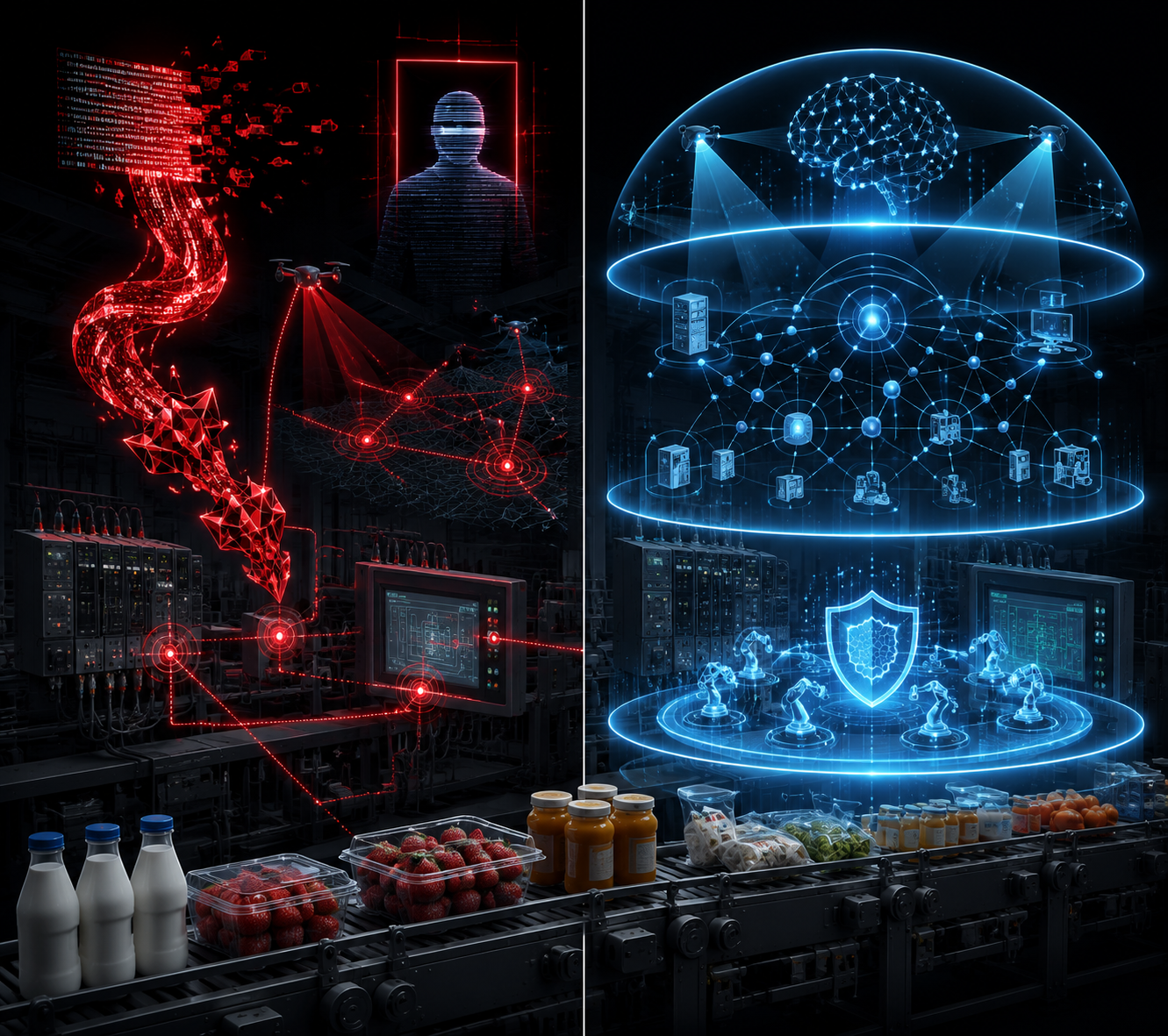
The strongest case for defensive AI is not that it replaces security teams. It is that it can connect signals too dispersed for people to track manually at sector speed: an unusual authentication event, an OT protocol anomaly, a vendor server communicating at the wrong hour, a change in traffic between plant zones, or a backup system behaving differently after a software update. In food manufacturing, those signals often sit across IT, OT, cloud systems, and vendor-managed infrastructure.
The Smarttech247 case is useful because it shows the kind of mess responders actually inherit. Its security operations center detected ransomware already resident on vendor-owned on-premise servers at a major food company; the company itself reportedly did not know those servers existed.[6] That detail is more important than the branding. An unknown server is an inventory failure, a vendor governance failure, and a detection challenge at the same time.
Layered AI defenses try to close that visibility gap in stages. A machine-learning detection layer can flag abnormal behavior that does not match a known signature. A graph-ML correlation layer can connect events across domains, showing that a vendor login, a server process, and an OT network change may be part of the same incident rather than three isolated alerts. LLM or agentic response tools can then help triage, summarize, recommend containment actions, or initiate approved playbook steps. SCMR’s discussion of Stellar Cyber’s layered AI model describes this kind of stack across food manufacturing OT environments.[7]
| Layer | What it helps detect or do | Why it matters in food operations |
|---|---|---|
| ML detection | Anomalous behavior, suspicious traffic, deviations from normal system activity | Older OT and production systems may not produce clean signature-based warning signs |
| Graph-ML correlation | Relationships among users, assets, vendors, IT events, and OT signals | Incidents often cross plant, enterprise, and third-party environments |
| LLM or agentic response | Alert summarization, playbook support, response prioritization, approved containment assistance | Small teams need faster interpretation when production downtime is already accumulating |
The most striking defensive claim is the detection-time contrast: layered AI reduced mean time to detect threats in monitored OT environments from 180–220 days to under two hours.[7] That is a meaningful operational difference. A threat found after months may already have mapped dependencies, harvested credentials, touched backups, and positioned itself for extortion. A threat found within hours may still be containable before it becomes a plant shutdown or distribution failure.
The condition is doing a lot of work. The result shows what layered AI can do in monitored environments with sufficient telemetry, tuned models, response workflows, and teams prepared to act. It does not mean the whole food sector now has two-hour OT detection. A plant cannot detect what it does not monitor. A security team cannot triage an asset no one inventoried. An AI tool cannot govern a vendor contract that never required visibility into on-premise equipment, remote access, or incident notification.
The net risk depends on governance, not model capability alone
Food companies are adopting AI into environments that include IoT devices, SCADA systems, PLCs, quality-control sensors, warehouse automation, and vendor-supported platforms. That adoption can improve forecasting, maintenance, inspection, routing, and detection. It also expands the number of systems that must be inventoried, monitored, validated, and governed. The sector’s problem is not AI adoption by itself; it is AI adoption faster than operational accountability matures.
Third parties are the obvious stress point. Forbes, citing SecurityScorecard’s 2025 supply-chain trends, reported that more than 70% of organizations experienced at least one material third-party cybersecurity incident in the prior year.[5] The same article notes that Verizon’s 2025 DBIR found third-party involvement in breaches nearly doubled, from roughly 15% to 30%.[5] Those are not food-only figures, so they should not be treated as sector-specific incident rates. They do, however, describe the environment food companies share with healthcare, logistics, retail, and manufacturing: material risk increasingly arrives through someone else’s system.
Good governance starts with unglamorous questions. Which vendor-owned servers sit inside the plant? Who can remotely access PLCs or SCADA-connected systems? Which systems feed AI models used for quality, routing, forecasting, or security detection? Which alerts go to the food company, which go to the vendor, and who has authority to isolate a system during production? In an emergency, the answer cannot be “open a ticket and wait.”
Adversarial machine learning adds another governance reason to be cautious. Researchers and security practitioners have raised concerns about attackers manipulating sensor data to corrupt AI-driven crop analytics or altering PLC logic in ways that avoid detection.[8][9] The evidence base here is narrower than the ransomware trend line, so it should be treated as an emerging risk rather than proof of widespread food-sector compromise. Still, it points to the same operational requirement: AI systems need validation, data integrity controls, segmentation, and human review where automated decisions could affect production, safety, or continuity.
The public-health layer raises the stakes. A food company may measure the incident in downtime, ransom exposure, spoiled inventory, delayed shipments, and recovery cost. A hospital may experience it as menu substitutions, nutrition service strain, emergency purchasing, or supply uncertainty during a broader crisis. A community may experience it as reduced availability of specific foods in the wrong week. These are not always catastrophic outcomes, but they are exactly the kinds of compounding failures emergency planners are paid to notice before they become visible to everyone else.
Where the current window stands
AI is becoming necessary in food supply chain cybersecurity because human-scale monitoring cannot keep up with ransomware volume, vendor complexity, and OT visibility gaps. The detection-time gains reported in monitored OT environments are too large to dismiss.[7] Used well, layered AI can shorten the distance between weak signal and containment decision.
But the same period is an elevated-risk window. Offensive AI gives attackers more leverage in reconnaissance, phishing, malware variation, affiliate scaling, and vendor impersonation. Defensive AI can reduce detection time and improve correlation, but it cannot compensate for absent inventories, unmanaged third-party access, unmonitored OT, unclear response authority, or public-health planning that treats food disruption as someone else’s operational problem.
The narrow judgment is the most useful one: AI can materially improve food supply chain defense, but only where organizations already know what they own, who maintains it, how it connects, and who acts when the alert arrives. Without that foundation, AI cannot fully offset the offensive leverage it gives attackers.
References
- Navigating the 2025 Food and Agriculture Sector Ransomware Landscape — Food and Ag-ISAC
- Food & Agriculture Digital Defense: Tackling Cybersecurity Threats — Cybersecurity Guide
- Cybercriminals Targeting U.S. Food and Agriculture Sector Now More Than Ever — FDD, Feb 2025
- Cybersecurity for Food Companies: How to Prepare for Ransomware, AI Threats, and Supply Chain Disruptions — Food Institute
- The Growing Cybersecurity Risks To The Supply Chain In The AI Era — Forbes, June 2026
- Managing AI Risk in Food Production From Compliance to Cyber Threats — Smarttech247
- Why a secure industrial supply chain depends on layered AI — SCMR / Stellar Cyber
- How AI Enables Resilience in Agri-Food Supply Chains — Cutter Consortium
- Cybersecurity in the Food Sector: How Cyberattacks Can Disrupt the Supply Chain — TXOne Networks
Comments
Join the discussion with an anonymous comment.