
Administrative AI in 2026: Crossing the Early-Adoption Threshold
The data from early 2026 is unambiguous: administrative AI in healthcare has moved past the pilot-and-curiosity phase into structured, measurable deployment. A February 2026 survey of 120 U.S. health systems conducted by Eliciting Insights found that 75% have deployed at least one AI solution, up from 59% in 2025. More telling is the jump in multi-solution adoption: the share of systems running three or more AI tools grew 67% year over year, reaching 59% of all surveyed organizations.
These numbers sit against a backdrop of persistent financial pressure. Operating margins across U.S. hospitals hovered at just 1.5% at the end of 2025, according to Strata Decision Technology. Administrative costs account for roughly 25% of total healthcare spending — approximately $1.3 trillion of the $5.3 trillion the U.S. spent on healthcare in 2024, per AHA and JAMA data. When margins are that thin, every percentage point of administrative waste matters.
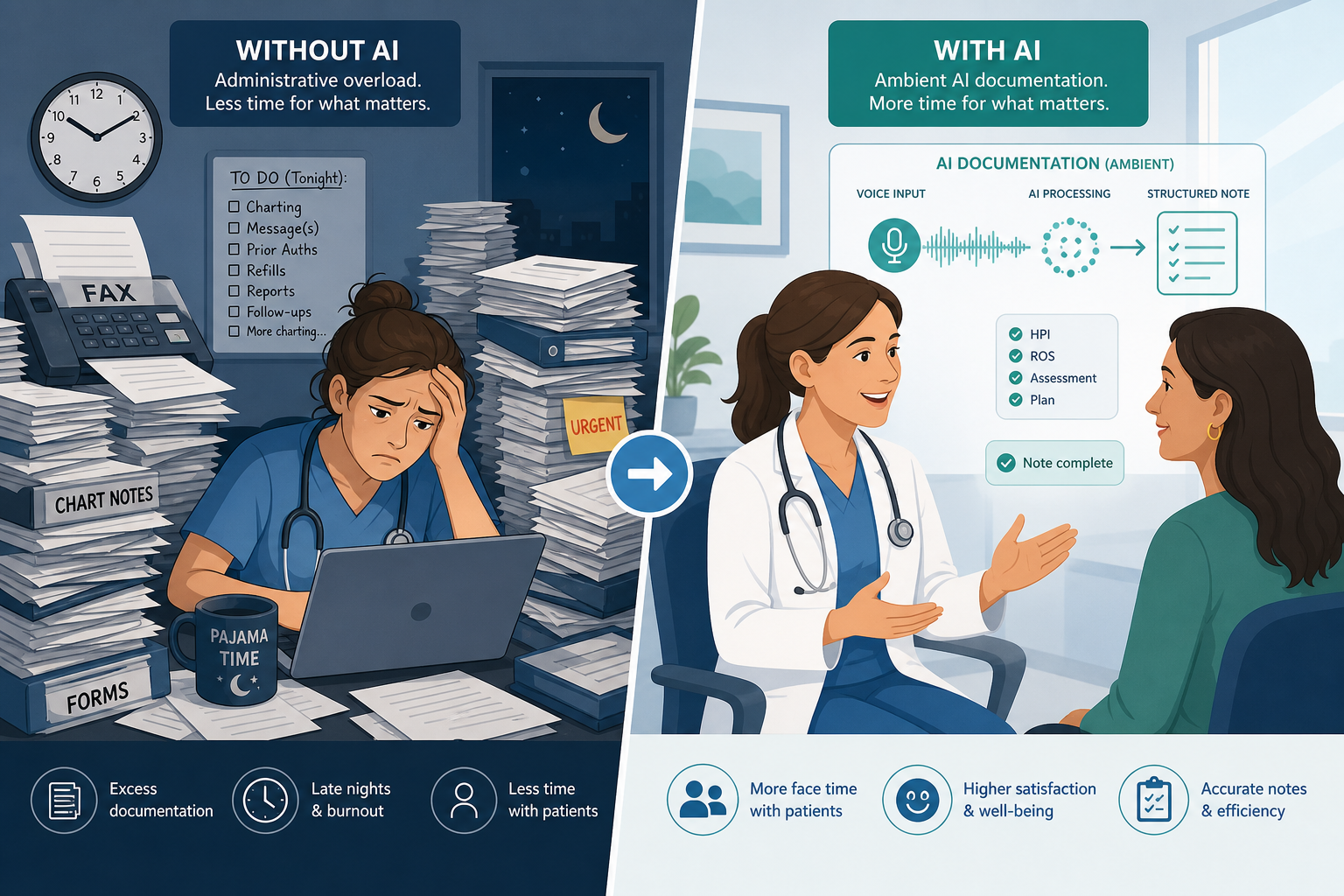
Physician sentiment reinforces the urgency. A November 2024 AMA survey of nearly 1,200 physicians found that 57% identified reducing administrative burdens as AI's single biggest opportunity. 75% believed AI could improve work efficiency, up from 69% in 2023. 54% saw potential for reducing stress and burnout, up from 44%. The use cases physicians rated most relevant to their daily practice — billing codes, chart notes, visit notes (80%), prior authorization automation (71%), and draft responses to patient portal messages (57%) — are all squarely in the administrative domain.
Yet the headline adoption number — 75% — conceals a deeply uneven distribution. The gap between what health systems have implemented and what they are actively considering is not uniform across categories. That unevenness is the central strategic fact for buyers and vendors alike in 2026.
Category-by-Category Deployment: Where AI Is Working and Where It Isn't
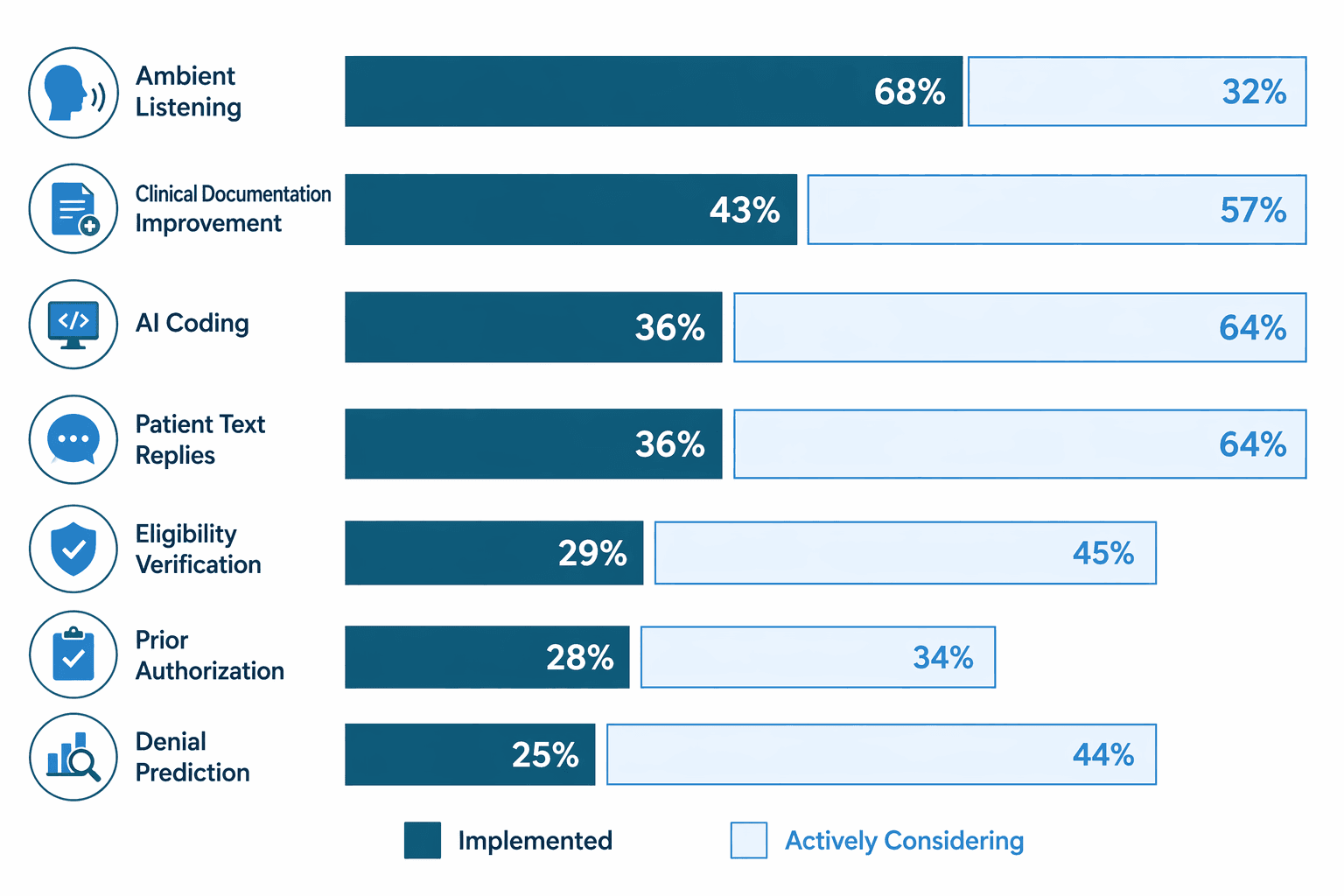
The Eliciting Insights survey tracked implementation rates across 13 AI categories spanning clinical documentation, revenue cycle management, patient communication, and clinical decision support. The spread between the most and least deployed categories is striking — and instructive.
| AI Category | Implemented | Actively Considering | YOY Growth (Implemented) |
|---|---|---|---|
| Clinical documentation / ambient listening | 68% | 18% | 62% |
| AI-based clinical documentation improvement (CDI) | 43% | 30% | 59% |
| AI coding | 36% | 28% | 29% |
| Draft replies to patient text messages | 36% | 28% | 80% |
| Eligibility verification AI agents | 29% | 45% | Not disclosed |
| Prior authorization AI | 28% | 34% | Not disclosed |
| Denial prediction AI | 25% | 44% | Not disclosed |
| AI-assisted scheduling | ~30% (estimated) | ~35% | Not disclosed |
| AI for claims processing | ~25% (estimated) | ~30% | Not disclosed |
Clinical documentation and ambient listening sit at 68% implementation — the clear leader, with 62% year-over-year growth. AI-based CDI follows at 43%, AI coding at 36%, and draft replies to patient texts also at 36% but with the highest YOY growth rate at 80%. These categories share a common profile: they address a well-understood pain point (physician documentation burden), integrate into existing EHR workflows with relatively low friction, and have a clear, immediate ROI story.
The contrast with revenue cycle categories could not be sharper. Eligibility verification AI agents sit at 29% implementation, denial prediction at 25%, and prior authorization at 28%. These are not niche tools — they address workflows that consume enormous staff time and directly affect cash flow. The gap between implementation and active consideration in these categories is the widest in the entire survey.
The Revenue Cycle Whitespace: Eligibility, Denial Prediction, and Prior Authorization
The three RCM categories with the largest deployment-vs-consideration gaps represent the most significant near-term opportunity in administrative AI. The pattern is consistent across all three: implementation rates in the mid-to-high 20s, consideration rates in the mid-30s to mid-40s.
| RCM Category | Implemented | Actively Considering | Gap (Consideration - Implementation) |
|---|---|---|---|
| Eligibility verification AI agents | 29% | 45% | 16 points |
| Denial prediction AI | 25% | 44% | 19 points |
| Prior authorization AI | 28% | 34% | 6 points |
Why the gap? Several factors are at play. RCM AI tools often require deeper integration with existing billing systems and payer portals than documentation tools do. The ROI case, while strong, is less visible to clinicians — it accrues to revenue cycle teams and finance departments rather than to physicians experiencing documentation burden directly. And the vendor landscape for RCM AI is more fragmented, with fewer established players that have proven enterprise-grade deployments.
Yet the evidence for ROI in these categories is compelling. A Fresno, California community health network using an AI tool to review claims before submission reported a 22% decrease in prior-authorization denials by commercial payers and an 18% decrease in denials for services not covered, while saving an estimated 30-35 hours per week without hiring additional RCM staff. Auburn Community Hospital, a 99-bed rural access hospital, leveraged RPA, NLP, and ML to achieve a 50% reduction in discharged-not-final-billed cases and a more than 40% increase in coder productivity.
For health system buyers, the implication is clear: the RCM categories with the widest consideration-implementation gaps are not speculative bets. They are proven in peer-reviewed case studies and survey data. The barrier is not evidence — it is execution. Health systems that can build the governance and integration capacity to deploy these tools are entering a market with relatively few established competitors and high potential returns.
ROI Evidence: Which Categories Deliver 2x+ Returns
The Eliciting Insights survey asked implementers in each category whether they had achieved at least 2x return on their AI investment. The results provide the most granular category-level ROI data available for administrative AI in 2026.
| AI Category | Implementers Reporting 2x+ ROI | Implementers Reporting 3x+ ROI | Typical Payback Period |
|---|---|---|---|
| AI-based clinical documentation improvement (CDI) | 71% | 42% | 12-18 months |
| Denial prediction AI | 70% | 43% | 12-18 months |
| AI coding | 66% | Not disclosed | 12-18 months |
| Ambient listening / clinical documentation | 61% | Not disclosed | 12-18 months |
| Prior authorization AI | 59% | Not disclosed | 12-18 months |
| Eligibility verification AI agents | 59% | Not disclosed | 12-18 months |
Several patterns stand out. First, the two categories with the highest 2x+ ROI rates — CDI (71%) and denial prediction (70%) — are also the categories where the highest proportion of implementers report 3x+ returns (42% and 43%, respectively). This suggests that these tools do not merely deliver marginal improvements; for a substantial minority of adopters, they transform the economics of the workflow entirely.
Second, ambient listening — the most widely adopted category — sits at 61% for 2x+ ROI. This is a strong figure, but notably lower than CDI and denial prediction. The explanation likely lies in the nature of the return: ambient listening ROI is partly financial (improved coding and reimbursement) and partly experiential (reduced physician burnout, improved job satisfaction). A Hattiesburg Clinic pilot found that job satisfaction received a 17% boost when using one vendor's ambient AI scribe. These experiential returns are real but harder to quantify in strict financial terms.
Third, the payback period of 12-18 months cited across categories is consistent with broader industry data. For health systems operating on 1.5% margins, a sub-18-month payback on a tool that also reduces staff burden and improves revenue cycle performance is a compelling proposition — provided the upfront infrastructure and training costs can be managed.
The Size-Based Adoption Gap: Why Sub-500 Bed Systems Are the Underserved Majority
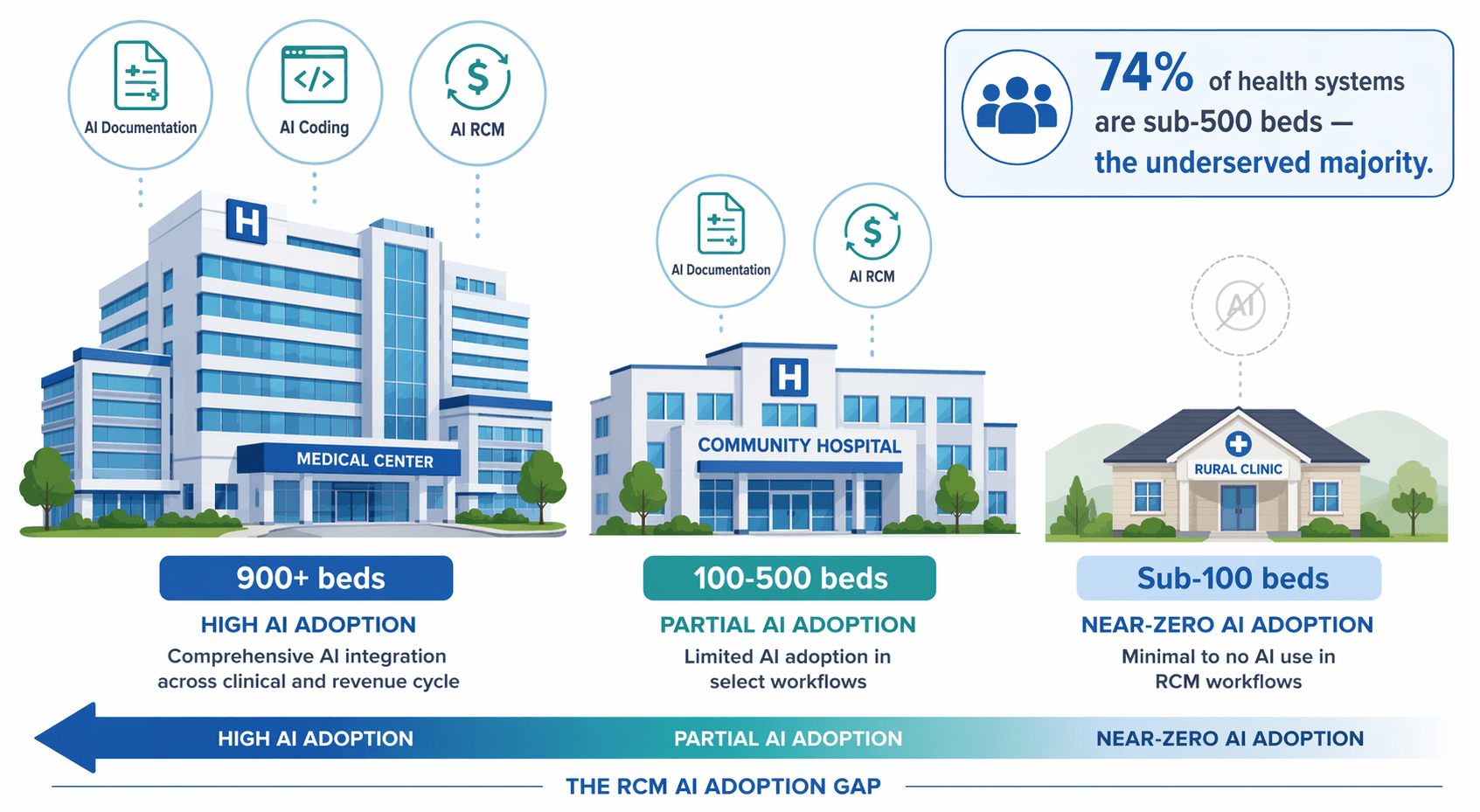
The most consequential finding in the 2026 survey data may be the stratification of adoption by health system bed size. The pattern is not gradual — it is a cliff.
| Health System Bed Size | RCM AI Adoption (Eligibility, Denial Prediction, Prior Authorization) | Receptivity Score (0-100) | Share of All Health Systems |
|---|---|---|---|
| 900+ beds | Moderate (estimated 40-50%) | 65 | ~5% |
| 500-899 beds | Moderate (estimated 30-40%) | 60 | ~10% |
| 100-499 beds | Low (estimated 10-20%) | 57 | ~30% |
| Sub-100 beds | Near-zero (approximately 0%) | 45 | ~55% |
The sub-500 bed segment represents 74% of surveyed health systems. Within that segment, sub-100 bed systems — which make up the majority of U.S. hospitals — show approximately 0% adoption of RCM AI tools for eligibility verification, denial prediction, and prior authorization. Their receptivity score of 45 out of 100, while lower than the 65 score of 900+ bed systems, still indicates meaningful openness to adoption.
This creates a structural market opportunity. The large health systems that have driven adoption to date are approaching saturation in some categories (ambient listening at 68% leaves limited room for growth). The sub-500 bed majority, by contrast, is almost entirely unpenetrated for RCM AI tools. Vendors that can build solutions appropriate for smaller systems — lower upfront cost, simpler integration, less demanding IT support requirements — have a multi-year runway of addressable demand.
For health system buyers in the 100-499 bed range, the implication is strategic: early adoption in this segment carries competitive advantage. As larger systems have already demonstrated the ROI case, the risk of being an early adopter is lower than it was two years ago. The window for capturing that advantage, however, is unlikely to remain open indefinitely.
Implementation Considerations: Governance, Cost, Risk, and EMR Fragmentation
The data makes a strong case for administrative AI adoption, but deployment decisions must account for four structural factors that determine whether a tool succeeds or becomes shelfware.
Governance
Multidisciplinary governance structures are emerging as a prerequisite for successful AI deployment. The stakes differ between administrative and clinical AI — a denial prediction model that misfires causes financial harm, not patient harm — but the governance principles are similar: clear ownership, documented evaluation criteria, and a process for monitoring model performance over time. Health systems that have established AI governance frameworks are better positioned to evaluate vendors, manage risk, and scale successful pilots.
For readers developing governance structures, the NIST AI Risk Management Framework in Healthcare provides a structured approach that maps to the specific obligations of healthcare organizations.
Upfront Cost and Training
The 12-18 month payback period cited across categories assumes successful deployment. That success depends on upfront investment that goes beyond software licensing: infrastructure integration, workflow redesign, staff training, and change management. A Sermo poll of its global physician community found that 14% of physicians identified lack of training as a key concern about AI adoption, and 12% cited cost of implementation. These concerns are concentrated in smaller systems where IT staff and training budgets are thinner.
Distinguishing Administrative vs. Clinical AI Risk
Administrative AI tools carry a different risk profile than clinical decision support or diagnostic AI. A billing code suggestion that is incorrect can be caught in the claims review process; a misdiagnosis recommendation cannot. This distinction matters for procurement because it changes the level of vendor vetting required. Health systems should evaluate whether vendors are willing to share risk through contractual guarantees — a practice that is more common in administrative AI than in clinical AI, where liability concerns make vendors more cautious.
EMR Fragmentation and Vendor Lock-In
The EMR landscape remains fragmented: Epic holds 48% market share, with Oracle/Cerner at 16%, Meditech at 8%, CPSI at 7%, AthenaHealth at 4%, and other platforms accounting for 17%. The Eliciting Insights survey found meaningfully lower AI adoption rates on non-Epic platforms. This creates a structural advantage for vendors whose tools are EMR-agnostic — they can address the 52% of systems that are not on Epic without requiring a platform migration.
For health system buyers, the EMR integration question is strategic. A tool that is deeply integrated with Epic may offer superior functionality for Epic shops but creates dependency. A tool that is EMR-agnostic preserves optionality but may require more integration effort. The right choice depends on the system's long-term EMR strategy and its tolerance for vendor lock-in.
For a deeper analysis of the governance obligations specific to Epic's AI ecosystem, see Governing Epic's AI Ecosystem.
Where the Market Is Heading: Priorities for Buyers in 2026
The 2026 data paints a clear picture of a market in transition. The early-adoption phase is over for clinical documentation and ambient listening; these categories are approaching mainstream saturation. The next wave — revenue cycle AI — is where the combination of high consideration rates, proven ROI, and low current implementation creates the most compelling buying opportunity.
For health system decision-makers, the following priorities emerge from the data:
- Prioritize categories with high consideration and proven ROI. Denial prediction and eligibility verification show the widest consideration-implementation gaps and the strongest ROI data. These are not speculative categories — they are under-deployed solutions to well-understood problems.
- Build governance frameworks before scaling. The health systems that have successfully deployed multiple AI tools share a common characteristic: they invested in governance structures early. The regulatory context for AI adoption is evolving rapidly, and systems with established governance are better positioned to adapt.
- Evaluate EMR-agnostic vendors to preserve optionality. With 52% of health systems on non-Epic platforms, and AI adoption rates lower on those platforms, EMR-agnostic tools address a larger addressable market and reduce dependency risk.
- Consider the sub-500 bed opportunity strategically. For smaller systems, the window for competitive advantage through early RCM AI adoption is open but finite. The ROI case is proven by larger systems; the execution challenge is real but manageable with the right vendor and governance approach.
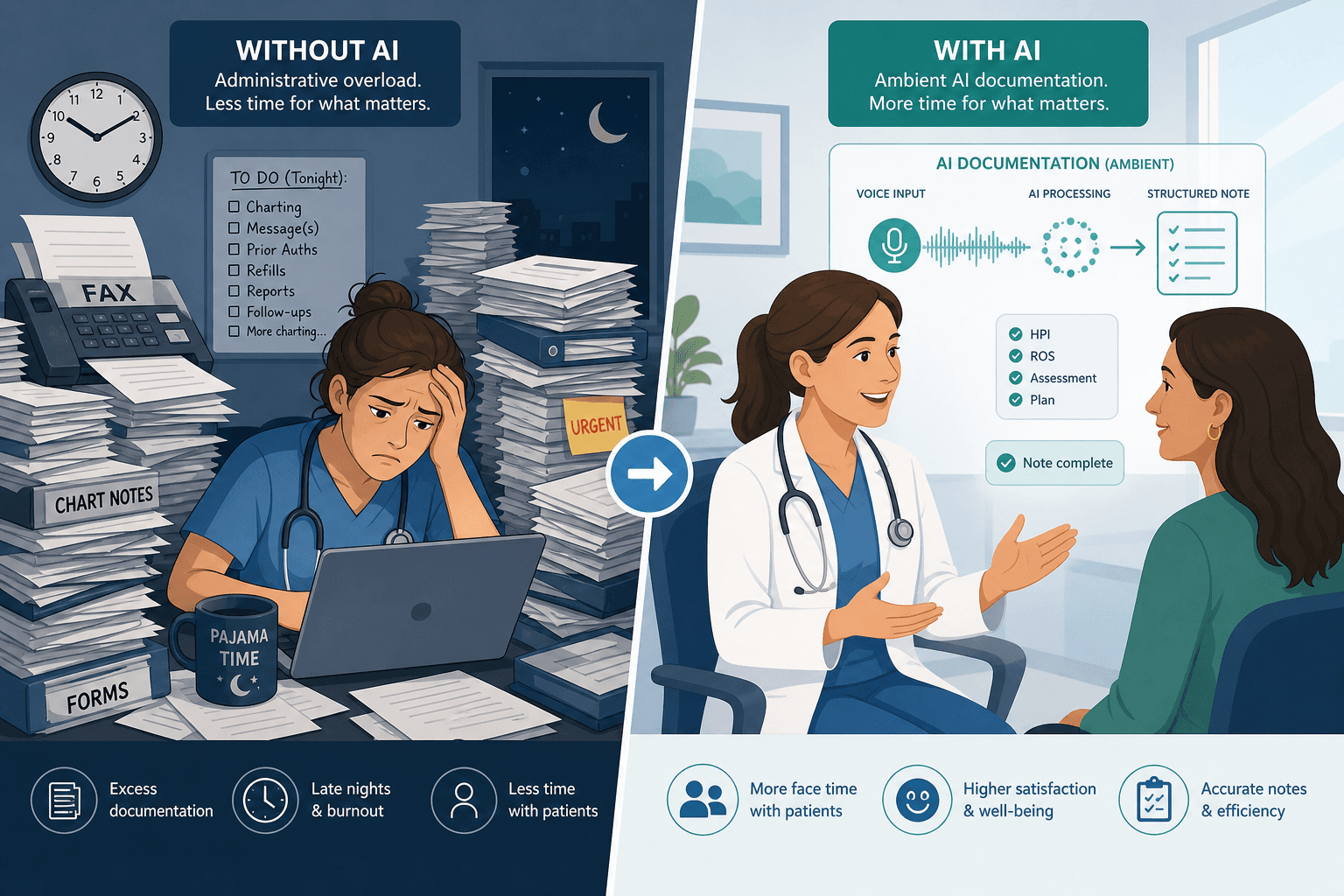
- Link administrative AI investments to downstream patient care impacts. Reduced physician documentation time translates to more patient-facing time. Faster prior authorization translates to shorter time-to-treatment. These connections align administrative AI adoption with the clinical mission that drives health system strategy.
For readers seeking a deeper dive into the prior authorization category specifically, Prior Authorization AI: Evidence, Adoption, and Regulatory Landscape covers the evidence base and the impact of CMS-0057 mandates on adoption timelines.
Comments
Join the discussion with an anonymous comment.