The market for AI-powered consumer health apps for recalls starts with a blunt problem: the recall may exist, the database may be public, and the person using the product may still never receive a timely warning. That gap matters across food, medical devices, household goods, vehicles, and consumer products. It is especially visible in health-adjacent categories where the product is not sitting unused on a shelf but is already in a pantry, attached to a patient, implanted in a body, or managed by a caregiver.
Food recalls show the communication failure in a form consumers can recognize. PIRG Education Fund reported that FDA and USDA announced 320 food recalls in 2025, up from 296 in 2024, while also noting that FDA does not publish press releases for all Class I recalls. The same report found that 17 of 28 outbreak investigations in 2025 had no recall announced at all, and it describes a 3–5 week gap between contamination detection and public alert in some food-safety workflows.[1]
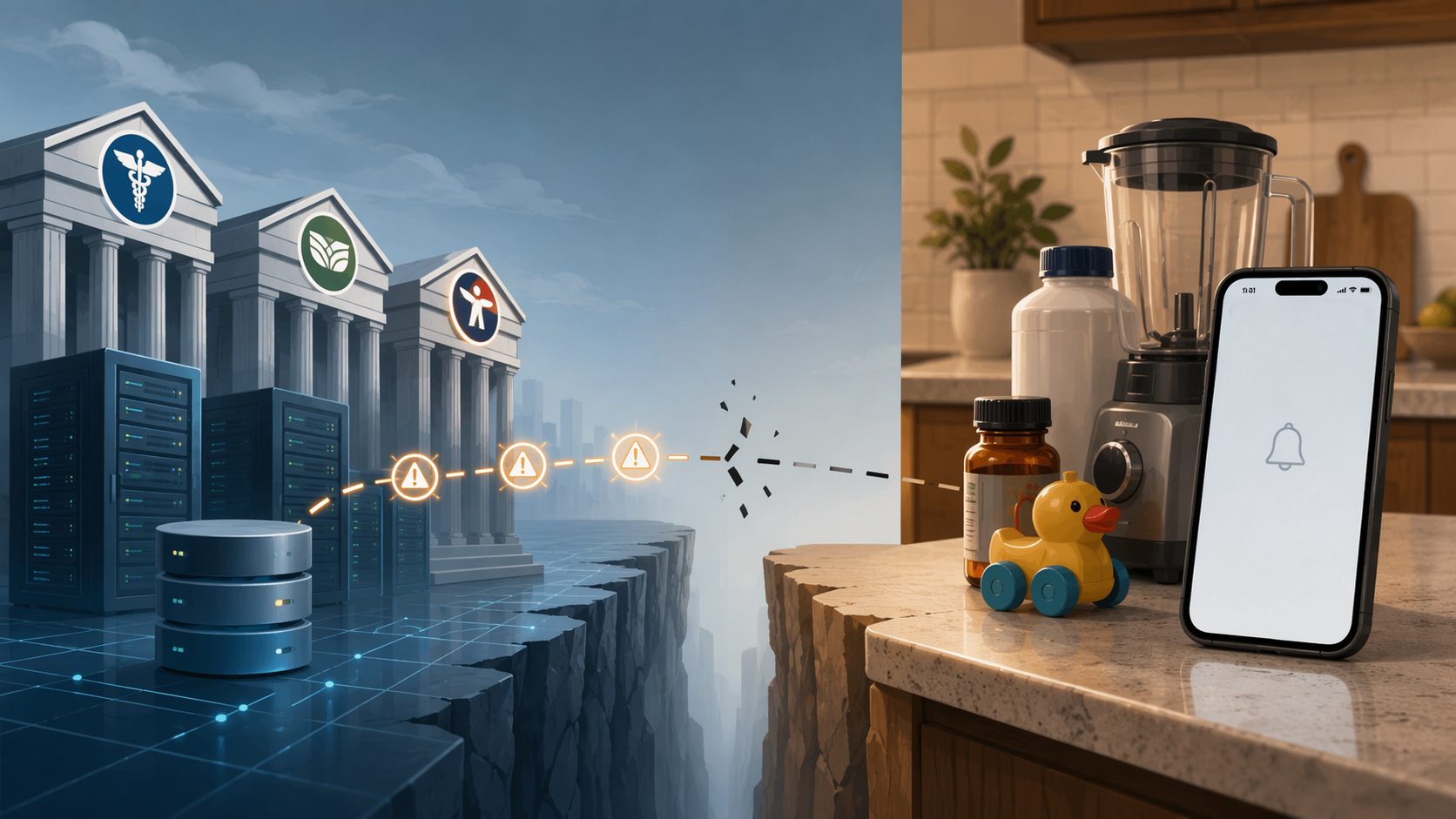
That is not a convenience problem. It is a distribution problem. Official recall infrastructure can be extensive and still fail to produce direct notice at the moment a consumer, caregiver, patient, or clinician needs to act. The newer recall apps are best understood as attempts to compress that last-mile delay, not as replacements for the agencies that identify hazards, oversee recalls, or publish enforcement data.
The broader recall environment is large enough to support a new layer of monitoring tools. Sedgwick’s 2025 recall index, summarized by Risk & Insurance, counted 3,295 U.S. recall events affecting about 858 million units, a 26% increase in unit volume; medical-device recalls alone exceeded 490 million units, the second-highest total in 20 years.[2] That number spans multiple industries and should not be treated as the addressable market for any one consumer health app. It does, however, show why recall monitoring is becoming too broad and too frequent for consumers to manage through scattered press releases, agency pages, and occasional news coverage.
The app category emerged from a notification failure
SoomSafety remains the clearest origin story because it begins with a concrete breakdown. Founder Charlie Kim said the company’s work was shaped by a recalled breathing device used by his daughter; the family was not notified. The app, launched in July 2019, connected openFDA medical-device recall data directly to consumers through barcode scanning and covered devices such as insulin pumps, pacemakers, and apnea monitors.[3][4][5]
That story is useful because it does not require a grand theory of AI. The immediate problem was simpler: a device was recalled, the recall information existed somewhere, and the affected family did not know. SoomSafety’s value proposition was to shorten the path between FDA data and the person holding or using the device.
The newer app landscape is broader and less uniform. RecallSentry, launched in March 2026, presents itself as a free iOS and Android app with multi-agency coverage across FDA, CPSC, NHTSA, and USDA, using AI for barcode and image recognition and recall matching.[6] Food Recalls & Alerts emphasizes food-safety alerts and an AI-powered chatbot; its App Store listing claims more than 250,000 users, a useful adoption signal but one that remains vendor-supplied rather than independently verified.[7] See Produce combines AI-powered expiry prediction with recall scanning for grocery products.[8] RecallScope says it monitors recall databases across the United States, United Kingdom, Canada, and Australia.[9] Yuka, already known as a consumer barcode scanner, is part of the same recall-alert expansion, though its core consumer proposition is broader than recalls alone.
Calling all of these tools “AI-powered” is technically plausible only if the phrase is allowed to cover very different functions. A chatbot answering food-safety questions, an image-recognition tool matching a product package, an expiry-prediction feature for produce, and an inventory comparison engine are not the same capability. For market analysis, the distinction matters more than the label.
What the apps actually do
The basic workflow is more prosaic than app-store language suggests. Agency data or recall feeds enter the ecosystem. The app ingests, monitors, or queries that information. Automation then tries to match a recall notice to a product, device, barcode, image, inventory entry, or user question. The consumer still has to do something: scan an item, save a device, build a pantry list, upload or photograph packaging, search a product, or ask the chatbot a question. Only then can the app return a relevant alert.
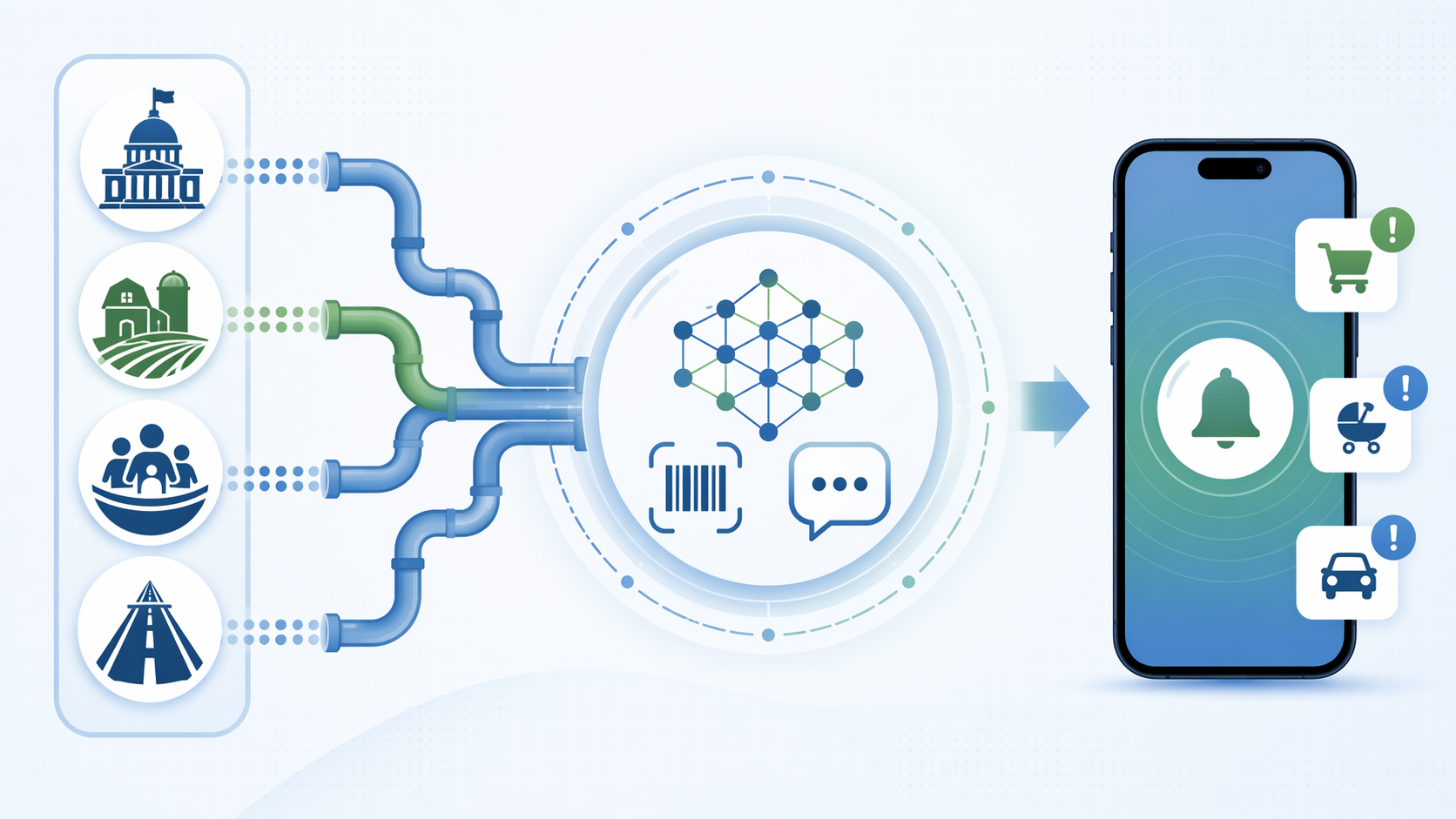
This workflow changes the user’s position in the recall chain. Instead of waiting for a manufacturer notice, a clinician’s office, a retailer alert, a news article, or a social-media post, the user creates a personal bridge to recall data. That bridge is useful when the product category is covered, the source data is available, and the user has already created enough information for matching.
| App | Primary recall focus | AI or automation claim | What the user must do | Coverage boundary to keep in view |
|---|---|---|---|---|
| SoomSafety | FDA medical-device recalls through openFDA, including examples such as insulin pumps, pacemakers, and apnea monitors | Barcode-based connection between consumer-held devices and openFDA recall data | Scan or enter device information | Strongest fit is medical-device notification, not whole-house recall coverage |
| RecallSentry | Multi-agency consumer recall monitoring across FDA, CPSC, NHTSA, and USDA as described at launch | AI-assisted barcode scanning, image recognition, and recall matching | Scan products or use app-based matching features | Launch claims indicate breadth, but effectiveness still depends on feed completeness and user participation |
| Food Recalls & Alerts | Food recalls and food-safety questions | AI-powered chatbot for recall and food-safety answers | Follow alerts or ask questions in the app | The 250,000-plus user figure comes from the App Store listing, not an independent adoption study |
| See Produce | Grocery products, produce quality, expiry, and recall scanning | AI-powered expiry prediction and produce assessment | Scan or assess grocery items | Quality and expiry prediction are adjacent to recall monitoring, not the same as official recall detection |
| Yuka | Consumer product scanning with recall-alert expansion | Barcode-driven consumer product information, with recall alerts added | Scan products | Broader consumer product scoring may shape use more than recall monitoring alone |
| RecallScope | Recall database monitoring across the U.S., U.K., Canada, and Australia | Database aggregation and monitoring rather than a single narrowly described AI feature | Search or monitor covered recall sources | International breadth does not by itself mean category completeness inside each country |
The table makes the category look orderly, but the market is not yet orderly. Some apps are built around a product graph: scan a barcode, identify the product, compare it with recall records. Some are built around natural-language access: ask whether a product, ingredient, or alert matters. Some are closer to inventory tools. Others are broad database monitors. Each model solves a different part of the recall-notification problem.
Barcode and image recognition reduce search friction
Barcode scanning is the most practical consumer interface because it turns a vague question into a product lookup. The user does not need to know the manufacturer’s legal name, the recall title, or the correct agency jurisdiction. In the best case, a scan produces enough structured information for the app to compare the item against recall records.
Image recognition tries to solve a neighboring problem: packaging is visible when the barcode is damaged, unavailable, or inconvenient. RecallSentry’s launch materials describe AI use for barcode and image recognition along with recall matching.[6] The practical value is not that the feature sounds advanced; it is that a consumer may be able to check a product without typing a long product name into several agency websites.
Chatbots make recall records easier to interrogate, but not more complete
Food Recalls & Alerts’ chatbot illustrates another path. A natural-language interface can help a user ask whether a product category, ingredient, allergen, or recall notice is relevant. That may be valuable when official notices are written for compliance and publication rather than household decision-making. Its App Store listing says the app has more than 250,000 users and includes an AI-powered chatbot for food-safety and recall questions.[7]
The limitation is equally important. A chatbot can retrieve, summarize, or explain information it can access. It cannot compensate for a recall that has not been announced, a feed that is delayed, a product that is not in the app’s coverage area, or a user who never asks the question.
Inventory matching is where notification becomes personal
The most important functional shift is inventory matching. A public recall page tells everyone that something has happened. A saved item list tells one household that a product it may still own is affected. The difference is the difference between broadcasting risk and routing risk.
This is also where the engagement burden becomes unavoidable. An app cannot compare a recall against a pantry, a child’s supplies, a caregiver’s device list, or a home medical inventory unless someone first builds that list. Motivated consumers may scan products after shopping. A caregiver managing devices may enter model information carefully. The average user may not sustain that behavior unless the perceived risk is high or the scanning habit attaches to another routine.
Coverage is fragmented by category, agency, and business model
The core market question is not whether an app monitors recalls. It is which recalls, from which agencies, in which countries, for which product categories, and at what level of user effort. A food-focused app, a medical-device app, a multi-agency consumer app, and an international recall database are not interchangeable.
SoomSafety’s early design is strongest as a medical-device pathway, using openFDA recall data to connect patients and providers to device notices.[3][4][5] That is a high-stakes category, but it does not make the app a general recall shield for food, toys, vehicles, and household goods. RecallSentry’s launch claim is broader, naming FDA, CPSC, NHTSA, and USDA coverage.[6] That breadth is notable, especially for a free consumer app, but launch coverage claims do not by themselves establish completeness, speed, or sustained engagement.
Food Recalls & Alerts narrows the domain to food, where recall and outbreak information is particularly visible but still incomplete. PIRG’s finding that 17 of 28 outbreak investigations in 2025 had no recall announced is the uncomfortable fact for any consumer food-recall app: monitoring recall announcements cannot surface a recall that was never announced.[1] See Produce moves partly into a different problem space by applying AI to produce quality and expiry prediction in addition to recall scanning.[8] That may be useful for waste reduction or freshness decisions, but expiry prediction should not be confused with regulatory recall coverage.
RecallScope adds another dimension by claiming coverage across U.S., U.K., Canadian, and Australian recall databases.[9] International coverage is valuable for researchers, travelers, cross-border households, and market analysts, but it introduces its own fragmentation. Different jurisdictions classify, publish, and structure recall information differently. A larger map is not the same as a single normalized safety layer.
No free-tier consumer app in this landscape should be treated as comprehensive across FDA, USDA, CPSC, and NHTSA domains. Some may cover multiple agencies. Some may cover multiple countries. Some may go deep in one category. The practical question is whether a given app’s coverage matches the product risk a user is actually trying to manage.
The upstream data problem remains outside the app
The strongest recall apps still sit downstream from official data. That is both their opportunity and their ceiling. If an agency publishes structured, timely information, an app can ingest it, match it, and deliver a cleaner consumer notification. If the recall notice is absent, delayed, incomplete, or published in a format that is difficult to normalize, the app inherits the weakness.
PIRG’s food-recall findings show the issue plainly. FDA and USDA announced hundreds of food recalls in 2025, but not every severe recall receives the same public communication treatment, and many outbreak investigations did not produce an announced recall.[1] An app that watches public recall notices may improve the distribution of those notices. It does not fix the institutional decision about whether a notice exists.
The same distinction matters in medical devices. The device recall burden is large, and Sedgwick’s 2025 figures indicate that medical-device recalls affected more than 490 million units that year.[2] That is adjacent to a broader concern in health technology: as AI-enabled and software-driven medical products expand, recall monitoring and postmarket safety communication become more operationally important. ClinicalMind’s analysis of why AI medical devices are recalled sooner and more often addresses the device side of that issue; consumer recall apps occupy the downstream notification layer rather than the product-safety root cause.
There is also a regulatory-side AI context developing in parallel. FDA launched Elsa, an agency-wide AI tool intended to support internal work including adverse-event review and other performance functions.[10] That is not the same as a consumer recall app. Still, it shows that AI is appearing both inside public health agencies and in consumer-facing tools that depend on agency data. The two layers may eventually influence each other, but current consumer apps should be judged on what they can deliver now: matching, routing, explaining, and alerting based on available data.
Food recalls expose the difference between prevention and notification
Some recall problems are theoretically preventable before they ever reach a consumer alert. PIRG’s 2026 report emphasizes that labeling failures, including undeclared allergens, remain a major driver of food recalls.[1] That points toward a different AI use case: upstream screening, label verification, supplier monitoring, or manufacturing quality control.
Consumer recall apps operate after that prevention window has already failed. They may help a parent find out that a product in the kitchen is affected. They may help a caregiver learn that a device requires attention. They may help a patient connect a device identifier to a public notice. But they are still working after the contaminated product, mislabeled package, defective device, or unsafe consumer good has entered circulation.
That distinction should keep the market language disciplined. AI in recall prevention, AI in agency review, AI in recall matching, and AI in consumer Q&A are related only at a high level. They occupy different points in the safety chain, rely on different data, and have different failure modes.
The consumer engagement problem is not a footnote
The recall-app model depends on a user who is willing to participate before there is an obvious crisis. That is a demanding assumption. People may download an app after a newsworthy recall, scan a few pantry items, and then stop. A patient with a high-risk medical device may be more diligent. A caregiver managing supplies for someone medically fragile may see the value. A general consumer may not.
This is why adoption figures deserve caution. Food Recalls & Alerts’ App Store listing says the app has more than 250,000 users.[7] That suggests consumer interest, but it does not reveal active monthly use, scanning frequency, alert open rates, recall matches, or whether users removed affected products faster than they otherwise would have. Those are the metrics that would begin to show effectiveness rather than mere adoption.
The same caution applies across the category. A multi-agency app can sound comprehensive on launch day. A barcode scanner can lower friction. A chatbot can make a recall notice easier to understand. None of those features guarantees that a household will maintain an accurate inventory or respond quickly when an alert appears. The technology compresses part of the notification path only when the user has already created a path for the notification to follow.
What would count as real effectiveness
The next stage of evaluation should move beyond whether an app has AI features. For industry intelligence, the useful questions are operational: how many agency sources are monitored, how quickly records appear after publication, how product identifiers are normalized, how many alerts are matched to saved items, how often users act, and whether the app distinguishes between official recall notices, outbreak investigations, quality warnings, and general food-safety advice.
- Traceability: Does the app show the source agency, notice date, product identifier, and recall classification where available?
- Coverage: Does it cover one category deeply, several agencies broadly, or multiple countries with uneven category depth?
- Data dependence: Does it rely on press releases, structured agency APIs, database scraping, vendor feeds, or user-submitted information?
- Matching quality: Does it match at the product, lot, model, serial number, ingredient, barcode, or broad category level?
- User burden: How much scanning, saving, questioning, or inventory maintenance is required before alerts become relevant?
- Outcome evidence: Is there any independent evidence that users learn sooner, remove products faster, contact providers earlier, or avoid exposure?
Most public information available today answers the first few questions better than the last one. The category is visible. The use cases are plausible. The feature claims are increasingly concrete. Evidence that these apps materially change recall outcomes at population scale is still thin.
A targeted notification layer, not a rebuilt recall system
Consumer recall apps are becoming a meaningful layer over a fragmented safety system. Their best use case is targeted notification compression: taking recall information that already exists, matching it to a product or device a user has identified, and delivering a more direct alert than the consumer would likely receive through official channels alone.
That is worth tracking, particularly in health-adjacent markets where devices, food risks, allergens, and caregiver-managed inventories carry real consequences. It is also narrower than the most ambitious app-store language implies. These tools cannot repair missing upstream announcements, inconsistent agency publication practices, category fragmentation, or low public engagement. They can only work with the data they can access and the product information users provide.
For healthcare and safety-market observers, the category belongs beside medical-device recall intelligence and the broader AI-in-healthcare safety infrastructure, not inside a vague consumer wellness trend. Its current value is not full recall-system modernization. It is a practical, bounded attempt to make existing recall information reach the right person sooner.
References
- Food for Thought 2026, PIRG Education Fund.
- 2025 Product Recalls Increase Amid Shifting US Regulatory Landscape, Risk & Insurance.
- SoomSafety: tackling medical device recalls with a mobile app, NS Medical Devices.
- Soom launches mobile app to alert patients to medical device recalls, Fierce Healthcare.
- Smartphone app alerts providers, patients of FDA device recalls, Becker’s Hospital Review.
- RecallSentry App Launch: Home Safety, Yahoo Finance, March 2026.
- Food Recalls & Alerts, App Store.
- See Produce, See Produce.
- RecallScope, RecallScope.
- FDA Launches Agency-Wide AI Tool to Optimize Performance for the American People, U.S. Food and Drug Administration.
Comments
Join the discussion with an anonymous comment.