
Introduction: The Summit Circuit as a Barometer of Industry Maturation
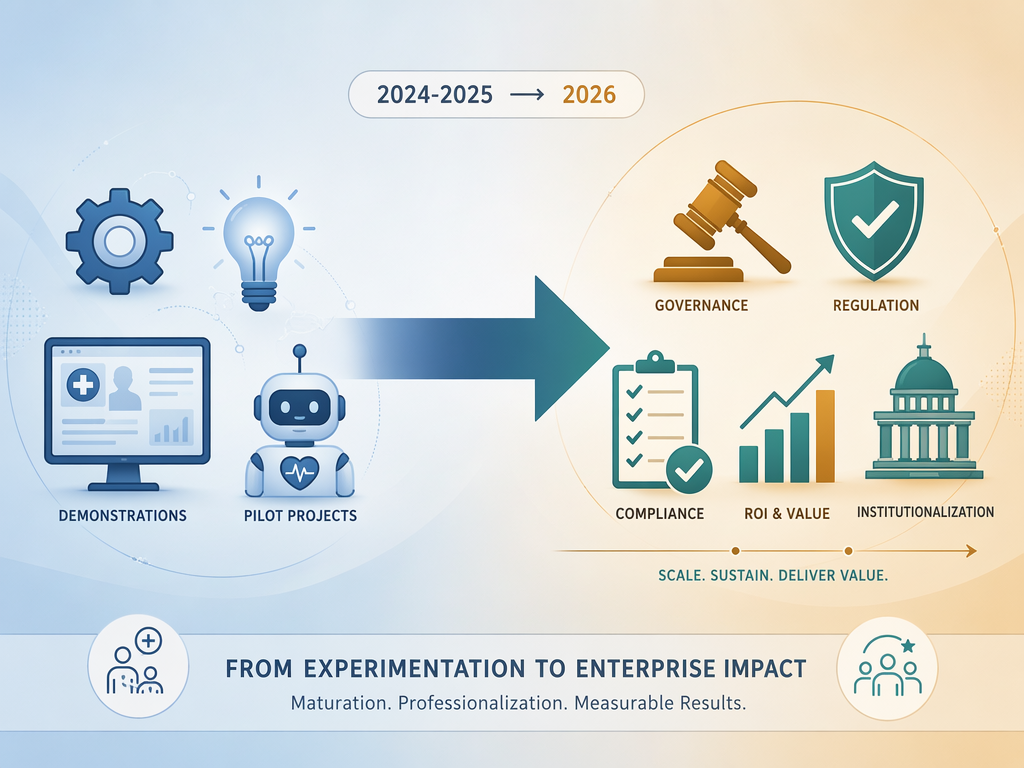
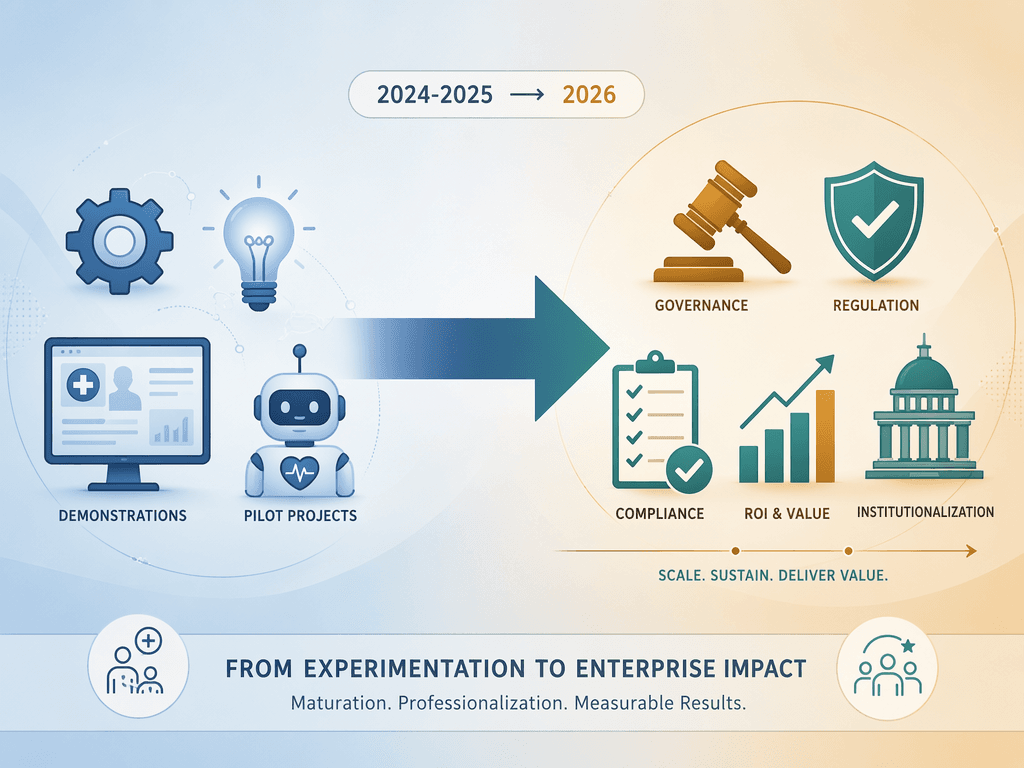
For the past several years, the AI in healthcare summit circuit followed a predictable formula: a parade of vendors demonstrating algorithms on curated datasets, keynote speeches heavy on aspirational language about transforming medicine, and breakout sessions organized around technical capabilities. The implicit message was that the technology was the story, and adoption was simply a matter of time.
The 2026 calendar tells a different story. Across the major events — from the RISE AI in Health Care Summit in January to the Economist AI in Health Summit in November — the center of gravity has shifted decisively. Sessions on AI governance frameworks, regulatory compliance, Medicare reimbursement pathways, bias mitigation, and return-on-investment measurement now dominate the agendas. Technology demonstrations have not disappeared, but they have been pushed to the margins, treated as supporting evidence for operational arguments rather than as the main attraction.
This article argues that the 2026 summit circuit is not merely reflecting industry trends but functioning as a barometer of maturation. The collective agenda reveals that AI in healthcare has moved beyond the hype phase into an operational discipline defined by governance, compliance, and demonstrable value. For health system executives and compliance officers, understanding this shift is essential for aligning enterprise AI strategy with the realities of the current landscape.
The Governance and Compliance Pivot: Evidence from the 2026 Agendas
The most concrete evidence of the pivot comes from examining how individual summits allocated their programming. In prior years, a typical summit might feature one regulatory panel buried in the afternoon of the second day. In 2026, governance and compliance sessions are not just present — they are the headliners.
Consider the following examples from the 2026 calendar:
- The RISE AI in Health Care Summit (January 21–23) dedicated its entire first-day workshop to "AI Regulatory and Compliance Issues in Health Care." The session featured Brenna Loufek, Director of AI Regulatory & Quality at Mayo Clinic, and Nakis Urfi, Chief Compliance & Communications Officer at Cantex Continuing Care Network. A separate keynote addressed how federal policy is shaping the future of AI in healthcare, delivered by Lauren Riplinger of AHIMA.
- The Hogan Lovells AI Health Law & Policy Summit (May 13–14, Washington DC) featured CMS Deputy Administrator and COO Kim Brandt as its keynote speaker. Breakout sessions covered FDA perspectives on AI in medical products, FDA review of AI-enabled medical device software, digital pathology reimbursement trends, and EU AI Act implications for life sciences.
- The Newsweek AI Health Summit (September 23, NYC) included a standalone interview session on "250+ State AI Bills: what multi-state health systems need to watch." The summit noted that 250 state-level AI bills were introduced in 2025 alone, with 33 enacted across 21 states.
- The Economist AI in Health Summit (November 4, London) featured Lawrence Tallon, Chief Executive of the MHRA; Thomas Renner, Head of Directorate Digitalization and Innovation at the German Federal Ministry of Health; and Dr. Nicola Byrne, the UK National Data Guardian. The summit framed its central question as: "AI is ready. How can health systems turn it into real-world, beneficial human impact?"
These are not isolated data points. They represent a structural shift in how summit organizers perceive their audience's priorities. The RISE summit, which describes itself as "the only summit designed for health plan leaders driving responsible AI," explicitly targets compliance and risk management professionals alongside clinical and IT leaders. Its attendee organizations include Medicare Advantage plans, ACOs, hospitals, and IPAs — organizations that need to operationalize AI within existing regulatory frameworks, not evaluate theoretical capabilities.
Key Regulatory Signals from the Summit Circuit: FDA, CMS, and State-Level Legislation
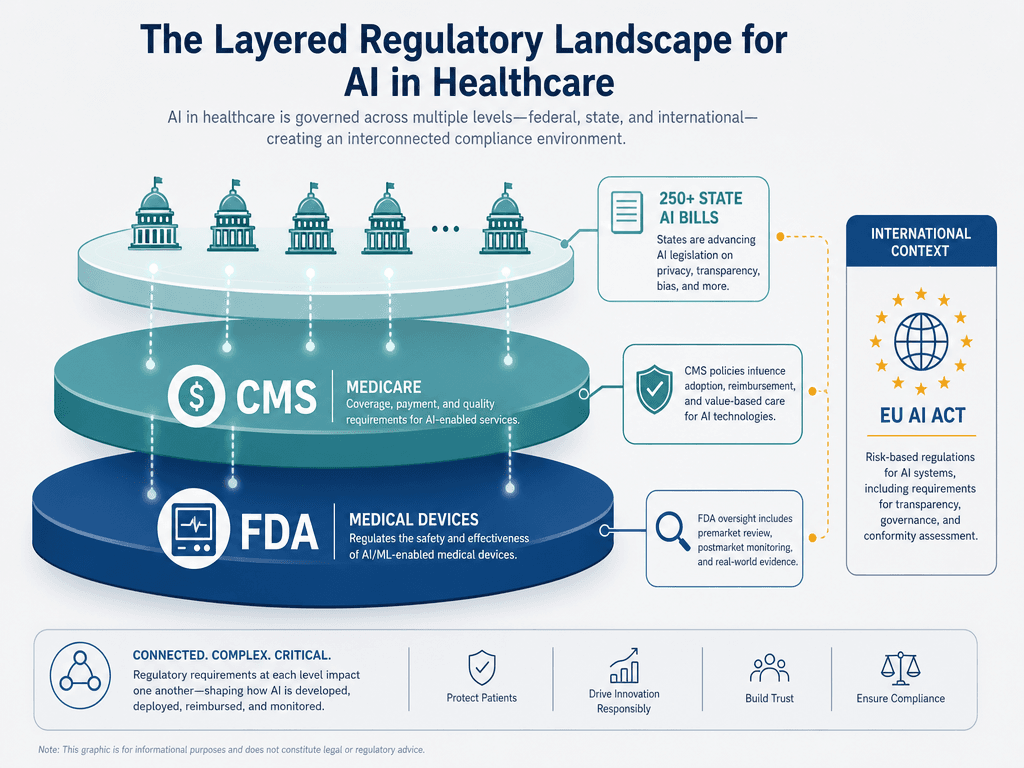
The summit agendas do more than signal a general interest in compliance — they surface specific regulatory developments that health systems must track. Three domains stand out across the 2026 circuit: FDA oversight of AI-enabled medical devices, CMS coverage and reimbursement pathways, and the rapidly expanding patchwork of state-level AI legislation.
| Regulatory Domain | Key Summit Signal | Implication for Health Systems |
|---|---|---|
| FDA AI/ML Device Oversight | Hogan Lovells breakout on FDA review of AI-enabled medical device software and SaMD strategy | Health systems must understand predetermined change control plans (PCCPs) and total product lifecycle (TPLC) requirements when evaluating AI tools for procurement |
| CMS Coverage & Reimbursement | Hogan Lovells session on Medicare coverage and payment for AI-based services, featuring CMS Director Ryan Howe | Reimbursement pathways are emerging but remain fragmented; systems need to track CPT coding developments and coverage determinations |
| State-Level AI Legislation | Newsweek summit session on 250+ state AI bills introduced in 2025, 33 enacted across 21 states | Multi-state health systems face a compliance burden that varies by jurisdiction; a single national framework does not exist |
The Hogan Lovells summit provided the most detailed window into FDA thinking. Anindita Saha, Associate Director for Data Science and AI Policy at CDER and Associate Director for Strategic Initiatives at the Digital Health Center of Excellence (CDRH), led a session on FDA perspectives across drugs, devices, and SaMD. A separate breakout specifically addressed the practical realities of submitting AI-enabled medical device software for FDA review — a topic that would have been niche two years ago but is now central to vendor evaluation and procurement decisions.
On the reimbursement front, the Hogan Lovells summit featured Ryan Howe, Director of the Hospital & Ambulatory Policy Group at CMS, in a session titled "What's New with Medicare Coverage and Payment for AI-based Health Care Services." This was complemented by a fireside chat with Dr. Richard Frank, Co-Chair of the AMA/CPT Digital Medicine Coding Committee. The presence of both CMS policy leadership and CPT coding leadership at the same summit underscores that reimbursement is no longer a theoretical future concern — it is an active policy development area with direct implications for health system revenue cycles.
The state-level dimension, highlighted at the Newsweek summit, adds another layer of complexity. With 250 state AI bills introduced in 2025 and 33 enacted across 21 states, health systems operating in multiple states cannot rely on a single compliance framework. The summit's dedicated session on this topic reflects growing recognition that state-level variation may be the most immediate regulatory challenge for enterprise AI deployment.
For readers seeking deeper analysis of these regulatory developments, ClinicalMind's analysis of FDA's reshaping of AI device regulation through PCCPs and TPLC requirements provides a detailed examination of the regulatory framework that summit sessions are now addressing. Similarly, the overview of US federal and state AI regulation in public health covers the multi-jurisdictional landscape that the Newsweek summit highlighted.
Real-World ROI and Deployment Case Studies: From Pilots to Enterprise
The shift from technology demonstrations to operational reality is perhaps most visible in how summits now frame their case study content. Rather than showcasing what an algorithm can do on a benchmark dataset, 2026 sessions focus on what happens when AI tools are deployed in real clinical environments — the integration challenges, the workflow disruptions, the staff adoption patterns, and the measurable outcomes.
The Guidehouse/HIMSS 2026 Healthcare AI Trends survey provides the statistical backdrop for this programming shift. The survey found that 78% of health systems are already engaged in AI projects, and 58% plan to implement AI-driven workflow automation or productivity tools within two years. The question is no longer whether to adopt AI, but how to do so effectively, safely, and at scale. At the same time, 48% of health systems cited cybersecurity and data privacy concerns as top barriers to AI adoption — a finding that explains why compliance-heavy programming resonates with attendees.
Summit agendas reflect this reality. The Newsweek summit included a session titled "Hospitals Reimagined" focused specifically on ROI and outcomes from AI deployments. The Health AI Summit (April 8–9, Anaheim) listed "Case studies highlighting real-world AI applications in hospitals" as a key topic, alongside sessions on generative AI for workflow and patient engagement. The RISE summit featured a session on "AI Promises and Perils: From Hype to Hands-On Adoption" with physician speakers from Catholic Medical Partners — a title that explicitly acknowledges the gap between vendor promises and operational reality.
The Economist summit's framing is perhaps the most direct articulation of this shift. Its central question — "How can health systems turn AI into real-world, beneficial human impact?" — treats AI as a tool to be operationalized, not a technology to be marveled at. The 2025 edition of the same summit drew 389 attendees from 31 countries and 271 unique companies, with 41% of attendees at director level or above. The audience composition itself signals that the conversation has moved from research labs to enterprise decision-making.
Clinical Trust and Bias Reduction as Recurring Themes
A third dimension of the 2026 pivot is the prominence of bias mitigation, algorithmic accountability, and clinical trust as standalone agenda items. These topics are not new to the AI in healthcare conversation, but their elevation to featured session status — rather than afterthought panels — signals a maturing understanding that clinical adoption depends on trust, not just technical performance.
The RISE summit included a dedicated panel titled "Beyond the Algorithm: Reducing Bias and Stereotypes in AI Through Better Data and Better Design," featuring speakers from The Stereotype Project Foundation. The session's framing — that bias reduction requires attention to data quality and design methodology, not just post-hoc auditing — reflects a more sophisticated approach than the generic "fairness in AI" sessions of prior years.
The Newsweek summit addressed the trust question directly with a session titled "AI-enabled clinicians: trust, accountability and decision-making." This framing is significant because it positions trust as a property of the clinician-AI relationship, not just the algorithm's performance metrics. It acknowledges that even a highly accurate model will fail to improve patient outcomes if clinicians do not trust its recommendations or understand its limitations.
The Hogan Lovells summit approached trust from the regulatory side, with sessions on FDA transparency requirements and the practical realities of AI device submissions. Regulatory transparency and clinical trust are linked: clinicians and patients cannot trust what they cannot understand or verify, and regulatory frameworks are increasingly demanding explainability and post-market surveillance as conditions of approval.
What the Pivot Means for Health Systems Planning Their AI Strategy
The 2026 summit circuit does more than reflect industry trends — it provides a roadmap for health systems building or refining their AI strategies. The collective agenda suggests several actionable priorities for executives and compliance officers.
- Prioritize governance frameworks before technology selection. The RISE summit's full-day regulatory workshop and the Hogan Lovells summit's focus on FDA and CMS frameworks make clear that governance is not an afterthought — it is the foundation on which successful AI deployment depends. Health systems should establish AI governance committees, develop clear policies for procurement and deployment, and ensure compliance teams are involved from the outset of any AI initiative.
- Engage proactively with regulatory developments. The presence of CMS Deputy Administrator Kim Brandt and FDA's Anindita Saha at summit sessions signals that regulatory agencies are actively shaping the AI landscape. Health systems should monitor FDA guidance on AI/ML SaMD, CMS coverage determinations, and the evolving state-level legislative environment. The analysis of the AI healthcare market's regulatory crossroads provides a deeper examination of how FDA clearances, Joint Commission guidelines, and the EU AI Act shape commercial prospects.
- Invest in bias mitigation and cybersecurity as core competencies. With 48% of health systems citing cybersecurity as a top barrier (Guidehouse/HIMSS) and bias reduction now a standalone summit topic, these are not optional add-ons. Health systems should allocate dedicated resources to algorithmic auditing, data quality assessment, and cybersecurity infrastructure for AI systems.
- Demand ROI evidence from vendors, not just performance metrics. The summit circuit's emphasis on real-world deployment case studies and ROI measurement reflects a market that has moved beyond proof-of-concept demonstrations. Health systems should require vendors to provide evidence of operational impact, workflow integration, and measurable outcomes — not just algorithm accuracy on retrospective data.
- Prepare for multi-jurisdictional compliance. With 33 state AI bills enacted across 21 states in 2025, health systems operating in multiple states face a compliance burden that will only grow. The analysis of generative AI governance challenges addresses the shadow AI governance challenge that many organizations are only beginning to recognize.
The 2026 summit circuit validates a fundamental shift: AI in healthcare is no longer an experimental technology awaiting adoption. It is an operational discipline with established regulatory frameworks, emerging reimbursement pathways, documented deployment challenges, and measurable ROI expectations. The summits that succeed in 2026 are those that help health systems navigate this new reality — not by showcasing what AI can do, but by providing the governance, compliance, and operational tools to make it work.
Comments
Join the discussion with an anonymous comment.