
AI in hurricane disaster response and healthcare preparedness is already doing useful work, but not in one uniform way. Its strongest evidence sits at specific decision points: narrowing a storm track, estimating which hospitals may lose functionality, moving patients through disaster triage faster, and identifying communities that need recovery support. The operational question is less whether AI belongs in hurricane planning than whether a particular tool is validated for the phase, decision, and failure conditions it will face.
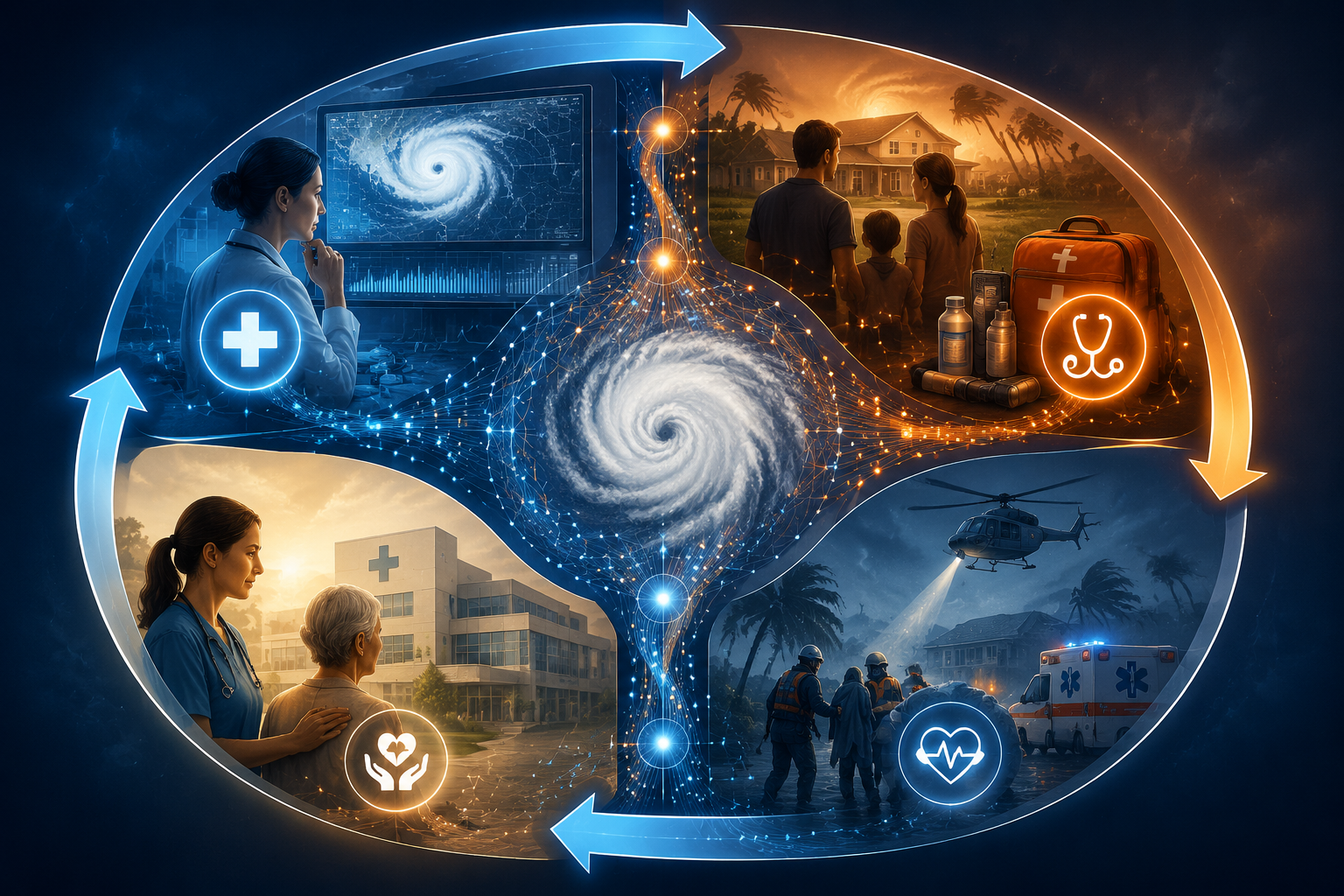
A practical map starts with four phases: prediction, preparedness, response, and recovery. Healthcare resilience runs through all of them. A better forecast only matters if it changes evacuation timing, staffing rosters, generator fuel checks, ambulance staging, dialysis continuity plans, or patient-routing decisions before roads, power, and communications begin to fail.
Where the Evidence Is Measurable
The headline benchmarks are worth taking seriously, with their limits attached. NOAA and partner machine-learning models have been reported to improve hurricane track forecast accuracy by roughly 20%, based on 2025 data cited by Texas A&M Stories; that is a meaningful gain for emergency operations, but the figure comes through a secondary report rather than a directly reviewed NOAA technical source in the available materials.[1] In disaster triage, a 2024 systematic review found that AI and machine-learning models outperformed conventional triage tools for predicting mortality and hospital admission across general disaster settings, including an e-triage system that processed about three times as many patients as paper methods and a deep neural network survival model with an AUC of 0.89.[2] Those are stronger clinical decision-support signals, but they are not hurricane-specific validation.
That distinction matters. A hurricane response can include blunt trauma, drowning, electrical injuries, heat exposure, medication interruption, delayed rescue, and long transport times. A mass-casualty simulation that improves triage throughput does not automatically prove performance in flooded neighborhoods, dark emergency departments, or shelters where the clinical problem is partly acuity and partly continuity of care.
| Hurricane phase | AI use with current evidence | Healthcare decision affected | Main limitation |
|---|---|---|---|
| Prediction | Machine-learning hurricane track and intensity forecasting, including reported track-error improvement | Evacuation timing, hospital surge posture, ambulance staging, continuity planning | Key benchmark available here through secondary reporting |
| Preparedness | Hospital resilience modeling using beds, staff, utilities, transportation, housing, and wait times | Which hospitals are likely to lose or regain functionality, and where patients may need to be routed | Research or pilot-stage maturity rather than standard deployment |
| Response | AI-supported disaster triage and information management | Patient prioritization, throughput, mortality and admission prediction | No hurricane-specific AI triage validation in the available evidence |
| Recovery | Damage and poverty mapping to support relief allocation | Which households or communities receive assistance first | Risk of reinforcing inequities if visible property damage drives allocation |
Prediction Helps Only If It Buys Usable Time
In hurricane operations, forecast improvement is not an abstract modeling win. A smaller track error can move a hospital from watchful monitoring to action: discharging medically appropriate patients earlier, transferring neonatal or ICU patients before transport windows close, repositioning oxygen and dialysis resources, or deciding whether staff should shelter on site. The reported roughly 20% improvement in track forecast accuracy is therefore operationally important even though the evidence path is not as clean as a peer-reviewed clinical trial.[1]
The same caution applies to flood forecasting. Tools such as Google’s flood forecasting work are relevant to hurricane-related flooding, but a flood-risk alert is only a healthcare preparedness tool when it is connected to a decision owner. A county warning, hospital command center, EMS agency, and long-term care facility may all see the same risk map and make different choices. The AI output does not solve that coordination problem by itself.
For health systems, the forecasting question should be written in operational language: which facilities may become inaccessible, which service lines cannot safely ride out the storm, which staff groups are likely to be unable to report, and how much time remains to move patients before a transfer becomes more dangerous than sheltering in place. The best models reduce uncertainty early enough for those choices to change.
Preparedness Is Where Healthcare AI Has to Model the System, Not Just the Storm
The most useful preparedness models do not stop at hazard exposure. They ask whether a hospital can still function. Colorado State University researchers have described a healthcare network resilience model as the first known tool to predict post-disaster hospital functionality and recovery trajectories, incorporating staffed beds, staff availability, housing functionality, patient wait times, and interdependencies across water, power, and transportation systems.[3]
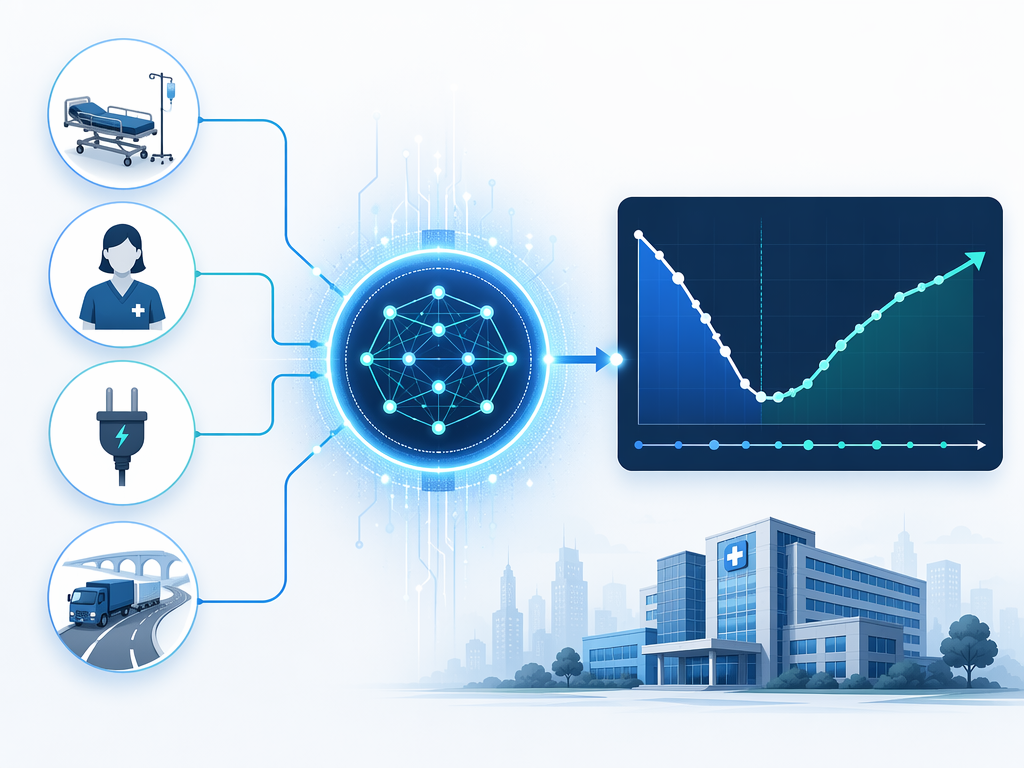
That design is important because hospital resilience is rarely lost through one failure. A facility may have physical beds but not enough nurses. It may have clinicians but no reliable transportation corridor for incoming patients. It may have generator power but limited fuel. It may reopen its emergency department while the surrounding community loses housing, increasing demand faster than staffing can recover. A model that treats those dependencies together is closer to the problem emergency managers actually face.
The CSU work should still be described as research-stage or pilot-stage evidence, not a standard hospital operating system. Its value in 2026 is that it shows what preparedness analytics should measure: staffed capacity, workforce availability, utility fragility, transport access, and time to recovery. Administrators evaluating similar products should ask whether the model predicts a dashboard metric or a usable action, such as where to pre-stage ambulances, when to divert emergency department arrivals, or which mutual-aid agreement needs activation.
Field-tested hurricane tools strengthen the case that AI can help before and during landfall. Texas A&M’s UrbanResilience.AI Lab reports deployments during Hurricanes Beryl, Milton, and Helene for evacuation monitoring, power outage tracking, and damage assessment.[1] Those uses sit near the operational bottlenecks: who is still in harm’s way, where power loss is spreading, and which areas may need rapid assessment. They do not prove clinical outcome improvement, but they can improve the situational awareness that clinical operations depend on.
Digital health continuity belongs in the same preparedness discussion, but with narrower claims. A California Telehealth Resource Center environmental scan identified AI, telehealth, and remote monitoring as important tools for maintaining healthcare continuity during infrastructure compromise.[4] That supports planning for remote visits, monitoring, and communication alternatives, not a blanket conclusion that digital health will remain available during severe outages.
Hurricanes Maria and Irma exposed the dependency clearly: 90% of mobile network sites were destroyed in Puerto Rico in 2017.[5] Any preparedness plan that assumes AI-supported telehealth, remote monitoring, or cloud triage will function during a similar communications collapse is not a resilience plan; it is a best-case workflow. Offline modes, paper fallbacks, radio procedures, local caches, and staff training remain part of the AI deployment architecture.
Triage Evidence Is Stronger Than the Hurricane Evidence Around It
The clearest clinical decision-support evidence in the available materials comes from Tahernejad et al.’s 2024 systematic review of AI and machine learning for disaster triage. The review screened 2,630 articles and included 19 high-quality studies, concluding that AI and machine-learning models significantly outperformed conventional triage tools in predicting mortality and hospital admissions during disasters.[2]
Several findings are operationally meaningful. The AID-N e-triage system triaged about three times as many patients as paper methods and used eight times less energy than prior embedded triage systems.[2] A deep neural network for survival prediction reached an AUC of 0.89 and outperformed the Revised Trauma Score.[2] Smart Check reduced triage time by 33 seconds per patient, which the review associated with 62 hours of classification time saved per month.[2]
Throughput matters in a hurricane because congestion becomes clinical risk. Patients may arrive after long delays, ambulances may queue, shelters may need medical screening, and hospitals may be deciding whether to transfer or hold patients while transport routes are deteriorating. A tool that cuts classification time or improves mortality prediction can create room for clinicians to spend attention where judgment is most needed.
But this is also where procurement language can outrun evidence. The review supports AI-assisted disaster triage as a promising and, in some settings, better-performing approach. It does not establish that an AI triage tool has been validated for hurricane-specific injury patterns, extended infrastructure disruption, shelter-based care, or the mixed medical-social needs that follow flooding and prolonged outages. For hurricane preparedness, the correct conclusion is not that AI triage is unready everywhere. It is that local deployment should be treated as a controlled, governed clinical decision-support implementation unless hurricane-relevant validation exists.
This is the same gap seen across many healthcare AI deployments: promising performance in bounded studies does not automatically translate into safe performance in messy care environments. For broader context, see AI and Healthcare: What Real Clinical Deployments Actually Look Like.
Response Tools Need a Human Chain of Command
During response, AI can help consolidate reports, classify damage, prioritize calls, summarize incident information, and support patient routing. WHO’s AI-powered All-Hazard Information Management Toolkit points to the growing institutional interest in using AI for emergency information management across hazards.[6] FEMA’s AI use case inventory also shows federal experimentation with functions such as surge hiring support, disaster declaration processing, and damage pattern identification.[7]
Those uses are not interchangeable. Damage pattern identification may speed situational awareness. Disaster declaration processing may affect administrative timing. Surge hiring support may relieve staffing pressure. Clinical triage affects patient prioritization at the bedside or in the field. Each use needs a different threshold for validation, auditability, and human review.
The practical test is whether the AI output lands inside an accountable response structure. If a model recommends diverting patients from one hospital to another, who approves it? If an outage prediction changes EMS staging, who sees the confidence level and who updates the decision when a road washes out? If an automated summary misses a shelter request for oxygen concentrators, who is responsible for catching the omission?
RAND’s 2025 commentary frames the accountability problem plainly: when AI-based disaster response depends on many tools or agents working together, “it is hard to locate responsibility for an AI-based disaster response decision because AI systems are made up of many different tools or agents working together.”[5] That is not an abstract ethics concern. In a hurricane, responsibility has to be locatable while decisions are still being made.
Governance should therefore be specified before deployment: what the model is allowed to recommend, which decisions require human authorization, how uncertainty is displayed, how overrides are recorded, and how performance is reviewed after the incident. Healthcare organizations already working through AI governance can connect hurricane-response tools to broader controls such as the NIST AI Risk Management Framework in Healthcare.
Recovery Allocation Can Be Fast and Still Miss People
Recovery is where AI’s speed can be most visible. RAND described a GiveDirectly and Google AI tool used after Hurricanes Helene and Milton in 2024 to identify high-damage, high-poverty areas and deliver $1,000 cash relief to affected households.[5] The appeal is obvious: if a model can combine damage signals and poverty indicators quickly, relief can move before traditional assessment processes finish.
The same example also shows why allocation logic needs scrutiny. If models prioritize visible property damage, they may favor places where damage is easier to detect, property records are cleaner, or housing assets are more legible. RAND warns that aid allocation based on property damage can reinforce wealth-based disparities.[5] Wood’s 2025 framework similarly argues that AI deployment in disaster response can reinforce systemic inequalities affecting marginalized communities.[8]
For healthcare preparedness, that risk is not separate from clinical planning. Communities with lower documentation quality, informal housing, limited broadband, or lower insurance coverage may also have higher chronic disease burden and fewer transportation options. If they are underdetected in recovery allocation, the healthcare system may see the consequence later through emergency department visits, medication interruptions, missed dialysis, unmanaged diabetes, behavioral health crises, or delayed wound care.
Bias review cannot wait until after a relief algorithm has ranked neighborhoods. It should include community data checks, appeal pathways, human review for excluded areas, and comparison against non-AI sources such as shelter reports, EMS calls, public health outreach, and local organization input. For healthcare-specific examples of why algorithmic bias can become operational harm, see documented examples of algorithmic bias in healthcare AI.
What Healthcare Administrators Should Require in Q3 2026
By Q3 2026, the adoption question should be specific enough to survive an incident command meeting. A vendor claim that AI “improves hurricane response” is too broad. A useful claim says which phase the tool supports, which decision it changes, what evidence supports that use, what data it needs, what happens when infrastructure fails, and who remains accountable.
- Use forecast AI where the evidence supports earlier or more accurate hazard estimates, but tie it to predefined operational triggers.
- Treat hospital resilience models as promising preparedness tools when they include staff, beds, utilities, transportation, housing, wait times, and recovery trajectories.
- Do not extrapolate general disaster triage performance into hurricane clinical readiness without hurricane-relevant validation or a controlled local implementation plan.
- Require offline procedures, backup communications, manual fallbacks, and staff training for any AI workflow that depends on power, broadband, mobile networks, or cloud access.
- Audit recovery and allocation models for communities that may be underdetected by property, satellite, insurance, or administrative data.
- Assign decision rights before deployment: who can accept, reject, override, and later review an AI-supported recommendation.
Market projections and broad healthcare AI adoption trends can help explain why more products are arriving, but they should not be treated as evidence that a hurricane-response tool works. The more relevant question is whether the tool has been tested against the operational conditions it will face: incomplete data, exhausted staff, damaged infrastructure, contested priorities, and communities whose needs may not be visible in the easiest datasets. For broader adoption context, see How Is AI Actually Being Used in Healthcare in 2026?.
AI is already useful across the hurricane disaster cycle, but adoption should remain an evaluation posture rather than a category endorsement. The responsible standard is to match each tool to its validated context, operational dependencies, and governance plan, with accountability, bias review, and infrastructure resilience treated as deployment requirements rather than afterthoughts.
References
- AI hurricane preparedness reporting, Texas A&M Stories, Oct. 2025.
- Artificial intelligence and machine learning in disaster triage: a systematic review, BMC, 2024.
- Healthcare network resilience model reporting, CSU College of Engineering.
- Environmental scan on digital health tools for healthcare continuity, California Telehealth Resource Center, Oct. 2024.
- AI disaster response accountability commentary, RAND, Aug. 2025.
- AI-powered All-Hazard Information Management Toolkit, WHO EMRO.
- AI use case inventory, U.S. Department of Homeland Security.
- AI and big data in disaster response: Ethical and practical challenges, ScienceDirect, 2025.
Comments
Join the discussion with an anonymous comment.