
The question behind “ai being used in healthcare” is no longer whether hospitals and physicians are experimenting with it. They are. The harder question is what kind of use is being counted, who checks the output, and whether the result is safer, faster, or simply another task handed to already crowded clinical teams.
By 2026, 81% of physicians report using AI in practice, more than double the 38% reported in 2023.[1] In hospitals, 71% used predictive AI integrated into their EHRs in 2024.[2] FDA-authorized AI/ML medical devices have passed 1,451 cumulatively, with radiology still dominating the list.[3] At the same time, 80% of hospitals lack internal AI governance standards, a gap that matters more as tools move from pilots into daily work.[4]

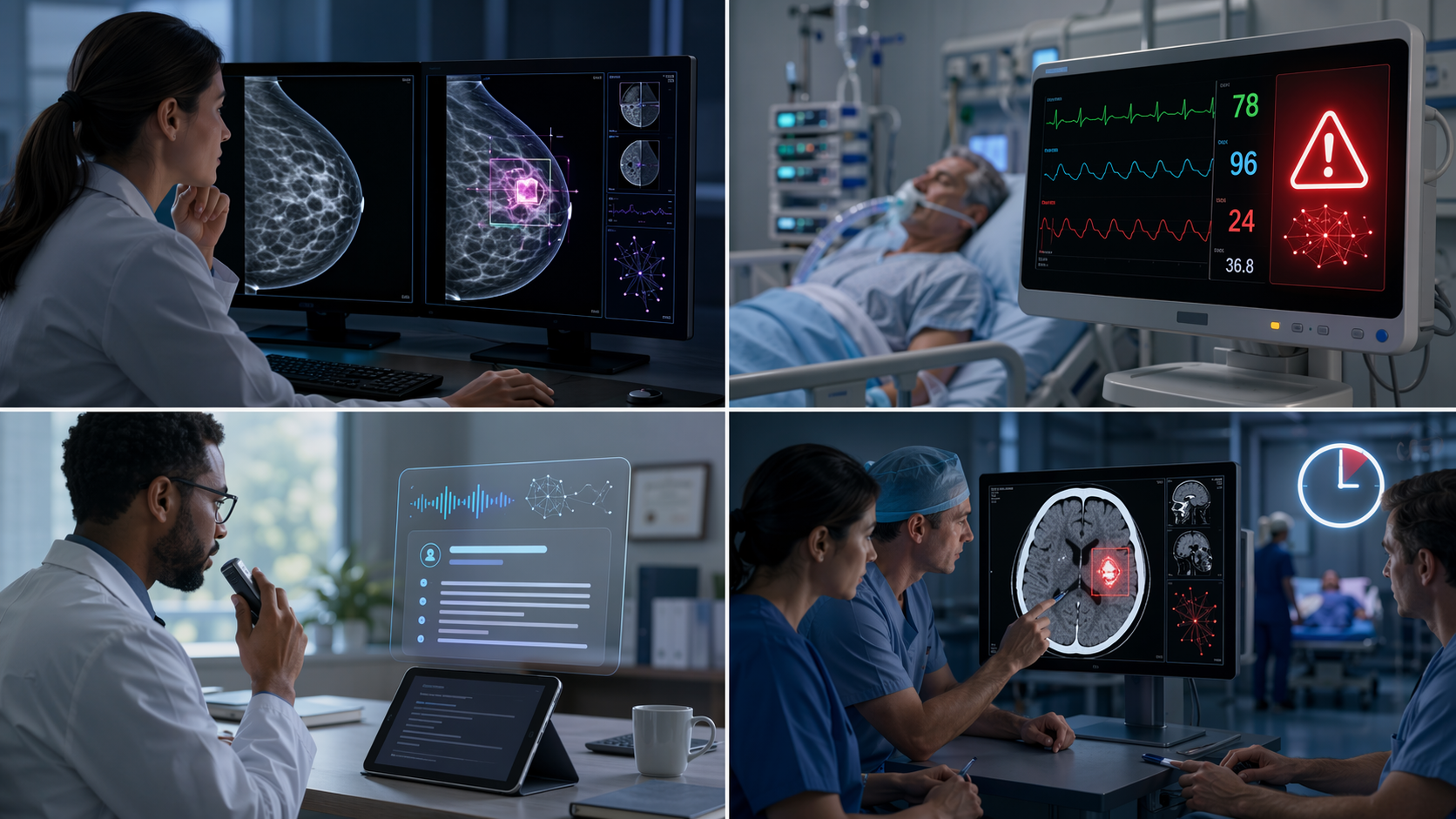
That is the state of healthcare AI in Q3 2026: broad enough to be operational, uneven enough that the word “adoption” needs unpacking. A physician who uses an ambient documentation tool, a radiology department running FDA-authorized image analysis, an ICU using a sepsis alert, and an administrator drafting prior authorization language may all count as AI users. They are not doing the same thing, carrying the same risk, or relying on the same evidence.
What “Use” Means Inside Healthcare
A single adoption number hides several layers of deployment. Some AI tools are regulated medical devices. Some are predictive models embedded in EHR workflows. Some are documentation, coding, revenue cycle, or inbox tools. Some are general-purpose generative AI systems used around the edges of clinical work, often outside the FDA medical-device pathway.
| AI use pattern | Typical setting | What has to be checked |
|---|---|---|
| FDA-authorized image or signal analysis | Radiology, cardiology, neurology, pathology-adjacent workflows | Device indication, local performance, false positives, false negatives, clinician review |
| Predictive AI in the EHR | Sepsis, deterioration, readmission, operational risk scoring | Model drift, alert fatigue, local validation, workflow response |
| Ambient documentation and administrative drafting | Exam rooms, telehealth, inbox, coding, prior authorization, chart summarization | Accuracy, attribution, privacy, clinician signoff, downstream billing or care effects |
| General-purpose generative AI use | Ad hoc summarization, patient-message drafting, education, internal productivity | Whether use is allowed, whether protected data enters the tool, and who is accountable |
The distinction is not bureaucratic. A breast imaging algorithm that has been reviewed for a specific device indication sits in a different risk category from a chatbot summarizing a discharge note. A sepsis model that fires an alert in the EHR is different again: the model may not directly diagnose, but it changes who gets paged, how quickly a nurse or physician responds, and which patients occupy attention.
This is why clinician validation behavior is as important as adoption behavior. In one 2026 healthcare AI discussion, 77% of clinicians said they “always” or “often” validate AI-generated outputs.[1] That is reassuring, but it also names the work that adoption statistics can blur. Validation is labor. It takes time, expertise, and a local policy that says what happens when the tool is wrong.
The Most Mature Footprint Is Still Imaging
If the task is to find the most visibly mature area of medical AI, start with imaging. As of early 2026, the FDA had authorized more than 1,451 AI/ML-enabled medical devices, and roughly 80% of authorized devices were radiology-specific.[3] Innolitics counted 295 AI/ML medical device 510(k) clearances in 2025 alone, showing how quickly the cleared-device inventory has expanded.[5]
Radiology’s lead is not accidental. Imaging offers digitized inputs, repeated tasks, established specialist review, and measurable endpoints such as lesion detection, prioritization, and reading time. The workflow still has plenty of hard edges, but at least the tool usually has a defined place: it flags, segments, prioritizes, or assists interpretation, while a clinician remains responsible for the report.
The clinical evidence is also more concrete here than in many other domains. In breast cancer screening, the PRAIM study reported a 17.6% increase in cancer detection rate with AI-supported screening.[6] That figure is not a license to generalize every imaging product as clinically proven. It does show why radiology has become the test case for moving from algorithmic performance to operational performance: detection changes only matter if the workflow handles the extra findings, recalls, reads, and follow-up without creating new harm.
The regulatory caveat is especially important for generative AI. A March 2026 database analysis reported that no generative AI-powered medical device had received FDA authorization at that point.[3] That does not mean generative AI is absent from healthcare. It means much of the generative AI now being used belongs to a different operational category: documentation, drafting, summarization, search, patient communication support, and administrative workflow assistance rather than FDA-cleared autonomous medical-device use.
Predictive AI Is Common, but Local Performance Is the Real Test
Predictive AI has already entered the EHR-shaped workday. The 71% hospital figure for predictive AI integrated into EHRs suggests that many organizations are past the procurement or pilot phase.[2] These tools commonly aim to identify deterioration, sepsis risk, readmission risk, scheduling problems, or operational bottlenecks. The promise is earlier action. The practical question is whether anyone can trust the signal enough to act on it.
Sepsis models show both why hospitals keep trying and why implementation is not trivial. Across multiple health systems, AI sepsis models have been associated with 17% to 39% reductions in in-hospital mortality.[7] The word “associated” is doing real work. The model alone does not treat sepsis; people do. Outcome improvement depends on how alerts are routed, whether bedside teams believe them, whether treatment protocols are ready, and whether false alarms erode trust.
Stroke triage gives a cleaner example of workflow compression. Viz.ai large-vessel occlusion detection has been reported with a 31-minute reduction in time-to-treatment.[7] In stroke care, minutes are not an abstract efficiency metric. They determine who sees the scan, when the team assembles, and how quickly a patient reaches intervention. Even here, the benefit is not just the algorithm spotting a pattern. It is the alert, routing, review, and escalation chain around it.
For readers who want a deeper emergency-care evidence review, ClinicalMind’s discussion of AI in emergency medicine separates triage, sepsis prediction, and stroke decision support in more detail.
Ambient Documentation Is Where AI Feels Most Immediate to Clinicians
Ambient documentation has become one of the clearest examples of AI helping with a problem clinicians already recognize: the visit ends, but the documentation does not. These tools listen to or process clinical conversations and draft notes for clinician review. They do not remove responsibility from the clinician, but they can change when and how note work happens.
A 2026 JAMA study across five sites and 1,800 clinicians found ambient AI scribes saved 13.4 to 16.0 minutes of documentation time per 8-hour shift.[8] That is not a miracle number; it is a workflow number. It matters because a few minutes per shift can be meaningful when multiplied across clinics, but it also reminds hospitals not to sell ambient documentation as if it automatically fixes staffing, inbox overload, or EHR design.
The burnout and well-being signals are notable. Mass General Brigham observed a 21.2 percentage-point absolute burnout reduction, from 52.6% to 30.7%, after ambient documentation implementation.[8] Emory Healthcare reported a 30.7 percentage-point absolute increase in documentation-related well-being.[8] Those are closer to lived clinical burden than most market forecasts, though they still depend on deployment setting, note quality, specialty mix, clinician editing behavior, and whether saved time is actually returned to clinicians or absorbed by higher throughput.
Ambient tools also illustrate the governance problem in miniature. A drafted note can be useful and still contain an omitted medication, a hallucinated detail, or an overconfident summary of a nuanced conversation. The output becomes part of the record only after someone signs it. That signoff is not a ceremonial click; it is the point where responsibility lands.
Administrative AI Has Strong ROI Claims, but the Counting Matters
Administrative use is one reason healthcare AI adoption feels broader than the regulated-device count. Revenue cycle, prior authorization, call centers, coding support, denial management, supply chain, staffing, inbox drafting, and chart summarization all attract AI investment because they target expensive friction rather than direct diagnosis.
Industry and consultant estimates report an average return of $3.20 for every $1 invested in healthcare AI, and a potential $360 billion in annual savings.[9] Another 2026 statistics roundup reports that 64% of organizations see positive ROI from AI investments.[10] These figures are useful as pressure indicators, not as proof that any particular hospital will save money. Savings depend on what is counted: labor avoided, labor shifted, denials reduced, documentation accelerated, visits added, or downstream clinical complications prevented.
A prior authorization tool that drafts letters faster may reduce staff time in one department while increasing review work elsewhere. A coding assistant may improve completeness while introducing audit risk if oversight is weak. A summarization tool may save a physician from searching the chart but still require careful checking before it informs a care decision. Operational AI earns its keep in the handoff between machine output and human accountability.
For a more focused treatment of ROI evidence and validation methods, see ClinicalMind’s analysis of where health AI companies are delivering real ROI.
Market Pressure Is Real, but It Is Not Clinical Evidence
Spending helps explain the pace. Healthcare AI spending reached $1.4 billion in 2025, and one market estimate projects growth from $36.96 billion in 2025 to $110.61 billion by 2030.[10] Those numbers help explain why executives, vendors, and investors keep pushing AI into healthcare workflows. They do not tell us whether an alert is calibrated, whether a note is accurate, or whether a hospital has enough data engineering capacity to maintain the tool after launch.
Market-size estimates also vary depending on what the analyst includes: devices, software, services, administrative automation, drug discovery, imaging, or generative AI infrastructure. A large market forecast can be true and still say very little about bedside usefulness. The better evidence comes from narrower questions: did documentation time fall, did detection improve, did time-to-treatment decrease, did clinicians trust the alert enough to act, and did the hospital monitor performance after go-live?
Why Scaling Still Breaks Down
The barriers are not mysterious. In 2026 reporting, 77% cite immature tools as a barrier to healthcare AI adoption, 47% cite financial concerns, and 40% cite regulatory uncertainty.[1] These obstacles are not interchangeable. An immature documentation assistant creates one kind of burden; an unvalidated deterioration model creates another; an unclear policy for using generative AI with protected health information creates a third.
Data fragmentation is the quiet constraint behind many failed deployments. Hospitals may have EHR data, imaging archives, device feeds, claims, scheduling systems, and patient messages, but that does not mean the data are clean, consistent, current, or usable for local validation. A model trained or tested elsewhere can degrade when coding practices, patient mix, scanner protocols, clinical pathways, or documentation habits differ.
This is where many AI conversations become too loose. A model does not become safe merely because it was purchased from a reputable vendor, cleared for a particular use, or impressive in a pilot. Someone has to define the intended use, test the model locally when needed, monitor drift, decide who can override it, audit failures, and retire or recalibrate it when performance changes.
The governance gap is therefore not a paperwork issue. If 80% of hospitals lack internal AI governance standards, then many organizations are adopting tools faster than they are defining how those tools should be evaluated, approved, monitored, and challenged.[4] That gap becomes more serious as AI moves into more routine work, because routine systems are often trusted precisely when they become least visible.
A practical governance program does not need to slow every useful deployment to a crawl. It does need to answer basic questions before use becomes dependency: what problem the tool is allowed to solve, what data it uses, what evidence supports it, what human review is required, what metrics are monitored, what happens after an adverse event, and who owns the decision to suspend it.
ClinicalMind’s agentic AI governance blueprint and NIST AI Risk Management Framework in healthcare discussion are useful companions for organizations trying to turn that checklist into policy.
The 2026 Answer
AI is being used in healthcare in 2026 across imaging, predictive risk scoring, stroke triage, sepsis alerts, ambient documentation, inbox support, coding, prior authorization, revenue cycle, and other administrative workflows. The most defensible claims are specific: a breast screening program reports higher cancer detection, sepsis models are associated with lower in-hospital mortality in some systems, stroke tools can reduce treatment time, and ambient scribes can return measurable documentation minutes to clinicians.[6][7][8]
The less defensible claim is that high adoption equals mature deployment. It does not. Adoption says a tool has entered the workflow. Maturity requires evidence that the tool performs in the local setting, that clinicians know how to use and challenge it, that failures are reviewed, that data pipelines are maintained, and that accountability is explicit.
Healthcare AI has moved beyond the demo stage. The next threshold is not whether hospitals will adopt AI; many already have. It is whether they can define standards for validation, monitoring, accountability, and data readiness before today’s uneven gains become tomorrow’s unmanaged risk.
References
- How AI Is Transforming Healthcare in 2026, Wolters Kluwer
- From Promise to Practice: The Next Era of AI in Health Care, NEJM Catalyst
- The Current State Of Over 1450 FDA-Approved, AI-Based Medical Devices, Bertalan Meskó / LinkedIn
- The AI Wild West Is Over: Why 2026 Is the Year Health Systems Must Take Control, Premier Inc.
- 2025 Year in Review: AI/ML Medical Device 510(k) Clearances, Innolitics
- Emerging healthcare AI trends in 2026 so far, Philips
- AI Adoption in Healthcare Is Surging, Forbes / Menlo Ventures
- Healthcare AI In 2026: What's Working, What Isn't, And What's Next, MDRG
- Why digital solutions and AI in healthcare fail to scale, World Economic Forum
- AI In Healthcare Statistics (2026), DemandSage
Comments
Join the discussion with an anonymous comment.