
By the time the lettuce recall arrived, the public-health clock and the laboratory clock were already badly out of sync. CDC had reported 1,645 laboratory-confirmed domestically acquired cyclosporiasis cases as of July 14, 2026, with more than 5,100 additional cases under review across 34 states.[1] Three days later, FDA said traceback work had identified a single supplier of iceberg lettuce from Mexico used by Taco Bell restaurants in five states, and Taylor Farms de Mexico initiated a voluntary recall.[2]
That sequence sounds familiar from bacterial foodborne outbreaks: illnesses accumulate, investigators interview patients, records point upstream, a supplier is named, product is pulled. But a Cyclospora investigation tied to a lettuce recall does not have the same laboratory machinery behind it as a Salmonella or E. coli investigation. The recall may be the visible endpoint of one operational traceback. It is not, by itself, an explanation for why the source remained difficult to identify while case counts grew.
The hard part is not simply that Cyclospora is obscure, or that patients may forget what they ate. Those are real problems, but they are not the center of this one. The center is that Cyclospora denies investigators several of the tools that now shape public expectations for foodborne outbreak response: routine culture, high-resolution whole-genome sequencing, rapid clustering, and clean comparison of isolates across people, foods, and facilities.
The bacterial model does not transfer cleanly
For many bacterial outbreaks, the investigation begins to sharpen once a clinical specimen yields an organism that can be grown. Culture gives laboratories enough material to sequence. Sequencing gives investigators a genomic fingerprint. If many patients carry highly related bacterial genomes, and if a food or environmental sample carries the same or a closely related strain, epidemiology and genomics can reinforce each other.
That is the model many people now have in mind when they hear that a national foodborne outbreak is under investigation. A stool specimen becomes an isolate. The isolate becomes a sequence. The sequence joins a database. A cluster becomes visible faster than patient interviews alone could make it visible. The genomic evidence does not replace traceback, but it can narrow the field and give investigators confidence that scattered cases belong together.
Cyclospora breaks that workflow near the beginning. FDA’s Cyclospora action plan states that no in vitro culture system or animal model exists for Cyclospora, and that chemically disinfecting or sanitizing produce might not fully eliminate it.[4] Without a culture system, laboratories cannot amplify the organism in the ordinary way. Without that growth step, the path to routine whole-genome sequencing is blocked. The problem is not that investigators forgot to run the bacterial playbook. The organism does not give them the same playbook to run.
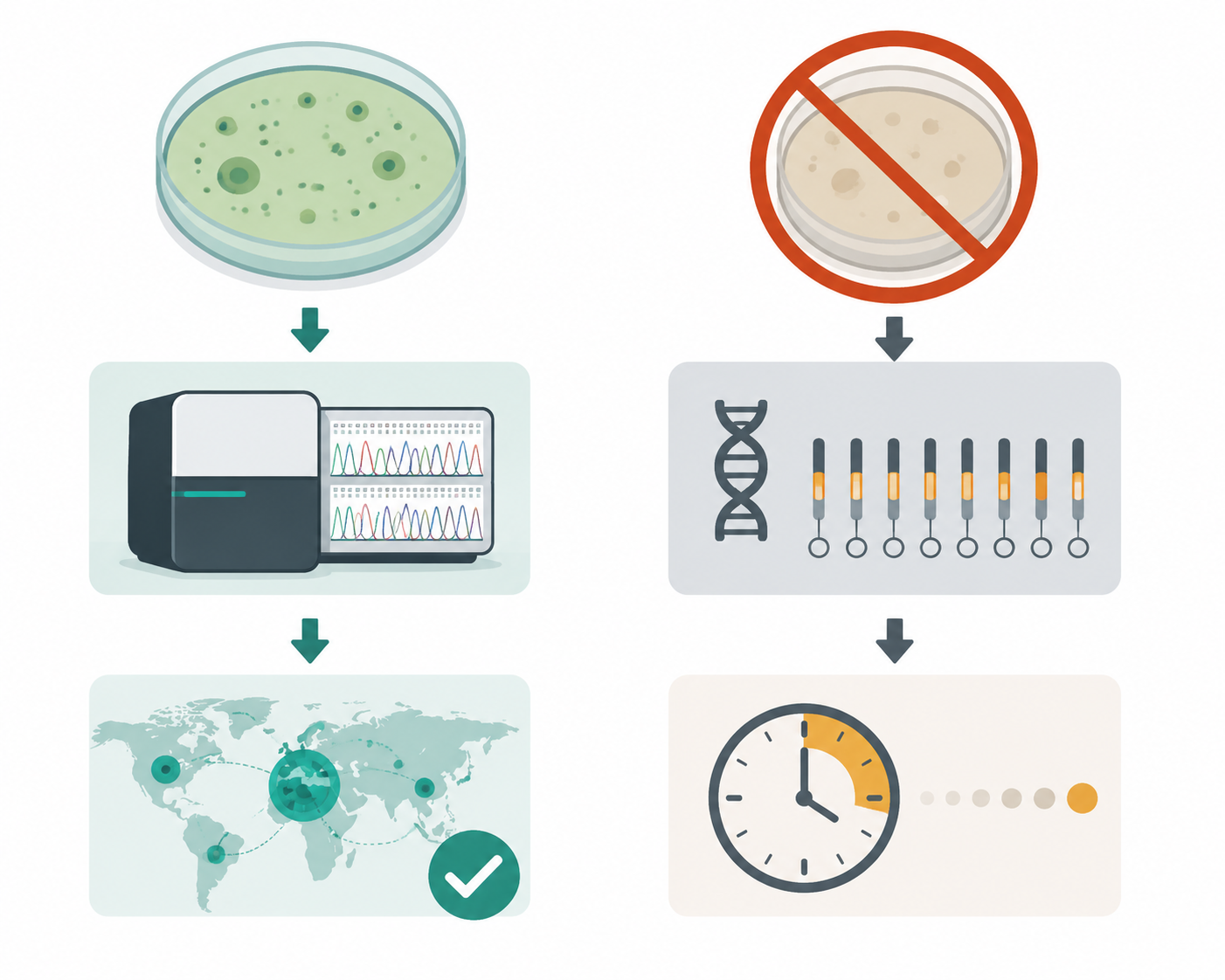
That distinction matters because public timelines often treat detection as a communications problem: why was the source not announced earlier, why did the agency not name the product sooner, why were additional cases still being reviewed? Those are legitimate accountability questions. But in Cyclospora, some of the delay is baked into what can be measured. The parasite is present in specimens and on produce in ways that are harder to enrich, harder to compare, and harder to interpret than a cultured bacterial isolate.
What investigators have instead: CYCLONE
CDC’s main genotyping tool for Cyclospora is CYCLONE, a targeted system built for an organism that cannot be handled like Salmonella in PulseNet. Experts quoted by CIDRAP described CYCLONE as using eight genotyping markers, with a reporting lag of roughly six weeks.[3] That single sentence explains more about the 2026 investigation than most speculation about institutional sluggishness.
Eight markers can help identify relatedness, but they are not a whole genome. They provide a partial view, not a high-resolution map. When bacterial whole-genome sequencing separates cases into tight clusters, investigators can often distinguish one contamination event from another with increasing precision. With Cyclospora, the available genotyping is more limited. Similar marker patterns may suggest a connection, but they do not carry the same discriminating power as a full bacterial genome comparison.
The lag also changes the practical rhythm of an outbreak response. A six-week genotyping delay means that interviews, food histories, purchase records, restaurant supply chains, and produce traceback may be moving while molecular confirmation trails behind. By the time a genotype result helps sort cases, patients may have recovered, menus may have changed, lettuce lots may have moved through distribution, and the public may already be demanding a definitive source.
None of this makes CYCLONE unimportant. It is precisely the kind of tool public health needs for a parasite that cannot be cultured. But it should not be mistaken for the bacterial surveillance infrastructure it partly substitutes for. A partial genotyping system with a long reporting interval is useful evidence. It is not the same as rapid, national, high-resolution whole-genome clustering.
This is also where AI and machine-learning expectations need restraint. Pattern-finding tools can assist outbreak workflows when the underlying data are timely, comparable, and dense. The difference between PulseNet-style bacterial WGS and CYCLONE-style Cyclospora genotyping is one reason methods that look promising in the standard gastrointestinal outbreak protocol do not automatically translate to this parasite; the input data are thinner and slower. That distinction matters for any attempt to apply computational tools to CDC’s GI outbreak protocol.
The source can be plausible before it is scientifically neat
FDA’s July 17 traceback finding was operationally important. It connected illnesses in a five-state investigation to iceberg lettuce used by Taco Bell and supplied by a single Mexican source, prompting the Taylor Farms de Mexico voluntary recall.[2] If contaminated product is still in the distribution chain, that kind of action can reduce exposure even before every molecular question is resolved.
But traceback is not the same as a complete scientific reconstruction. It depends on where sick people ate, what they remember, what records exist, how ingredients moved, how lots were commingled, and whether produce samples are available and testable. In a bacterial outbreak, genomics may help decide whether a traceback lead is likely to be the outbreak source or only a coincidental common exposure. In Cyclospora, investigators may have to work longer with less molecular separation.
The uncertainty is uncomfortable because the exposure is ordinary. Lettuce is not a niche product. It moves quickly, crosses state lines, appears in meals where consumers do not always notice it, and may be mixed with other ingredients. A source announcement therefore carries public weight. It can affect restaurants, suppliers, farms, import channels, and consumers who want a simple answer about whether their next salad is safe.
The better reading of the July 17 recall is narrower: investigators had enough traceback evidence to support a public-health action in the five-state iceberg lettuce investigation. That does not mean the wider 2026 case burden across 34 states had been fully explained, nor that Cyclospora traceback had suddenly reached bacterial-level resolution.[1][2]
A parasite that turned out not to be one thing
The laboratory gap became more complicated when CDC’s Advanced Molecular Detection program reported that what had been treated as Cyclospora cayetanensis included at least three species: C. cayetanensis, C. ashfordi, and C. henanensis. CDC described those species as having different geographic distributions and seasonality.[5]
That finding should be handled carefully. It is not a ready-made explanation for the 2026 lettuce traceback. It does not, on its own, say which species caused which cases in the current outbreak or prove a particular geographic origin. Its importance is more basic: the organism under investigation has hidden diversity that older detection frameworks did not fully resolve.
For epidemiologists, hidden diversity is not an academic inconvenience. If related parasites differ by geography and seasonality, then a signal that looks like one broad Cyclospora pattern may actually contain biologically meaningful subdivisions. Conversely, without high-resolution routine tools, investigators may see cases grouped under the same diagnostic label while missing distinctions that could matter for traceback.
This is the kind of discovery that improves the questions before it improves the answer. It tells laboratories and outbreak teams that they may need more refined assays, better reference data, and more experience interpreting species-level patterns. It does not eliminate the immediate problem of investigating live outbreaks with limited operational tools.
The newer sequencing work is real progress, not a finished system
The most promising technical movement is targeted sequencing designed around Cyclospora’s constraints. A 2023 FDA/CDC targeted amplicon sequencing assay for Cyclospora genotyping was developed to work with fresh produce and clinical samples, targeting 52 loci with 396 SNP sites.[6] Compared with an eight-marker framework, that is a meaningful increase in genomic information.
| Tool or constraint | What it changes | What it does not yet solve |
|---|---|---|
| Culture-based bacterial WGS | Can generate high-resolution genome comparisons when organisms are grown and sequenced | Does not apply cleanly to Cyclospora because routine culture is unavailable |
| CYCLONE | Provides targeted Cyclospora genotyping from a limited marker set | Uses eight markers and has a roughly six-week reporting lag |
| Targeted amplicon sequencing | Expands genotyping targets to 52 loci and 396 SNP sites in the 2023 assay | Should not be treated as deployed at national outbreak scale |
| Species-level discovery | Shows Cyclospora includes at least three species with different geographic and seasonal patterns | Does not by itself identify the 2026 source |
The temptation is to describe that assay as the long-awaited replacement for bacterial WGS. That would overstate the evidence. The assay shows that higher-resolution Cyclospora genotyping is technically possible and that both produce and clinical samples can be targets for improved methods.[6] It does not mean public-health laboratories already have a fast, standardized, nationally scaled system that functions like PulseNet for Salmonella.
Operational scale is its own scientific fact. A method in the literature must still be validated across sample types, integrated into laboratory workflows, interpreted consistently, connected to reference datasets, and returned quickly enough to affect decisions. For a perishable food outbreak, a beautiful result that arrives after distribution has shifted may still help explain what happened, but it may not prevent the next exposure.
Why sanitation and sampling do not close the gap
Cyclospora’s biology also weakens the comfort usually taken from downstream controls. FDA states that chemically disinfecting or sanitizing produce might not fully eliminate Cyclospora.[4] That does not make sanitation irrelevant. It means sanitation cannot be treated as a guaranteed reset button once contamination has occurred.
Produce investigations also depend on finding the organism in the right place at the right time. A contaminated lot may be gone by the time an investigation matures. Environmental sampling may miss intermittent contamination. Clinical samples may be available from some patients but not others. And because the organism cannot be cultured, a weak positive sample cannot simply be expanded into abundant material for deeper comparison.
This is why case counts can climb faster than certainty. Each new report adds urgency, but it does not necessarily add the specific sample, exposure record, or genotype needed to separate one source from another. The public sees accumulation. Investigators need resolution.
Capacity still matters, but it is not the whole explanation
It would be too tidy to say the 2026 delay was only biology. Surveillance choices, staffing, laboratory capacity, and interagency coordination shape how fast specimens move and how quickly interviews, records, and traceback analyses come together. A difficult organism becomes harder when the public-health system has fewer people, thinner surveillance, or less slack.
But it would be just as misleading to flatten the investigation into a generic story of bureaucracy. Even a fully staffed response would still be working against a parasite without a culture system, without an animal model, without routine whole-genome sequencing, and with a genotyping system that has lower resolution and a long lag.[3][4] Administrative capacity determines how well the available tools are used. It does not conjure tools that do not yet exist.
That distinction matters for accountability. If the lesson is only “move faster,” the next outbreak will run into the same wall. If the lesson includes method development, reference data, sample-sharing, field validation, and routine implementation of higher-resolution Cyclospora tools, then the response system has a chance to change what it can know in real time.
What the 2026 recall can and cannot tell us
The Taylor Farms de Mexico recall was a public-health action, not a final scientific settlement. It matters because removing implicated iceberg lettuce can reduce exposure in the restaurants and supply chain covered by the investigation.[2] It should not be stretched into proof that every 2026 domestically acquired case had the same source, especially while thousands of additional cases were still under review and the outbreak was ongoing as of July 18.[1]
Cyclospora punishes borrowed assumptions. The public has learned, reasonably, to expect genomic clustering from foodborne investigations. That expectation came from organisms that can be cultured and sequenced at high resolution. Cyclospora sits in a different technical category. It can be detected, investigated, and sometimes traced, but the route is narrower, slower, and less discriminating.
The deeper lesson of the 2026 outbreak is therefore not that source tracing failed because no one cared enough, nor that the recall solved the scientific problem once and for all. It is that public-health response is being asked to deliver bacterial-speed answers for a parasite whose core investigative tools remain underdeveloped. Until culture, genomic resolution, and operational turnaround improve, Cyclospora traceback will continue to live in the gap between the urgency of exposure and the slower pace of evidence.
References
- Transcript - Update on CDC's Cyclosporiasis Response – 7/14/26 — CDC Newsroom, July 14, 2026.
- Investigation of 5-State Outbreak of Cyclospora Illnesses: Iceberg Lettuce (July 2026) — FDA.
- What we truly know about the huge US Cyclospora outbreak—and what we don't — CIDRAP.
- Cyclospora Prevention, Response and Research Action Plan — FDA.
- Three of a Kind: CDC Researchers Find Cyclospora is Not Just a Single Species — CDC Advanced Molecular Detection.
- Development of a targeted amplicon sequencing method for genotyping Cyclospora cayetanensis from fresh produce and clinical samples — Frontiers in Microbiology, 2023.
Comments
Join the discussion with an anonymous comment.