
The Accuracy Paradox: High AUCs, Low Clinical Utility
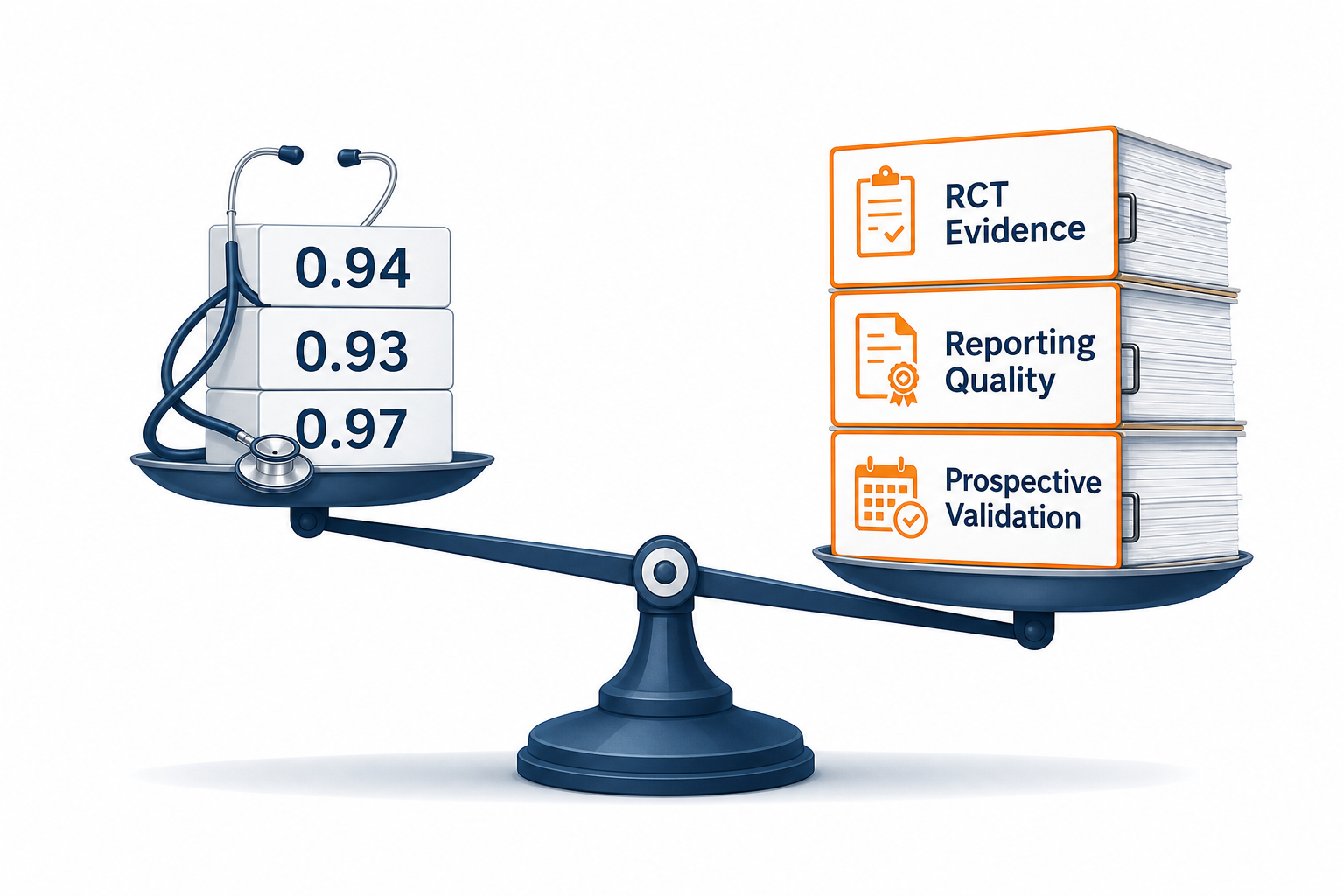
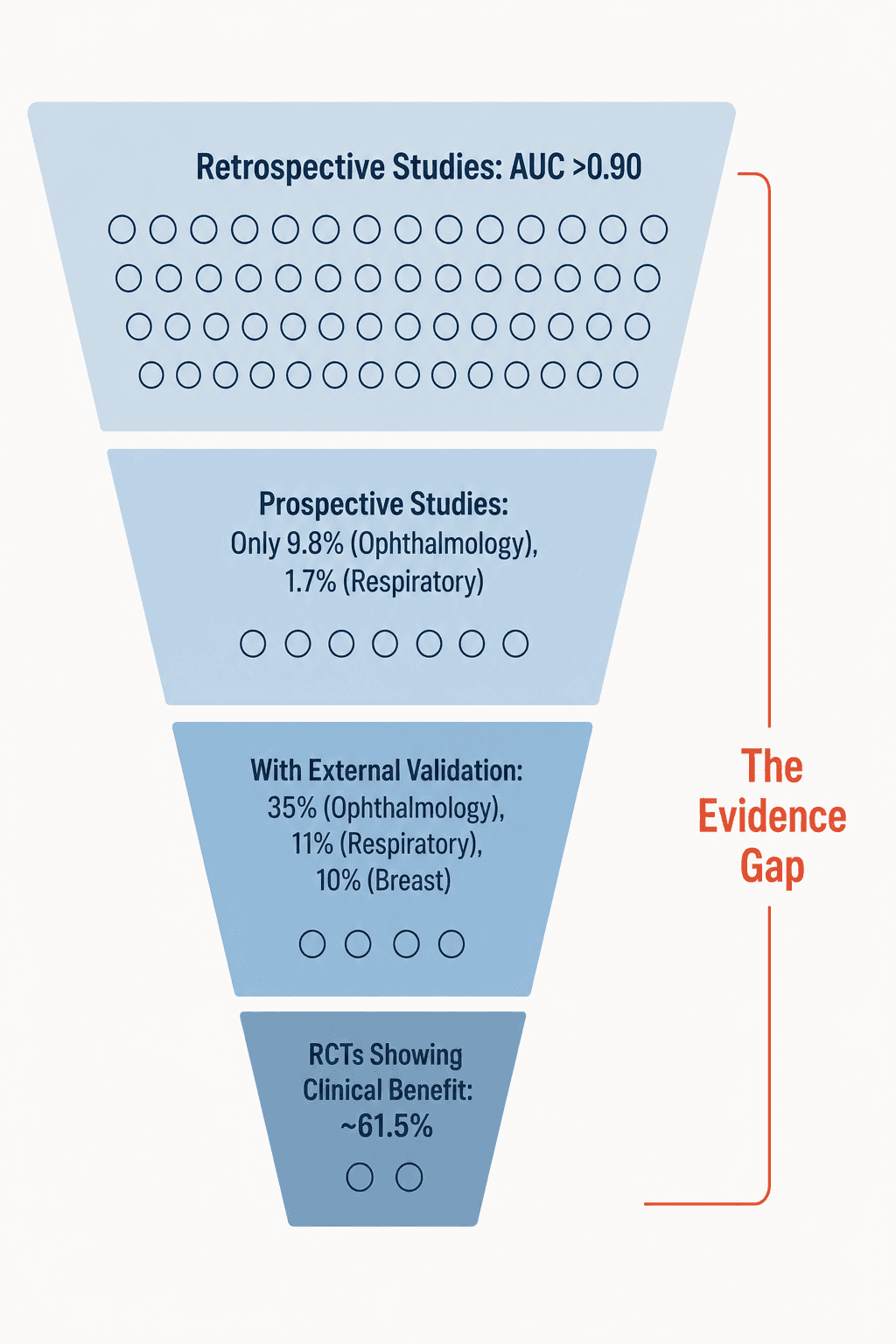
A deep learning model for detecting diabetic retinopathy on fundus photographs reports a pooled area under the curve (AUC) of 0.939. A model for age-related macular degeneration reaches 0.963. For glaucoma, the figure is 0.933. These numbers, drawn from a 2021 systematic review of 503 studies in npj Digital Medicine, represent the kind of headline performance that drives excitement around machine learning in medical diagnosis. Yet when these same tools are tested in randomized controlled trials, the picture shifts dramatically.
The cautionary example of IBM Watson for Oncology remains instructive. Despite substantial investment and high-profile hospital partnerships, the system failed to demonstrate clinical benefit in multiple evaluations and was eventually shuttered. Its trajectory illustrates a pattern that persists across diagnostic AI: strong retrospective performance does not translate into improved patient outcomes in prospective settings.
A 2021 review of 65 randomized controlled trials of AI prediction tools found that 38.5% (25 of 65) showed no statistically significant benefit over standard care. This finding is not an outlier. It is the central challenge of the field: the gap between what models achieve in controlled, retrospective datasets and what they deliver in real clinical workflows.
This article examines the translational evidence gap in ML diagnostics. It draws on three major systematic reviews — covering diagnostic accuracy studies, randomized controlled trials, and reporting quality — to identify where the evidence chain breaks and what standards should be met before clinical deployment.
What Goes Wrong: Common Study Design Deficiencies
The impressive AUCs reported in diagnostic accuracy studies are often artifacts of study design rather than genuine measures of clinical performance. The Aggarwal et al. meta-analysis, which included 279 studies across ophthalmology, respiratory medicine, and breast imaging, documented a consistent pattern of methodological weaknesses that inflate reported accuracy.
| Methodological Issue | Ophthalmology (82 studies) | Respiratory (115 studies) | Breast Imaging (82 studies) |
|---|---|---|---|
| Prospective data collection | 9.8% (8 studies) | 1.7% (2 studies) | 0% |
| External validation performed | 35% (29 studies) | 11% (13 studies) | 10% (8 studies) |
| Pre-specified sample size calculation | 0% | 0% | 0% |
| High/unclear risk of bias in patient selection (QUADAS-2) | 72% | 77% | 76% |
| Reference standard applicability concerns (QUADAS-2) | 73% | 90% | 95% |
The absence of prospective data collection is particularly striking. In ophthalmology, where models achieved some of the highest AUCs (0.933–1.00), fewer than one in ten studies used prospectively collected data. In respiratory imaging, the figure was below 2%. In breast imaging, not a single study among the 82 meta-analyzed was prospective.
External validation — testing a model on data from a different institution, population, or device — was performed in only a minority of studies across all three specialties. Without external validation, models may simply be memorizing dataset-specific noise rather than learning generalizable diagnostic features. The heterogeneity across pooled metrics was extremely high (I² > 95% for many analyses), further suggesting that reported performance is heavily context-dependent.
Perhaps most concerning: no study in any of the three specialties provided a pre-specified sample size calculation. This means that studies may have been underpowered to detect meaningful differences, or conversely, that small, non-representative samples produced inflated accuracy estimates that would not hold in larger, more diverse populations.
Evidence from Randomized Controlled Trials: The 38.5% That Showed No Benefit
If diagnostic accuracy studies represent the promise of ML diagnostics, randomized controlled trials represent the proof. The Zhou et al. systematic review of 65 RCTs published between 2010 and October 2020 provides the most comprehensive assessment of whether ML prediction tools actually improve clinical outcomes.
The headline finding is sobering: 38.5% of trials found no statistically significant benefit over standard care. But the more revealing finding emerges when trials are stratified by risk of bias.
| Trial Type | All Trials | Low-Bias Trials | High-Bias Trials |
|---|---|---|---|
| Traditional statistical methods | 51.4% positive | 63% positive | 44% positive |
| Machine learning | 70.6% positive | 25% positive | 100% positive |
| Deep learning | 81.8% positive | 80% positive | 100% positive |
The pattern is striking. In high-bias trials, both ML and DL methods showed 100% positive rates — every trial reported a benefit. But in low-bias trials — those with adequate randomization, blinding, and outcome assessment — ML's positive rate dropped to 25%, while traditional statistical methods actually improved to 63%. Deep learning maintained an 80% positive rate even in low-bias trials, but the number of such trials was small.
This bias-dependent performance has direct implications for procurement decisions. A hospital evaluating an ML diagnostic tool based on published RCTs must ask not just whether trials exist, but whether those trials had low risk of bias. The Zhou et al. review found that only 26.2% (17 of 65) of trials had overall low risk of bias. Only 4 of 65 trials were double-blinded. Nearly three-quarters did not reference the CONSORT reporting standard, and 60.3% did not use or mention intention-to-treat analysis.
Reporting Failures: CONSORT-AI Adherence Gaps
Even when RCTs are conducted, the quality of reporting often prevents readers from assessing the validity and reproducibility of the findings. The Shahzad et al. review evaluated 42 AI RCTs against the 43-item CONSORT-AI checklist, an extension of the CONSORT 2010 statement designed specifically for AI interventions.
The results reveal systematic omissions in how AI trials are reported:
- 19% of studies (8 of 42) did not report more than 50% of CONSORT-AI items
- 64% (27 of 42) did not mention the AI algorithm version used
- Only 35% (15 of 42) identified inclusion and exclusion criteria at the input data level
- Only 14% (6 of 42) reported how poor quality or unavailable input data was handled
- Harms were fully reported in only 4 of 42 studies
The failure to report algorithm version is particularly problematic for clinical reproducibility. ML models are not static artifacts — they are updated, retrained, and deployed in different configurations. Without version identification, a clinician reading a 2022 trial has no way of knowing whether the model evaluated is the same as the one currently available for deployment.
The median number of fully reported CONSORT-AI items across all 42 studies was 30 out of 43, with a range of 7 to 37. Only 2 of the 43 items were fully reported in all studies. For readers who need the full checklist, the CONSORT-AI reporting standard glossary entry provides a detailed breakdown of each item and its clinical relevance.
The Regulatory Landscape: What FDA Authorizations Reveal
The U.S. Food and Drug Administration has authorized 736 unique AI/ML-enabled medical devices as of September 2024, according to the Singh et al. taxonomy analysis published in npj Digital Medicine in 2025. The distribution of these devices reveals important patterns about where AI is being deployed and where the evidence gaps are most acute.
| Characteristic | Proportion |
|---|---|
| Image-based devices | 84.4% (621 of 736) |
| Signal-based devices | 14.5% (107 of 736) |
| Omics-based devices | 0.7% (5 of 736) |
| EHR tabular data devices | 0.4% (3 of 736) |
| Patient assessment function | 84.1% |
| Intervention function | 15.9% |
| AI function: analysis | 85.6% |
| AI function: data generation | 11.3% |
| AI function: both | 3.1% |
The dominance of image-based devices (84.4%) aligns with the diagnostic accuracy literature, where imaging studies also predominate. The most common AI analysis subclass is quantification and feature localization (58% of all devices), followed by triage (11.4%) and image enhancement (11.4%). Notably, no large language model-based devices were identified in the FDA authorization database as of September 2024.
A critical trend is the increasing proportion of device updates: 34% of authorizations between 2022 and 2024 were updates of existing devices, compared to only 14% between 2017 and 2019. This reflects the iterative nature of AI software, but also raises questions about how clinical validation is maintained across versions. The proportion of new image-based devices peaked at 94% in 2021 and declined to 81% in 2024, suggesting gradual diversification into non-imaging applications.
It is essential to note that FDA clearance does not equate to proven clinical efficacy. Most AI devices enter the market through the 510(k) pathway, which requires demonstration of substantial equivalence to a predicate device rather than independent clinical evidence of improved patient outcomes. The FDA's January 2025 draft guidance on AI-enabled device software functions proposes nine documentation requirements that would strengthen premarket review, but these remain in draft form as of mid-2026.
Bridging the Evidence Gap: A Path Forward
The evidence gap between high retrospective AUCs and clinical readiness is not inevitable. It is the result of specific, addressable weaknesses in how ML diagnostic tools are developed, evaluated, and reported. Closing this gap requires a set of evidence standards that should be met before clinical adoption.
- Prospective data collection must become the norm, not the exception. The current rates — 9.8% in ophthalmology, 1.7% in respiratory, 0% in breast imaging — are indefensible for a field seeking clinical credibility.
- External validation on diverse, multi-institutional populations is essential. Models that perform well on a single institution's data cannot be assumed to generalize.
- Pre-registered RCTs with low risk of bias should be required before deployment for high-stakes diagnostic decisions. The finding that ML's positive rate drops to 25% in low-bias trials is a signal that cannot be ignored.
- Full CONSORT-AI reporting must be enforced by journals and expected by readers. The current state — 19% of studies failing to report half the checklist — undermines the entire evidence base.
- Algorithm versioning and input data quality handling must be transparently documented. Without this, clinical reproducibility is impossible.
- Regulatory frameworks should require progressively stronger evidence as devices move from triage and notification functions to autonomous diagnostic decision-making.
These standards are not theoretical. They are drawn directly from the methodological deficiencies documented in the systematic reviews cited throughout this article. The tools to meet them — prospective study designs, external validation datasets, CONSORT-AI checklists, pre-registration platforms — already exist. What has been missing is the collective expectation that they be used.
For clinicians and procurement decision-makers evaluating ML diagnostic tools, the practical implication is clear: published AUCs are a starting point, not an endpoint. The relevant questions are whether the model has been prospectively validated on a population similar to your own, whether the supporting RCTs had low risk of bias, and whether the reporting is complete enough to assess reproducibility. The broader industry evidence assessment on ClinicalMind provides additional context on how these evidence standards fit into the larger landscape of healthcare AI evaluation.
The accuracy paradox is not a reason to abandon ML diagnostics. It is a reason to demand better evidence. The technology has genuine potential, but that potential will remain unrealized if the field continues to accept high AUCs as sufficient proof of clinical readiness.
Comments
Join the discussion with an anonymous comment.