
The cleanest answer to “How many U.S. doctors use artificial intelligence?” is also the least useful one: it depends what the survey means by use. In 2026, the AMA reported that 81% of physicians use AI professionally, up from 38% in 2023.[1] Doximity, surveying 3,151 physicians, found that 54% currently use AI and 63% have used AI in practice.[2] Offcall, in a survey of more than 1,000 physicians, reported that 67% use AI daily.[3]
Those numbers are not interchangeable, but they point in the same direction. Artificial intelligence for doctors is no longer a side topic confined to innovation committees or a few early adopters. It is already part of ordinary clinical work for a large share of physicians. The harder question is what kind of work physicians are actually handing to AI, and whether health systems are governing that work as carefully as clinicians are adopting it.

Why the adoption numbers look different
The AMA’s 81% figure is the broadest benchmark because it asks about professional use. That can include a wide range of tasks: drafting patient messages, summarizing information, using AI-enabled search, or working inside an institutionally deployed tool.[1] Doximity’s 54% current-use figure is narrower, and its 63% “have used AI in practice” figure sits between current routine use and any exposure.[2] Offcall’s 67% daily-use number measures intensity among physicians reporting real-world tool use rather than a general professional-use category.[3]
For a department chair or CMIO, the practical interpretation is not that one survey is right and the others are wrong. It is that “AI adoption” has become too blunt a phrase. A physician who uses an AI literature tool twice a week, a family physician dictating into an ambient scribe all afternoon, and a specialist receiving an AI-generated chart summary before a consult may all count as AI users. Their risk profiles, training needs, and downstream effects are different.
That distinction matters because self-reported adoption is not the same as measured benefit. The major surveys tell us what physicians say they are using and what they perceive it does for their work. They do not, by themselves, prove better diagnostic accuracy, safer prescribing, shorter hospital stays, or improved long-term outcomes. That evidence gap is the reason adoption data should be read alongside clinical validation work, not treated as a substitute for it; we have discussed that broader problem in the evidence base for AI in medicine.
| Survey | What it measured | Key adoption finding | How to read it |
|---|---|---|---|
| AMA 2026 survey | Professional AI use among physicians | 81% report using AI professionally; 38% did so in 2023 | Broadest benchmark for professional exposure and use |
| Doximity 2026 report | Current AI use and use in practice among 3,151 physicians | 54% currently use AI; 63% have used AI in practice | Useful for specialty, age, use-case, and perceived-benefit patterns |
| Offcall physician survey | Daily AI tool use among more than 1,000 physicians across 106 specialties | 67% use AI daily | Useful for intensity of use and tool-level behavior |
Doctors are using AI where the clinic day hurts
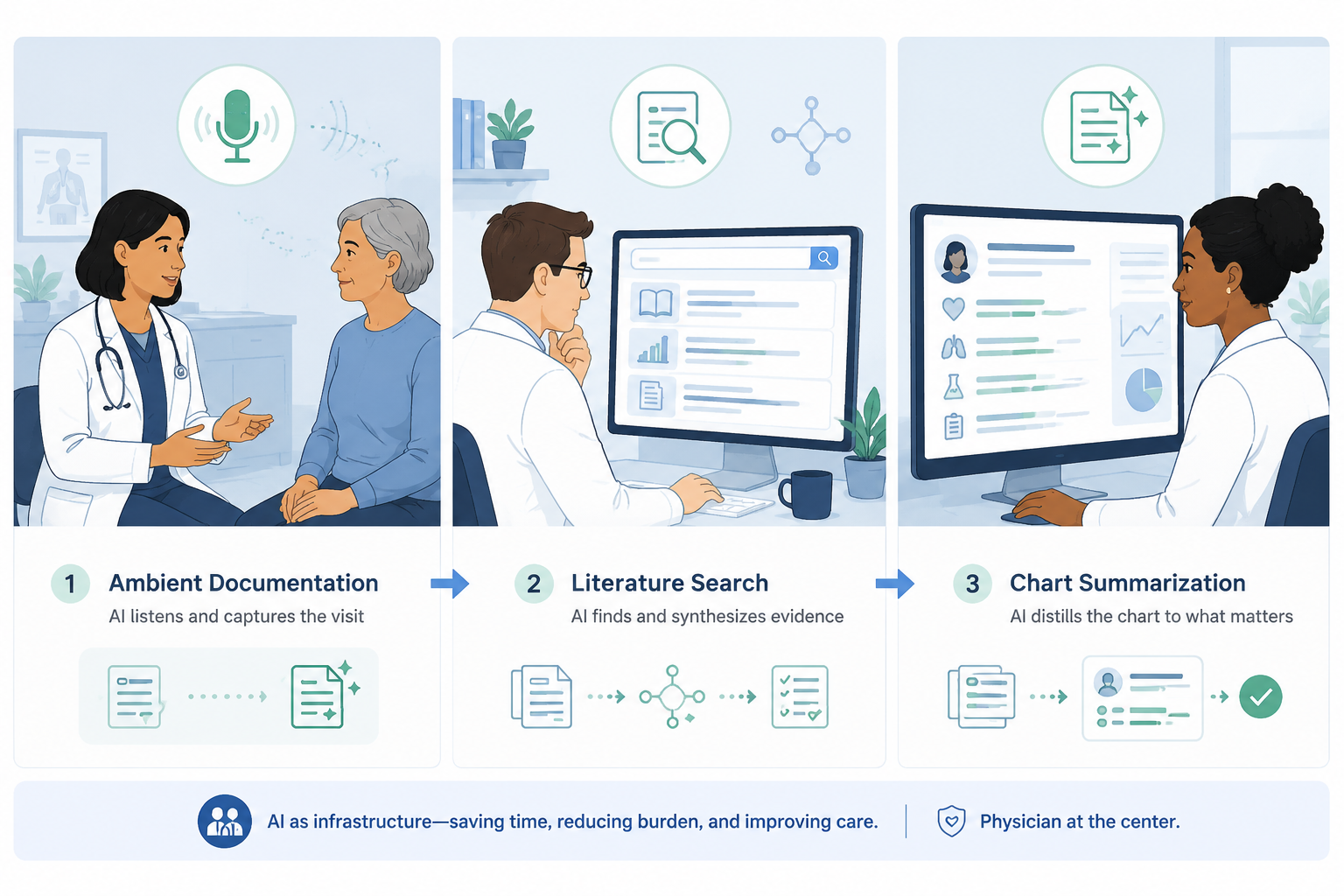
The dominant pattern is not physicians asking AI to replace clinical judgment. It is physicians using AI around the work that surrounds clinical judgment: finding literature, closing notes, digesting charts, and reducing the cognitive drag of administrative residue.
Across the survey findings, the leading use cases are literature search, reported in the 35% to 39% range; ambient documentation, at 29%; and chart summaries, at 28%.[2] These are not glamorous use cases, which is partly why they are important. They live in the time between patients, the hour after the last visit, the pre-charting block that disappears when the schedule runs late, and the message thread that requires a clinician to reconstruct context from scattered data.
Literature search is a clinical workflow tool, not just a research convenience
Literature search deserves more attention than it usually gets in AI discussions. A clinician using AI to find or synthesize medical literature is not necessarily delegating a decision. More often, they are trying to shorten the path from a clinical question to a usable answer: a new drug interaction concern, a changing guideline, a rare adverse effect, or a patient question that deserves more than a generic reassurance.
That does not make the task risk-free. Search and summarization tools can omit context, elevate weak evidence, or produce a confident synthesis from an incomplete retrieval set. But the physician behavior is understandable. If a tool reduces the time between uncertainty and a defensible next step, doctors will try it. The governance question is whether organizations can help clinicians distinguish retrieval, summarization, and recommendation before all three are collapsed under the same “AI search” label.
Ambient documentation has the clearest clinic-day logic
Ambient documentation is the AI use case that most directly maps onto physician pain. The work is concrete: capture the encounter, draft a note, preserve the clinical narrative, and reduce the amount of evening cleanup. It also has obvious failure modes. A bad summary can misstate the plan, omit a negative, or create a note that looks polished but still needs careful physician review.
Still, this is where enthusiasm from practicing clinicians is easiest to understand. Documentation burden is not an abstract productivity metric; it changes how the visit feels and how the day ends. Doximity found ambient documentation among the leading physician AI use cases at 29%.[2] In a separate study reported by Yale and published in JAMA Network Open, use of AI scribes among 263 clinicians across six health systems was associated with 74% lower odds of burnout.[4]
That burnout finding should not be stretched into a claim that every AI scribe implementation will improve clinician well-being. It is study-specific, and the effect of any scribe tool depends on specialty, visit type, EHR integration, review burden, consent workflow, and local expectations for note quality. But it is more clinically meaningful than a generic “saves time” claim because it connects a defined tool category to a clinician-centered outcome.
For readers looking specifically at this category, the evidence issues around ambient tools are covered in more depth in our analysis of ambient intelligence in healthcare.
Chart summarization is where convenience and liability meet
Chart summarization, reported by 28% of physicians in Doximity’s survey, sits in a different part of the workflow.[2] It is pre-visit infrastructure. The physician is not asking AI to write the final assessment; they are asking it to reduce the time required to understand what happened before they walked into the room.
This is especially valuable when the chart is long, fragmented, or full of copied-forward material. It can also move risk upstream. If a summary misses a discontinued medication, a prior imaging result, or the reason a consultant changed the plan, the physician may enter the visit with a false sense of orientation. That is why chart summaries should be treated as navigational aids, not authoritative clinical histories.
Specialty patterns show adoption is not one physician behavior
The specialty breakdown is one of the most useful parts of the Doximity report because it prevents a single national adoption number from doing too much work. Current AI use was highest in neurology at 64%, followed by gastroenterology at 61%, internal medicine at 60%, and family medicine at 58%.[2] Those differences are not enormous, but they are large enough to remind health systems that AI uptake will not look identical across service lines.
Neurology and internal medicine both involve dense longitudinal information and frequent synthesis across notes, medications, imaging, labs, and prior evaluations. Gastroenterology has procedure documentation, referral review, and chronic disease follow-up. Family medicine carries broad undifferentiated demand, inbox load, prevention, chronic disease management, and documentation volume. It is not surprising that tools promising summarization or note relief would find traction there.
Offcall’s daily-use finding adds another layer: among adopters, daily use intensity was highest in family medicine, at 88%.[3] That number is not the same as saying 88% of all family physicians use AI daily. It describes intensity among family medicine adopters. But it fits the lived workflow of primary care, where even modest reductions in note drafting, message composition, or pre-visit review can compound across a full clinic day. For a more specialty-specific view, see our guide to AI in primary care.
Specialty variation should also change how leaders evaluate pilots. A tool that delights a high-volume family medicine clinic may not solve the main problem in procedural subspecialty practice. A summarization workflow that helps neurology prepare for a complex follow-up may have less value in a setting where the primary burden is peri-procedural documentation. Specialty-specific evidence is still uneven, but specialty-specific workflow assessment is already necessary; we discuss that broader evidence map in AI in healthcare by specialty.
This is not just a younger-doctor phenomenon
The age distribution punctures one of the easier assumptions about medical AI adoption. In Doximity’s survey, current use was 60% among physicians ages 35 to 44, 61% among those ages 45 to 54, and 57% among those 55 and older.[2] The differences are small enough that age alone is a poor explanation for adoption.
That matters operationally. Training and governance cannot be designed as if AI users are mostly younger physicians quietly experimenting at the edge of practice. Mid-career and senior physicians are using these tools too, and they often bring a sharper sense of where a workflow has actually improved versus where work has merely shifted to a different person.
Reported benefits are meaningful, but they are not outcome proof
Physicians are reporting benefits that should be taken seriously. In Doximity’s survey, 75% of AI users reported reduced administrative burden, and 69% reported improved patient care or outcomes.[2] Wolters Kluwer’s 2026 Future Ready Healthcare Report also found that physicians’ priorities for future AI use centered on documentation and scribing at 65%, administrative relief at 48%, and clinical decision support at 43%.[5]
Those figures are useful because they show what physicians want AI to do next. Documentation relief leads the list. Administrative relief follows. Clinical decision support is important, but it is not the only priority and it is not the leading one in that set of reported preferences.[5]
The cautious reading is straightforward: perceived benefit is real evidence of clinician experience, not proof of clinical efficacy. A doctor who reports leaving clinic earlier or spending more attention on the patient is describing something that matters. But a survey response that says care improved is not the same as an independently measured improvement in diagnostic accuracy, adverse events, disease control, or mortality. Adoption data can tell health systems where to look; it cannot finish the evaluation.
This distinction is especially important because the most widely adopted uses are workflow uses. They may improve the conditions under which care is delivered before they show up, if they ever do, in hard clinical endpoints. That does not make them trivial. It does mean the evaluation strategy should match the use case: note closure time, pajama time, inbox turnaround, patient face time, correction burden, and clinician burnout may be more appropriate first measures for documentation AI than disease-specific outcomes.
The barrier is not only trust in AI; it is control over AI
Accuracy and reliability remain the leading concern, reported by 71% of physicians across all specialties.[2] That concern should not be dismissed as professional conservatism. In clinical work, a tool can be useful 20 times and still create serious downstream work on the 21st if it fabricates, omits, or overstates something important.
The more revealing governance problem is that adoption is moving faster than institutional control. Doximity reported that 47% of physicians say institutional AI policies are still evolving, while 71% report little influence over institutional AI decisions.[2] At the same time, the survey findings show strong physician preference for peer-driven adoption, with 95% supporting that model.[2]
That combination should make health system leaders uncomfortable. Physicians are already using AI. Many prefer adoption guided by peers. Yet many also feel they have little influence over institutional decisions. This is the recipe for parallel systems: official tools selected through procurement, unofficial tools selected by individual clinicians, and ambiguous accountability when output enters the chart, the inbox, or the patient conversation.
The practical questions are less dramatic than the public debate about AI replacing doctors, but they are more urgent. Who reviews an AI-drafted note before signing? Can an AI-generated chart summary be copied forward? Is patient consent required for ambient capture, and where is that consent documented? Are physicians allowed to use external AI tools for de-identified clinical questions? Who monitors whether a tool reduces physician work by increasing medical assistant, nurse, coder, or patient burden?
These are deployment questions, not just ethics questions. A tool that saves a physician three minutes but creates five minutes of correction work for someone downstream has not improved the system. A tool that drafts a beautiful note but buries uncertainty may make the chart worse. A tool that reduces evening documentation for one specialty may be worth adopting even if it has no role in another. Real clinical deployments tend to look like this: local, uneven, negotiated, and dependent on workflow details, as covered in our review of clinical AI deployment realities.
What the 2026 evidence says
By Q3 2026, the evidence supports a practical middle position. AI use among U.S. physicians is widespread, whether the benchmark is 54% current use, 63% use in practice, 67% daily use in one physician survey, or 81% broad professional use.[1][2][3] It is not marginal, and it is not mainly a story about autonomous diagnosis.
The center of gravity is workflow: literature search, ambient documentation, chart summarization, and administrative relief. Adoption spans age groups and varies by specialty, with especially notable uptake in neurology, gastroenterology, internal medicine, and family medicine.[2] Physicians report less administrative burden and, in some settings, lower burnout odds with AI scribes.[2][4] They also continue to name accuracy and reliability as the leading concern and report limited influence over institutional AI decisions.[2]
That is the state of artificial intelligence for doctors in 2026: already normal in practice, uneven in distribution, more physician-initiated than centrally governed, and concentrated in the unglamorous work that determines whether a clinic day ends on time.
References
- More than 80% of physicians use AI professionally, AMA
- Doximity 2026 State of AI in Medicine Report, Doximity
- The 10 AI Tools Doctors Actually Use Daily, Offcall
- AI Scribes Reduce Physician Burnout, Return Focus to the Patient, Yale School of Medicine
- 2026 Future Ready Healthcare Report, Wolters Kluwer
Comments
Join the discussion with an anonymous comment.