
Patient safety monitoring in mental health facilities usually fails in ordinary ways before it fails dramatically. A risk form is completed on admission and then goes stale. A nurse sees a change in sleep, appetite, agitation, or engagement, but the signal is buried inside a busy handover. A patient’s distress builds across hours, while the ward is still organized around yesterday’s risk category. That is the practical promise behind AI for monitoring patient safety in mental health facilities: not a machine declaring who is dangerous, but a system that notices clinically meaningful change early enough for staff to adjust observation, de-escalation, staffing, or care planning.
The strongest current example is PRIME, the Predictive Risk Identification for Mental Health Events tool. In a retrospective cohort study at Waypoint Centre for Mental Health Care in Ontario, Canada, PRIME was evaluated on data from 4,651 patients, 48,313 encounters, and 2,106 adverse events. It achieved an overall AUC of 0.83. On the same cohort, the Dynamic Appraisal of Situational Aggression-IV, or DASA-IV, achieved an AUC of 0.61.[1]
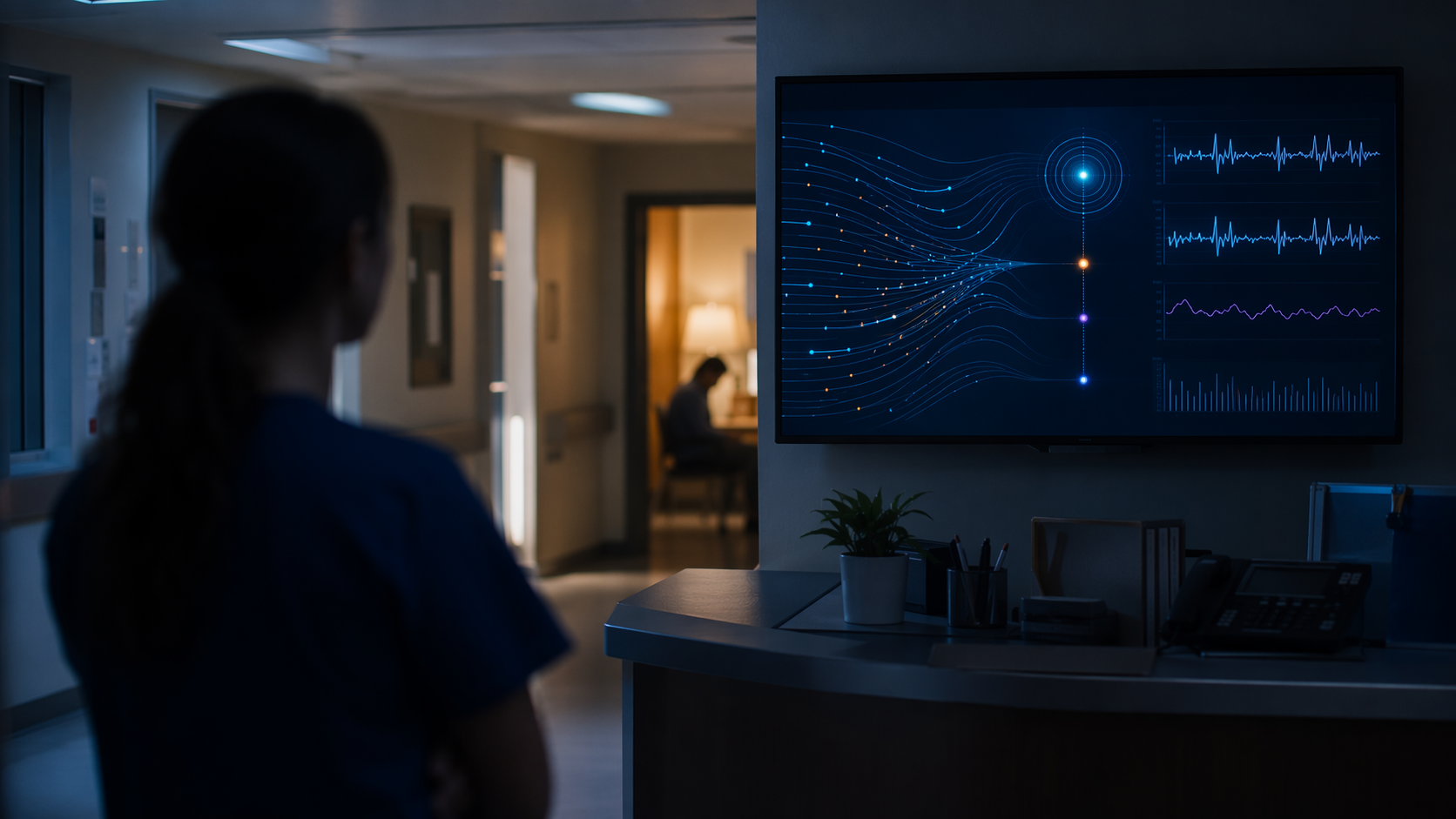
That comparison matters because DASA-IV was not a distant benchmark from a different dataset. PRIME and DASA-IV were assessed on the same cohort, which makes the performance gap harder to dismiss as an artifact of population, setting, or outcome definition. An AUC of 0.83 does not mean the model is correct 83% of the time; it means that, across pairs of encounters where one has an event and one does not, the model is substantially better at ranking the event encounter as higher risk. For a ward team, that distinction matters. Ranking can help prioritize attention, but it still has to be translated into action without overreacting to every alert.
| Approach | Reported AUC on the PRIME evaluation cohort | What the comparison suggests |
|---|---|---|
| PRIME LSTM with attention | 0.83 | Sequence-aware modeling of longitudinal psychiatric EMR data performed best in this study. |
| DASA-IV | 0.61 | The traditional structured aggression-risk tool was substantially less discriminating on the same cohort. |
| LightGBM | 0.51 | A non-sequential machine learning approach did not show comparable performance. |
| Feedforward neural network | 0.52 | A simpler neural network also did not approach PRIME’s performance. |
What PRIME Actually Predicted
The outcome was not a vague label such as “clinical deterioration.” PRIME was designed around adverse events relevant to inpatient psychiatric safety, including events such as self-harm, suicide attempts, violence, aggression, and elopement. These are not interchangeable events clinically, but they share one operational feature: if a warning arrives after the incident, it is documentation, not prevention.
PRIME used longitudinal electronic medical record data and generated predictions over 24-hour rolling windows.[1] That time window is one of the more important design choices. A one-time admission score can be useful, especially for baseline planning, but psychiatric inpatient risk often moves with sleep disruption, medication changes, conflict on the unit, substance withdrawal, accumulating frustration, or a change in privileges or observation level. A rolling window is closer to the rhythm of a ward shift: what has changed, what is building, and what needs attention before the next handover.
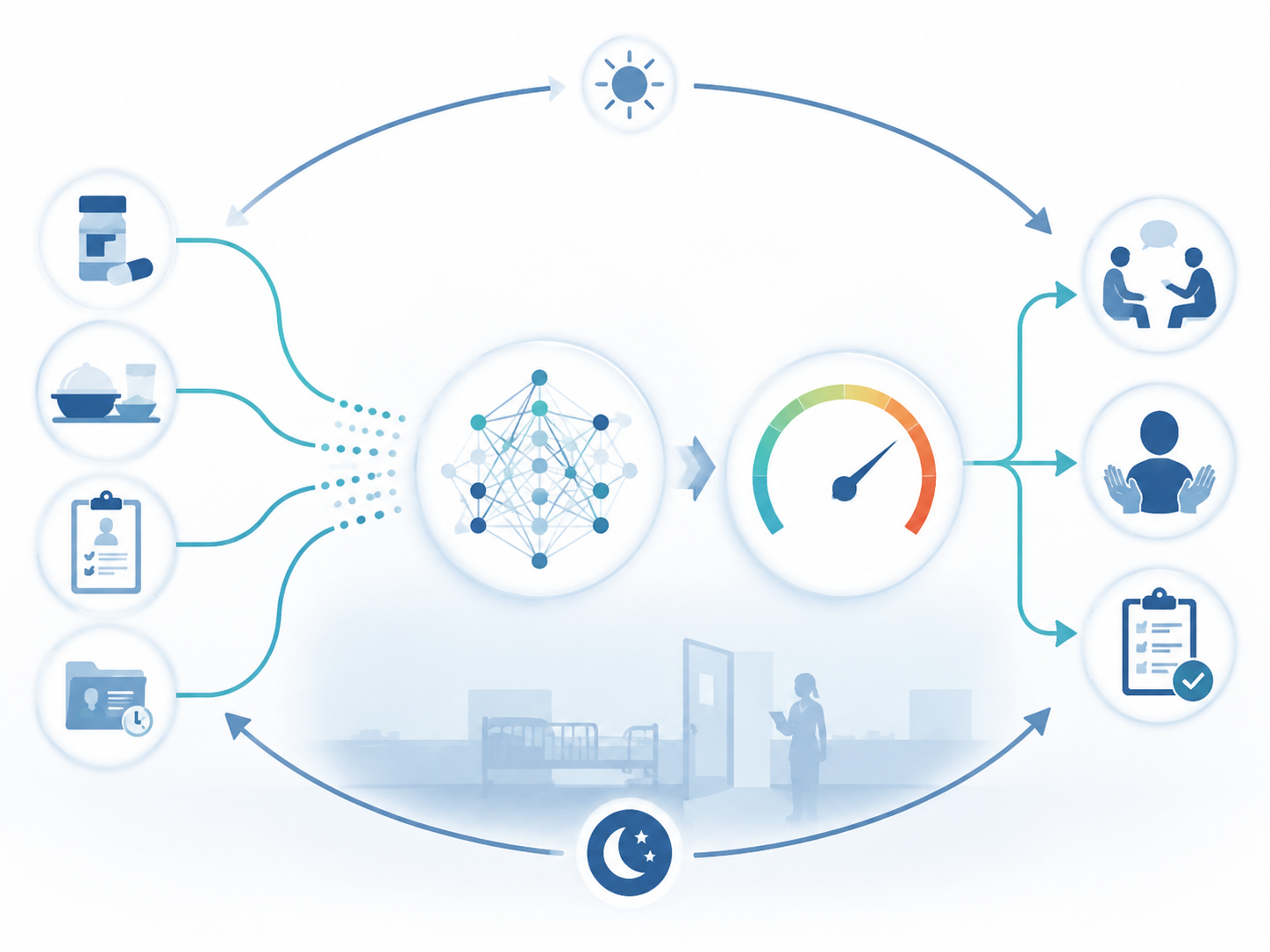
The model architecture was an LSTM with attention mechanisms and an autoregressive design.[1] In plain clinical terms, the system was built to learn from sequences, not just from a pile of static variables. The attention mechanism also matters because staff and governance teams will want some trace of why the model elevated risk, even if attention is not the same thing as a full causal explanation. The reported top predictive features included schizophrenia diagnosis, length of hospital stay, history of past incidents, and meal tolerance as an activity-of-daily-living measure.[1]
Those features are plausible, but plausibility should not make anyone too comfortable. A history of past incidents can be clinically relevant and institutionally contaminated at the same time. Diagnoses can reflect illness burden, documentation practice, referral patterns, and clinician bias. Meal tolerance may be a useful proxy for daily functioning or distress, but it also depends on how consistently staff document it. An early warning system that relies on structured EMR fields inherits the strengths and the distortions of the record.
Why the Architecture Result Is More Than a Technical Detail
The comparison with LightGBM and a feedforward neural network is useful because it narrows the explanation for PRIME’s performance. In the study, LightGBM achieved an AUC of 0.51 and the feedforward neural network achieved 0.52, far below the LSTM-with-attention model’s 0.83.[1] That does not prove that every psychiatric safety model must use an LSTM. It does suggest that, in this dataset and task, the temporal structure of the record carried information that simpler approaches did not capture well.
That finding fits the clinical problem. Inpatient psychiatric risk is often not a single variable crossing a threshold. It can be a sequence: withdrawal from meals, reduced sleep, more frequent redirection, medication refusal, escalating peer conflict, then an incident. A model that can use order and timing may see a pattern that a static score flattens. The question for deployment is whether that pattern is stable enough, fair enough, and interpretable enough to support action outside the original hospital.
This is where accuracy stops being the end of the discussion. A ward does not experience AUC. It experiences alert volume, missed events, handover burden, observation changes, patient conversations, and staff confidence. A high-ranking model can still be unsafe if it produces alerts that are too frequent, too opaque, or too poorly matched to the interventions available on a night shift.
The Same Result Looks Different Once Subgroups Are Visible
The most important limitation in the PRIME study is not hidden in a general warning about bias. Subgroup performance varied. The reported AUC was 0.69 for Black patients and 0.84 for White patients.[1] That gap changes how the headline result should be read. The model did not simply achieve “AUC 0.83” in a way that can be assumed to serve all patients equally.
For patient safety, unequal performance can harm in more than one direction. If the model performs less well for a subgroup, staff may receive false reassurance when risk is actually rising. If calibration or thresholding differs across groups, some patients may receive more false alarms, more restrictive observation, or more frequent labeling as high risk. Both outcomes matter. The first exposes patients and staff to preventable harm; the second turns surveillance into a clinical burden carried unevenly by patients already more vulnerable to institutional coercion.
The study also reported AUC variation across other subgroups, including higher performance for intersex patients, but small or differently represented groups require especially careful interpretation.[1] A subgroup number can be clinically alarming without being fully explanatory. Before any broad rollout, a hospital would need to know whether the performance gap reflects sample size, documentation patterns, event base rates, local practice, structural inequity in care, or model design. The answer changes the mitigation plan.
Treating equity as a deployment detail would be backwards. In an inpatient psychiatric facility, a risk score can influence where someone is observed, how they are spoken to, how much privacy they retain, and how staff interpret ordinary distress. If performance differs by race, that is part of the safety profile of the tool, not an ethical footnote after the technical evaluation.
What a Clinician-in-the-Loop System Would Have to Specify
The phrase “clinician in the loop” is often used as if it solves the implementation problem by naming a person somewhere near the alert. In a psychiatric ward, it has to be more concrete. Who receives the alert: the charge nurse, the primary nurse, the psychiatrist, the crisis response team, or the bed manager? When does it appear: at handover, in real time, once per shift, or only when a threshold changes? What can the recipient do within the next hour? What should never happen automatically?
A usable early warning workflow would need to separate the alert from the intervention. A rising score might trigger review of recent notes, a brief team huddle, medication and observation review, a de-escalation conversation, a check for pain or withdrawal, or reassessment of environmental stressors. It should not automatically mark a patient as violent, increase restrictions without clinical review, or substitute for direct engagement. If the model cannot point staff toward a proportionate next step, it risks becoming another item in the stream of warnings that staff learn to acknowledge and ignore.
- The alert should arrive with enough lead time to change observation, staffing, or care planning.
- The system should show the recent factors contributing to the alert, while making clear that they are not causal proof.
- Thresholds should be reviewed for false positives, false negatives, and subgroup performance before and during deployment.
- Clinical teams should define prohibited automatic actions, especially restrictive interventions based only on model output.
- Alert burden should be monitored as a patient safety issue, not only as a usability complaint.
This level of specificity is not bureaucracy. It is how a promising statistical signal becomes either a safety practice or safety theater.
The Evidence Base Is Active, but Still Narrow
PRIME is not appearing in a vacuum. A scoping review identified 24 studies on the role of artificial intelligence in managing hospitalized patients with mental illness, which suggests that inpatient psychiatric AI is now a real evidence area rather than a speculative side project.[2] That matters because psychiatric inpatient safety has too often been treated as a local operational struggle rather than a field for careful tool development and evaluation.
The pressure is not abstract for staff. The broader literature cited in this area reports that approximately 24% of healthcare workers globally experience physical violence annually, with psychiatric staff at highest risk.[2] That figure should not be used to justify any tool uncritically. It does explain why administrators and clinical leaders are looking for earlier warning systems instead of relying only on post-incident review, restraint audits, or staff injury reports.
Still, the core PRIME evidence is retrospective and single-site.[1] It was developed and evaluated at one psychiatric hospital in Ontario. Other facilities may have different patient populations, staffing models, documentation habits, observation policies, legal frameworks, and adverse-event definitions. A model trained in one setting can lose performance when moved to another, especially when the input data depend on structured EMR fields that are not collected consistently across hospitals.
Hospitals already exploring adjacent AI applications in mental health should keep those boundaries clear. Evidence for inpatient safety prediction is different from evidence for outpatient monitoring, therapy chatbots, or administrative automation. Those topics may overlap technically, but they carry different risks and outcome measures. Readers looking at adjacent use cases can compare this with clinical evidence for AI in remote patient monitoring or AI therapy chatbot evidence, but neither substitutes for prospective evaluation on an inpatient psychiatric ward.
What Prospective Validation Needs to Prove
A prospective study should not merely ask whether PRIME or a similar model maintains an attractive AUC. It should ask whether the system changes care in a measurable and acceptable way. Did staff receive alerts early enough to intervene? Did alerts lead to specific clinical actions? Did adverse events decrease, or did documentation simply improve? Did restrictive interventions increase? Did staff trust the tool appropriately, or did they become dependent on it for reassurance? Did patients experience the system as safer care or as another layer of surveillance?
Prospective validation also has to preserve subgroup analysis as a primary safety concern. A site could improve overall performance while leaving one group with more missed events or another group with more false alarms. That would be an operational success only if the hospital is willing to ignore who bears the cost. Fairness monitoring should include calibration, threshold behavior, alert frequency, downstream interventions, and outcome rates by subgroup.
Integration work is just as important as model development. PRIME depended on longitudinal EMR data and structured clinical inputs.[1] Facilities with fragmented records, inconsistent activity-of-daily-living documentation, weak medication reconciliation, or limited informatics support may not be able to reproduce the necessary data pipeline. Even where the data exist, the model must fit into existing workflows without forcing staff to leave the clinical record, duplicate documentation, or interpret risk scores without context.
Staff adoption cannot be treated as resistance to innovation. Psychiatric nurses, mental health workers, psychiatrists, and allied staff already balance observation levels, therapeutic engagement, legal requirements, and immediate environmental risk. If an AI system adds alerts without clarifying responsibility, it creates new work and new liability. If it helps a team notice a deteriorating pattern and choose a proportionate intervention, it may earn its place.
Readiness Judgment
The PRIME study is strong enough to take seriously. A retrospective psychiatric early warning system using longitudinal EMR data, 24-hour rolling prediction windows, and sequence-aware deep learning outperformed DASA-IV by a wide margin on the same cohort.[1] It also outperformed simpler machine learning and neural network approaches, which strengthens the case that temporal modeling mattered in this setting.[1]
It is not strong enough to justify broad clinical rollout. The evidence is still single-site and retrospective, the system depends on structured EMR data, workflow effects remain unproven, and the Black-versus-White AUC gap is a direct patient safety concern.[1] The right next status for tools like this is serious prospective pilot evaluation with bias mitigation, external validation, EMR integration planning, and explicit rules for clinical response. That is a promising position. It is not yet a deployment verdict.
Comments
Join the discussion with an anonymous comment.