
The most important clinical fact about ai for earthquake early warning and emergency health response is that the earthquake has already started. These systems are not predicting a future quake. They are detecting the first waves of an event in progress, estimating where stronger shaking is headed, and trying to move a warning faster than the damaging waves arrive.
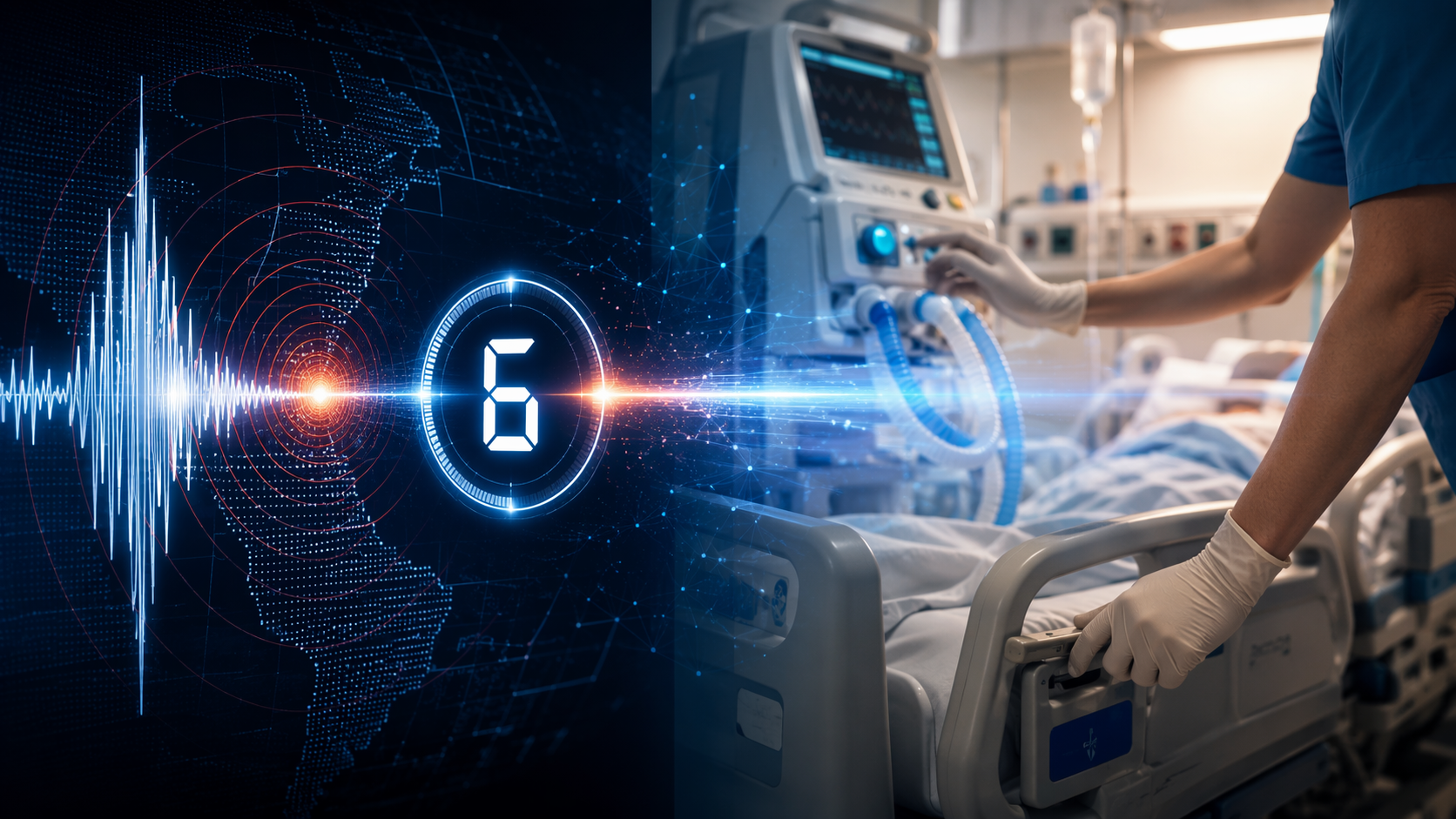
That distinction matters inside a hospital. A warning that arrives 8, 12, or 18 seconds before strong shaking is not a planning memo. It is a small operational interval in which someone may be able to lock a bed, brace a ventilated patient, stop a sterile procedure from becoming a sharps injury, secure an oxygen cylinder, or move away from a glass-fronted cabinet. The clinical value is not in the alert by itself. It is in whether the receiving unit already knows what those seconds are for.
Early warning has moved past the pilot stage
Android Earthquake Alerts is the strongest evidence that earthquake early warning has become a population-scale system rather than a laboratory demonstration. A Science report published in July 2025 described a system that had detected more than 18,000 earthquakes, sent 790 million alerts across 98 countries, and expanded earthquake-alert reach from about 250 million people to 2.5 billion people. In surveys of 1.5 million users, 85% rated the alerts as “very helpful.” The same report gives event-level warning times, including 8.0 seconds for the April 2025 M6.2 earthquake in Turkey and 18.3 seconds for the November 2023 M6.7 earthquake in the Philippines.[1]
In the western United States, ShakeAlert provides another operational anchor. The USGS-backed system is active in California, Oregon, and Washington and sends warnings through channels that include mobile alerts and integrated institutional systems. Its purpose is similarly bounded: detect an earthquake that is already underway and deliver warning before strong shaking arrives where possible.[2]
For clinical leaders, the point is not that every earthquake will produce usable warning time. Near the epicenter, there may be little or none. Alerts can also arrive with uncertainty about expected intensity at a particular facility. But the evidence now supports a practical premise: in some real events, warning is measurable, short, and potentially actionable. That shifts the question from whether an alert can exist to whether hospitals have designed actions that fit the interval.
Seconds are enough only when the task is already assigned
Hospital incident command plans often do well at the minutes-to-hours scale: activate command, assess damage, call in staff, shift capacity, document resource needs. Earthquake early warning lives at a different tempo. It asks whether the ICU, emergency department, operating room, laboratory, neonatal unit, facilities team, and security desk have preselected actions that can be completed before shaking peaks.
A qualitative 2024 hospital-focused discussion summarized by Temblor makes the gap painfully concrete. In one Mexican hospital, an earthquake early warning alert reportedly triggered shouting, but staff did not carry out protective actions. The same article describes the need for unit-specific micro-protocols: ICU teams may need to secure ventilators and bed wheels; neonatal units may need actions for incubators; pathogen laboratories may need procedures to reduce exposure risk; facilities teams may need oxygen tanks and other unsecured equipment addressed before they become hazards.[4]
That is the failure mode that deserves more attention than the novelty of the detection model. A staff member who hears an alarm but has no practiced action loses the only thing the warning system produced: time. In an ICU, “drop, cover, and hold on” may be relevant for an ambulatory clinician but incomplete for a ventilated patient attached to lines, pumps, and gas delivery. In a laboratory, the first protective act may be to stabilize a biological or chemical exposure pathway. In facilities, the right response may be to prevent a mobile tank, cart, or unsecured object from becoming the first injury source.
| Hospital area | What the warning interval can realistically support |
|---|---|
| ICU or high-acuity ward | Lock bed wheels, protect airway equipment, secure ventilator tubing, move away from overhead or glass hazards when possible |
| Emergency department | Stabilize patients on stretchers, protect staff at triage and medication areas, pause nonessential movement through corridors |
| Operating room or procedure suite | Stop a noncritical maneuver, protect the sterile field where feasible, prevent sharps or equipment injury |
| NICU | Secure incubators and nearby equipment, protect staff posture, avoid moving neonates unless a preplanned action requires it |
| Pathogen or hazardous-materials lab | Reduce immediate exposure risk, secure active work surfaces, move away from breakable containers if protocol allows |
| Facilities and security | Secure known mobile hazards, prepare for elevator and utility checks, initiate post-shaking access control |
The table should not be read as a universal protocol. It shows the translation problem. Earthquake early warning gives a facility an interval, not a clinical order set. The hospital has to decide in advance which actions are safe, which are too complex for a seconds-long window, and which staff role owns each action.
The alert-to-hospital pipeline has more than one weak link
A useful earthquake health-response chain has several links: seismic detection, alert delivery, immediate protective action, hospital activation, patient inflow monitoring, triage, resource allocation, and coordination with external responders. AI is strongest at the first link today. It is much less mature as a continuous clinical pipeline.
The first handoff is from a public or institutional alert to a hospital notification pathway. A phone alert may reach individual clinicians, but hospitals also need integration with overhead systems, nurse call workflows, facilities alerts, security desks, and command-center dashboards. If the same warning reaches staff as an undifferentiated alarm, the system has technically succeeded and operationally underperformed.
The second handoff is from immediate protection to activation. Once shaking stops, the questions change. Are elevators functioning? Are oxygen, water, power, and information systems intact? Has the emergency department lost space? Are outpatient areas now sources of walk-in casualties? Are staff injured or trapped? A hospital that treats early warning only as an individual safety message misses its value as the first timestamp in incident command.
The third handoff is from activation to triage and resource allocation. This is where much of the AI-in-disaster literature becomes tempting, and where the evidence needs careful grading. Emergency departments already use AI in other forms of decision support, as discussed in broader work on AI in emergency medicine triage, sepsis prediction, and stroke decision support. Earthquake mass casualty triage is a harsher setting: infrastructure may be damaged, connectivity may be unreliable, patient identity may be uncertain, and the first wave of patients may arrive before a complete command picture exists.
AI triage evidence is promising, but not yet an earthquake response system
Tahernejad and colleagues’ 2024 PRISMA-compliant systematic review is the best starting point for judging the downstream health-response evidence. The review screened 2,630 triage articles and included 19 high-quality studies. It found that AI tools can improve resource management and real-time data transmission, and it reported measurable gains in some triage workflows, including electronic triage processing about three times as many patients as paper-based methods. But the review also identified the barriers that repeatedly determine whether tools leave the demonstration environment: lack of trust, training deficits, equipment shortages, and data privacy concerns. Its search included studies up to September 2024, so it should not be treated as a complete inventory of every newer tool, but it does capture the maturity problem well.[3]
Kim and colleagues provide a more model-specific signal. Their 2018 deep neural network remote triage model reported an AUC of 0.89 for survival prediction and outperformed the Revised Trauma Score benchmark in the studied context.[5] That is a meaningful performance result, but it is not the same as proving that an algorithm can safely direct live earthquake mass casualty triage across damaged hospitals, intermittent communications, and changing resource constraints.
ERTRIAGE sits closer to the operational target many people have in mind: an autonomous, offline-capable AI system used in a simulated coastal earthquake. The system’s site reports that it processed more than 80 patients in the first hour and prioritized cases such as crush injuries and airway obstructions.[6] That is exactly the type of capability a damaged health system would want. It is also vendor-reported simulation evidence, not independent proof of field performance during a real earthquake.
Older earthquake-specific work points to a more modest but clinically relevant use case: helping non-specialists recognize injury patterns that require escalation. Aoki and colleagues analyzed data from 372 patients after the 1995 Kobe earthquake and identified 21 risk factors for crush syndrome that could support triage by non-specialists.[7] The value here is not automation for its own sake. It is the possibility of giving responders a structured way to recognize patients who may deteriorate if crush injury, renal risk, or delayed extrication is missed.
Taken together, the triage evidence supports a narrow conclusion. AI can help structure disaster triage, speed information flow, and potentially improve prioritization under constrained conditions. It does not yet support a confident claim that hospitals can connect an earthquake early warning alert to fully automated patient sorting, bed allocation, and regional transfer decisions. The gap is not just algorithmic. It is procedural, infrastructural, legal, and human.
A staged response is safer than a single autonomous system
The strongest near-term architecture is not a single autonomous earthquake AI. It is a staged system in which each component has a defined job and a defined evidentiary status.
- Before shaking: EEW detects an event already in progress and sends a warning through public and institutional channels.
- During the warning interval: units perform preassigned protective actions that fit seconds, not minutes.
- Immediately after shaking: facilities, safety, and clinical leaders assess damage, utilities, staff injuries, and care-space availability.
- During patient inflow: triage tools may support documentation, prioritization, and resource visibility, but clinicians remain accountable for decisions.
- During regional coordination: hospitals share capacity, casualty patterns, supply constraints, and transfer needs with emergency management partners.
This sequence keeps each component bounded. EEW should not be sold as earthquake prediction. A triage model should not be treated as validated for mass casualty command unless it has been tested in conditions close to the intended use. A dashboard should not be assumed to improve care unless staff know who updates it, who acts on it, and what happens when network access fails.
The same caution applies to broader AI disaster-response frameworks. Satellite and AI approaches, including the ESA Φ-lab AI for Earthquake Response Challenge, may help with post-earthquake damage assessment and coordination.[8] Those systems can be valuable for situational awareness, especially beyond a single facility. But they do not replace the immediate bedside problem created by an alert that arrives while a nurse is standing next to an unstable patient.
Commercial claims should be handled in the same way. If a vendor says early warning can reduce non-structural damage or that an AI triage platform can accelerate casualty sorting, the claim may point toward a legitimate operational need. It still needs independent validation, clear deployment conditions, and testing against failure modes that are common in hospitals: alarm fatigue, role confusion, equipment scarcity, downtime procedures, and uneven staff training.
The integration layer hospitals need to build
The missing layer is not another generic disaster plan. It is a clinical integration layer that connects a seismic alert to unit-specific behavior, command activation, data capture, and triage support. In practice, that means mapping every alert pathway to an owner and an action.
For a hospital safety officer, the test is simple: when the alert fires, what does the charge nurse in the ICU do in the first five seconds? What does respiratory therapy do if a ventilator is in use? What does the operating room do if a procedure is underway? Who checks medical gas after shaking? Who declares whether the emergency department can receive walk-ins? Where does the first casualty count enter the command workflow? If the answer is “staff will use judgment,” the system is asking people to improvise during the one interval when rehearsal matters most.
Health IT teams have a different version of the same test. Can the alert enter the hospital’s notification stack without becoming just another alarm? Can it trigger a downtime-aware workflow? Can it mark the incident start time in a command dashboard? Can triage documentation continue if connectivity degrades? Can AI recommendations be audited after the incident? These questions resemble the broader bench-to-bedside translational gap in AI healthcare, but earthquake response compresses the gap into seconds.
Equity and trust also enter earlier than procurement teams sometimes expect. If staff do not understand when an alert may arrive, why it may not arrive, or what authority an AI triage recommendation carries, they may ignore the system or over-defer to it. If patient data are collected during chaotic triage, privacy and governance cannot be afterthoughts. These concerns overlap with broader evidence gaps around AI bias in emergency medicine, but earthquakes add geography, infrastructure loss, and uneven alert access to the usual clinical-risk mix.
Cross-hazard work can help, particularly for hospitals already studying AI in hurricane disaster response and healthcare preparedness. But earthquakes differ in the absence of a long pre-impact preparation window. Hurricane planning can move patients, stage supplies, and adjust staffing before landfall. Earthquake early warning asks a narrower question first: what can be safely done now, with the patient and equipment already in place?
Where the evidence leaves us in 2026
By Q3 2026, the first link in the chain is real. AI-enabled and sensor-network earthquake early warning systems operate at large scale, with documented alerts, surveyed user responses, and event-specific lead times. In the right geography and at the right distance from the epicenter, those lead times can be clinically meaningful.
The downstream hospital response is not equally mature. AI triage tools show encouraging throughput, survival-prediction, and prioritization signals, but much of the evidence remains simulated, retrospective, vendor-reported, or limited by implementation barriers that are familiar to anyone who has watched a drill fail at the handoff. The practical frontier is no longer proving that a phone can receive an earthquake alert. It is building the clinical application layer that turns that alert into rehearsed protective action, accountable activation, usable triage support, and coordinated emergency health response.
References
- Global earthquake early warning with Android smartphones, Science, July 2025.
- ShakeAlert Earthquake Early Warning System, USGS.
- Artificial intelligence in disaster triage: A systematic review, 2024.
- Earthquake early warnings: Are hospitals prepared?, Temblor, 2024.
- A deep learning model for remote trauma triage, PLOS ONE, 2018.
- ERTRIAGE, ERTRIAGE.
- Data mining analysis of the 1995 Kobe earthquake crush syndrome patients, PubMed, 2007.
- AI for Earthquake Response Challenge, ESA Φ-lab.
Comments
Join the discussion with an anonymous comment.