AI ethics training for clinicians is no longer a preparatory exercise for a distant technology. The working problem in 2026 is that clinicians are already using AI, being evaluated near AI-generated documentation, supervising learners who use AI, or practicing in organizations buying AI-enabled systems. In AMA physician sentiment data, more than 80% of physicians reported using AI professionally and more than 75% reported that it improves care, while fewer than one-third felt adequately trained on AI ethics.[1] That gap is large enough to make ethics education an operational responsibility, not an elective enrichment topic.
The same pattern appears, less neatly but consistently, across training environments. A 2024 CAP TODAY report on pathology education noted that only 16% of responding pathology training programs offered education on appropriate AI use; the survey had a 7.4% response rate, so it should be read as a warning signal rather than a national denominator.[2] In a 2026 STFM study from one French university department, 91% of GP supervisors wanted formal AI training and 83% reported ethical concerns about AI in academic writing, a finding useful for educator concern but limited by setting.[3] A 2026 UIC needs assessment reported that 92% of 529 health professions students rated understanding AI's negative effects as a core learning need, again from a single institution rather than a generalizable national sample.[4] Elsevier's 2025 reporting that only 30% of clinicians felt they had received sufficient AI training adds another cross-professional signal, though it does not by itself define what sufficient training should include.[5]

Those figures do not prove that every clinician is unsafe with AI, and they should not be stretched into claims they cannot support. They do show something curriculum leaders can act on: use, enthusiasm, concern, and formal preparation are not moving at the same speed. A one-hour lecture on "responsible AI" cannot carry the ethical load created when a clinician must decide whether a patient needs to be told an AI tool influenced a recommendation, whether a model's output fits the patient in front of them, or who is accountable when AI-supported documentation distorts the clinical record.
The Curriculum Core Hiding in Plain Sight
The useful news is that medical educators do not need to invent AI ethics training from scratch. The major frameworks do not use identical language, and they were written for different purposes, but they converge enough to support a defensible curriculum map. The NAM AI Code of Conduct, released in May 2025, includes commitments to workforce training and workforce well-being as part of responsible health AI adoption; it is voluntary, so its force depends on institutional uptake, but it names training as an organizational duty rather than an individual hobby.[6] WHO's 2021 guidance set out six consensus principles for AI in health, including protecting autonomy, promoting safety, ensuring transparency, fostering responsibility and accountability, ensuring inclusiveness and equity, and promoting responsive and sustainable AI.[7]
Weidener and Fischer's 2024 framework is especially useful for education because it was designed for clinical education settings. It extends the four familiar principles of medical ethics with public health-oriented principles of efficiency, common good orientation, and proportionality, which helps move the curriculum beyond bedside dilemmas into allocation, institutional design, and population-level effects.[8] The EU AI Act's Article 4 adds a different kind of pressure: AI literacy is required for staff dealing with AI systems in EU member states. For US programs, that is not a direct domestic compliance mandate, but it is a clear regulatory benchmark and a sign of where governance expectations are moving.[9]
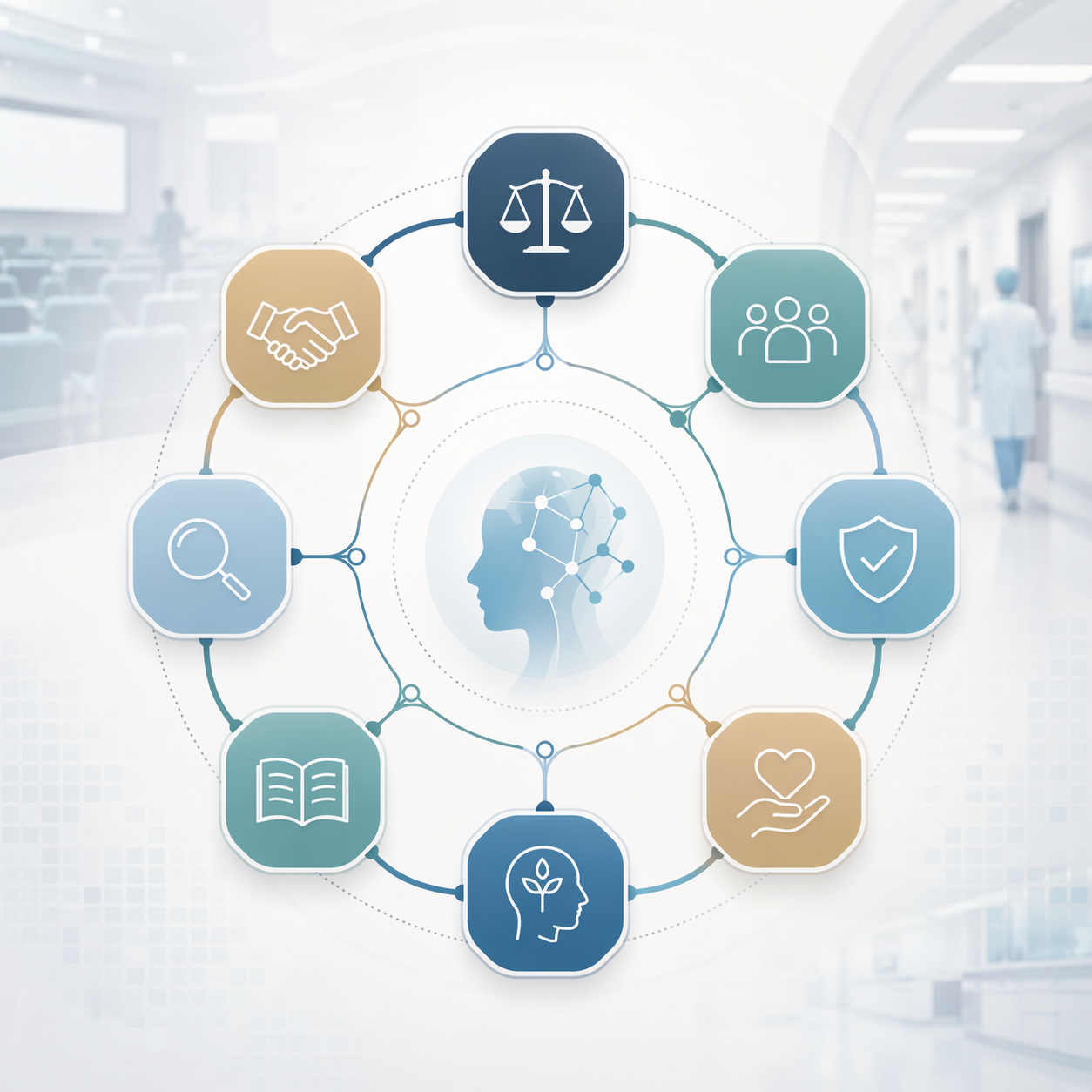
Taken together with the AMA's ethics-evidence-equity framing, these materials point to eight competencies that belong in comprehensive AI ethics training for clinicians: informed consent, algorithmic bias and fairness, transparency and explainability, privacy and data governance, safety and validation literacy, liability and accountability, human autonomy and clinical judgment, and equitable access.[1][6][7][8][9] They are not tidy because clinical practice is not tidy. They are teachable because each one maps to a decision clinicians already make or will be asked to defend.
Eight Competencies a 2026 Program Must Cover
The point of naming competencies is not to create another laminated framework. It is to make a curriculum committee answer practical questions: What should a student recognize? What should a resident be able to do under supervision? What should an attending or CME learner be accountable for in practice? The following map is therefore less a taxonomy than a set of teachable obligations.
| Competency | What clinicians should be trained to do |
|---|---|
| Informed consent | Recognize when AI involvement is material to patient understanding, disclose it in plain language when appropriate, and avoid treating consent as satisfied by a generic technology notice. |
| Algorithmic bias and fairness | Identify where training data, deployment context, or workflow design may disadvantage patient groups, and know when to escalate concerns for review. |
| Transparency and explainability | Distinguish between tools that can be meaningfully explained at the point of care and tools that require institutional-level documentation, validation, or governance support. |
| Privacy and data governance | Understand what data are being used, where they move, who may access them, and why AI-related data reuse is not automatically covered by ordinary clinical assumptions. |
| Safety and validation literacy | Read validation claims with enough discipline to ask whether performance applies to the patient population, setting, and workflow in front of them. |
| Liability and accountability | Know who is responsible for reviewing, documenting, overriding, escalating, and reporting AI-related concerns. |
| Human autonomy and clinical judgment | Preserve patient choice and clinician responsibility when AI output is persuasive, convenient, or institutionally favored. |
| Equitable access | Ask who benefits from the tool, who is excluded from it, and whether the deployment widens or narrows access to appropriate care. |
Informed Consent
Consent training has to be more specific than telling clinicians to "be transparent." A patient does not need a technical lecture every time software is present in the background. But when AI meaningfully shapes a diagnosis, risk estimate, treatment recommendation, triage decision, documentation output, or communication, clinicians need a practiced way to explain what role the system played, what it cannot decide, and what human review remains in place.
This competency draws most directly from WHO's protection of autonomy and transparency principles, the AMA's emphasis on ethics and evidence, and Weidener and Fischer's extension of traditional medical ethics into AI-mediated education and care.[1][7][8] The curriculum task is to make consent operational. Learners should practice language for an AI-assisted recommendation, identify when a general institutional disclosure is insufficient, and recognize when the patient's ability to refuse or question AI involvement is only theoretical because the workflow offers no real alternative.
Algorithmic Bias and Fairness
Bias training cannot stop at the sentence "AI can be biased." Clinicians need to know where unfairness can enter: in the data used to train a model, the labels chosen as proxies for health, the clinical setting where the system was validated, the way staff respond to its output, and the institutional decision to deploy it for some patients before others. A learner who can define bias but cannot recognize a mismatched population in a validation report is not yet prepared.
WHO's inclusiveness and equity principle, the AMA's equity framing, the NAM Code's responsible adoption commitments, and Weidener and Fischer's common good orientation all support bias and fairness as a required domain.[1][6][7][8] For deeper treatment of audit concepts and mitigation strategies, a curriculum can link this domain to institutional resources on algorithmic bias and health equity in clinical AI. The baseline clinician competency, however, is not to become a model auditor. It is to know when a performance claim is too broad, when subgroup performance matters, and when an apparent efficiency gain may transfer burden to patients already least served by the system.
Transparency and Explainability
Explainability is often taught as if every clinician must understand the model architecture. That is the wrong standard for most clinical roles. The teachable distinction is between explanation needed for patient care, explanation needed for professional accountability, and explanation needed for institutional governance. A clinician may not be able to inspect the model, but they should be able to ask what input data the tool uses, what output it produces, how confidence or uncertainty is represented, whether the tool was validated locally, and what its known limitations are.
WHO's transparency principle and the EU AI Act's AI literacy requirement both make this domain difficult to ignore.[7][9] The NAM Code also helps because it frames responsible AI as an organizational system, not merely a vendor promise.[6] That matters pedagogically: learners should not be told that ethical practice depends on personally reverse-engineering every tool. They should be taught what information must be available somewhere, who should maintain it, and how clinicians can act when the information is missing.
Privacy and Data Governance
Clinicians are accustomed to privacy rules, but AI changes the questions learners must ask. The issue is not only whether a chart note is protected. It is whether data are being reused to train, tune, monitor, or evaluate a system; whether patient-generated or operational data are included; whether de-identification is being overclaimed; and whether staff understand the difference between approved institutional tools and consumer-facing systems that may not be appropriate for protected information.
This competency sits at the intersection of WHO's safety, transparency, and accountability principles, the AMA's ethics and evidence framing, and the NAM Code's governance-oriented commitments.[1][6][7] It should be taught with local policy examples whenever possible, because privacy failures usually occur in workflows rather than in abstract principle statements. A resident drafting a discharge summary with an AI assistant needs to know whether the tool is approved, what data it can receive, and who is responsible for correcting output that becomes part of the record.
Safety and Validation Literacy
Safety training should give clinicians enough methodological literacy to resist two common errors: accepting a vendor's performance claim as if it applies everywhere, and dismissing AI entirely because no model is perfect. A clinically useful curriculum teaches learners to ask what outcome was measured, what comparator was used, where the model was tested, whether the patient population resembles their own, how performance changes over time, and what monitoring occurs after deployment.
WHO explicitly includes safety among its principles, the AMA emphasizes evidence, and the NAM Code places responsible health AI inside a learning health system orientation.[1][6][7] Weidener and Fischer's proportionality principle adds an important clinical education question: is the risk of using the tool proportionate to the benefit in this setting?[8] That question keeps validation literacy connected to patient care rather than turning it into a statistics detour.
Liability and Accountability
Many clinicians do not need a full legal course on AI liability, but they do need to know the accountability chain in their own setting. Who approves the tool? Who monitors incidents? Who reviews overrides? Who documents disagreement with the AI output? Who tells the patient if an AI-supported process contributed to harm? If a curriculum cannot answer those questions, it is not preparing clinicians for practice; it is merely making them aware of risk.
WHO's responsibility and accountability principle, the NAM Code's organizational commitments, and the EU AI Act's literacy requirement all point toward role clarity.[6][7][9] This is where training has to connect with governance. A health system that teaches clinicians about accountability but has no clear escalation pathway is asking individuals to absorb institutional ambiguity. Curriculum leaders can pair this competency with governance work such as a clinical AI governance committee charter, because training and governance fail separately when they are designed separately.
Human Autonomy and Clinical Judgment
The ethics problem here is not only that an AI system might be wrong. It is that a wrong or poorly fitted output can arrive with speed, confidence, and workflow authority. Clinicians should be trained to preserve judgment when AI output is convenient, when supervisors expect conformity, when documentation systems make acceptance easier than revision, or when patients assume the computerized answer is more objective than the clinician's explanation.
WHO's autonomy principle, the AMA's emphasis on physician leadership in augmented intelligence, and Weidener and Fischer's grounding in medical ethics make this competency central.[1][7][8] It should include deliberate practice in overriding or questioning AI output, not just approving it. A resident should be able to say, in the chart and in conversation, why the AI suggestion was not followed. An attending should be able to model that disagreement without treating the tool as either an oracle or a nuisance.
Equitable Access
Access is sometimes treated as an implementation issue after the ethics curriculum is finished. It belongs inside the curriculum. AI systems may concentrate benefit in well-resourced clinics, English-dominant patient populations, digitally connected patients, or services with stronger informatics support. Conversely, a well-governed tool may improve access if it reduces delays, supports scarce expertise, or helps prioritize care. Clinicians need to learn to ask who is included in the benefit, not only whether the tool works in aggregate.
WHO's inclusiveness and equity principle, the AMA's equity framing, the NAM Code's attention to workforce and system responsibilities, and Weidener and Fischer's common good orientation all support equitable access as a curriculum domain.[1][6][7][8] This is also where the learner should see why individual professionalism is not enough. If only certain sites receive the tool, if interpreter needs are poorly supported, or if patient portals become the main route to AI-enabled services, equity consequences appear before any clinician has acted with bad intent.
How the Competencies Should Mature Across Training
The CAP, STFM, UIC, AMA, and Elsevier signals all point toward the same curricular problem: learners and clinicians are encountering AI at different career stages, but preparation remains uneven.[1][2][3][4][5] The answer is not to place the entire burden on medical school or to push everything into CME after habits have formed. AI ethics training for clinicians works best as a spiral curriculum: the same ethical domains return over time, but the expected performance changes.

| Stage | Appropriate expectation |
|---|---|
| Medical school and early health professions education | Recognize AI involvement, name major ethical risks, practice patient-facing explanations, and identify when supervision or escalation is needed. |
| Residency, fellowship, and graduate clinical training | Apply the competencies in real workflows, document AI-assisted decisions, challenge outputs, participate in local review, and understand specialty-specific risks. |
| CME and attending-level practice | Evaluate tools before and after deployment, supervise learners and teams, shape local policy, report incidents, and connect AI use to quality, safety, equity, and governance. |
Medical School: Recognition Before Mastery
At the undergraduate stage, the goal is not to produce AI governance experts. It is to prevent future clinicians from entering practice with no vocabulary for the ethical work already embedded in AI-assisted care. Students should be able to recognize when AI may be shaping a clinical task, explain basic risks to a patient in ordinary language, distinguish a decision-support output from a clinical decision, and know when the limits of their knowledge require supervision.
The UIC needs assessment is helpful here precisely because it captures learner demand, not because one institution can define national curriculum standards. When 92% of 529 students rated understanding AI's negative effects as a core learning need, that supports early inclusion of ethics content alongside technical literacy, clinical reasoning, and professionalism.[4] The right undergraduate assessment might be a short observed explanation to a standardized patient, a critique of a hypothetical AI-generated note, or a case discussion identifying consent, bias, privacy, and accountability issues.
Residency and Graduate Training: Responsibility in Workflow
Graduate clinical training is where AI ethics becomes less hypothetical. Residents and fellows work inside documentation systems, triage processes, imaging workflows, population health tools, and specialty-specific decision aids. They need more than awareness: they need supervised responsibility. That means documenting why an AI-supported suggestion was accepted or rejected, recognizing when output is inconsistent with the patient presentation, and escalating concerns through the actual pathway used by the institution.
The pathology and family medicine signals are useful because they show that the training gap is not confined to one discipline or one learner level. The CAP survey's low response rate prevents broad claims about all pathology programs, but the finding that only 16% of respondents reported education on appropriate AI use is difficult to ignore in a field where AI-related tools are likely to touch diagnostic work.[2] The STFM study, though limited to one French department, shows faculty supervisors themselves asking for formal AI training while expressing ethical concern about AI use in academic writing.[3] Supervisors cannot reliably assess learner behavior they have not been prepared to evaluate.
CME: Governance, Supervision, and Local Judgment
Continuing education should not be remedial medical school content with updated slides. Practicing clinicians need role-specific training tied to local tools and responsibilities. An attending who supervises residents using AI documentation tools needs different preparation from a department chair reviewing a predictive model for resource allocation, and both need more than a general reminder that bias exists.
The AMA and Elsevier figures make this stage hard to postpone: reported professional use is already common, while perceived sufficiency of training remains low.[1][5] CME should therefore include tool-specific orientation, incident reporting expectations, documentation standards, patient communication practice, and periodic updates when models, workflows, or regulations change. Clinicians who want to move beyond baseline literacy into implementation or AI leadership may need a deeper pathway, such as training for a pivot into AI without a computer science background, but that should not be confused with the minimum ethics preparation every clinician needs.
What a Defensible Program Looks Like
A comprehensive program in 2026 should be built from the eight competencies, mapped to learner stage, and tied to the actual AI systems or AI-like workflows clinicians encounter. The frameworks justify the domains; local practice determines the examples, escalation paths, and assessments. That distinction matters. WHO, NAM, AMA, Weidener and Fischer, and the EU AI Act can justify why the curriculum exists, but they cannot tell a resident in a specific hospital which governance committee receives an AI safety concern or what language the institution expects in a note.
- Start with an inventory of AI-enabled tools and likely AI uses in care, documentation, communication, education, and administration.
- Map each tool or use case to the eight competencies, rather than creating a separate ethics module for every product.
- Define what students, trainees, attendings, and supervisors are expected to recognize, do, document, and escalate.
- Use cases and simulations to assess decisions, not only knowledge of terms.
- Update training when tools, validation evidence, governance processes, or regulatory expectations change.
The assessment strategy should match the responsibility. A medical student may be assessed on recognizing incomplete consent in a hypothetical scenario. A resident may be assessed on documenting why an AI-generated recommendation was not followed. An attending may be assessed through participation in a case review, an incident report, or a department-level discussion of whether a tool's validation evidence fits the local population. None of these requires pretending that every clinician can audit a model. They do require clinicians to know enough to avoid passive dependence.
Institutions should also be honest about what training cannot do. It cannot make a poorly governed deployment ethical. It cannot compensate for missing validation evidence. It cannot transfer accountability from health system leaders to the individual clinician at the bedside. Training is necessary because clinicians face AI-mediated decisions; governance is necessary because clinicians should not face them alone.
Using the Frameworks Without Overclaiming Them
Framework convergence is useful, but it is not implementation. The NAM Code is voluntary.[6] WHO's principles are foundational, but principles do not automatically become clinical behavior.[7] Weidener and Fischer provide an education-focused framework, but local curricula still have to translate it into objectives, cases, assessments, and faculty development.[8] EU Article 4 creates a literacy requirement in EU member states; for US-based programs, it is best treated as a benchmark and policy signal unless the organization is directly subject to EU obligations.[9]
The empirical signals also need restraint. The AMA data are self-reported physician sentiment; the CAP response rate was low; the STFM study came from a single university department; the UIC paper describes one institution's experience; and the Elsevier figure measures perceived training sufficiency rather than verified competence.[1][2][3][4][5] These caveats do not weaken the case for training. They keep the case honest. The defensible conclusion is not that the field has precise national measurements of AI ethics readiness. It is that multiple imperfect sources point in the same direction: clinicians are encountering AI faster than educational systems are preparing them.
Comprehensive AI ethics training for clinicians in 2026 should not be a one-off lecture, a compliance slide deck, or a promise that every clinician can inspect every algorithm. It should be structured, recurring preparation for informed consent, bias and fairness, transparency, privacy, safety, accountability, human judgment, and equitable access—the ethical responsibilities clinicians already carry as AI becomes part of care, documentation, education, and health system governance.
References
- Augmented intelligence in medicine, American Medical Association.
- As AI use expands, ethics at the leading edge, CAP TODAY, 2024.
- Cabrol et al., Family Medicine, June 2026.
- UIC needs assessment, PMC, 2026.
- Elsevier report, Elsevier, 2025.
- Health Care Artificial Intelligence Code of Conduct, National Academy of Medicine, May 2025.
- Ethics and governance of artificial intelligence for health, World Health Organization, 2021.
- Principle-based framework for artificial intelligence in clinical education, PMC, 2024.
- Top AI ethics and policy issues of 2025 and what to expect in 2026, AIhub, March 4, 2026.
Comments
Join the discussion with an anonymous comment.