
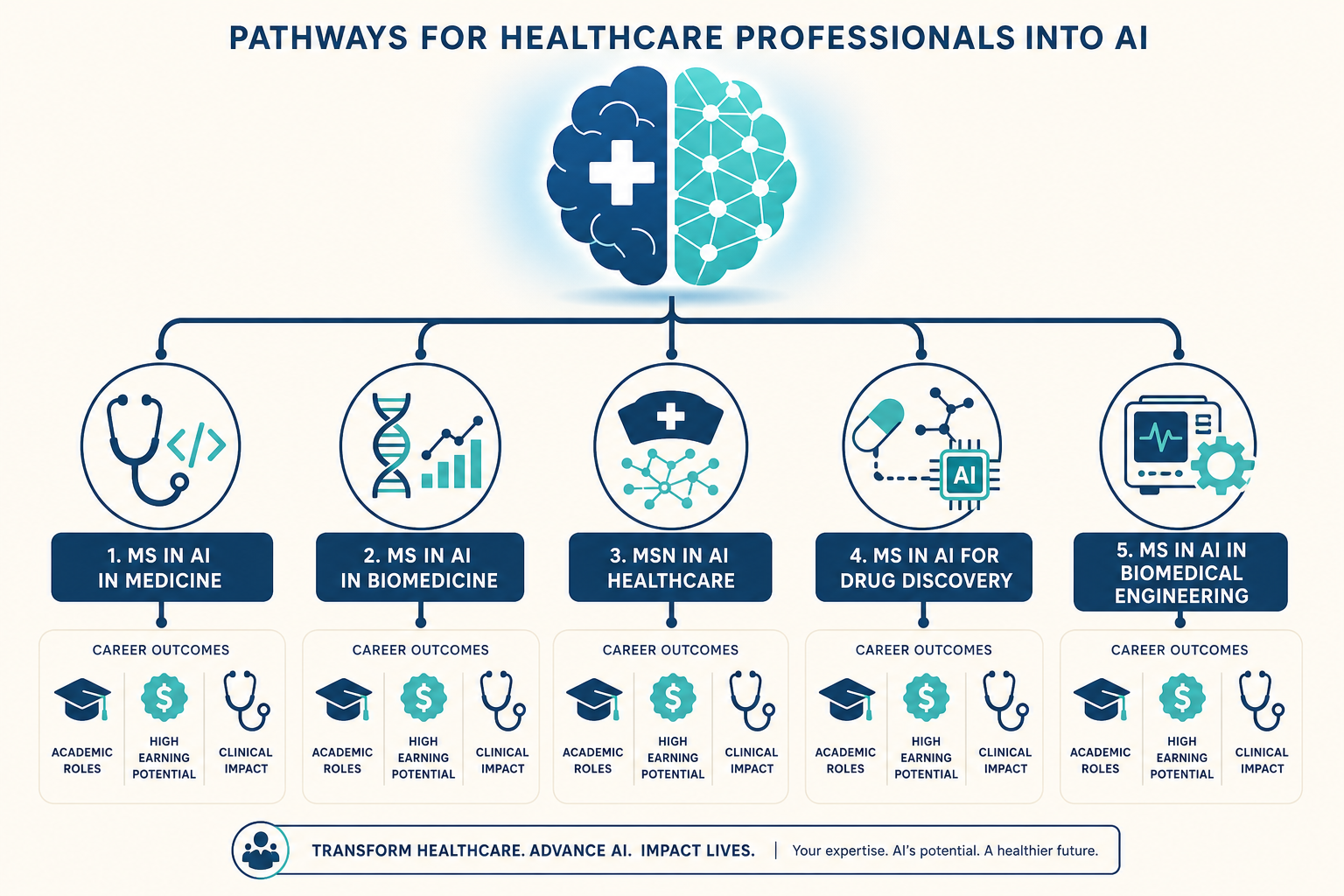
 Multiple (FSU, Yale, UF, UofL, Rochester, Bryant)
The Perception Barrier: Why Most Clinicians Assume They Can’t Do AI
Ask a room of practicing clinicians whether they’ve considered a role in healthcare AI, and the most common response is a version of “I’m not a programmer.” The assumption that artificial intelligence belongs exclusively to computer scientists is the single largest barrier keeping clinically experienced professionals out of the field. It is also, increasingly, wrong.
The mental model most clinicians carry is that AI work means writing neural network architectures from scratch or deploying production-grade machine learning pipelines. That image comes from media coverage of tech giants and from the way computer science curricula are traditionally structured. But healthcare AI is not a subset of general AI — it is a distinct domain where clinical knowledge is not a nice-to-have but a prerequisite for building tools that actually work in patient care settings.
The gap between perception and reality is wide enough that it deserves a closer look. The data on who actually enrolls in healthcare AI master’s programs tells a very different story from the one most clinicians tell themselves.
The Data That Changes the Conversation: 73% Start Without CS
The most important single statistic for any clinician considering this path comes from the Coursera and LinkedIn Learning Skills Report (2024): 73% of healthcare professionals pursuing AI master’s degrees start without a computer science background. That figure is not a niche finding from a single survey — it reflects enrollment patterns across multiple institutions and program types.
This number matters because it inverts the common assumption. The typical healthcare AI master’s student is not a CS graduate pivoting into medicine. The typical student is a clinician — a nurse, a physician, a pharmacist, a radiologic technologist — who brings domain expertise and learns the technical skills along the way.
The broader context reinforces the trend. U.S. master’s programs focused on AI increased by 58% between 2022 and 2024, and 23% of new offerings specifically target healthcare fields (Research.com, citing QS data). The healthcare AI market itself is projected to reach $67.4 billion by 2027, growing at a compound annual rate of 38.1%. These numbers signal that the demand for AI-capable clinicians is not a future possibility — it is a present reality that educational institutions are actively building programs to meet.
How Bridge Courses and Foundations Programs Remove the Technical Barrier
The 73% figure would be meaningless if programs did not accommodate non-CS backgrounds. They do — through a mechanism called bridge courses, which have become a standard feature of healthcare AI master’s programs.
Bridge courses are short, intensive modules that bring students up to speed on the prerequisites they missed during their clinical training. They typically cover three areas:
- College-level statistics and probability — the mathematical foundation for understanding model performance metrics, confidence intervals, and study design in AI validation
- Introductory programming — usually Python, sometimes R, focused on data manipulation and basic algorithm implementation rather than software engineering
- Data structures and linear algebra fundamentals — enough to understand how models represent and transform data, without requiring a full undergraduate CS sequence
The University of Louisville’s online MS in AI in Medicine provides a concrete example. The program requires a bachelor’s degree with a 3.0 GPA, completion of college-level statistics, and introductory programming as prerequisites. But it explicitly offers bridge courses for applicants who lack these prerequisites. The program is 100% online, costs $850 per credit hour ($25,500 total for 30 credits), and does not require GRE scores. It launched in fall 2024 as one of the first degrees of its kind nationally.
The University of Rochester follows a similar model, offering foundational modules that allow clinicians to enter the program without a STEM undergraduate degree. These bridge courses are typically completed in the first semester, after which students join the standard curriculum alongside their technically trained peers.
Programs Built for Clinicians: MSN in AI, MHS in Medical AI, and AIBHS
While many programs accommodate clinicians, a growing number are designed specifically for them. Three programs illustrate the range of options available as of mid-2026.
| Program | Institution | Format | Target Audience | Key Feature |
|---|---|---|---|---|
| MSN with Concentration in AI in Healthcare | Florida State University | Online | Registered nurses | Nation’s first MSN in AI; launched fall 2024 |
| MHS in Medical Artificial Intelligence | Yale School of Medicine | Online + in-person bootcamps | Clinicians, CS professionals, regulatory professionals | First cohort applications due Feb 1, 2027; $51,100 total tuition |
| MS in AI in Biomedical and Health Sciences (AIBHS) | University of Florida | On-campus / hybrid | Clinicians and biomedical scientists | 30 credits, 1.5 years; launches fall 2026 |
Florida State University’s College of Nursing launched the nation’s first MSN with a concentration in AI in healthcare in September 2024, accepting applications for a spring 2025 start. The program is fully online and housed within the College of Nursing, meaning the curriculum is built around nursing workflows, patient safety considerations, and clinical decision-making — not abstract machine learning theory. For nurses who want to stay in the clinical domain while building AI expertise, this program represents a direct pathway.
Yale’s MHS in Medical AI takes a different approach. It is fully online but requires in-person bootcamps in New Haven each semester, creating a hybrid model that combines flexibility with hands-on collaboration. The program targets applicants with a strong technical background in CS or data science, but also explicitly welcomes medical and healthcare professionals. The total tuition is $51,100, and the first cohort’s application deadline is February 1, 2027. Yale’s brand recognition and the School of Medicine’s research infrastructure make this program particularly attractive for clinicians who want to work at the intersection of clinical practice and AI development.
The University of Florida’s AIBHS master’s program, launching fall 2026, is a 30-credit hour program designed to be completed in 1.5 years. Its curriculum includes courses in fundamentals of AI and medicine, AI ethics and alignment, clinical design, and medical image analysis. UF notes that positions in AI and biomedical sciences have a mean annual salary over $95,000 in Florida, with projected national job growth 7% to 35% faster than average depending on the specific role.
No-GRE Admissions: The New Norm for Healthcare AI Master’s Programs
For clinicians who have been out of school for years — sometimes decades — the prospect of taking the GRE can be a significant deterrent. Many practicing professionals have not taken a standardized test since medical or nursing school admissions, and the idea of preparing for the quantitative and verbal sections while working full-time is unappealing at best.
A growing number of healthcare AI master’s programs have responded by making the GRE optional or eliminating it entirely. The University of Louisville’s MS in AI in Medicine explicitly states that no GRE is required. Bryant University’s MS in Health Informatics and AI also waives the GMAT and GRE. This is not a marginal trend — it is becoming the standard for programs that target working professionals.
The rationale is straightforward. These programs are designed for professionals who have already demonstrated competence through clinical licensure, advanced degrees, and years of practice. A standardized test score adds little predictive value for success in a clinically focused AI curriculum. Admissions committees are more interested in a candidate’s clinical experience, their understanding of healthcare workflows, and their motivation for pursuing AI training than in their ability to solve abstract math problems under time pressure.
- University of Louisville MS in AI in Medicine: No GRE required
- Bryant University MS in Health Informatics and AI: No GMAT/GRE required
- Multiple other programs (Rochester, NEOMED, UF) have adopted no-GRE or GRE-optional policies for healthcare AI tracks
What Clinicians Bring That Pure CS Graduates Lack
The most common mistake in discussions about healthcare AI is treating clinical knowledge as secondary to technical skill. In practice, the opposite is often true. The hardest problems in healthcare AI are not technical — they are problems of workflow integration, patient safety, regulatory compliance, and clinical relevance. These are precisely the domains where clinicians have deep expertise and CS graduates typically have none.
Consider what a clinician brings to an AI team:
- Workflow understanding: Clinicians know how a hospital actually operates — where data enters the system, where decisions are made, where bottlenecks occur, and where an AI tool would help versus where it would add friction
- Patient safety perspective: Clinicians are trained to think in terms of harm reduction, false positives and false negatives, and the consequences of errors. This perspective is essential for building AI systems that are safe, not just accurate
- Regulatory awareness: Clinicians who have worked under HIPAA, FDA regulations, and institutional review boards understand the compliance landscape in a way that few CS graduates do
- Problem identification: The most valuable AI applications are not obvious to outsiders. Clinicians see the pain points in their daily work — the documentation burden, the diagnostic uncertainty, the administrative inefficiencies — and can identify which problems are worth solving with AI
Employers are increasingly recognizing this value. A survey cited by mastersinai.org found that 75% of U.S. health systems were using at least one AI application in 2026, up from 59% in prior years. These systems need people who understand both the technology and the clinical environment — a combination that pure CS graduates rarely possess.
The Salary Uplift: 34% Higher Earnings With a Clinical Degree + AI Master’s
The financial case for combining clinical training with an AI master’s is supported by data from Burning Glass Technologies: healthcare professionals who hold both an AI master’s degree and industry certifications earn approximately 34% higher salaries compared to those with the degree alone. This premium reflects the market’s willingness to pay for the rare combination of clinical domain expertise and AI capability.
The broader salary picture reinforces the investment. Median salaries for healthcare AI specialist roles range from $125,000 to $165,000, depending on geography, experience, and specific role (BLS, Burning Glass, LinkedIn, BU analysis). The Bureau of Labor Statistics projects 42% growth for these roles through 2029. For context, the median annual wage for data scientists across all industries exceeds $100,000, and specialists working on diagnostic algorithms or healthcare data platforms typically earn between $110,000 and $140,000.
The return on investment for a healthcare AI master’s is also favorable. According to GMAC data cited by Research.com, the median ROI within five years is 156%. Tuition for these programs ranges from approximately $25,500 (UofL) to $51,100 (Yale) to $120,000 for some on-campus programs. Even at the high end, the salary differential makes the math work for most graduates.
| Metric | Value | Source |
|---|---|---|
| Salary premium (AI master’s + certification vs. degree alone) | 34% higher | Burning Glass Technologies |
| Median salary range, healthcare AI specialist | $125K–$165K | BLS, Burning Glass, LinkedIn, BU analysis |
| Projected job growth, healthcare AI roles | 42% through 2029 | Bureau of Labor Statistics |
| Median ROI within five years | 156% | GMAC (cited by Research.com) |
| Tuition range (selected programs) | $25,500–$120,000 | Program pages, mid-2026 |
Practical First Steps: How to Prepare Before Applying
If the data above has shifted your thinking from “I can’t do AI” to “How do I start?”, the following steps will help you prepare before submitting an application. These are not hypothetical recommendations — they are the concrete actions that successful clinician-transitioners take in the months before enrollment.
- Assess your current math and statistics comfort. You do not need calculus, but you should be comfortable with descriptive statistics, probability, and basic hypothesis testing. If you have not used these concepts since your clinical training, spend two to four weeks reviewing them through free resources like Khan Academy or OpenStax.
- Take a free introductory Python course. Python is the dominant language in healthcare AI. Free courses from Codecademy, Coursera, or edX can give you enough familiarity to determine whether programming feels accessible. You do not need to become a software developer — you need to be able to read and modify code, not write production systems from scratch.
- Research program prerequisites. Visit the admissions pages of programs that interest you. Look specifically for the “prerequisites” or “admissions requirements” section. Note which programs offer bridge courses and which require prerequisites to be completed before enrollment. This will tell you how much preparation you need before applying.
- Use a structured decision framework. Not all programs are right for all clinicians. Factors to weigh include: online vs. in-person format, cost, duration, clinical focus area (imaging AI, NLP, clinical informatics, general AI literacy), and whether the program offers CME credits or a formal certificate. Our decision framework for choosing the right AI course can help you evaluate programs against your specific background and career goals.
- Reach out to program directors. Most healthcare AI master’s programs are new enough that their directors are eager to speak with prospective students. A 15-minute phone call can answer questions about bridge courses, clinical relevance, and career outcomes that no website page can fully address.
The transition from clinician to AI specialist does not require abandoning your clinical identity. It requires adding a new layer of capability to the expertise you already have. The programs, the data, and the market demand are all aligned. The only missing piece is the decision to start.
Comments
Join the discussion with an anonymous comment.