
AI in healthcare prior authorization is already doing two very different jobs. In one workflow, it helps a provider assemble clinical documentation, match it to payer criteria, submit the request, and follow up before a nurse spends half a day chasing a portal. In another, it helps an insurer screen requests, flag medical-necessity concerns, and move more denials through the system with less human time attached. Calling both of those uses “automation” hides the most important distinction: one can shorten the path to care, while the other can industrialize the fight over access.
That distinction is not theoretical. Nirmitee reports that its AI agents reduced prior authorization turnaround from 14 days to under 3 hours, automated 85% of requests, and cut denials by 66%, from 35% to 12%, in a 2026 case study. It also reports a 340% ROI, a figure that should be read as vendor-reported rather than independently audited evidence of system-wide savings.[1] On the payer side, the American Medical Association cites a Senate committee finding that AI-driven denial rates were 16 times higher than typical manual review, while its own survey found that 61% of physicians fear unregulated payer AI will increase denials.[2]

The easy version of the story says AI speeds up prior authorization. The more useful version asks what, exactly, is being sped up.
Prior Authorization Is a Relay, Not a Single Task
Prior authorization sits between a clinician’s treatment plan and a payer’s agreement to cover it. The work sounds administrative until it lands in a clinic inbox: collect chart notes, prove step therapy history, attach imaging or lab results, select the right portal, translate clinical reasoning into payer criteria, wait, correct missing fields, call, escalate, appeal, repeat.
That is why AI has leverage here. A request can fail because the patient does not meet medical criteria. It can also fail because the required note was buried in the record, the wrong form was used, the payer portal changed, or the submission arrived without a detail that a human reviewer would have known to include. Automation that reduces those misses can spare patients delay and spare clinical staff from clerical salvage work.
But prior authorization is also adversarial by design. Payers are trying to control utilization and spending; providers are trying to secure timely access for care they believe is clinically appropriate. Put AI into that structure and it does not become neutral simply because the interface looks efficient.
Provider-Side AI: Less Missing Paper, Fewer Avoidable Denials
Provider-deployed AI tends to start where the pain is most visible inside hospitals and clinics: incomplete submissions, payer-specific rules, slow documentation retrieval, and staff time spent watching portals. The promise is not that the AI decides what care the patient needs. The promise is that it helps the care team present the request in the format the payer has already demanded.
The Nirmitee case study is useful because it describes the operational chain, not just a dashboard metric. Its agents reportedly identified authorization requirements, gathered supporting documentation, submitted requests, tracked status, and routed exceptions to human staff. The headline result — 14 days to under 3 hours — matters because turnaround time is not an abstract efficiency measure when a patient is waiting for a scan, procedure, or medication.[1]
The denial reduction is equally important, but it needs careful interpretation. A drop from 35% to 12% suggests fewer requests were rejected at the front door, yet the case study does not prove that medical necessity changed or that the whole system spent less money. It more plausibly shows that more requests arrived complete, routed correctly, and aligned with payer documentation requirements. For a revenue cycle team, that is still meaningful. For a patient, it may be the difference between a scheduled service and another week of silence.
| Deployment context | What the AI is optimizing | Likely access effect | Evidence caveat |
|---|---|---|---|
| Provider-side preparation | Completeness, routing, documentation retrieval, follow-up | Can reduce avoidable denials and shorten turnaround | Most public figures are vendor-reported |
| Payer-side review or denial support | Screening, medical-necessity checks, denial workflow throughput | Can increase denial volume if oversight is weak | Adoption and denial concerns are better documented than causality |
| Provider and payer bots interacting | Transaction speed on both sides | Can increase total contestation instead of reducing burden | Market-level cost evidence remains limited |
This is where provider-side automation earns a fair hearing. If the AI reduces the number of avoidable rejections caused by missing records or portal friction, it is not merely saving clicks. It is preventing work from being pushed downstream to nurses, physicians, schedulers, and appeal teams.
Still, vendor-reported ROI is not the same as audited savings. A provider may save staff time while a payer faces more complete requests. A payer may automate responses while a provider absorbs more appeal work. A hospital may see faster first-pass throughput while patients with complex cases still wait in the exception queue. The useful question is not whether a product has an impressive case study, but which work disappeared and which work moved to someone else.
Payer-Side AI Raises a Different Set of Questions
When insurers deploy AI in prior authorization, the same speed can produce a different consequence. Faster clinical matching may help if it identifies approvals that do not need manual review. Faster denial support is another matter. The governance question becomes: is the tool assisting a human reviewer, narrowing the evidence packet, recommending a denial, or effectively deciding before a clinician meaningfully looks at the case?
Physicians are reacting to that distinction. In the AMA’s 2025 survey, 61% of physicians said they feared unregulated use of AI by insurers would increase denials, and 49% ranked oversight of payer AI for medical-necessity determinations among their top three regulatory priorities.[2] Those are attitudes, not direct measurements of denial behavior. But they are not random anxieties either; they come from the people who must tell patients a treatment is delayed, then spend clinical time generating another packet of proof.
The adoption picture makes the concern harder to dismiss. A 2025 NAIC survey cited in coverage of payer AI use found that 84% of large health insurers use AI or machine learning operationally, while 8% to 12% use AI specifically to support denials.[2] That does not mean most denials are automated. It does mean AI is no longer a peripheral experiment in insurance operations.
The AMA also cites a 2024 Senate committee report finding that AI-driven denial rates were 16 times higher than typical manual review.[2] Because the original Senate report was not independently verified in the supplied research, that figure should be treated as a serious warning signal rather than a settled benchmark. It still points to the central policy problem: if an AI system can scale denial recommendations faster than humans can scrutinize them, a formal human-in-the-loop process may not be enough.
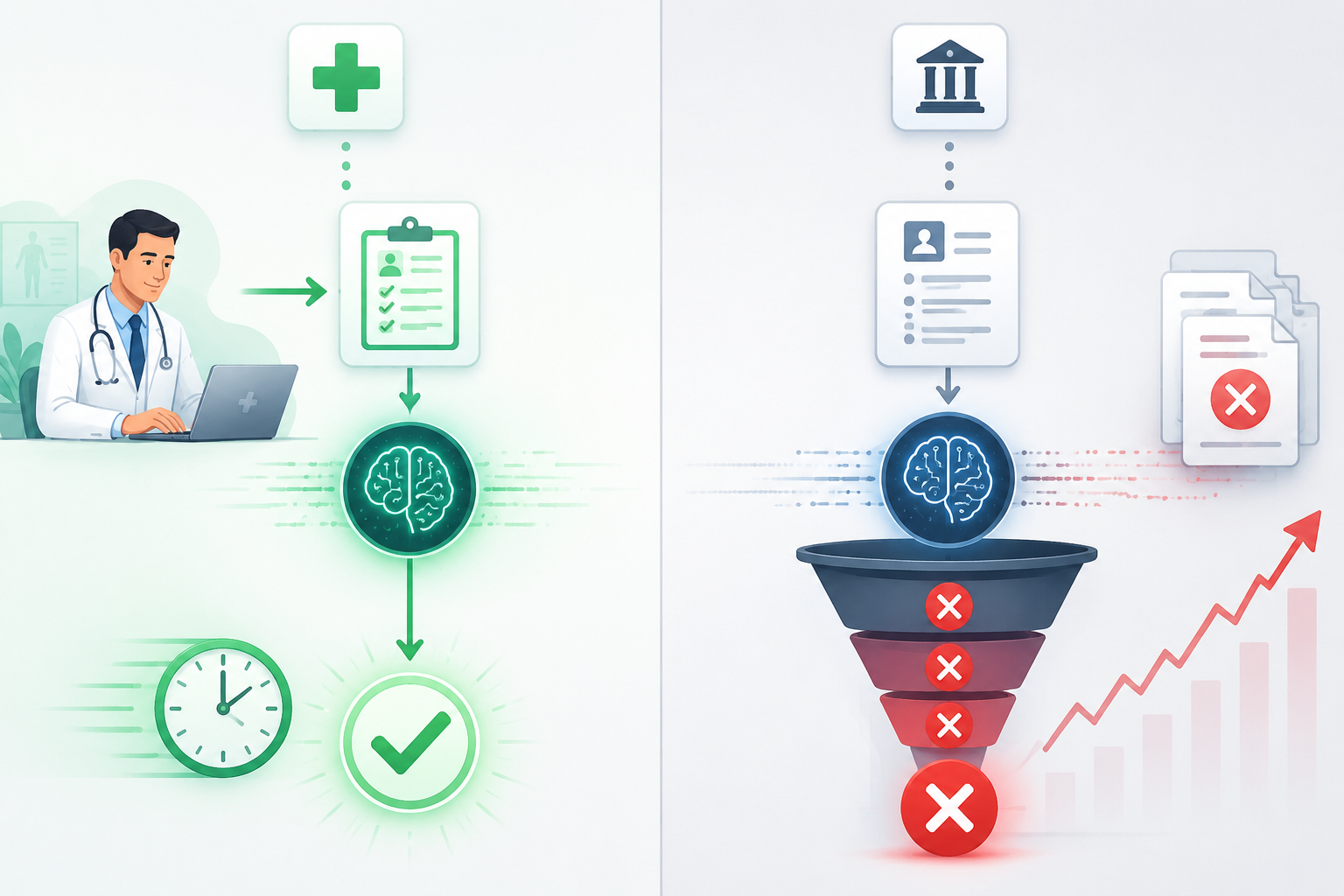
That is the operational line worth drawing. AI that prepares a request for review and AI that accelerates a denial are not equivalent interventions. They may share natural language processing, rules engines, prediction models, and workflow automation, but they sit on opposite sides of the access decision.
The Medicare Advantage Signal Is Troubling, but Not Proof of AI Causation
Medicare Advantage data adds context without proving that AI caused the problem. A Stanford and Health Affairs analysis reported that Medicare Advantage prior authorization denial rates ranged from 5.6% to 5.8% from 2019 through 2021, then rose to 7.4% in 2022. It also noted that more than 80% of appealed denials were overturned.[3]
The overturned-appeal figure matters more than the trend line alone. Appeals require time, documentation, clinical attention, and patient endurance. If most appealed denials are reversed, then at least some patients are being delayed by decisions that do not survive review. AI did not need to cause that pattern to make it more consequential. A model trained on flawed past decisions or rigid historical policies can preserve those patterns at higher speed.[3]
This is also where a simple adoption story becomes inadequate. A plan can say AI supports consistency. A physician can say the system is denying appropriate care. Both can be describing the same workflow from different positions. The audit question is whether denial recommendations, human overrides, appeal reversals, and patient delays are visible enough for anyone outside the deploying organization to evaluate.
For a deeper look at the payer-side policy and litigation environment, see The AI Arms Race in Health Insurance Utilization Review. The narrower point here is that payer-side AI should be judged by what it does to medical-necessity determinations, not by whether it makes an existing queue move faster.
Why Faster Transactions May Not Lower Total Cost
The strongest economic claim for AI in prior authorization is that automation should reduce administrative burden. That claim is plausible at the task level. It is not yet demonstrated at the system level.
The Peterson Health Technology Institute reported in April 2026 that it found no existing evidence that AI translates to lower average cost per claim. Its analysis also described rising transaction volumes and “bot wars,” where provider and payer systems automate against each other instead of resolving the underlying dispute.[4]

The mechanism is easy to recognize for anyone who has watched utilization management queues. If a provider can generate a better packet faster, the payer may receive more complete submissions. If a payer can generate a denial or request for more information faster, the provider may respond with another automated packet. Each side reduces friction inside its own shop. The total number of transactions can still rise.
That is why per-task efficiency should not be mistaken for net administrative savings. A three-minute documentation retrieval step is better than a 30-minute manual search. But if the system creates more rounds of review, more denials to appeal, and more exception handling, the total burden may grow even as each unit of work becomes cheaper.
The broader cost context explains why vendors and payers are moving anyway. Prior authorization administrative costs have been estimated at $35 billion to $45 billion annually, and manual prior authorization processing has been reported at $12.88 compared with $0.05 for electronic processing. AI spending on prior authorization tools reportedly grew tenfold year over year, from $10 million in 2024 to $100 million in 2025.[5] Those numbers make automation attractive. They do not answer whether automation reduces total burden once both sides adopt it.
This distinction also belongs in broader benchmarks for administrative AI. For adjacent evidence on deployment and ROI measurement, see AI in Healthcare Administration: Evidence-Based Benchmarks. Prior authorization should be measured with the same discipline: not only time saved per task, but appeal rates, denial reversals, patient delay, and staff work shifted across the boundary between payer and provider.
The Governance Test Is Practical
The governance test for AI in prior authorization does not need to start with abstract promises about responsible AI. It can start with workflow questions that are hard to fake.
- Who deploys the tool: provider, payer, third-party administrator, or vendor acting on behalf of one side?
- What decision does it support: documentation assembly, benefit lookup, routing, approval, denial recommendation, or medical-necessity determination?
- What can a human reviewer actually change, and how often are AI recommendations overridden?
- What happens after denial: appeal rate, overturn rate, time to resolution, and patient abandonment?
- Where are costs counted: inside the payer, inside the provider, across both organizations, or at the patient access level?
A provider-side tool that increases first-pass completeness, leaves clinical judgment with clinicians, and reduces preventable denials deserves different treatment from a payer-side tool that screens medical necessity at scale with opaque criteria. A payer tool that auto-approves low-risk requests may also deserve different treatment from one that produces denial recommendations. The deployment context is not a footnote; it is the intervention.
Patient trust sits behind all of this. Public concern about health data privacy with AI was reported at 77%, and two-thirds of adults had little trust that AI would be used responsibly. At the same time, only 21% of members reported using AI tools despite 94% payer adoption.[5] Whether those figures come from consumer-facing tools or payer operations, the gap is instructive: institutions are adopting AI faster than patients can see, understand, or contest how it affects them.
Regulation is moving into that gap, especially around prior authorization transparency, decision timelines, and AI oversight. For a focused policy analysis, see CMS Prior Authorization and AI policy analysis. The operational test remains the same: oversight has to reach the point where the AI changes access, not merely the procurement document where the vendor describes it.
So Is AI in Prior Authorization a Net Positive?
The evidence does not support one verdict for AI in prior authorization. It supports a conditional one.
Provider-side tools can plausibly improve patient access when they reduce documentation gaps, identify payer requirements earlier, route requests correctly, and keep clinical staff from rebuilding the same packet after an avoidable denial. The Nirmitee example shows what that can look like in vendor-reported operational terms: faster turnaround, more automation, and fewer denials.[1] Those figures still need independent validation and broader cost accounting.
Payer-side tools require stricter scrutiny when they touch medical-necessity determinations, denial recommendations, or post-denial workflows. Physician concern, insurer adoption, the Senate-cited denial signal, and Medicare Advantage appeal reversals do not prove that AI alone is driving denials. They do show why opaque automation in this part of the workflow deserves close audit rather than routine efficiency language.[2][3]
AI in prior authorization is not one intervention with one outcome. It is an accelerant inside an already contested workflow. The net effect remains ambiguous until governance, appeal transparency, auditability, and cost accounting show whether automation is removing friction from care or industrializing the fight over it.
References
- AI Agents Eliminating Prior Authorization Bottleneck in Healthcare, Nirmitee, 2026.
- How AI is leading to more prior authorization denials, American Medical Association, 2025.
- AI algorithms in health insurance care risks research, Stanford News, January 2026.
- AI speeding prior authorizations while driving higher costs for health systems, Fierce Healthcare, April 2026.
- How AI Is Reshaping Prior Authorization In Health Insurance, Forbes Councils.
Comments
Join the discussion with an anonymous comment.