
The most provocative result in the current evidence on ai in sports nutrition and diet optimization is not a futuristic digital-twin promise or a polished consumer app demo. It is a narrow fluid-management task in ultra-endurance sport: secondary reporting of the ULTRA-Q study states that ChatGPT-4 reached 93% accuracy on fluid management recommendations, compared with 44% for human dietitians, a 49-point gap in favor of the model.[1]
That number deserves attention. It also deserves restraint. The primary PMC article for the ULTRA-Q work was not directly accessible because of a reCAPTCHA block, so the exact 93% versus 44% figure is being treated here as secondary reporting rather than independently extracted primary-study data.[1] Even if the reported result is taken at face value, it shows something specific: a large language model performed well on a structured, calculation-heavy hydration scenario. It does not show that the model optimized an athlete's total diet, understood gut tolerance during race stress, detected disordered eating risk, reconciled supplement use with medication, or carried responsibility when the recommendation failed.
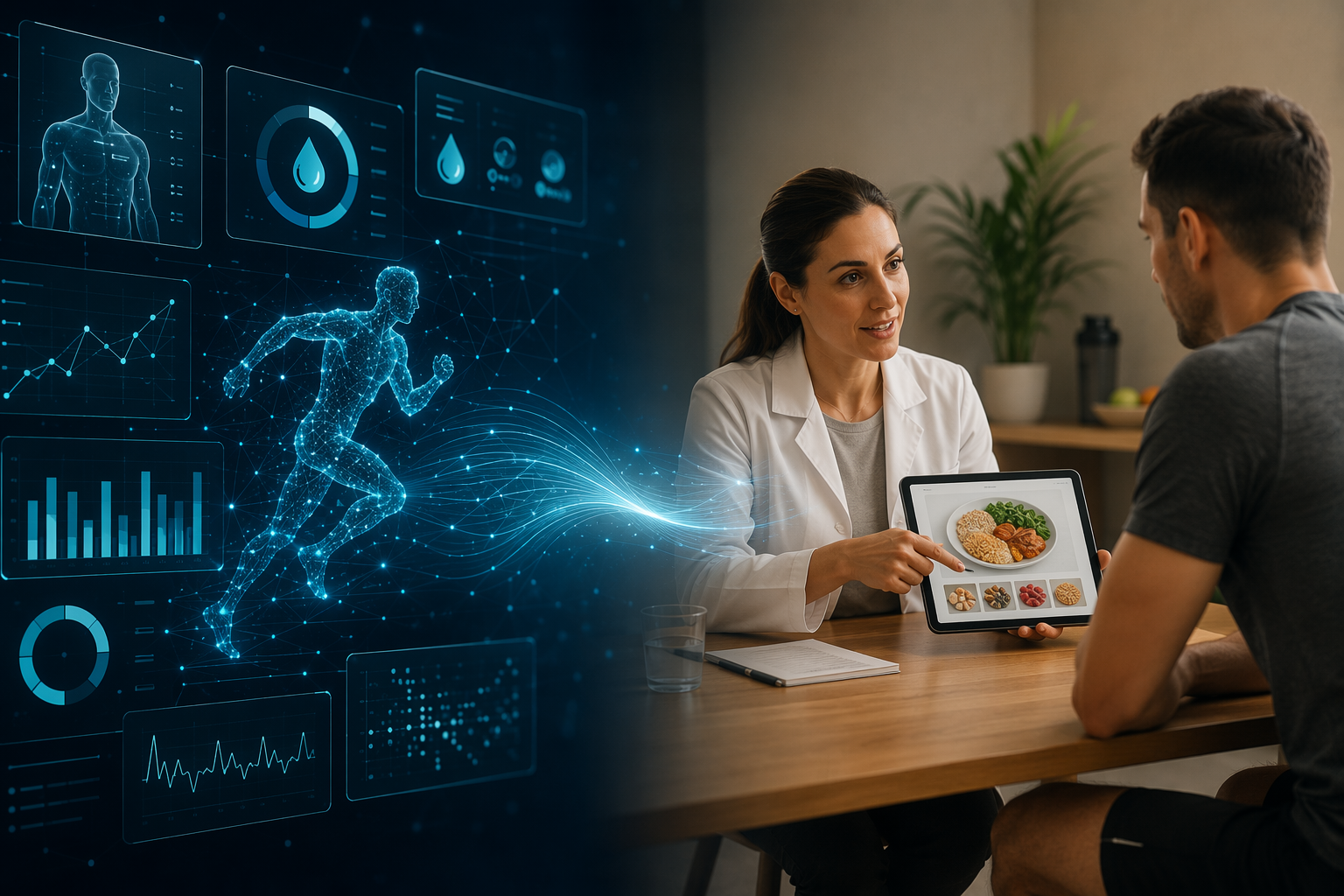
That distinction is where the evidence becomes useful. AI looks most reliable when the nutrition problem has a defined input, a constrained output, and a way to check whether the answer is plausible. It becomes much less reliable when the task depends on ambiguous athlete context, uncertain food records, competing clinical risks, or the model's ability to verify its own sources.
The Difference Between a Calculation and a Care Decision
Fluid management is a good example of a task where an AI system can plausibly outperform a rushed practitioner if the scenario is clean enough. The model can hold several variables in view, apply a known rule set consistently, and avoid arithmetic drift. That is not trivial. Sports dietitians and clinicians make errors under time pressure, and a benchmark that exposes those errors is useful rather than threatening.
But athlete nutrition decisions rarely stop at the calculation. A hydration recommendation may be mathematically appropriate and still fail if the athlete cannot tolerate the fluid volume, is racing in heat, has a history of gastrointestinal distress, is using sodium supplements inconsistently, or changes pacing strategy. In practice, the calculation is one layer in a decision chain. The accountable decision is the one that survives contact with the athlete.
This is why the strongest case for AI in sports nutrition is not replacement. It is augmentation: using models to process data, calculate structured requirements, detect patterns, and flag likely states for a human practitioner who still has to interpret the result.
Where the Evidence Is Strongest
The better-supported uses of AI in athlete nutrition share a practical feature: they reduce a messy workflow into a bounded prediction or calculation. That does not make them easy, but it makes them auditable.
| Workflow | Typical Data Entering the System | AI Output | Reasonable Use in Practice |
|---|---|---|---|
| Fluid management | Body mass change, sweat-rate assumptions, event duration, environmental context, intake targets | Estimated fluid and electrolyte recommendation | Calculation support, scenario checking, and error reduction in structured endurance cases [1] |
| Macronutrient periodization | Training load, session type, body composition goals, dietary intake records, recovery demands | Suggested carbohydrate, protein, or energy targets aligned to training blocks | Planning support when reviewed against athlete tolerance, availability, and clinical context |
| CGM pattern detection | Continuous glucose traces, meal timing, exercise timing, sleep, and sometimes wearable data | Predicted or classified glycemic responses | Pattern recognition and hypothesis generation, not stand-alone diagnosis or performance prescription [2][3] |
| Recovery prediction | Heart-rate variability, sleep, diet, wellness measures, repeated athlete-day observations | Next-morning recovery estimate or readiness classification | Monitoring support for practitioners managing training and fueling decisions [4] |
Macronutrient periodization sits in the middle of this spectrum. If the task is to translate a training plan into carbohydrate availability targets or protein distribution reminders, software can help. The burden is not simply knowing that a hard session requires more fuel than a rest day. The burden is remembering which athlete skipped breakfast, who is traveling, who has low appetite after evening sessions, who is trying to make weight, and who has been quietly under-fueling for weeks. A model can help organize the plan; it should not be mistaken for the person who understands why the athlete is not following it.
Continuous glucose monitoring is similar. The landmark Zeevi et al. study showed that machine-learning models could predict personalized postprandial glycemic responses using individual features, microbiome data, blood parameters, dietary inputs, and lifestyle information.[2] That work is foundational for personalized nutrition. It is not, by itself, validation that CGM-driven AI advice improves performance or health outcomes in elite athletes.
That boundary matters because athlete glucose traces are not general wellness dashboard signals. Training timing, glycogen status, stress, sleep, heat, fueling during exercise, and recovery nutrition can all change interpretation. Flockhart and Larsen's 2024 Sports Medicine discussion of CGM in athletes without diabetes emphasizes limitations in interpretation and the need for caution when translating glucose data into athlete guidance.[3] A CGM pattern can suggest a question worth asking. It cannot, on its own, answer whether the athlete should change race fueling, reduce carbohydrate intake, or worry about a transient spike after a high-intensity session.
Recovery Prediction Is a Better Fit Than Diet Advice Chat
The most persuasive near-term role for AI may be less glamorous than automated meal planning: predicting recovery states from repeated athlete data. Rothschild et al.'s athlete-day work is a useful example because it looks like a real workflow. In a dataset of 43 athletes and 3,572 athlete-days, machine-learning models used variables including heart-rate variability, sleep, diet, and wellness measures to predict next-morning recovery, and the models outperformed baseline approaches.[4]
This is the kind of problem where machine learning has an obvious role. The model is not pretending to be a dietitian. It is taking repeated measurements, looking for patterns across modalities, and producing a defined prediction target. A practitioner can then ask the more important questions: whether low predicted recovery reflects under-fueling, poor sleep, life stress, illness, training load, travel, or a measurement artifact.
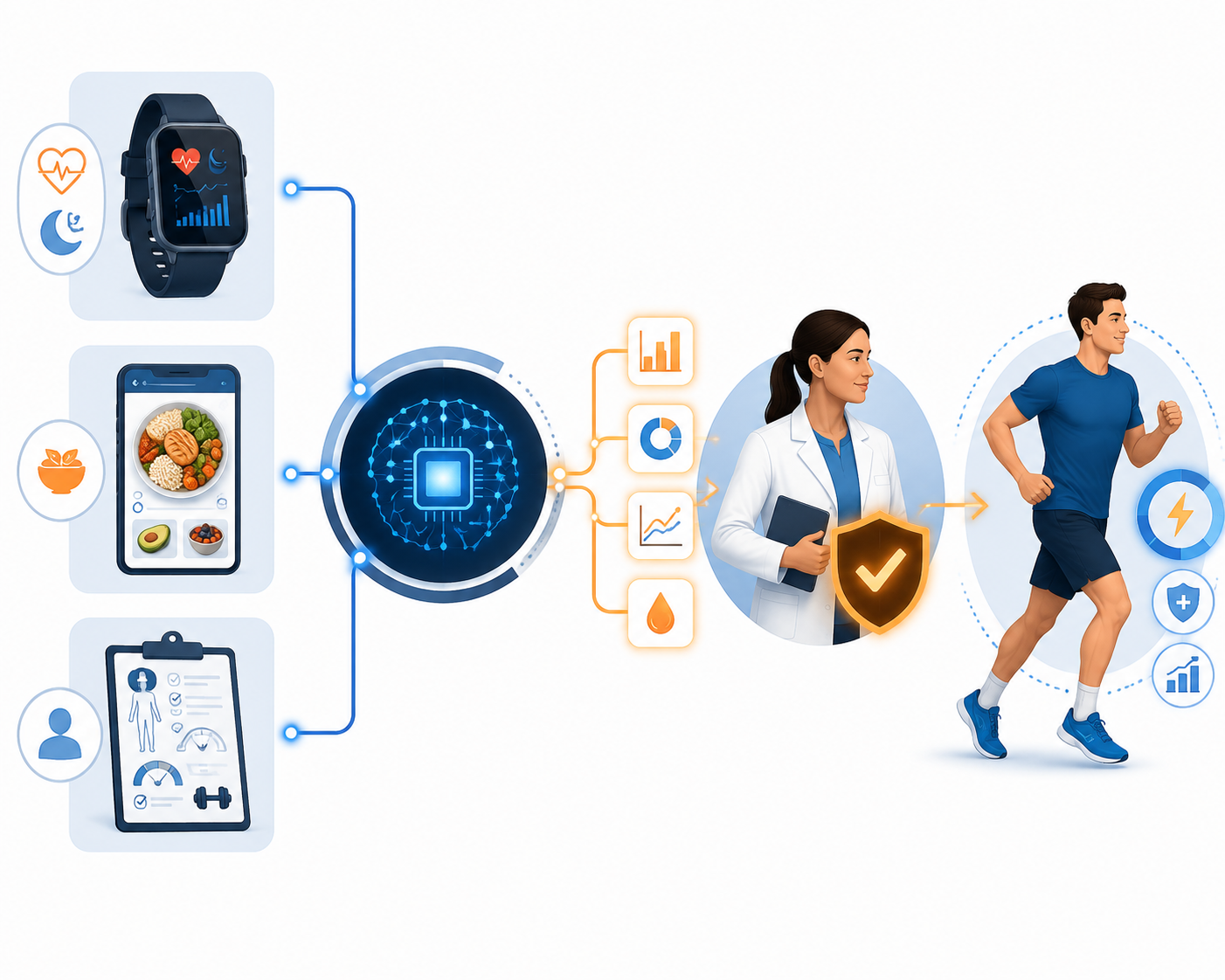
The recovery-prediction example also keeps the word "personalized" honest. Personalization is not just using an athlete's name or producing a meal plan with preferred foods. It means the system has enough athlete-specific signal over time to detect what changes for that athlete, under those conditions, with that training load. Without repeated data and a clear outcome, "personalized" often becomes a label attached to generic advice.
Where Performance Starts to Degrade
Food-image recognition is a predictable weak point. It is tempting because the athlete takes a photo, the software estimates the meal, and everyone pretends a burdensome food log has been solved. The problem is that portion size, hidden ingredients, cooking methods, sauces, mixed dishes, and brand-specific products can matter enough to change the nutrition decision. For a recreational wellness app, approximate macro tracking may be acceptable. For an athlete trying to recover from high load, make weight safely, manage gastrointestinal tolerance, or identify chronic low energy availability, approximation can become misleading.
Large language models create a different failure mode. They can produce confident, well-structured advice even when they lack the clinical reasoning or verified sourcing needed for athlete care. USADA's analysis of ChatGPT for sports nutrition advice highlights fabricated citations and cautions that the tool lacks clinical judgment.[5] Training & Conditioning's 2024 review similarly warns that AI-generated meal plans were not assessed for athletes with performance goals and did not include medical evaluation or drug-nutrient interaction checks.[6]
Those are not cosmetic problems. A fabricated citation is not just an academic inconvenience; it is a broken safety signal. In sports nutrition, a source may be doing work the athlete cannot see: distinguishing a tested supplement from a contaminated one, separating a population-level recommendation from a clinical exception, or identifying when a medication, medical condition, or anti-doping risk changes the advice. If the model invents the source, the practitioner loses the audit trail.
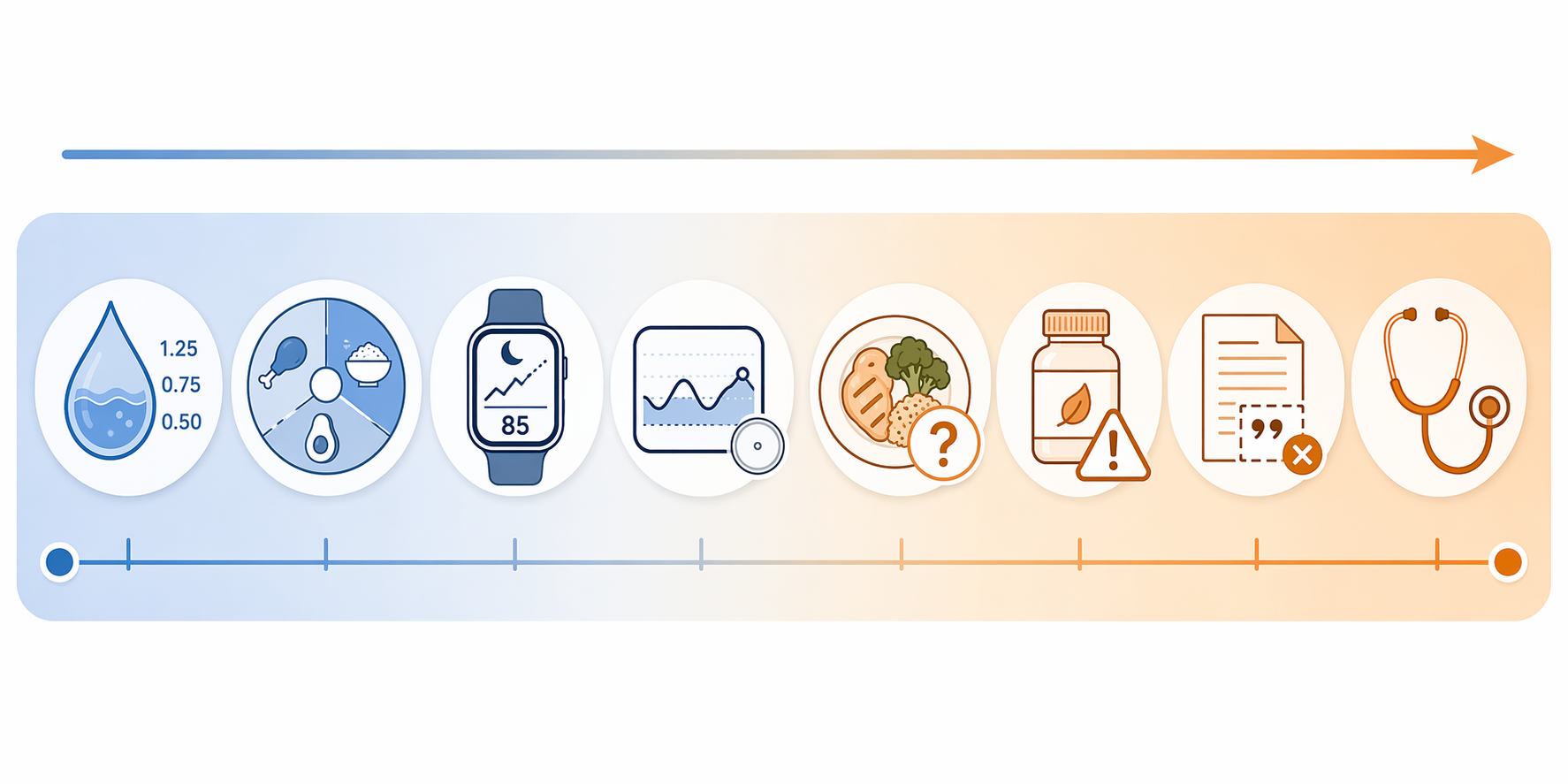
Supplement reasoning is especially exposed to this problem. The evidence base can involve dose, timing, training status, genotype, medication interaction, contamination risk, competition rules, and product quality. Guest et al.'s 2019 review on nutrigenomics discusses CYP1A2 genotype and caffeine response, illustrating why genotype-aware supplementation is scientifically plausible but not reducible to a simple chatbot prompt.[7] An athlete asking whether caffeine is "good for me" is not asking one question. They are asking about response likelihood, side effects, sleep disruption, anxiety, gastrointestinal tolerance, event timing, dose, and safety.
Algorithmic supplement-personalization work is moving quickly, but much of it remains closer to proposal than validated clinical outcome. Pandya et al.'s 2026 work describes machine-learning and optimization methods including Random Forest, XGBoost, artificial neural networks, genetic algorithms, and Bayesian optimization for supplement personalization.[8] That is a plausible technical toolkit. It is not the same as evidence that athletes using such systems have better performance, fewer adverse events, or safer supplement decisions.
Generalizability Is Not a Footnote
Much of the stronger sports-nutrition AI evidence sits near endurance contexts: ultra-endurance fluid management, cycling or running-like monitoring problems, CGM interpretation around exercise, and recovery prediction from repeated wearable data. That is not a weakness by itself. Endurance sport produces exactly the kind of repeated, continuous, quantifiable data that models can use.
It does mean conclusions should not be casually transferred to team sports, strength sports, or weight-category sports. A soccer player, powerlifter, combat-sport athlete, and ultramarathon runner may all need nutrition periodization, but the consequences of an error are different. Under-fueling a weight-category athlete during a cut is not the same clinical problem as misjudging carbohydrate intake during a long training ride. A hydration model validated in one event context does not automatically understand collision load, repeated sprint demands, rapid weight loss, or the social pressure around body composition in aesthetic and judged sports.
Emerging digital-twin work should be read in that light. Amawi, Grivas, and Alkasasbeh's 2026 Frontiers in Public Health framework for Taekwondo athletes integrates nutrition, psychology, and performance data in a sport-specific digital twin.[9] That is the right conceptual direction: context-rich, athlete-specific, and multi-domain. But digital twins remain largely conceptual or pilot-stage in sports nutrition rather than large-scale, multi-sport systems with validated clinical and performance outcomes.
The same evidence-quality standard applies across adjacent clinical AI work, from athlete health monitoring during wildfire smoke to rehabilitation outcome modeling and broader healthcare AI validation standards. Sports nutrition tools should not get a lower evidentiary bar just because the interface looks convenient. Related evidence reviews include AI tools for athletes during wildfire smoke, AI-assisted rehabilitation for sports injuries, and healthcare AI companies with the strongest clinical validation evidence.
A Practical Evidence Judgment
The current evidence supports a simple working boundary. AI is most reliable when it is asked to calculate, classify, detect patterns, or predict a defined outcome from structured data. That includes fluid-requirement support, nutrition-periodization scaffolding, CGM pattern analysis with careful interpretation, and recovery prediction from wearable and wellness measures.
AI is least reliable when it is asked to replace clinical interpretation, resolve ambiguous athlete context, verify its own references, or produce supplement and diet advice without professional oversight. The fluent answer is the dangerous part because it can make a missing assessment look complete.
For clinicians evaluating AI systems, the first question should not be whether the tool saves time. It should be which part of the nutrition decision the tool actually performs. A model that calculates a hydration target, flags an unusual recovery pattern, or organizes training-day carbohydrate targets may be useful. A model that claims to optimize an athlete's diet without showing validated inputs, outcome evidence, source traceability, and clinical accountability is asking for more trust than the evidence currently supports.
References
- ULTRA-Q study secondary reporting, Healify blog
- Personalized Nutrition by Prediction of Glycemic Responses, Cell, 2015
- Continuous Glucose Monitoring in Endurance Athletes Without Diabetes, Sports Medicine, 2024
- Artificial Intelligence in Endurance Sports, Nutrients, 2025
- Using ChatGPT for Sports Nutrition Advice, USADA
- AI Meal Plans: Can ChatGPT Fuel Athletes?, Training & Conditioning, 2024
- International society of sports nutrition position stand: nutrigenomics, Frontiers in Nutrition, 2019
- Machine Learning-Driven Personalized Supplement Optimization, Advances in Consumer Research, 2026
- Digital Twin Framework for Taekwondo Athletes Integrating Nutrition, Psychology, and Performance Data, Frontiers in Public Health, 2026
Comments
Join the discussion with an anonymous comment.