
Recovery after anterior cruciate ligament reconstruction is long enough to be clinically awkward and variable enough to make a fixed calendar date unreliable. The athlete often wants to know when they can play again before the graft has finished declaring itself, before strength symmetry has stabilized, and before confidence and workload have been tested together. That is why ai in sports injury recovery and surgery timelines has become attractive: not because clinicians need a more impressive dashboard, but because return-to-sport decisions after sports surgery still carry too much uncertainty at the exact point when everyone wants certainty.
The clinical need is real. After ACL reconstruction, only 63% of patients regain their preinjury activity level, and recovery commonly spans 6 to more than 12 months.[1] A model that could identify, early in rehabilitation, which patients are tracking toward a 12-month functional recovery target would be useful. It could change how aggressively a team addresses quadriceps strength, balance, conditioning, and expectations. It could also prevent the common mistake of treating “9 months post-op” as if it means the same thing for every knee.
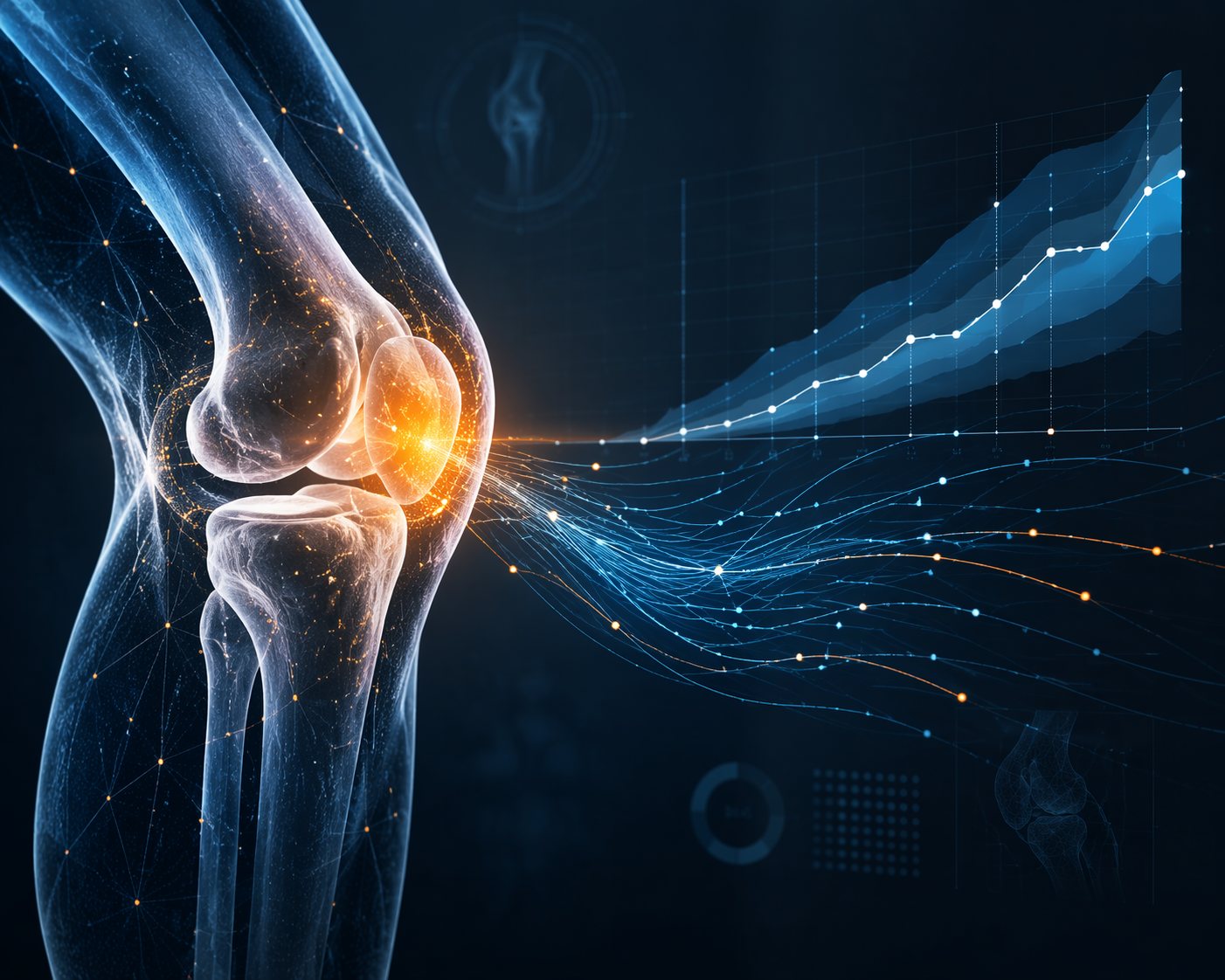
The strongest ACL timeline model is impressive, but narrow
The best load-bearing example is Hwang et al. 2024, a single-center Korean study of 102 patients after ACL reconstruction. The investigators used 3-month postoperative physical performance data to predict 12-month recovery outcomes. Their random forest model reported an AUC of 0.952 for predicting the single-leg hop test outcome at 12 months and an AUC of 0.949 for predicting the Tegner activity score.[1]
Those numbers deserve attention because the inputs are clinically recognizable. The model did not depend on exotic imaging features or a black-box stream of wearable data. It used measures that many sports rehabilitation teams already care about: Y-balance performance, isokinetic strength, and BMI. In the SHAP analysis, the leading predictors included 60°/s knee extensor peak torque, Y-balance total score, and BMI.[1]
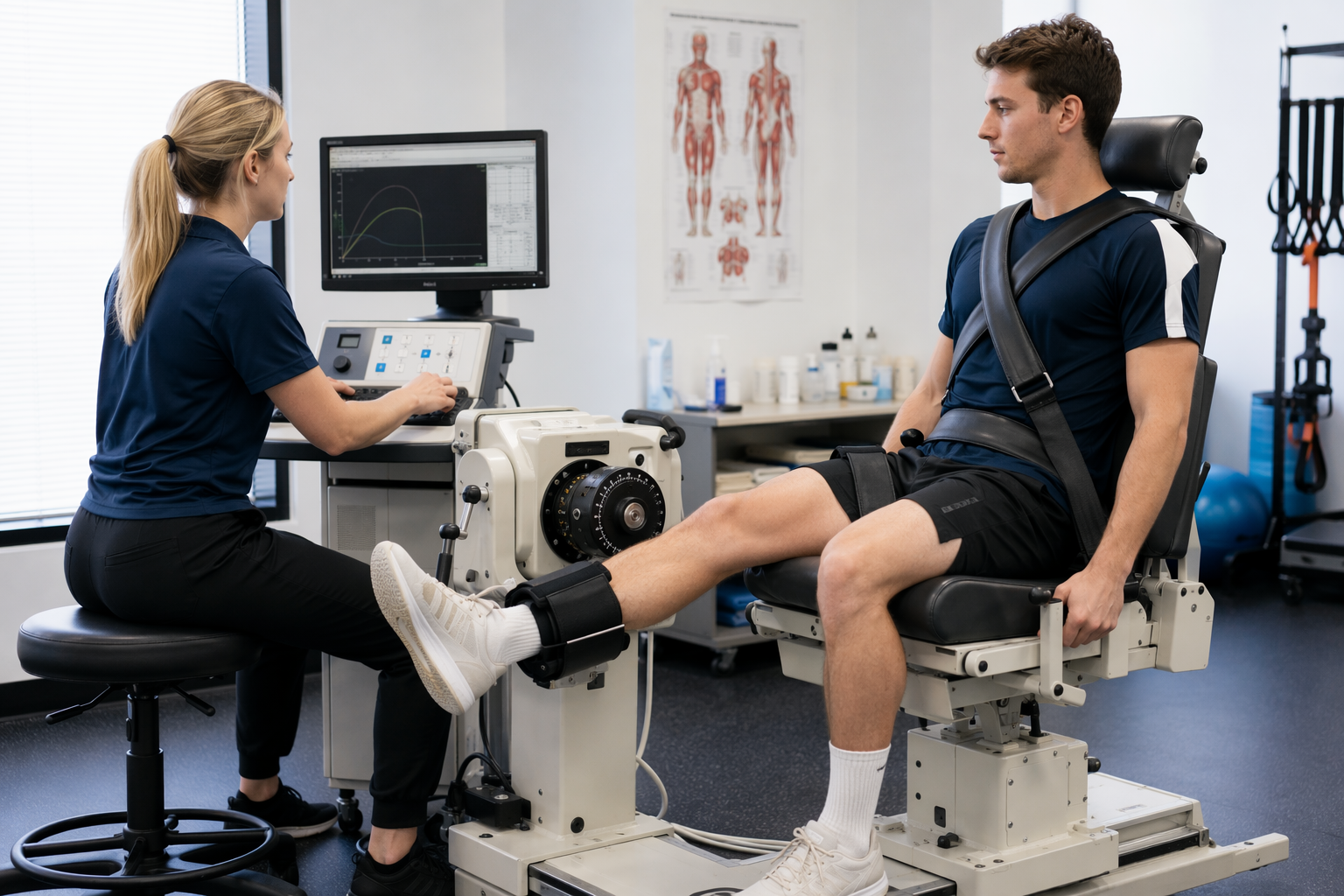
That is the kind of machine learning result a clinician can interrogate. If knee extensor strength at 3 months is carrying substantial predictive weight, the model is not replacing clinical reasoning so much as quantifying a pattern clinicians already suspect. If Y-balance performance contributes meaningfully, the result points toward neuromuscular control rather than simply time since surgery. BMI is more complicated: it may carry biomechanical, conditioning, or population-level signal, but it should not be mistaken for a modifiable short-term rehabilitation target in the same way quadriceps strength can be.
The limitation is just as important as the AUC. A 102-patient, single-center cohort can show that a signal exists inside one hospital’s patients, surgical patterns, testing protocol, and rehabilitation culture. It cannot prove that the same model will hold for a different surgeon group, a different return-to-sport philosophy, a different athlete mix, or a clinic that measures strength and balance differently.
What the published prediction studies are actually predicting
The published sports surgery models are often discussed as if they answer one question: “When will this athlete recover?” They do not. Some predict return to sport, some predict revision risk, some predict patient-reported recovery, and some predict physical performance at a later time point. Those targets overlap clinically, but they are not interchangeable.
| Study or context | Surgery or injury area | Prediction target | Reported performance | Main caution |
|---|---|---|---|---|
| Hwang et al. 2024 | ACL reconstruction | 12-month single-leg hop and Tegner activity score using 3-month postoperative data | AUC 0.952 for single-leg hop; AUC 0.949 for Tegner activity score | n=102, single-center Korea |
| Ye et al. 2022 | ACL reconstruction | Return-to-sport prediction | AUC 0.777 | Retrospective model; generalizability remains uncertain |
| Martin et al. | ACL reconstruction registry context | Revision risk | Concordance 0.68 | Revision risk is not the same outcome as return-to-sport timing |
| Valle et al. 2022 | Hamstring injury in elite soccer | Return-to-play prediction | Machine learning models outperformed traditional statistical models | Elite soccer findings may not transfer to broader sports surgery populations |
Ye et al. 2022 reported an AUC of 0.777 for return-to-sport prediction after ACL reconstruction in a cohort of 432 patients.[2] That is a more modest number than Hwang’s 12-month performance models, but the outcome is also closer to the practical question patients ask in clinic. Return to sport is a behavioral and medical endpoint at once. It depends on knee function, symptoms, sport demands, risk tolerance, coach pressure, access to rehabilitation, and whether the athlete actually chooses to return.
Revision-risk models answer a different question. Martin et al. reported a concordance of 0.68 for revision risk in a registry-based context.[3] That can matter for counseling and surveillance, but it should not be translated into a return-to-play date. An athlete can be functionally delayed without needing revision surgery, and an athlete can return quickly while still carrying an elevated long-term failure risk.
The hamstring literature reinforces the same point from another direction. Valle et al. 2022 found that machine learning models outperformed traditional statistical models for predicting return to play after hamstring injury in elite soccer.[4] That supports the idea that nonlinear models can capture useful recovery patterns, especially in high-quality performance environments. It does not establish that a hamstring return-to-play model for elite soccer can be imported into ACL reconstruction, rotator cuff repair, or a community sports medicine clinic.
Most of this is not deep-learning magic
The models that matter here are mostly random forests, gradient boosting methods, and logistic regression. That is a strength, not an embarrassment. For timeline prediction after sports surgery, the problem is not usually a shortage of algorithmic sophistication. It is the difficulty of collecting consistent, clinically meaningful postoperative data across enough patients and enough settings.
Random forests are well suited to mixed clinical inputs because they can model nonlinear relationships without requiring every predictor to behave neatly. SHAP analysis then gives the rehabilitation team a way to inspect which variables influenced the prediction. In Hwang’s study, that made the model more clinically readable: extensor strength, Y-balance, and BMI were visible signals rather than hidden mathematical residue.[1]
There is room for richer data streams. Wearables, force plates, app-based rehab adherence, and patient-reported symptoms could eventually improve postoperative monitoring. But the evidence for AI wearables in sports injury prediction is adjacent to this question, not a substitute for it. Predicting who is at risk of injury before surgery and predicting who is ready after reconstruction are related problems with different labels, consequences, and validation requirements.
A high AUC is not the same as a deployable clearance tool
AUC is useful because it measures discrimination: how well a model separates patients who will meet an outcome from those who will not. It does not tell the clinician whether the model is calibrated for a local patient population, whether it performs equally well across sex, age, sport, graft type, or competition level, or whether using it changes outcomes.
This is where the current evidence becomes much less reassuring. The reported AUC values for sports surgery recovery and return-to-sport prediction range from about 0.77 to 0.95 across published studies, but the evidence base is almost entirely retrospective, single-center, and externally unvalidated.[1][2] That is not a small footnote. It is the central barrier to clinical deployment.
External validation matters because rehabilitation is not standardized in the way a model spreadsheet suggests. One clinic may test isokinetic strength at fixed intervals; another may not have a dynamometer. One surgeon may delay pivoting sport exposure; another may use a more accelerated progression. A professional athlete may have daily supervised therapy, while a recreational athlete may be fitting exercises around work and insurance limits. These differences can change both the predictors and the outcome.
Prospective testing matters for a different reason. A retrospective model can look clean because the data already exist and the outcome has already happened. In practice, the model would be used while the athlete is still recovering, when measurements are missing, symptoms fluctuate, and decisions made by the clinician may alter the very timeline being predicted. A model that performs well on historical records still needs to show that it remains useful when embedded in care.
Recovery, revision, and patient-reported outcome should not be blended together
For clinical research, the outcome definition is not a technical detail. “Return to sport” can mean clearance, first participation, return to preinjury level, sustained participation, or return without reinjury. A Tegner activity score at 12 months is not the same as a coach putting an athlete into unrestricted competition. A single-leg hop target is not the same as psychological readiness. Revision surgery is not the same as functional failure.
That distinction also matters for patient counseling. If a model predicts a lower probability of reaching a 12-month hop or activity target, the responsible conversation is about modifiable deficits, uncertainty, and monitoring. It should not become a definitive statement that the athlete will not return. If a model estimates revision risk, the conversation is about risk management and long-term graft protection, not simply whether the athlete can pass a functional test next month.
This is where the related rehabilitation literature is useful but limited. Evidence on AI rehab for sports injuries can help frame how digital tools might support exercise progression, adherence, and monitoring. But a rehabilitation support tool and a post-surgical timeline prediction model are not the same device, and they should not be evaluated as if they carry the same clinical risk.
The field is still investigational
The broader literature has reached a similar point. A 2026 narrative review in The Knee concluded that most AI models in sports knee injury management remain investigational and have limited explainability.[5] That does not make the work unimportant. It means the distance between publication and clinical clearance is still substantial.
The regulatory context points in the same direction. AOSSM’s overview of AI in orthopedics notes that FDA-cleared AI in orthopedics is concentrated in imaging, not sports recovery timeline prediction.[6] Commercial performance and wellness tools may use AI language, but there is no FDA-cleared device specifically for predicting sports surgery recovery timelines.
That distinction should keep clinicians from over-borrowing confidence from other areas of orthopedic AI. An imaging algorithm that detects or measures a structure on a scan is solving a different problem from a model that predicts whether an athlete will safely and successfully resume sport months after surgery. The latter depends on biology, rehabilitation exposure, behavior, sport context, and decision-making by multiple people.
The broader AI sports injury prediction reliability question has the same recurring problem: a model can perform well in the dataset where it was built and still fail when the population, measurement process, or clinical use case changes.
What would make these models more clinically credible
The next useful studies do not need to prove that machine learning can produce another high AUC in one more retrospective cohort. They need to test whether these models travel.
- External validation across hospitals, surgeons, rehabilitation protocols, and athlete populations.
- Prospective testing where predictions are generated during active recovery, not after outcomes are already known.
- Clear outcome definitions that separate clearance, first return, return to preinjury level, sustained participation, revision, and patient-reported recovery.
- Calibration reporting, not just discrimination, so clinicians know whether predicted probabilities match observed outcomes.
- Decision-impact studies showing whether model use changes rehabilitation choices, return-to-sport timing, reinjury surveillance, or patient understanding.
The practical conclusion is restrained but not dismissive: current AI models are accurate enough in single-center studies to justify serious validation work, especially when they identify interpretable signals such as knee extensor strength and Y-balance. They are not yet validated well enough to be treated as broadly deployable tools for sports surgery recovery timelines.
References
- Machine learning-based prediction model for postoperative recovery after anterior cruciate ligament reconstruction. PMC. 2024.
- Machine learning algorithms for predicting return to sport after anterior cruciate ligament reconstruction. PubMed. 2022.
- Registry-based prediction of revision risk after anterior cruciate ligament reconstruction. PubMed.
- Machine learning models for predicting return to play after hamstring injury in elite soccer. Sports Medicine. 2022.
- Artificial intelligence in sports knee injury management: a narrative review. The Knee. 2026.
- Artificial Intelligence in Orthopaedics. AOSSM Sports Medicine Update.
Comments
Join the discussion with an anonymous comment.