
In street medicine, AI for drug overdose prevention in the homelessness crisis is not an abstract screening dashboard waiting inside a clinic. It is more often a tablet or phone used beside a tent, in a parking lot, under an overpass, or during a brief encounter with a person who may be ready for buprenorphine today and unreachable tomorrow. That is why the most important early claims about AI-augmented street medicine are operational as much as clinical: same-day provider access, medication-assisted treatment initiation, emergency department use, and whether one physician can safely carry a larger panel without turning care into a referral slip.
Akido Labs’ Scope AI is the clearest current example. In company-published reporting, Akido says its street medicine program has served about 7,000 patients since 2023, enrolled about 1,800 people in ongoing care, enabled 53% of patients to see a provider on the first day, initiated medication-assisted treatment for 83% of roughly 2,400 patients with substance use disorder, reduced emergency department use by 55%, expanded physician panels from about 150 to more than 500 patients, and achieved 100% Medi-Cal reimbursement for visits submitted through the model.[1]
Those numbers deserve attention because they describe parts of care that commonly break first for unhoused patients with substance use disorder. They do not, by themselves, prove that Scope AI reduces overdoses. They are internally reported program outcomes, not peer-reviewed trial results, and the comparison conditions behind them are not the same as random assignment. Still, in a care setting where a missed follow-up can mean a return to fentanyl exposure, an 83% MAT initiation claim is not a vanity metric. It is a claim about whether a treatment window stayed open long enough for medication to begin.
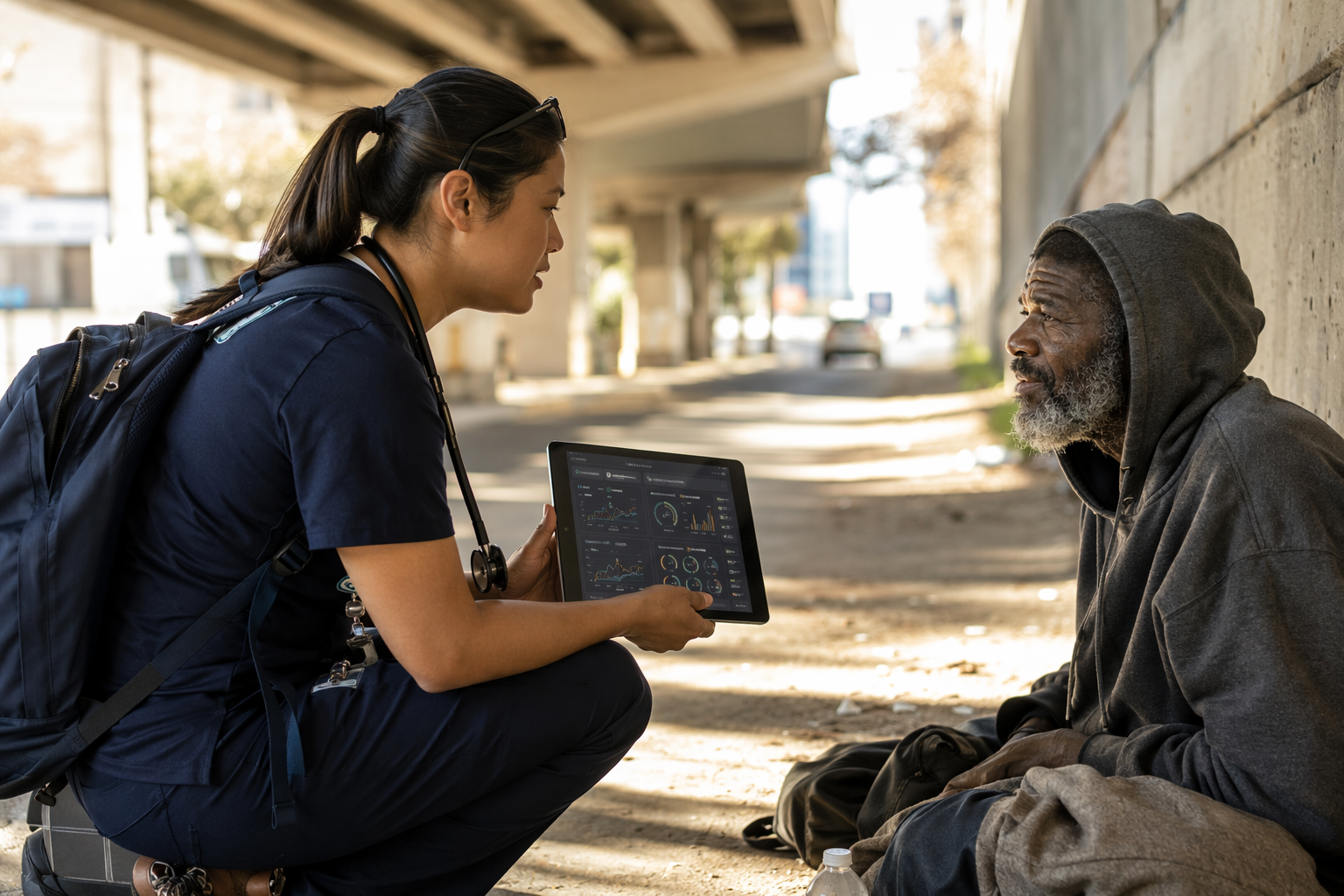
Where Scope AI Enters The Street Medicine Visit
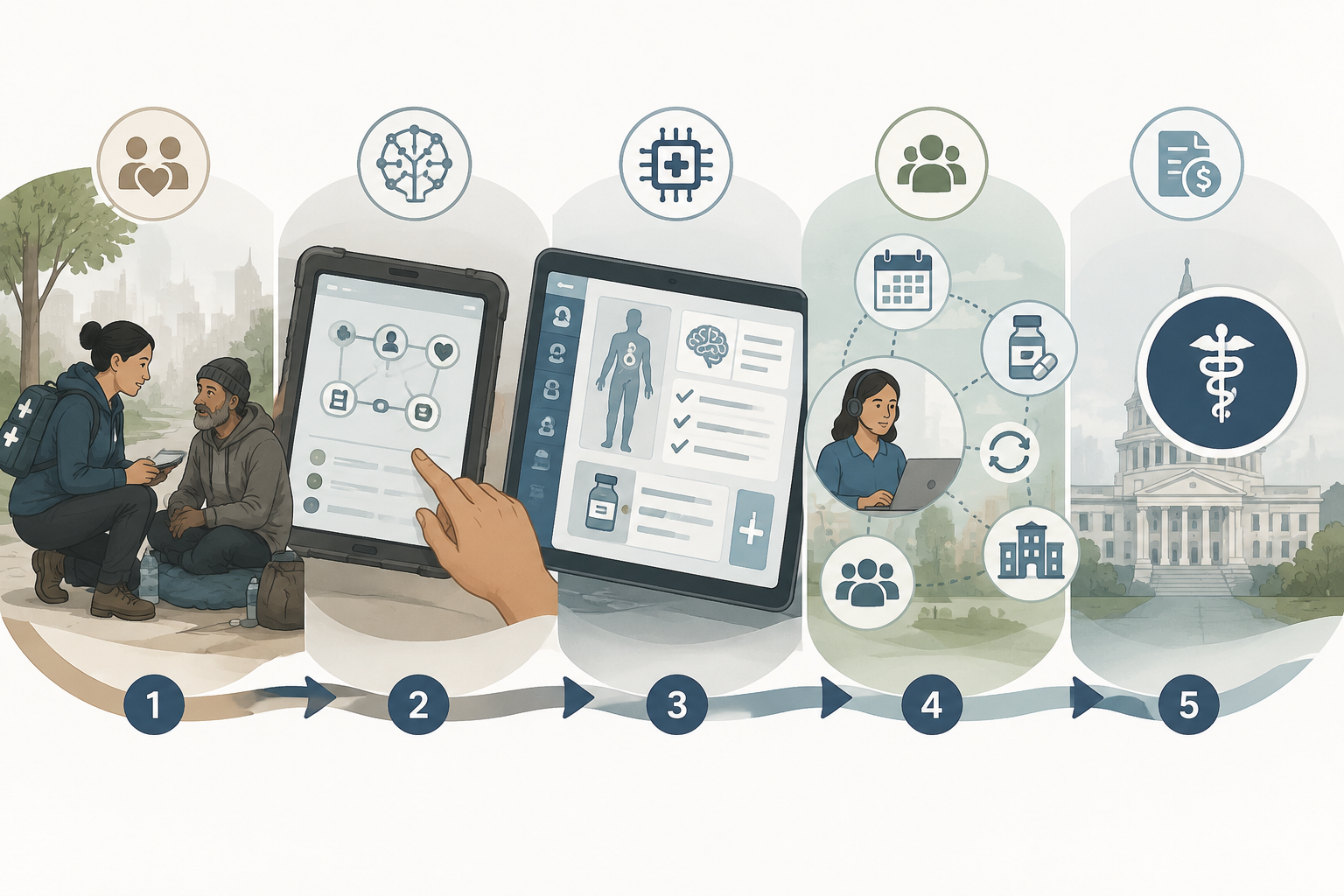
Scope AI is reported to support several steps that street teams usually have to hold together with memory, paper notes, messaging threads, and delayed charting: intake, diagnosis support, treatment planning, care coordination, and reimbursement documentation. The attraction is not that a model recognizes addiction risk in a database. The attraction is that it may reduce the number of fragile handoffs between a sidewalk encounter and an actual treatment plan.
| Street medicine task | What AI support is reported to change | Why it matters for overdose prevention |
|---|---|---|
| Intake | Structured data capture during the outreach encounter | The first visit may be the only reliable moment to document substance use history, current withdrawal risk, and immediate needs. |
| Diagnosis and clinical support | Suggested diagnoses and care pathways for clinician review | Medication decisions can move faster, but only if the recommendation fits the patient’s living conditions. |
| MAT initiation | Earlier identification of patients eligible for medication-assisted treatment | Starting medication quickly can matter more than scheduling a future intake that the patient may not reach. |
| Care coordination | Follow-up tasks, panel tracking, and service linkage | The work after the first dose determines whether treatment becomes ongoing care. |
| Medi-Cal reimbursement | Documentation aligned with billing requirements | Financial sustainability affects whether outreach teams can keep serving high-need patients. |
The reimbursement point can look bureaucratic until it is placed back on the street. Akido reports 100% Medi-Cal reimbursement for submitted visits in its model.[1] If accurate and reproducible, that matters because street medicine programs often operate on unstable funding, philanthropic support, or grant cycles. A clinician cannot initiate buprenorphine for a panel that the program cannot afford to keep seeing.
The panel expansion claim is more complicated. A physician panel growing from 150 to more than 500 patients sounds like access, and it may be. It can also become a warning sign if the additional capacity comes from thinner relationships, less field time, or overreliance on prompts that do not capture reality outside the chart. The question is not whether a larger panel is good or bad in isolation. It is what gets preserved as the panel grows: same-day clinician review, medication access, follow-up, documentation quality, and enough human attention to notice when a technically correct plan is impossible to carry out.
The Outcome Claims Are Promising, But Their Source Matters
Scope AI’s reported 83% MAT initiation rate among roughly 2,400 patients with substance use disorder is the strongest operational signal because MAT initiation is close to the clinical event that matters. It is still not the same as retention in treatment, reduced illicit opioid exposure, reduced overdose, or mortality benefit. The 55% emergency department reduction is also important, but ED use can fall for more than one reason: better outpatient care, barriers to hospital access, changes in patient mix, local policy changes, or measurement differences across time.[1]
Company-published outcomes are not useless. In emerging service models, internal data often appears before formal trials because the clinical need is already present and the implementation is moving faster than the research cycle. But internal reporting should stay in its lane. It can justify close attention, replication attempts, and more rigorous evaluation. It should not be treated as settled clinical proof that AI independently caused fewer overdoses among unhoused patients.
Independent reporting from CalMatters adds useful context on Scope AI’s Los Angeles County deployment and also surfaces skepticism from clinicians who work directly with unhoused patients. The reporting includes a critique from the director of USC Street Medicine that AI “would not work for this population,” centered on the problem that clinical recommendations can fail when they do not account for street conditions.[2]
That critique is strongest when it is specific. A topical scabies treatment plan may be clinically standard, but it depends on access to a shower and clean clothing. For a patient without those basics, the recommendation can be correct in the abstract and wrong at the bedside — except the bedside is a curb, a shelter line, or a car. This is not a philosophical objection to AI. It is a clinical safety issue: the model may optimize for a patient who has the resources assumed by the guideline, while the outreach clinician is treating the patient who is actually there.

The Failure Mode Is Often Context, Not Computation
The most useful way to evaluate AI in homeless-serving addiction care is to ask where the failure would occur. Some failures are technical: inaccurate diagnosis suggestions, poor calibration, missing data, or a model trained on patients unlike the population being served. Some are operational: no pharmacy access, no phone battery, no transportation, no safe storage for medication, no clinician available to review a recommendation. Some are ethical: using unhoused patients as a testing population without transparent evidence, consent practices, or accountability. Some are legal: mishandling substance use treatment records that carry special protections.
For overdose prevention, this distinction matters. If the problem is technical, the model may need retraining, validation, or narrower use. If the problem is operational, a more accurate model may change very little unless the program can deliver medication, follow-up, and harm reduction supplies. If the problem is privacy, the correct response is not better prediction; it is governance that patients and outreach teams can trust.
Akido’s published material includes a diagnostic accuracy claim that Scope AI is 99% correct within its top three suggestions, but that claim is also company-published and has not been independently peer reviewed.[1] Even if such a figure is later validated, top-three diagnostic accuracy would answer only part of the street medicine question. The harder test is whether the right clinician action happens faster, whether the patient can carry it out, and whether care continues after the team leaves the block.
What The Research Models Add — And What They Do Not
Penn State’s CORTA system points to a different part of the field: optimization research for opioid-addicted homeless youth. The system uses information such as educational background, mental health history, and exposure to violence to assign personalized rehabilitation programs, and simulation work reported about a 110% improvement over baseline approaches.[3]
That is worth including, but only with the word simulation kept close to the result. CORTA does not provide real-world evidence that an AI tool improved MAT initiation, reduced emergency department use, or prevented overdose in a deployed homeless-serving program. It supports a narrower conclusion: researchers are trying to match interventions to the risk profiles and needs of homeless youth rather than assuming one generic substance use pathway.
The REALYST consortium adds another reason to be careful with generic overdose or relapse prediction models. University of Denver reporting describes research across roughly 1,400 to 1,600 youth experiencing homelessness in six states, identifying regionally specific risk factor profiles; adverse childhood experiences and physical street victimization were reported as more strongly associated with substance use disorder than sexual victimization.[4]
The point is not that every street medicine program needs its own bespoke model before it can act. The point is that homelessness is not merely another checkbox in a risk score. The exposures, service access patterns, and treatment constraints differ enough that models developed in Medicaid claims, hospital records, or general addiction populations may not transfer cleanly. Readers interested in the broader addiction modeling landscape can compare this with ClinicalMind’s coverage of AI addiction relapse prediction and opioid use disorder relapse tools.
The Evidence Gap Between Hospitals And Street Medicine
The stronger clinical evidence for AI-supported addiction intervention currently sits closer to the hospital than the sidewalk. ClinicalMind’s coverage of an AI-powered opioid screening hospital trial describes the Afshar et al. 2025 Nature Medicine randomized trial of AI-prompted addiction consults. That kind of trial design gives administrators and clinicians a cleaner basis for causal inference than an internally reported street medicine deployment can provide.
But the hospital comparison cuts both ways. Hospitals can randomize prompts, define readmission outcomes, and capture encounters inside an electronic health record. Street medicine teams work in settings where the patient may have no address, no charged phone, no secure place for medication, and no guarantee of being in the same location tomorrow. A weaker evidence base in street medicine does not mean the work is less important. It means the evidentiary burden has to be built around the actual care environment rather than borrowed wholesale from inpatient informatics.
For Scope AI, the missing study is straightforward to name: no peer-reviewed randomized clinical trial has yet evaluated its clinical outcomes in street medicine. A future evaluation would need to separate several effects that are currently bundled together: the AI tool, the outreach staffing model, clinician availability, MAT protocols, documentation support, and local Medi-Cal reimbursement workflows. Without that separation, it remains hard to know how much of the reported improvement comes from AI and how much comes from building a more responsive street medicine system around it.
Privacy Is Part Of The Clinical Model
Substance use treatment records are not ordinary care coordination data. In the United States, 42 CFR Part 2 creates special protections for records from federally assisted substance use disorder treatment programs. In homeless-serving systems, those protections are not a compliance afterthought; they affect whether patients believe that disclosing opioid use, stimulant use, relapse, pregnancy, criminal legal exposure, or shelter status will help them or harm them.
AI-supported care coordination can increase the number of people and systems touching sensitive information. That may be necessary for follow-up, billing, pharmacy coordination, and referrals, but it also raises hard questions: who can see the SUD record, whether consent travels with the data, how redisclosure is prevented, how model vendors handle protected information, and whether patients understand the consequences of being entered into an AI-supported care process.
For an unhoused patient, privacy breaches can carry practical consequences beyond embarrassment. Information can affect shelter access, family relationships, policing exposure, employment opportunities, and trust in outreach teams. A tool that improves billing and panel management but weakens trust in disclosure may damage the same clinical pathway it is trying to strengthen.
What Can Be Responsibly Concluded In Q3 2026
As of Q3 2026, AI-augmented street medicine is plausible and operationally promising for substance use treatment among people experiencing homelessness. Scope AI’s reported signals — first-day provider access, 83% MAT initiation among roughly 2,400 SUD patients, 55% emergency department reduction, about 1,800 patients enrolled in ongoing care, and physician panel expansion from about 150 to more than 500 patients — are large enough that health systems should not dismiss them as hype.[1]
The responsible conclusion stops before causal certainty. The Scope AI evidence remains early clinical application evidence, constrained by internal reporting, observational comparisons, no peer-reviewed Scope AI outcomes trial, context-blindness risks, and unresolved 42 CFR Part 2 privacy questions. CORTA and REALYST support the need for homelessness-specific modeling, especially among youth, but they do not establish deployed overdose prevention effectiveness.[3][4]
The best version of this work would make low-resource care less dependent on heroic individual memory without pretending that a model understands the street better than the clinician and patient standing in it. The evidence is not yet strong enough to say that AI-powered street medicine reduces overdoses among homeless populations as a proven outcome. It is strong enough to say that AI-supported intake, MAT initiation, documentation, and care coordination have produced unusually promising reported program results, and that those results now need independent validation in the conditions where the care actually happens.
References
- Street Smart: How Street Medicine Is Proving AI Works for Healthcare's Hardest Cases, Akido Labs.
- Can AI help make homeless Californians healthier?, CalMatters, Jan 2026.
- An AI algorithm to help identify homeless youth at risk of substance abuse, Penn State.
- Social Work Faculty Uses AI to Fight Substance Abuse in Youth Experiencing Homelessness, University of Denver.
Comments
Join the discussion with an anonymous comment.