
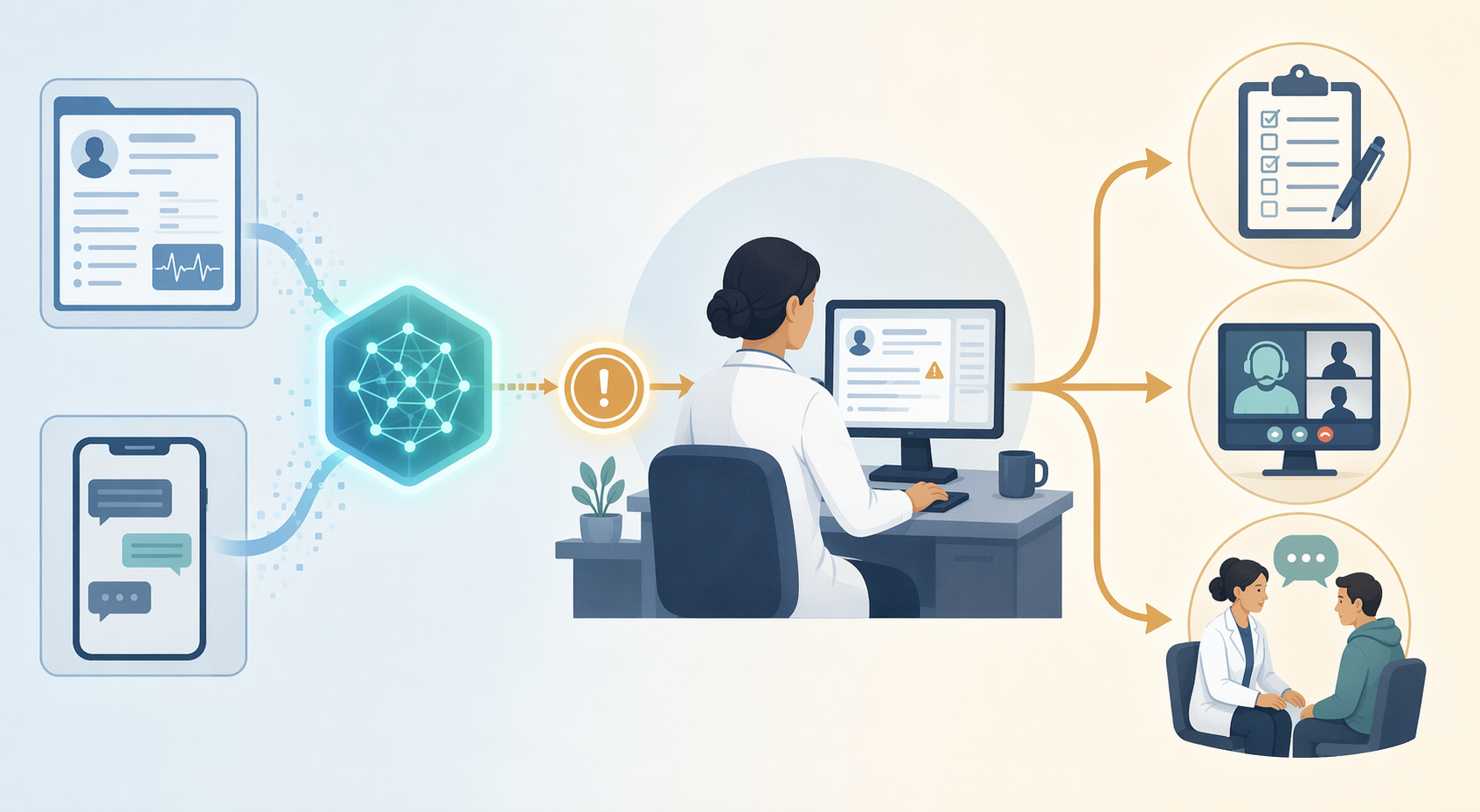
AI is beginning to change suicide risk detection in clinical practice in a narrower, more important way than the phrase often suggests. The useful question is not whether a model can label someone “high risk” in a dataset. It is whether that label reaches the right person, at the right time, in a workflow where screening, support, or crisis intervention can actually follow.
That distinction matters because three systems have now crossed from retrospective promise into live clinical operations: Vanderbilt’s EHR-based VSAIL alerts, Stanford and Cerebral’s CMD-1 crisis triage system, and Harvard/Beth Israel Deaconess work using digital phenotyping with multimodal data. They do not prove the same thing. Vanderbilt shows a large change in clinician screening behavior. Stanford and Cerebral show a dramatic reduction in crisis response time. The Harvard/BIDMC work shows how much signal may sit in everyday digital patterns, while also showing how unstable pattern recognition can become once the target is broader than one symptom change.
None of these systems, as of Q3 2026, has demonstrated a reduction in suicide mortality in a randomized controlled trial. That does not make the operational evidence trivial. It does mean the endpoint that patients, families, and health systems ultimately care about remains unproven.

What has actually moved into care
| System | Signal used | Where it enters workflow | Operational result | What it does not prove |
|---|---|---|---|---|
| VSAIL, Vanderbilt | EHR-based 30-day suicide attempt risk model | Neurology clinic visits, with either interruptive alerts or passive chart display | Across 7,732 visits, 8% were flagged; interruptive alerts produced 42% screening uptake versus 4% with passive display [1] | Whether screening gains reduce suicide attempts or deaths; whether results generalize beyond one academic neurology clinic |
| CMD-1, Stanford/Cerebral | Natural language processing of patient messages for crisis triage | Human-in-the-loop Slack workflow for clinical response | Median response time fell from more than 10 hours to under 10 minutes, with reported 97% sensitivity and 97% specificity [2] | Whether faster response changes downstream clinical outcomes; whether the same cost tradeoff works elsewhere |
| Harvard/BIDMC digital phenotyping | Wearables plus conversation text | Clinical research deployment around symptom-state recognition | Reported 100% accuracy for worsening depression and 83% for worsening anxiety, but 52% overall pattern recognition across clinical states [3] | Whether the approach can reliably drive suicide prevention decisions in routine care |
A systematic review helps set the outer frame: across 52 studies, Sherekar and Mehta reported that AI systems detected suicide risk with 72% to 93% accuracy across sources such as social media, EHRs, and language analysis, while unresolved ethical issues included data bias [4]. Those figures are useful as a signal that the field is no longer speculative. They are less useful as deployment guidance. Accuracy in a retrospective study does not tell a health system who receives an alert, who is interrupted, how quickly anyone responds, or how many patients and clinicians are swept into follow-up work that may or may not be clinically necessary.
Vanderbilt’s important finding was not only the model
Vanderbilt’s VSAIL study is valuable because it tested the same risk signal under two different clinical designs. The system estimated 30-day suicide attempt risk from EHR data and was tested across 7,732 neurology clinic visits. About 8% of visits were flagged. When the risk information appeared passively in the chart, clinicians completed screening in 4% of flagged visits. When the system used interruptive alerts, screening rose to 42% [1].
That is the kind of result clinical leaders should pay attention to, because it shows that implementation design changed behavior. The model did not simply exist near the clinician. It entered the visit loudly enough to alter what happened next.
The gain also carries the usual cost of interruptive design. A neurology clinician who opened the chart for headache, seizure follow-up, tremor, neuropathy, or multiple sclerosis could be pulled into suicide risk screening because the EHR model surfaced a risk estimate. That may be exactly the right interruption for a missed-risk patient. It may also be one more alert in a clinic session that is already running behind.
The study therefore supports a careful conclusion: interruptive AI alerts can substantially increase suicide risk screening uptake in a specific academic neurology clinic workflow. It does not support the broader claim that EHR suicide prediction systems, as a class, reduce suicide attempts or mortality. Nor should the Vanderbilt population be treated as interchangeable with community primary care, emergency care, pediatrics, or behavioral health clinics.
Still, the clinical leverage point is real. Many people who later die by suicide have contact with ordinary medical care before death, including primary care. That is why EHR-based screening feels different from a wellness app notification. It sits inside a place where a clinician can ask a question, document an answer, escalate if needed, and connect the patient to a human response.
CMD-1 shows what speed can and cannot settle
The Stanford/Cerebral CMD-1 deployment attacked a different bottleneck: crisis language buried in patient messages. The system used natural language processing to identify messages requiring urgent attention, then routed alerts into a human-in-the-loop Slack-based workflow. In live operations, median response time fell from more than 10 hours to under 10 minutes, with reported 97% sensitivity and 97% specificity [2]. For readers who want the technical background, the relevant method sits in the same family as NLP in clinical documentation, though the operational stakes here are different.
The response-time result is hard to dismiss. A message that waits overnight is not the same clinical object as a message reviewed within minutes. In crisis triage, time is part of the intervention pathway. Faster routing can determine whether the next action is outreach, safety planning, escalation, or documentation that no crisis is present.
The more revealing part of the deployment may be the cost assumption behind it. Clinical stakeholders weighted a false negative as 20 times more costly than a false positive [2]. That is a defensible institutional choice in suicide prevention, where missing a crisis can be catastrophic. It is not a universal constant. Another organization with fewer crisis staff, different message volume, weaker follow-up infrastructure, or a different patient population may not be able to absorb the same false-positive burden.
This is where accuracy figures can become misleading. A system can report strong sensitivity and specificity and still create a staffing problem if it is deployed at scale into a high-volume message stream. The practical question is not only “How accurate is it?” but “How many alerts does this generate per shift, who owns them, how fast must they respond, and what happens when two alerts arrive during another crisis?”
CMD-1’s strongest evidence is therefore operational: a supervised workflow turned language flags into much faster clinical review. It should not be stretched into proof that NLP crisis triage reduces self-harm, hospitalization, or death. For broader context on why conversational and language-based healthcare AI requires task-specific safety evaluation, see Conversational AI in Healthcare: A Performance Spectrum and the Unresolved Equity Risks.
Digital phenotyping is promising, but the denominator matters
The Harvard/BIDMC digital phenotyping work points toward a future in which risk detection is not limited to what a patient says in a visit or what appears in an EHR. Wearable signals, interaction patterns, and conversation text may capture change before a scheduled appointment. In the reported work from the Torous lab, multimodal data achieved 100% accuracy identifying worsening depression and 83% accuracy identifying worsening anxiety [3].
Those numbers are striking, but they are not the whole result. Overall pattern recognition across all clinical states was 52% [3]. That gap matters. A tool that performs very well for one deterioration pattern may still be unreliable when asked to distinguish a wider set of mental health states. In clinical operations, the system is rarely asked only the easiest version of the question.
Digital phenotyping also sharpens the consent and boundary problem. EHR data at least sits inside a recognizable clinical record. Message text used for crisis triage is plausibly part of care communication. Wearable and conversational traces can feel different to patients, especially if they did not understand those traces as clinical evidence. A suicide prevention system may be ethically motivated and still require plain governance over what is collected, who can see it, how long it is retained, and whether patients can opt out without losing access to care.
Clinical AI is not the same category as a mental health app
One source of confusion in suicide prevention AI is that supervised clinical systems, wellness chatbots, digital therapeutics, and consumer mental health apps are often discussed as if they carry the same evidence and safety assumptions. They do not.
The distinction is not cosmetic. Torous and colleagues’ safety concerns about mental health apps included findings that only 15% of reviewed apps referred users to 988, and that 14 apps with more than 3.5 million cumulative downloads gave incorrect or nonfunctional crisis numbers [3]. A broken crisis number in a consumer app is not equivalent to an EHR alert routed to a clinician, and it should not be used to dismiss all clinical AI. But it is a warning against treating “AI mental health support” as a single safety category.
Clinical deployment adds structure: authentication, documentation, escalation pathways, professional accountability, and often a human reviewer. It also adds new risks: alert fatigue, liability ambiguity, inequitable performance across patient groups, and workflow debt that falls on nurses, clinicians, therapists, and crisis staff. For a broader discussion of why healthcare automation projects fail when workflow ownership is vague, see Why Healthcare AI Automation Projects Fail and What Works.
The implementation hazards are not side issues
The hardest deployment questions begin after the model works well enough to pilot. Suicide prevention is an area where institutions may rationally tolerate more false positives to avoid false negatives. CMD-1 made that tradeoff explicit by weighting false negatives 20 times more heavily than false positives [2]. Vanderbilt’s interruptive alerts produced a much higher screening rate than passive display, but the same mechanism that drives action can contribute to alert fatigue [1].
- Alert fatigue: an interruptive alert has to justify the time it takes from the visit already underway.
- False positives: every flagged patient may require screening, documentation, reassurance, escalation, or follow-up capacity.
- False negatives: a missed crisis can carry consequences that are clinically and morally disproportionate.
- Bias and generalizability: a model trained or tested in one setting may perform differently across race, language, age, diagnosis mix, insurance status, geography, or care access.
- Governance: someone must decide who receives alerts, who can override them, how performance is monitored, and when the system should be paused.
Bias deserves more than a paragraph of reassurance. The systematic review found unresolved ethical issues around data bias across AI suicide risk studies [4]. That concern becomes more consequential when a model influences who is screened, who is labeled high risk, who receives outreach, and whose language is interpreted as crisis language. A model that performs well on average can still miss risk in underrepresented groups or over-alert on patients whose communication style differs from the training data.
Health systems should also resist the temptation to treat human-in-the-loop design as a magic phrase. A human reviewer only improves safety if that person has time, training, authority, and a clear next step. A Slack alert that no one owns is not oversight. An EHR flag that adds screening without a path to intervention is a documentation burden. A risk score that clinicians distrust may quietly become background noise.
Regulatory status remains plain: no authorized AI mental health device in the cited record
The regulatory picture is also unsettled. In November 2025, FDA Digital Health Advisory Committee discussions noted that no AI-enabled medical device for mental health had been authorized, despite more than 1,200 authorizations in other clinical areas [5]. That does not mean every clinical decision support tool is illegal or unusable. It means claims should be made carefully, especially when a tool is described as detecting suicide risk or supporting crisis intervention.
Regulatory ambiguity is not only a compliance problem. It affects procurement, patient communication, liability, monitoring, and the line between wellness support and medical decision-making. Organizations deploying these systems need to be explicit about whether the tool is being used for research, quality improvement, clinical decision support, operational triage, or patient-facing advice. For governance context around health information and AI systems, see ONC Information Blocking Rule: What It Means for AI Systems.
What a responsible deployment should be able to answer
Before adopting an AI suicide risk system, a health system should be able to describe the workflow in ordinary operational language, not only in model metrics. The key question is what happens after the score, flag, or message classification appears.
- What signal is being used: EHR history, message text, wearable data, conversation data, or a combination?
- Where does the system interrupt care: chart review, visit rooming, message triage, crisis line workflow, or population health queue?
- Who must act: physician, nurse, therapist, crisis responder, care manager, or centralized triage team?
- What action changed in evidence: screening, response time, referral, safety planning, emergency evaluation, or follow-up completion?
- What outcome remains unproven: suicide attempts, emergency utilization, hospitalization, mortality, patient trust, or staff workload?
- How will the organization monitor harm: false positives, false negatives, subgroup performance, alert overrides, delayed responses, and patient complaints?
These are not objections to AI. They are the minimum conditions for using it in a setting where a prediction can trigger fear, relief, stigma, interruption, or lifesaving help. The current evidence is strongest when the system changes a concrete clinical action: a clinician screens a patient who otherwise might not have been screened, or a crisis message reaches a human reviewer in minutes rather than hours.
For a broader evidence-quality frame in clinical AI, see Artificial Intelligence and Health: What the Clinical Evidence Actually Shows. For the same caution applied to psychiatric diagnosis more generally, see AI in Psychiatric Diagnosis Has Promise but Not Proof.
The bounded judgment for Q3 2026
AI suicide prevention systems now have credible evidence for improving screening uptake and crisis response speed in clinical settings. Vanderbilt’s VSAIL deployment shows that interruptive EHR design can move screening behavior. Stanford and Cerebral’s CMD-1 deployment shows that NLP triage can turn crisis language into much faster human review. Harvard/BIDMC digital phenotyping shows real promise in detecting symptom worsening, while also reminding the field that impressive task-specific performance can coexist with weak broader pattern recognition.
The limit is equally clear. These are implementation-dependent tools, not proven mortality-reduction interventions. Their clinical value depends on workflow ownership, manageable alert volume, bias monitoring, patient-facing transparency, and human response capacity. Prediction is not suicide prevention by itself; it becomes clinically meaningful only when someone can act on it well.
References
- AI tested for alerting clinicians of suicide risk at three VUMC clinics, Vanderbilt University Medical Center, Jan. 3, 2025
- Using NLP to Detect Mental Health Crises, Stanford HAI
- Millions Already Turn to AI Therapy. Is It Safe?, Harvard Medicine Magazine
- Artificial intelligence for suicide risk detection and prevention: advances, applications, and ethical considerations, Discover Mental Health, 2025
- FDA panel reviews AI tools for mental health use: 9 notes, Becker’s Behavioral Health
Comments
Join the discussion with an anonymous comment.