
The most interesting evidence for ai in mental health treatment and support is not coming from chatbots offering reassurance. It is coming from narrower, less glamorous tasks: classifying structured diagnostic information, detecting linguistic change, and comparing a model’s output against the symptom scales clinicians already know are imperfect.
That distinction matters. A machine learning system that performs better than the PHQ-9 or GAD-7 on a curated diagnostic task has done something worth studying. It has not, by that fact alone, earned the authority to diagnose a person sitting in a clinic with panic attacks, alcohol use, childhood trauma, insomnia from steroids, and a family history that arrives in fragments over three visits.
The strongest current claim is still substantial: in a reported 2025 Lund University Alba study of 303 participants, an AI assistant outperformed standard rating scales in 8 of 9 DSM-5 diagnostic categories, including depression, anxiety, OCD, PTSD, ADHD, autism, eating disorders, and substance use; bipolar disorder was the exception.[1] If verified in the primary paper, that result should make clinicians look carefully at how much routine diagnostic confidence is being delegated to blunt instruments.
What the Alba result does and does not show
The Alba study is the right place to begin because it tests a clinically recognizable problem: differential classification across psychiatric categories. The reported comparison was not between an AI assistant and expert diagnosticians conducting gold-standard structured interviews. It was between the AI assistant and standard symptom rating scales.[1]
That is a narrower result, but not a trivial one. Rating scales are useful because they are quick, reproducible, and easy to score. They are also thin. A depression scale can capture severity without resolving whether the depressive syndrome is unipolar depression, bipolar depression, grief, PTSD-related dysphoria, substance-related mood change, or a medication effect. Anxiety scales may quantify distress while leaving the diagnostic work untouched.
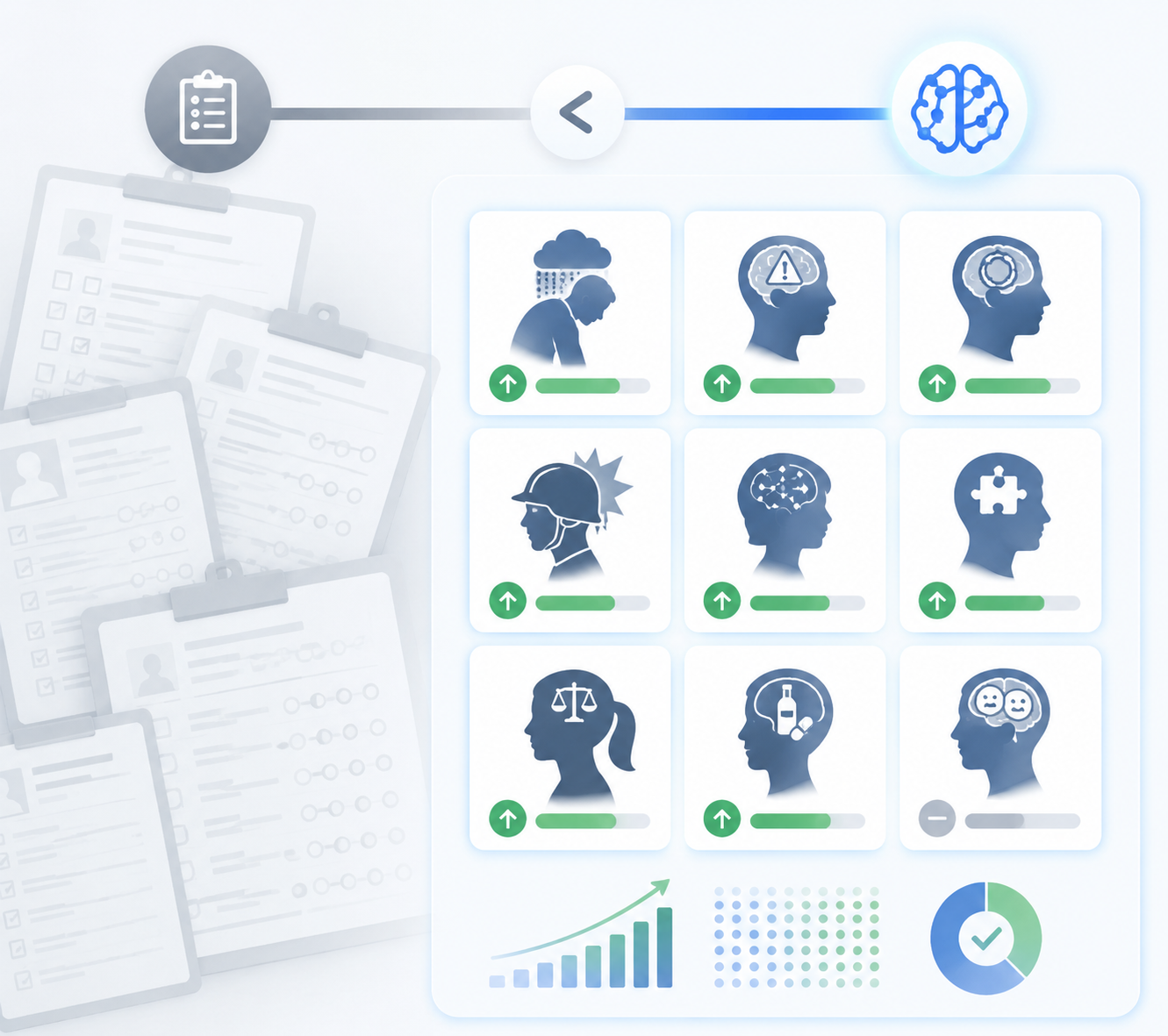
The reported pattern across nine DSM-5 categories is therefore more interesting than a single accuracy number. Depression, anxiety, OCD, PTSD, ADHD, autism, eating disorders, and substance use are common enough in clinical practice that even modest classification gains could change triage, referral, or intake review. The bipolar exception is also clinically plausible. Bipolar diagnosis often turns on longitudinal history, episodic change, family history, antidepressant response, substance exposure, and whether “activation” was hypomania, anxiety, insomnia, or situational arousal. A scale snapshot is a poor substitute for that history, and an AI tool trained on similar inputs may inherit the same ceiling.
The caveat is important enough to keep close to the result: the available details here come through secondary reporting by Digital Watch Observatory and Neuroscience News, not direct verification of the primary study.[1] The finding should be treated as a promising diagnostic-classification result, not as settled evidence that an AI assistant can diagnose psychiatric disorders better than trained clinicians.
This is where broader evidence reviews on AI diagnostic accuracy can mislead if psychiatric diagnosis is treated like a cleaner imaging problem. A model can classify cases in a dataset while the clinical setting changes the task: the patient may not know which symptoms are relevant, the chart may be incomplete, the interviewer may document unevenly, and the most consequential differential may be the one no rating scale asked about.
Speech analysis is a different diagnostic bet
The psychosis-prediction literature makes a different wager. Instead of asking whether a model can sort DSM-5 categories from symptom inputs, it asks whether language itself carries early signal: coherence, semantic drift, referential looseness, syntactic change, and other features that may appear before a first psychotic episode.
Corcoran and colleagues’ 2018 work in World Psychiatry used natural language processing on speech transcripts from clinical high-risk youth and reported prediction of later psychosis onset.[2] The clinical appeal is obvious. Psychosis risk assessment already depends heavily on interviews, subtle changes in thought form, and longitudinal observation. Automated language analysis fits the problem better than a generic distress score does.
Still, prediction is not diagnosis. A tool that flags elevated risk in a high-risk cohort has not shown that it can diagnose schizophrenia, bipolar disorder with psychosis, substance-induced psychosis, autism with unusual language, trauma-related dissociation, or culturally patterned speech in a general outpatient population. It may be best understood as an early-warning instrument, one that could sharpen monitoring or referral decisions if it survives stronger validation.
It also changes who carries the burden. If a speech model flags a teenager as high risk, a clinician has to decide what to say, how to document it, how to avoid over-labeling, and how to follow the patient without turning a probabilistic signal into an identity. The model’s output may take seconds; the explanation and consequences do not.
Behavioral traces are not clinical assessment
Social media studies push the field into still murkier territory. Reece and Danforth’s 2017 Instagram study showed that machine learning analysis of photo metadata could predict depression diagnosis, making it an important example of multimodal psychiatric inference outside the clinic.[3] It is useful evidence that mood-related signals may appear in everyday digital behavior.
It is not evidence that Instagram behavior is equivalent to a diagnostic interview. Posting patterns are shaped by platform norms, age, culture, privacy choices, self-presentation, social context, and the simple fact that not everyone lives the same proportion of life online. A depressed patient who does not post is not diagnostically invisible; an active poster with dark images is not automatically ill.
This is the point at which multimodal enthusiasm needs discipline. The American Psychiatric Association’s overview of AI applications in mental health usefully separates diagnosis, prediction, treatment, and monitoring rather than treating them as one interchangeable category.[4] A model that monitors relapse risk is not doing the same job as a model that assigns a DSM-5 label. A conversational agent that supports adherence is not doing the same job as a diagnostic interviewer. Lumping them together makes the evidence look larger than it is.
The missing evidence is not a technicality
For psychiatric diagnostic AI, the maturity gap is not mainly about whether a model can produce a plausible label. It is about whether the label holds up when the inputs become clinical: incomplete histories, multiple comorbidities, changing medication regimens, variable documentation, translated interviews, cultural differences in symptom expression, and patients who disclose different facts to different people.
| Evidence Question | Why it matters clinically |
|---|---|
| Was the model tested prospectively? | Retrospective performance can fall when the model is used on new patients in real time. |
| Was validation multi-site? | Single-site data can reflect local referral patterns, documentation habits, and population mix. |
| Were populations diverse enough? | Language, culture, age, comorbidity, and access to care can all change model behavior. |
| Was the comparator a rating scale, a clinician, or a structured interview? | Each comparison supports a different claim about diagnostic value. |
| Who is accountable for the output? | A diagnostic suggestion becomes clinical only when someone must explain, accept, reject, or document it. |
Lee and colleagues’ 2021 review describes clinical applications of AI in mental healthcare alongside barriers and facilitators, including the practical difficulty of moving from promising models to responsible care settings.[5] That is the correct frame for the present evidence. The field has enough signal to justify serious study, but the operational questions remain under-answered.
Psychiatric diagnosis is especially sensitive to workflow inversion. If an AI tool generates a diagnostic suggestion before the clinician has formed an independent formulation, the clinician may spend the visit confirming, correcting, or defending against that suggestion. Readers considering such systems should use a structured clinical AI evaluation framework and ask whether the tool changes the interview, the note, the patient’s label, or the threshold for referral.
The problem is not that clinicians are too fragile to use decision support. The problem is that psychiatric labels travel. They influence medication choices, insurance documentation, school accommodations, disability claims, stigma, self-understanding, and future clinicians’ expectations. A wrong suggestion may be easy to delete from a screen and difficult to erase from a chart narrative.
Regulation shows where the field actually stands
The regulatory picture is blunt. As of a November 2025 FDA Digital Health Advisory Committee discussion reported by Becker’s Behavioral Health, the FDA had authorized zero AI-enabled medical devices for mental health, compared with more than 1,200 in other clinical domains.[6] As of Q3 2026, the cited evidence identifies no FDA-authorized AI diagnostic device for psychiatry.
That absence should not be inflated into proof that the science is empty. It is better read as a marker of evidence maturity. A diagnostic product has to show more than retrospective classification performance. It has to define its intended use, population, comparator, failure modes, clinician role, monitoring plan, and risk controls. Psychiatry adds hard problems of language, context, longitudinal course, and harm from mislabeling.
The American Academy of Arts & Sciences framed the broader mental health AI landscape in 2026 around both what is known and what remains unknown.[7] For diagnosis, the unknowns are not ornamental. They are the difference between a research system that performs well on selected data and a clinical device that can be trusted across clinics, populations, and documentation styles.
A useful role, if the claim stays narrow
The near-term use case for psychiatric diagnostic AI is likely not autonomous diagnosis. It is structured assistance: highlighting inconsistencies between symptom scales and history, suggesting differentials for clinician review, prompting missing longitudinal questions, flagging speech changes that deserve follow-up, or helping organize intake material before the diagnostic interview. That kind of support could be valuable precisely because psychiatric assessment is cognitively crowded.
Even then, the implementation details decide whether the tool helps. A useful system should show why it raised a category, what data it relied on, what it did not know, and when its confidence should be discounted. It should make it easier for a clinician to ask the next question, not harder to resist a premature label. The more conversational the system becomes, the more important it is to separate fluent interaction from diagnostic validity; performance across conversational AI tools varies by task, as broader reviews of conversational AI in healthcare make clear.
The evidence therefore supports a measured conclusion. Machine learning and NLP tools have shown credible proof of concept in psychiatric classification and risk prediction. The Alba result, if confirmed in the primary literature, is a serious challenge to complacency about rating scales. Speech-based psychosis prediction remains one of the more clinically plausible NLP applications. But neither line of evidence yet supplies the prospective, multi-site, diverse-population validation or regulatory authorization needed for diagnostic authority in routine care.
Psychiatry should keep studying these tools, and should be exact about what they have proven. Better than a rating scale is not the same as better than a diagnostic evaluation. Predicting risk in a selected cohort is not the same as diagnosing a disorder in general practice. In 2026, AI belongs in psychiatric diagnosis as an object of serious clinical research and carefully bounded decision support, not as the final voice on what a patient has.
References
- New study shows AI improves mental health diagnoses — Digital Watch Observatory.
- Corcoran et al., World Psychiatry — 2018.
- Reece & Danforth Instagram depression prediction study — 2017.
- Applications of Artificial Intelligence in Mental Health Care — American Psychiatric Association.
- Artificial Intelligence for Mental Healthcare: Clinical Applications, Barriers, Facilitators, and Artificial Wisdom — PMC/NIH, 2021.
- FDA panel reviews AI tools for mental health use: 9 notes — Becker's Behavioral Health, November 2025.
- AI and Mental Health Care: What We Know, What We Don't, and What Comes Next — American Academy of Arts & Sciences, Winter 2026.
Comments
Join the discussion with an anonymous comment.